
"Grape Agate" mines, Mamuju Regency, West Sulawesi Province, Indonesiai
| Regional Level Types | |
|---|---|
| "Grape Agate" mines | Mining Area |
| Mamuju Regency | Regency |
| West Sulawesi Province | Province |
| Indonesia | Country |
This page is currently not sponsored. Click here to sponsor this page.




Type:
A series of deposits from a beach at Pantai Ngalo and then north towards the city of Mamuju - Takandeang (village), Tanete Kalaha (hamlet), Tanete Pao (village), Lumbia, Salletto (village).
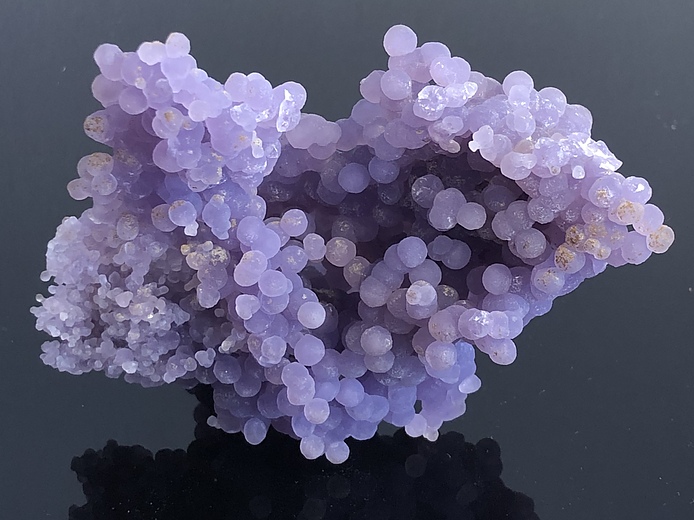
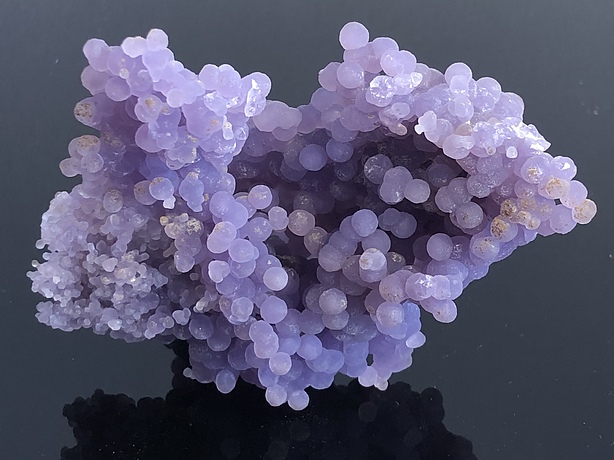
Note on the mineral list: The so-called "grape agate" is a marketing name for aggregates of spheroidal amethystine quartz/chalcedony. Individual spheres measure 2 to 20 millimeters in diameter and consist of thin radially grown "fibers" made of quartz. In spite of this spherulitic growth pattern, thin sections show that this is not agate (Laurs & Rossman, 2018). Colour can range from deep purple to very pale amethystine or whitish shades. There are also less commonly green ones (coloured by inclusions of some clay mineral), and even specimens with purple and green spherules together. Poorly coloured specimens are sometimes dyed violet. The material is sometimes (erroneously) referred to as "Manakarra grape agate".
Under even relatively low magnification, the bundles of quartz crystals that make up the spherules are easily seen. This material is essentially colloform habit quartz.
Select Mineral List Type
Standard Detailed Gallery Strunz Chemical ElementsCommodity List
This is a list of exploitable or exploited mineral commodities recorded at this locality.Mineral List
5 valid minerals.
Detailed Mineral List:
| ⓘ Calcite Formula: CaCO3 References: Alfredo Petrov observations on material imported from Indonesia by Jewel Tunnel.Identified by Alfredo Petrov: Visual Identification |
| ⓘ Celadonite ? Formula: K(MgFe3+◻)(Si4O10)(OH)2 References: Alfredo Petrov observations on material imported from Indonesia by Jewel Tunnel.Identified by Alfredo Petrov: Visual Identification |
| ⓘ 'Limonite' References: Alfredo Petrov observations on material imported from Indonesia by Jewel Tunnel.Identified by Alfredo Petrov: Visual Identification |
| ⓘ 'Phillipsite Subgroup' Formula: (Ca0.5,K,Na,Ba0.5)4-7[Al4-7Si12-9O32] . 12H2O References: Dr George Rossman observations on material imported from Indonesia by Jewel Tunnel.Identification: Visual Identification |
| ⓘ Pyrite Formula: FeS2 References: Alfredo Petrov observations on material imported from Indonesia by Jewel Tunnel.Identified by Alfredo Petrov: Visual Identification |
| ⓘ Quartz Formula: SiO2 References: Alfredo Petrov observations on material imported from Indonesia by Jewel Tunnel.Identified by Alfredo Petrov: Visual Identification |
| ⓘ Quartz var. Amethyst Formula: SiO2 Description: The so-called "grape agate" is a marketing name for aggregates of spheroidal amethystine quartz/chalcedony.
Individual spheres measure 2 to 20 millimeters in diameter and consist of thin radially grown "fibers" made of quartz.
In spite of this spherulitic growth pattern, thin sections show that this is not agate (Laurs & Rossman, 2018).
Colour can range from deep purple to very pale amethystine or whitish shades.
There are also less commonly green ones (coloured by inclusions of some clay mineral), and even specimens with purple and green spherules together.
Poorly coloured specimens sometimes get dyed violet. References: |
| ✪ Quartz var. Grape agate Formula: SiO2 |
| ⓘ Saponite Formula: Ca0.25(Mg,Fe)3((Si,Al)4O10)(OH)2 · nH2O References: Alfredo Petrov, by XRD and physical properties, on material imported from Indonesia by Jewel Tunnel.Identified by Alfredo Petrov: Visual Identification, XRD |

List of minerals arranged by Strunz 10th Edition classification
| Group 2 - Sulphides and Sulfosalts | |||
|---|---|---|---|
| ⓘ | Pyrite | 2.EB.05a | FeS2 |
| Group 4 - Oxides and Hydroxides | |||
| ⓘ | Quartz var. Amethyst | 4.DA.05 | SiO2 |
| ⓘ | 4.DA.05 | SiO2 | |
| ⓘ | var. Grape agate | 4.DA.05 | SiO2 |
| Group 5 - Nitrates and Carbonates | |||
| ⓘ | Calcite | 5.AB.05 | CaCO3 |
| Group 9 - Silicates | |||
| ⓘ | Celadonite ? | 9.EC.15 | K(MgFe3+◻)(Si4O10)(OH)2 |
| ⓘ | Saponite | 9.EC.45 | Ca0.25(Mg,Fe)3((Si,Al)4O10)(OH)2 · nH2O |
| Unclassified | |||
| ⓘ | 'Limonite' | - | |
| ⓘ | 'Phillipsite Subgroup' | - | (Ca0.5,K,Na,Ba0.5)4-7[Al4-7Si12-9O32] . 12H2O |
List of minerals for each chemical element
| H | Hydrogen | |
|---|---|---|
| H | ⓘ Celadonite | K(MgFe3+◻)(Si4O10)(OH)2 |
| H | ⓘ Phillipsite Subgroup | (Ca0.5,K,Na,Ba0.5)4-7[Al4-7Si12-9O32] . 12H2O |
| H | ⓘ Saponite | Ca0.25(Mg,Fe)3((Si,Al)4O10)(OH)2 · nH2O |
| C | Carbon | |
| C | ⓘ Calcite | CaCO3 |
| O | Oxygen | |
| O | ⓘ Quartz var. Amethyst | SiO2 |
| O | ⓘ Calcite | CaCO3 |
| O | ⓘ Celadonite | K(MgFe3+◻)(Si4O10)(OH)2 |
| O | ⓘ Phillipsite Subgroup | (Ca0.5,K,Na,Ba0.5)4-7[Al4-7Si12-9O32] . 12H2O |
| O | ⓘ Quartz | SiO2 |
| O | ⓘ Saponite | Ca0.25(Mg,Fe)3((Si,Al)4O10)(OH)2 · nH2O |
| O | ⓘ Quartz var. Grape agate | SiO2 |
| Na | Sodium | |
| Na | ⓘ Phillipsite Subgroup | (Ca0.5,K,Na,Ba0.5)4-7[Al4-7Si12-9O32] . 12H2O |
| Mg | Magnesium | |
| Mg | ⓘ Celadonite | K(MgFe3+◻)(Si4O10)(OH)2 |
| Mg | ⓘ Saponite | Ca0.25(Mg,Fe)3((Si,Al)4O10)(OH)2 · nH2O |
| Al | Aluminium | |
| Al | ⓘ Phillipsite Subgroup | (Ca0.5,K,Na,Ba0.5)4-7[Al4-7Si12-9O32] . 12H2O |
| Al | ⓘ Saponite | Ca0.25(Mg,Fe)3((Si,Al)4O10)(OH)2 · nH2O |
| Si | Silicon | |
| Si | ⓘ Quartz var. Amethyst | SiO2 |
| Si | ⓘ Celadonite | K(MgFe3+◻)(Si4O10)(OH)2 |
| Si | ⓘ Phillipsite Subgroup | (Ca0.5,K,Na,Ba0.5)4-7[Al4-7Si12-9O32] . 12H2O |
| Si | ⓘ Quartz | SiO2 |
| Si | ⓘ Saponite | Ca0.25(Mg,Fe)3((Si,Al)4O10)(OH)2 · nH2O |
| Si | ⓘ Quartz var. Grape agate | SiO2 |
| S | Sulfur | |
| S | ⓘ Pyrite | FeS2 |
| K | Potassium | |
| K | ⓘ Celadonite | K(MgFe3+◻)(Si4O10)(OH)2 |
| K | ⓘ Phillipsite Subgroup | (Ca0.5,K,Na,Ba0.5)4-7[Al4-7Si12-9O32] . 12H2O |
| Ca | Calcium | |
| Ca | ⓘ Calcite | CaCO3 |
| Ca | ⓘ Phillipsite Subgroup | (Ca0.5,K,Na,Ba0.5)4-7[Al4-7Si12-9O32] . 12H2O |
| Ca | ⓘ Saponite | Ca0.25(Mg,Fe)3((Si,Al)4O10)(OH)2 · nH2O |
| Fe | Iron | |
| Fe | ⓘ Celadonite | K(MgFe3+◻)(Si4O10)(OH)2 |
| Fe | ⓘ Pyrite | FeS2 |
| Fe | ⓘ Saponite | Ca0.25(Mg,Fe)3((Si,Al)4O10)(OH)2 · nH2O |
| Ba | Barium | |
| Ba | ⓘ Phillipsite Subgroup | (Ca0.5,K,Na,Ba0.5)4-7[Al4-7Si12-9O32] . 12H2O |
Fossils
This region is too big or complex to display the fossil list, try looking at smaller subregions.This page contains all mineral locality references listed on mindat.org. This does not claim to be a complete list. If you know of more minerals from this site, please register so you can add to our database. This locality information is for reference purposes only. You should never attempt to
visit any sites listed in mindat.org without first ensuring that you have the permission of the land and/or mineral rights holders
for access and that you are aware of all safety precautions necessary.

"Grape Agate" mines, Mamuju Regency, West Sulawesi Province, Indonesia