
Eddavidite
A valid IMA mineral species
This page is currently not sponsored. Click here to sponsor this page.
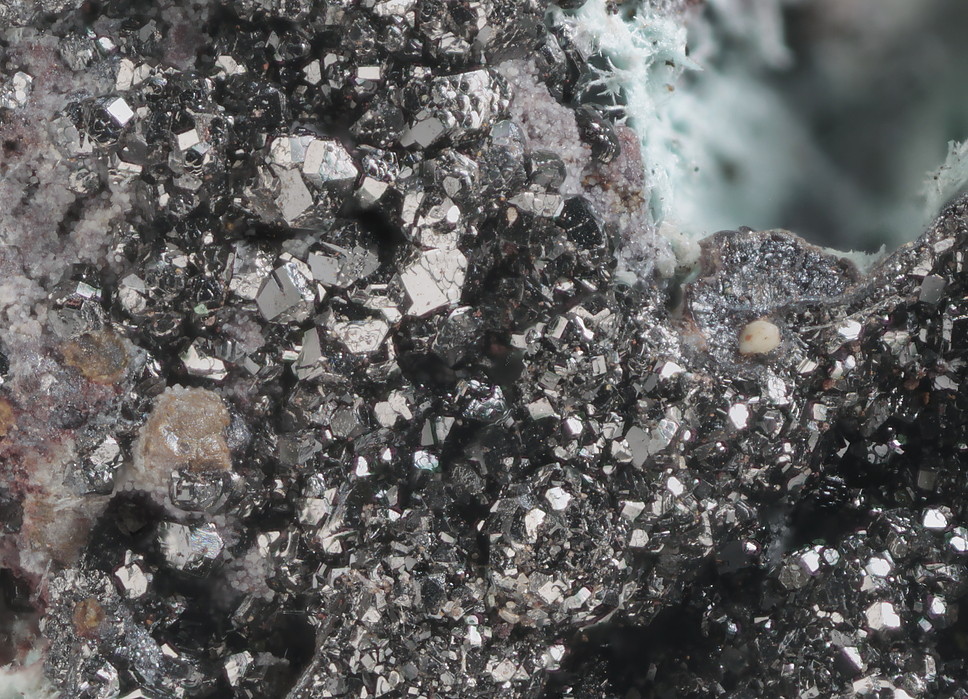

About Eddavidite
Formula:
Cu12Pb2O15Br2
Colour:
Black
Lustre:
Sub-Metallic
Hardness:
4
Specific Gravity:
6.45
Crystal System:
Isometric
Name:
honors Dr. Edward Emil “Ed” David (January 25, 1925 Wilmington, North Carolina – February 13, 2017, Bedminster, New Jersey). Dr. David sought to make science more relevant and accessible to the public; he received much recognition in the scientific, technical, and professional communities. Dr. David worked at Bell Labs from 1950 to 1970, eventually rising to Executive Director of Communications Systems Research. U.S. President Nixon tapped Dr. David to serve as National Science Advisor from 1970 to 1973. He also sat on NASA’s Advisory Council and served as the U.S. Representative to the NATO Science Committee. In 1973, Dr. David went to work in the private sector, later becoming President of Exxon Research Corporation in 1977, from which he retired in 1986.
Unique combination of elements. The Br analogue of murdochite with which it forms a solid solution.
Only way to distinguish eddavidite and murdochite is by chemical analysis.
The type locality of eddavidite is the 5th level of the Southwest mine in the Bisbee mining area.
The species-defining bromine is said to be remaining after desiccation of paleo-seawater.
Only way to distinguish eddavidite and murdochite is by chemical analysis.
The type locality of eddavidite is the 5th level of the Southwest mine in the Bisbee mining area.
The species-defining bromine is said to be remaining after desiccation of paleo-seawater.
Unique Identifiers
Mindat ID:
52996
Long-form identifier:
mindat:1:1:52996:3
IMA Classification of Eddavidite
Classification of Eddavidite
3.DB.45
3 : HALIDES
D : Oxyhalides, hydroxyhalides and related double halides
B : With Pb, Cu, etc.
3 : HALIDES
D : Oxyhalides, hydroxyhalides and related double halides
B : With Pb, Cu, etc.
Mineral Symbols
As of 2021 there are now IMA–CNMNC approved mineral symbols (abbreviations) for each mineral species, useful for tables and diagrams.
| Symbol | Source | Reference for Standard |
|---|---|---|
| Edv | IMA–CNMNC | Warr, L.N. (2021). IMA–CNMNC approved mineral symbols. Mineralogical Magazine, 85(3), 291-320. doi:10.1180/mgm.2021.43 |
Physical Properties of Eddavidite
Sub-Metallic
Transparency:
Opaque
Colour:
Black
Streak:
Black
Hardness:
4 on Mohs scale
Tenacity:
Brittle
Cleavage:
Distinct/Good
good on {111}
good on {111}
Density:
6.45 g/cm3 (Measured) 6.33 g/cm3 (Calculated)
Chemistry of Eddavidite
Mindat Formula:
Cu12Pb2O15Br2
Element Weights:
Elements listed:
Chemical Analysis
Empirical formulas:
| Sample ID | Empirical Formula |
|---|---|
| 1 | Cu12(Pb1.92Fe0.06Si0.06)(O15.08F0.02)(Br0.99Cl0.890.12) |
Sample references:
| ID | Locality | Reference | Notes |
|---|---|---|---|
| 1 | Southwest Mine, Hendricks Gulch, Bisbee, Cochise County, Arizona, USA | empirical formula basis: 12 Cu atoms per formula unit (apfu); the TL-sample has max. 67% of the eddavidite end-member, and the Ojuela one - up to 62%. |
Crystallography of Eddavidite
Crystal System:
Isometric
Class (H-M):
m3m(4/m32/m) - Hexoctahedral
Space Group:
Fm3m
Setting:
Fm3m
Cell Parameters:
a = 9.2407 Å
Unit Cell V:
789.07 ų (Calculated from Unit Cell)
Z:
2
Morphology:
Forms {100} and {111}; the habit grades from simple cubic through cuboctahedral to unmodified octahedral.
X-Ray Powder Diffraction
Powder Diffraction Data:
| d-spacing | Intensity |
|---|---|
| 5.296 Å | (40) |
| 4.739 Å | (15) |
| 2.668 Å | (100) |
| 2.305 Å | (31) |
| 2.120 Å | (13) |
| 1.632 Å | (35) |
| 1.394 Å | (28) |
| 1.060 Å | (11) |
Geological Environment
Paragenetic Mode(s):
| Paragenetic Mode | Earliest Age (Ga) |
|---|---|
| Stage 7: Great Oxidation Event | <2.4 |
| 47a : [Near-surface hydration of prior minerals] | |
| 47g : [Halogen-bearing surface weathering minerals] |
Type Occurrence of Eddavidite
General Appearance of Type Material:
eddavidite is only known as domains within mixed eddavidite–murdochite crystals.
Place of Conservation of Type Material:
Collections of the University of Arizona Mineral Museum, Tucson, AZ 85719, USA, catalogue # 12326, and the RRUFF Project, deposition # R050381
Geological Setting of Type Material:
oxidized zones in copper/lead mines.
Associated Minerals at Type Locality:
Synonyms of Eddavidite
Other Language Names for Eddavidite
Dutch:Eddavidiet
German:Eddavidit
Common Associates
Associations Based on Photo Data:
| 3 photos of Eddavidite associated with Aurichalcite | (Zn,Cu)5(CO3)2(OH)6 |
| 3 photos of Eddavidite associated with Goethite | Fe3+O(OH) |
Related Minerals - Strunz-mindat Grouping
| 3.DB. | Rickturnerite | Pb7O4[Mg(OH)4](OH)Cl3 |
| 3.DB.05 | Diaboleite | Pb2CuCl2(OH)4 |
| 3.DB.10 | Pseudoboleite | Pb31Cu24Cl62(OH)48 |
| 3.DB.15 | Boleite | KPb26Ag9Cu24(OH)48Cl62 |
| 3.DB.20 | Cumengeite | Pb21Cu20Cl42(OH)40 · 6H2O |
| 3.DB.25 | Bideauxite | Pb2AgCl3(F,OH)2 |
| 3.DB.30 | Chloroxiphite | Pb3CuO2Cl2(OH)2 |
| 3.DB.35 | Hematophanite | Pb4Fe3O8(OH,Cl) |
| 3.DB.40 | Parkinsonite | Pb7MoO9Cl2 |
| 3.DB.40 | Janchevite | Pb9V5+(O10.25◻0.75)Cl2.5 |
| 3.DB.40 | Asisite | Pb7SiO9Cl2 |
| 3.DB.45 | Murdochite | Cu12Pb2O15Cl2 |
| 3.DB.50 | Yedlinite | Pb6Cr3+Cl6(O,OH,H2O)8 |
| 3.DB.55 | Siidraite | Pb2Cu(OH)2I3 |
Other Information
Health Risks:
No information on health risks for this material has been entered into the database. You should always treat mineral specimens with care.
Internet Links for Eddavidite
mindat.org URL:
https://www.mindat.org/min-52996.html
Please feel free to link to this page.
Please feel free to link to this page.
Search Engines:
External Links:
Mineral Dealers:
References for Eddavidite
Localities for Eddavidite
Showing 3 localities.
 symbol to view information about a locality.
The
symbol to view information about a locality.
The Locality List
 - This locality has map coordinates listed.
- This locality has estimated coordinates.
ⓘ - Click for references and further information on this occurrence.
? - Indicates mineral may be doubtful at this locality.
- This locality has map coordinates listed.
- This locality has estimated coordinates.
ⓘ - Click for references and further information on this occurrence.
? - Indicates mineral may be doubtful at this locality.
 - Good crystals or important locality for species.
 - World class for species or very significant.
(TL) - Type Locality for a valid mineral species.
(FRL) - First Recorded Locality for everything else (eg varieties).
- World class for species or very significant.
(TL) - Type Locality for a valid mineral species.
(FRL) - First Recorded Locality for everything else (eg varieties).
All localities listed without proper references should be considered as questionable.
Mexico | |
| Rosenblatt et al. (2024) |
USA | |
| - (2018) |
| Hålenius et al. (2018) +1 other reference |
Quick NavTopAbout EddaviditeUnique IdentifiersIMA Classification Classification Mineral SymbolsPhysical Properties Chemistry Chemical AnalysisCrystallography X-Ray Powder DiffractionGeological EnvironmentType Occurrence SynonymsOther LanguagesCommon AssociatesStrunz-MindatOther InformationInternet Links References Localities Locality List

Southwest Mine, Hendricks Gulch, Bisbee, Cochise County, Arizona, USA