Reference

Showing posts with label Energy Efficiency. Show all posts

Conflicts on the ground that serve no purpose

I received the folloing tweet from engerati (if you are in energy join - its free and excellent  http://www.engerati.com/ )

Since this post was there - I thought I better put it here too !

A different type of conflict

Utility companies are no strangers to "conflict on the ground" when it comes to large scale geo-politics.  One needs hardly mention The Gulf, Nigeria, Ukraine and even historically Tobruk, or more surprisingly The Falklands to realise that a battle for scarce resources is nothing new. However, this is not the battle we are addressing here.
Our conflict occurs when mismatched intents between building services, powered by gas and electicity come into play.  Though each is small, unnoticed and imperceptible, they are nearly omnipresent eternal and their impact is huge.
Consider this: The IPCC and WCSBD together calculate that around 12% of global energy is wasted in buildings (29% of the 40% used). Obviously this represents the normal or "businesss as usual".
A simply corollary is that "exception based reporting" (the basis of 99% of commercial aM&T software) is utterly useless in this context. If it is normal, it is unexceptional and so this 12% of global energy flies "beneath our radar" (as waste).

Throw away counsels of despair

There is no point simply observing that a situation is broken. It is; and let me briefly define the problem, but let us then examine what needs to be done (as it is relatively simple).

The battleground:

When analysing energy use, the need to understand the stated purpose of consumption is implicit. It would be a better defined world if it were explicit.
Energy managers "chalk-up" energy consumption to causal factors of consumption (the "drivers"). Typically most are overlooked, but common considerations include (occupancy - no point cooling an unoccupied building), the weather (how hot or cold is it), the target "comfort" conditions, and exceptional items like school holidays, heating outside occupancy for fabric protection.
To the extent that these drivers together fully explain variations in consumption, we can assume well-managed energy use.
But they do not ! - Granted most utilities provide data-viewing apps, that feed back pretty graphs of consumption, or benchmarked comparitives of performance within a class of building types

Existing Analytics tools are not fit-for-purpose:

While you as the provider of a utility (say electricity) cannot explain to your client how much of their energy is wholly wasted in negating the effects of their overuse of another utilities resources (say gas), using your best data scientists - I would argue the system is broken, because it appears neither client nor supplier knows the benefits of the facilities provided (despite knowing the quantity sold).
This is a strategically significant statement -

"Utility companies cannot in general quantify their core value-proposition to their clients"


The solution is relatively simply defined, and is available based on metering techniques and analytics alone.

Selling Holes not Drills

Going one step further for your clients is easy if you are armed with a few bits of data.
Imagine a pub where the landlord responds to complains of cold by turning the thermostat up, and the drinkers respond to heat by leaving the doors and windows open. Now drive through any city on the planet and see how many centrally serviced buildings have their doors and windows open.

"This problem is so common, that people laugh about it."


Now, suppose you are armed with outside temperature and gas consumption histories. It is not rocket-science to come up with an email that says -
"At this temperature last year you were using X kW but now you are using twice as much (turn the thermostat down and make sure doors and windows are closed) and comfort is still possible"
If you consider that weather is a legitimate driver of heating consumption, it is a small step to recognise that money spent on cooling (usually electrically driven) is always an illegitimate driver of heating consumption.

It's a simple argument, but until utilities (or their service representatives) provide both electricity and gas data for a building in a single analytical context (even at a fiscal meter level without sub-metering) they cannot possibly know how much of the utility is useful and how much is simply encouraging their clients to look elsewhere causing competitive:


"conflicts on the ground that serve no purpose!"


originally posted on engerati.com

Smart-meter enabled innovation non-domestic - Carbon Trust

The Carbon Trust recently contacted us (and a number of other key companies) with the following
 "DECC has asked the Carbon Trust to understand, and report on, what innovations in technology, products and services we can expect to 2020 based on the roll out of smart meters for non-domestic customers.
DECC recommended speaking to you. We intend to interview technology developers, energy service providers, utilities and other stakeholders to understand their (not commercially sensitive) views and then hold a workshop with all stakeholders to problem-solve the question."
So after about a millisecond feeling slightly complimented we agreed to interview and attend the workshop last Friday. Why? - Well to be honest there were three reasons, two good, one questionable - so let me get the questionable one out the way, and then I will go on to the more interesting things ...

Note shift arrow third button down on left
  1. The Carbon Trust has a remarkable coffee machine with a shift key - Really - I kid you not - it modifies your selection and presumably reduces the number of buttons required. This saving comes at the cost of massive user confusion and huge amounts of wasted coffee / energy / carbon - ( to be fair the coffee was pretty good, but an escape or or cntrl-alt-del combination would have been more constructive) 
  2. Networking with UK government (DECC), the official regulator (ofgem) and The Carbon Trust and the bre can only be a good thing, especially when it comes to input on legislation and statutory instruments (Disclosure: Our UK subsidiary has worked with BRE and ofgem on CERT compliance on a commercial basis in the past)
  3. Networking with other attendees, This included representation from energy brokers, energy buying clubs, data consolidators, national utilities, and a small number of specialised consultants in the sustainable / smart field
So I thought, it might be useful to knock together these informal notes. 

There will be a formal feedback to the UK government, and the meeting was held under Chatham house rule so I will not name the commercial attendees (other attendees are a matter of public record). 

I do feel a few significant companies were notable by their absence (hint: buck your ideas up - you know who you are).

The agenda was deliberately loose (more brainstorming than directed) and as often happens several themes kept on re-emerging. So this is a personal, rough (and certainly not exhaustive) recollection of various issues that stuck in my mind - I hope its useful and I would love to hear any views in the comments - perhaps I missed some key things while dwelling on the shift key! :

The title of the workshop was:


Smart-meter enabled innovation for non-domestic customers
This immediately lead into a discussion of scope:

Most non-domestic customers need AMR (automatic meter reading) rather than smart meters (a local display device for readings). Yes, this comes up again and again, and saying "smart" does not make you smart (except in the stinging burning embarrassment sense).


The trouble is with a smart meter, thatwith despite nonsense to the contrary, seeing a consumption dial no more helps you save energy than standing on bathroom scales helps you lose weight.


So the value comes from action engendered by information, not by the existence of a soon ignored omnipresent (and very boring display) of energy data. In discussions with Steven Fawkes (whose blogs Only Eleven Percent is worth a read) earlier in the week I remember discussing "Mean Time to Kitchen Draw" - a fun metric that measure the Billions wasted worldwide on installing things that people soon learn to ignore.


It was agreed that the workshop should distinguish bottom-up, from top-down. The former is the application of household and domestic considerations to the small business market, where the latter is the application of large skill based diagnosis techniques (which apply to some much larger buildings) to the volume market. The vast gap of an un-served market between the two went unquestioned. (Hence, I suppose, the workshop).


The other aspect of scope was regarding purpose - is the purpose of high resolution metering:

  1. To allow purchase of cheaper energy in the market
  2. To enable energy savings

It is worth noting that a more efficient energy market reduces carbon burden, reduces energy security issues (which cause wars - a huge waste of energy), and that energy poverty is very real and meaningful for numerous families and small businesses (not just in the UK.

However, my vote would be for a focus on reduction in demand (perhaps because I have spent most of my career witnessing and diagnosing the ridiculous waste prevalent in society (energy spend that does not even deliver value).
This second priority lead on very nicely to the first agenda point about:

Competition and Switching

  1. Most people will not even bother to switch energy supplier until a threshold of around £75 per annum potential cash benefit is exceeded. This suggests to me that: 
  2. switching requires automation (vastly reduced friction)
  3. market is already relatively efficient (far greater savings can be had from efficiency improvements)
  4. the issues of perpetuating data histories in common formats over a supplier transition are very relevant (this effects both buying and analysis)
  5. There was huge skepticism from the group that the major players can ever be forced to align to common data-interchange formats (both for meter data and account meta-data)
    1. The smaller embedded smart meters store a history (too short for ideal analysis)
    2. AMR services don't make it easy to improve market efficiency - there is major disincentive to ease switching in the market. (I think there is scope for legislation here, but it had better be well considered and not the US green button initiative style half-cocked exercise although this is none-the-less better than nothing !)
Engagement and Energy Efficiency

Whether it is a counsel of despair or not - people don't care enough about energy efficiency, to take personal action. This was unanimously agreed. I would express the problem like this :
Like it or not energy is absurdly cheap - 100 years ago to harness 100 horses and work them for an hour required the riches reserved for royalty - hay needed to be gathered, livery made, and the capital asset cost far exceeded the cost of a family compact car. Now everyone can do this with a couple of litres of fuel, so we are collectively enabled to poison our planet and climate - and hey nobody really cares !

 After thisour discussion wove backwards and forwards around many themes but gradually moved on to:

"Cheap energy club" type services

The key issues here were automation, buyer friction and engagement, and the need to move from buying (which in a commodity market is and should be a race to the bottom with ever declining margins), which is a necessity for an efficient market to overcome oligopoly forces (nobody actually used the word cartel ! )
Other agenda points covered were:

Visualisation and “remote control" & Optimisation were the overwhelming consensus was (correctly) that:


  • visualising an energy spend is very far from saving energy and not sufficient to either inform or motivate action
  • remote control is trivial - there is space for "apps" and connectivity and they will happen, but the business models in this field are extremely naive (the motive to save energy is a pre-requisite to capital investment, and there are better ways of saving energy first) - the problem is determining the action to take
  • nobody came up with a definition of optimisation in this context (it was perhaps aspirational from the briefing - but bottom up optimisations for households are very different from SME in terms of occupancy, fabric, plant, use cases etc - so we moved on)
A brief and pleasant buffet sandwich lunch was provided and we moved on to 

Innovation that “stretches down” from Industry and commerce

Three issues were discussed that (apart from understanding that analysis has a role) are well outside my expert domain - (so I wont comment) - these were
  • Time-of-use and complex tariffs, 
  • Brokers/Third Party Intermediaries, 
  • Load aggregation & virtual power plants

We then moved on to the following areas which are all very closely related, and where I suppose my personal input was of some value. Grouping these together the following key points were made and I believe largely agreed (but I am so sure of my ground in this area that I may not have heard objections ! ;)
Demand Management

Managing is simple. but there are very complex pre-requisites. Energy relates to activity, and activities are

  1. either, waste or not
  2. Conducted (if at all) either effectively, using best resources, or not
Sub-metering & device disaggregation

These are two areas where data is either gathered directly or imputed. The huge potential waste of metering more than can be managed is one major issue - The internet of things is as yet young. The other is whether loads can be identified through pattern recognition (bear in mind that a smart phone with a gyroscope and accelerometer can tell from your gait, your height, your weight and your health)


Remote building performance diagnostics

No surprises here - According to a new Navigant report nicely summarised here 800M will be installed by 2020 and "Between 2012 and 2020 Europe shows the fastest electric smart meter penetration, growing from 15% to 85%."

It is clear that the entire purpose of this vast new industry boils down to one critical question - "What is it for?

Any reader of this blog will have an idea that is is NOT to draw pictures that no-one can understand or act on but that:

  1. It makes automated quantification of waste possible
  2. It allows cause of waste to be diagnosed
  3. Pattern recognition allows this to be done at scale
  4. Diagnosis is a pre-cursor to treatment
In turn, treatment may be :


  • Behavioural advice (pertinent, actionable, on-time)
  • Control parameter change (typically actionable remotely)
  • Control algorithm change (increasingly modifiable without site visits)
  • Hardware maintenance (it is too costly to send the wrong people to do the wrong job)
  • Plant refurbishment (where better decisions can be informed by knowledge of demand histories)
OR

Beyond the current capabilities of pattern recognition - In which case the appropriate expertise should be sent to site:

My conclusions

Overall "Smart-meter enabled innovation for non-domestic customers" is important:

The value is simple, if we can understand and act on energy-efficiency problems at scale for low costs, and if we can regulate demand to service our needs effectively we can live in a semblance of the current luxury we have come to expect - If we do not we cannot !

Please do leave comments below - I will respond and try to incorporate those with merit in future work.


Update : bre have requested that I link to their energy consulting site
Enhanced by Zemanta

Matching energy demand and supply (compensation)

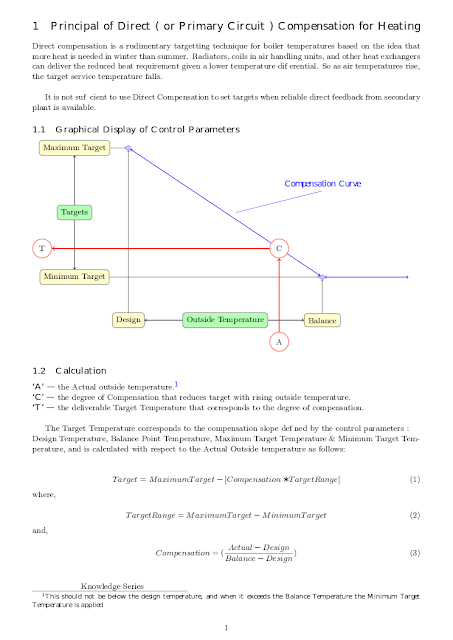
I  just added an brief entry to the kWIQly resources page which will help anyone wanting to understand the basics of how direct compensation can be implemented mathematically. Do feel free to use it in energy management or building services course materials etc.

However, more important for energy managers is knowing why and when to use compensation and more specifically its' superiot lesser known cousin, direct compensation.


The emphasis of this post is not about how it works, but why, the particular benefits and pit-falls, and how you can improve on it.
Direct compensation helps match supply of energy to demand
Compensation Is a key means to save energy

Definition of Temperature Compensation

Compensation is a strategy to save energy in buildings and is a principle strategy widely used to define target flow temperatures for most Variable Temperature Zones that may support Fan-Coils, VAV units radiators etc.

Waste problem? FG Answers - BE ON FIRE?

Yes, @FAKEGRIMLOCK. came to the right page to find out how climate-change can be fixed - but soon our thoughts were invaded by his awesome  GIANT ROBOT - this is what happened...


He generally "lectures" on lean business start-ups', and attitudes for success and efficiency in general and as you will see, he is generally a CAPITAL fellow :)

We will see how this applies to Climate-Change.

Be aware -  has some interesting teaching methods like eating people he doesn't like - or who just don't get it !

So take my advice - you should probably read about him here : fakegrimlock.com/ 

Having got that bit of gratuitous hyper-linking out of the way (in case he visits this piece of "virtual/real"-estate)

Hopefully I get myself into a category of people who will not be eaten on NOEATFRIDAY

Let me move on to why I think much of what he teaches is very funny instructive, relevant when it comes to energy efficiency.  I will use his illustrations to 'ahem' illustrate as he is also quite the artist...

I'll first apologize for his notion that making a difference necessarily involves violence (ie having an impact is "PUNCHING THE WORLD IN THE FACE") - I guess it's the dino in him, or what he had for breakfast.

I also guess he won't like me apologizing either - but hey I get to have an opinion too !

In an guest post for Brad Feld 'be on fire' FG made the following observation about how to find the right idea to work on and how it must be an idea to set you on FIRE. Enjoy it and I will explain why it is relevant to us at kWIQly

First he explains how cold dispassionate ideas are not so special.

BE ON FIRE
WORLD FULL OF IDEA. ALL NEED IS BRAIN. MOST HUMANS HAVE BRAIN. IDEA BY SELF IS COLD. JUST SIT THERE. DO NOTHING.IF WANT DO SOMETHING, NEED FIRE. NEED BE ON FIRE.

Well energy-efficiency is also about being comfortable and should never be too cold ... So he tells us how to get fired up

HOW MAKE FIRE?
WORLD IS BROKEN. FIX IT.
RIGHT IDEA HARD. RIGHT IDEA HURT. RIGHT IDEA IS HOLE IN WORLD.
RIGHT IDEA MAKE BURN INSIDE TO FIX.
CAN TAKE DAY OFF FROM IDEA? IT WRONG ONE.
FIND IDEA THAT BURN, GRAB WITH BOTH HANDS, NEVER LET GO.

THAT HOW MAKE FIRE.

Well WORLD IS BROKEN climate-change is a-coming  and so THE right idea must be to FIX IT.

IT HARD - in fact its so hard its capable of pushing water uphill...


Glacier Thickness and Climate Change Chart
Ice going "uphill" courtesy of wikipedia

RIGHT IDEA HURT. 

Bear Stranded on Ice Flow - Climate Change
Credit : - Unknown - contact please
(Yes we will get on to efficiency in a minute BEAR with me - there's a DINOSAUR in the room that's hard to ignore)


RIGHT IDEA IS HOLE IN WORLD


Climate Change in action
Asif Iqbal - The News Blog
Errm - yup - and floods, fires, storms, landslide, drought, disease and some other stuff!

RIGHT IDEA MAKE BURN INSIDE TO FIX.

Yes well there is a lot of TALKING going on...


1995: COP 1, The Berlin Mandate
1996: COP 2, Geneva, Switzerland
1997: COP 3, The Kyoto Protocol on Climate Change
1998: COP 4, Buenos Aires, Argentina
1999: COP 5, Bonn, Germany
2000: COP 6, The Hague, Netherlands
2001: COP 6, Bonn, Germany
2001: COP 7, Marrakech, Morocco
2002: COP 8, New Delhi, India
2003: COP 9, Milan, Italy
2004: COP 10, Buenos Aires, Argentina
2005: COP 11/MOP 1, Montreal, Canada
2006: COP 12/MOP 2, Nairobi, Kenya
2007: COP 13/MOP 3, Bali, Indonesia
2008: COP 14/MOP 4, Poznań, Poland
2009: COP 15/MOP 5, Copenhagen, Denmark
2010: COP 16/MOP 6, CancÚn, Mexico
2011: COP 17/MOP 7, Durban, South Africa
2012: COP 18/MOP 8, Doha, Qatar

 “IT HARD TO TALK ABOUT DOING IT RIGHT BECAUSE MOST PEOPLE NEVER EXPERIENCED IT.


The point is that a new technology with the power to set the world on fire is just that - "new". So doing an impossible thing is pretty easy if you believe that the classification "impossible" is utter nonsense - as often as not it is just that.

Finally the bit on why this applies to you merry reader - as a kWIQly reader you are empowered "kW" - Intelligent "IQ" - and you want to do it without delay "kWIQly"  (you did already link to this site didn't you ? ! )

So our regular readers have heard:
  • 100 times - every building is different so it is impossible to manage them all efficiently.
  • 1000 times - you can't manage what you can't measure.
  • A gazillion times - You can't please all the people all the time !
Well sorry but NO, NO,NO !

We were told that it is impossible to measure waste by considering smart-meters - well we do. YES we are the only software available that can deduce waste directly from consumption !

Waste Energy consumption calculation
WORLD FIRST
 Waste derived by pattern recognition in consumption
Date Formats need fixing - but this is the first ever graphic
produced
Saturday 10/10/2012
We use some pretty smart pattern recognition - who thought  we would have automated speeding fines 15 years ago ? -

Three  points...

"Every building is different so it is impossible to manage them all efficiently."

EPIC FAIL - this is scalable and requires no site visits (it's SaaS with zero disruption or site installation based on smart-meter data)

"You can't manage what you can't measure."
EPIC FAIL - We are not measuring waste - (where would you put the meter ? ) - but you can deduce waste and manage savings opportunity based on these deductions

"You can't please all the people all the time !"
YOU - CAN  - Well so long as we fix climate-change together - maybe everyone should be pleased

Yup FG said it first ....


CAN TAKE DAY OFF FROM IDEA? IT WRONG ONE.
FIND IDEA THAT BURN, GRAB WITH BOTH HANDS, NEVER LET GO.

But did you notice the date on the chart above - this happened at 02.00 a.m. this weekend.

THAT HOW MAKE FIRE!


Buildings share the Laws of Physics obviously making them more similar than different.  If that weren't the case how would any engineer ever become expert in building controls or energy efficiency ???

So if we take weather data (not from your building, but from a reliable source ! ), we take utility data from your smart-meters, we have two measures that are completely independent of your building and can audit what happens inside independently !

Now we expect that many of you (new visitors) won't really believe us - we also expect that FG will eat many of you for lunch - so we don't really care ! 

We only want winners to work for anyway.

So if you don't want to be eaten tweet something to @FAKEGRIMLOCK - or like us on Facebook or whatever rings your bell. 

But please don't just do the things that are easy (it's a start) ...

so do the things other people CAN'T DO !

You are an energy manager - no we don't have green elastomeric underwear

or a cloak for you - but you too can be a hero !


Oh and if you didn't realise it -  then that's another EPIC FAIL !

 - but you can  contact us if we can help ! anyway !

TOGETHER WE WILL EAT ENERGY WASTE FOR BREAKFAST !

Detection of Optimum Start Failure

Optimum Start is a fairly simply concept.  

Heating is started early enough that comfort is achieved before occupancy, but not too early. A start is optimal if comfort is achieved at least energy cost.

This means an early start when it is cold, and a later start when it gets warmer, for two related reasons:

1) On a cold night the building cools faster to a lower temperature.
2) On a cold morning the rate of warming is slower, because losses are greater

Optimum Start Explanation
On a cold night the optimum start is earlier

Fortunately the mathematical calculations are done by a control system so an energy manager does not have to worry.

Unfortunately, many control systems are very bad at this "optimum search".
Unfortunately, Optimum Start controllers often fail.

The worst thing is that they fail expensively and when they fail it is hard to know - some error is expected every day, and you have to "be there to see it ".


Happily a remote energy auditing tool like kWIQly can show and even score the possibility of start failure on a continual basis...
Evidence of waste due to optimum start failure
Optimum Start Failure
Above the difference between June and July is obvious. The heating start (green) has been getting later each day towards summer.  Suddenly, in July the start "jumps forward" by over an hour and stays there. In November optimum start fails altogether and it is then re-instated in December.

Optimum start is most important for older massive, airy, unventilated buildings (churches, castles) that respond slowly.  Failure can easily add 20% to a fuel bill per annum.

Knowing it is working is important and early failure identification easy given the right tools.

Top 5 Benefits - Tankless Hot Water Heaters


Hi - Today we get to sit back and read some thoughts by a guest blogger - lets see if he can fire up some interesting thoughts, so let me hand you over to ...


Kyle Brent, President OutdoorFurnaceSupply 

where they specialize in alternative heating and energy solutions. 


Benefits of Using Tankless Hot Water Heaters

There are infinite benefits of using a tankless hot water heater. Here are the top five reasons your household would benefit from having one in you home.
English: Stiebel Eltron Elektric bathroom cont...
Electric bathroom continuous-flow water heater, electric three-phase alternating current instantaneous water heater with 18 kW Power,  (Photo credit: Wikipedia)

Hot Water for Everyone

The number one benefit of having a tankless water heaters is that no one in your family will be left with cold water. Tankless water heaters heat on demand only. There is no storage of water like a traditional water heater, so no matter if you want to take a 45-minute shower or bath, or ten people in your home who need to shower, no one will be left out, everyone will have the hot shower or bath that they deserve.

Cleaner Water

Legionella sp. under UV illumination (Photo credit Wikipedia)
Traditional water heaters store water. As water heaters age, they become dirty and rusty on the inside where the water is stored, which means the water you shower or bathe in comes from a container that is less than clean. This isn't true with tankless hot water heaters, instead the water is heated as it passes through the unit, which provides cleaner water that has never been stored for your hygiene needs. 

kWIQly  - this is also true for pathogens like Legionella which establish and grow in stagnant warm water - if inhaled in a shower or as a spray it's a killer !

Ditch the Bulky Water Heater

Due to its design, traditional water heaters can only be placed in a handful of places in a home. Often times, the placement of these water heaters can be inconvenient or an eyesore. However, with tankless water heaters you have the convenience of placing the compact heater nearly anywhere, which frees up space in your home for more important things.

Cutting Energy Costs

Since tankless water heaters do not require constant heating and reheating, they cost less to use. (And help the environment - kWIQly ) The amount of money you can save varies on how much energy you currently use to heat water, but no matter what your cost is, installing a tankless water heater will decrease it.

Less Fuss

Tankless water heaters require very little maintenance, due to their design, and are much more durable than traditional water heaters, which means it will last longer than its counterpart.

Tankless water heaters add both luxury and maintenance benefits to your home. Simply install a tankless water heater and forget about all the things you used to worry about with your traditional water heater.

So there we have it - a little wiser thanks to Kyle before you move on don't forget to ask any tough questions in the comments or add views of your own - for example who could debate  "The things that are wrong with tankless ! " 
- Not so much from my understanding - but help me out if you can!

I'm sure Kyle will be very glad to hear and answer your questions them and will appreciate your visits here or tomorrow at blog.outdoorfurnacesupply.com

Enhanced by Zemanta

Oak Tree Kiss Management Style

The English Oak is used figuratively
 to represent "Britishness"


An Oak is known for : 

his moral rectitude - "A Good Oak" - or he may be a politician, 

Many British pubs are called 'Royal Oak' such ...
Many British pubs are called 'Royal Oak' such as this one in Fishguard, Wales (Photo credit: Wikipedia)
and for his strength of character - "A Sturdy Oak" - or stubborn inflexibility.


It is also the name of many a pub 627 'The Royal Oaks' at last count


One thing is clear - the Oak as a management style is straightforward - it is 
rather like the kiss principle, "do as I say" stated clearly with no room for doubt - 
but it can equally be simple and stupid.


If straightforward is a strength then so is flexibility, this leaves a choice. 

I read this somewhere...

"On matters of opinion, sway like a reed...
on matters on principle, stand like an oak"

Beautiful Oaks (Photo credit : unknown) click for original res.

We can illustrate the pros and cons using a very simple idea relating to this question. When should I switch my heating on ?

We assume comfort as an objective, and energy efficiency as a constraint.

In this diagram we see two rather different strategies showing start times for different months of the year in two English pubs.  

On the left - the OAK 
On the right the REED

Red shows peak energy use by time of day -
Rows are months - click to enlarge (Graphic credit kwiqly.com)


The OAK on the left starts just before opening at around 11:30, simple !


The REED is more flexible - heating starts later in summer and earlier in winter.  This is called start optimization:


Optimization sounds good doesn't it ? 
- almost ideal !

The REED starts heating between 03:00 and 06:00 right through the year - WHY ?

So flexibility is a good thing - but creates room for mistakes. Optimization is a useful feature, but is only a benefit when deployed in conjunction with the KISS idea of switching off when not needed at all !

In reality both of these pubs could save a good few beers, by rationalizing their expenditure and management strategy - but which would you choose as a default - The Oak or the Reed ? - And more importantly how do you like your beer ? let us know in the comments

Whether or not you drink beer - (we are flexible but we like it as a rule ! ) for energy management matters please do get in touch.

Enhanced by Zemanta

Energy Manager - Poacher or GameKeeper

Building Management Systems
Poacher or GameKeeper - who will police the police ?
Old Poacher and Gamekeeper Watercolour

 - It's is a well known question, so let's apply it to looking after the greatest asset of all - our environment.

The answer as always boils down to simple ideas of trust, independence, integrity and local knowledge. Let's look at these in turn, in the context of Building Management Systems ( BMS ) or Building Control Systems ( BCS )...

Trust
Effective Policing relies on trust
BMS are like policemen : -  not 100% reliable, and they will sometimes fail, and they are responsible for keeping behaviour of very un-intelligent things under control - that is the plant that determines both the comfort in a building, and the cost of achieving that comfort. In short they cannot be trusted not to waste energy, so an external mechanism or "energy audit" function is needed.

Independence
Any audit function, must be above corruption, whether by "bent coppers", "fraudulent financiers" or "flawed intelligence".


It is the last that concerns us - because of the Garbage In Garbage Out principal, if we use a BMS to audit the control of a BMS we are hopelessly lost.


It is like trying to measure your waistline with an elastic tape-measure - you will see what you want to see.

Integrity
Here we are not talking about a control system of 'good character' - we mean by this that a complete or integrated picture is required.


To contend that say a boiler is well-controlled in absence of occupancy schedules or weather conditions is a nonsense.

Local Knowledge
Every copper must "know his beat" - who are the "usual suspects".
Two identical buildings are not alike in every respect.

  • They may be identical internally, but be used for different purposes or at different occupancy levels.
  • They may be constructed identically, but one is in the lee of a building and the other on the shore of the sea.
  • They may have different shading characteristics, maintenance programmes, and a million other variables.

Conclusion

Any method of assessment to control wasted energy, must have the above conditions satisfied. This means local independent weather data, independent verifiable consumption data, and local building use context.  We can help !

Enhanced by Zemanta