





Amphibole minerals are among the most important rock-forming silicates in Earth’s crust. They occur in a wide variety of igneous and metamorphic rocks, where their composition, crystal structures, and textures provide valuable clues about the conditions under which the rocks formed.
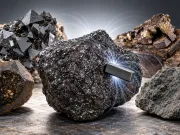
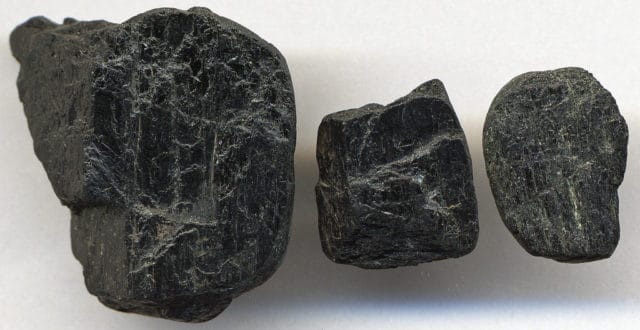
Often recognized by their dark green to black colors, elongated crystals, and distinctive cleavage angles, amphiboles are commonly found in rocks such as diorite, andesite, schist, gneiss, and amphibolite.
Amphibole is not a single mineral but a supergroup of chemically related double-chain silicate minerals. Its members include tremolite, actinolite, glaucophane, riebeckite, and several minerals commonly referred to as hornblende.
Although many amphiboles look similar, their chemical compositions and geological environments can differ considerably.
This guide explores the amphibole supergroup, its physical and optical properties, common mineral types, geological formation, and identification.
What Is Amphibole?
Amphiboles are silicate minerals characterized by a crystal structure consisting of linked double chains of silica tetrahedra.
They belong to the inosilicate class, which also includes pyroxenes. However, amphiboles have double-chain structures, whereas pyroxenes contain single chains.
The amphibole supergroup includes minerals containing various proportions of magnesium, iron, calcium, sodium, aluminum, and other elements.
Many amphiboles also contain hydroxyl (OH) groups in their crystal structures.
Amphiboles are particularly important in igneous and metamorphic petrology because their mineral assemblages and compositions can reflect geological conditions involving temperature, pressure, water availability, and rock chemistry.
Amphibole Mineral Facts
| Property | Description |
|---|---|
| Mineral classification | Silicates – inosilicates |
| Mineral family | Amphibole supergroup |
| Crystal structure | Double-chain silicate |
| Chemical composition | Variable; depends on mineral species |
| Crystal systems | Mainly monoclinic; some orthorhombic |
| Typical colors | Black, dark green, brown, blue, and pale green |
| Mohs hardness | Commonly about 5–6 |
| Specific gravity | Often approximately 2.9–3.5; varies by species |
| Cleavage | Two prominent directions, commonly around 56° and 124° |
| Luster | Vitreous, sometimes silky |
| Common crystal habit | Elongated prismatic, bladed, or fibrous |
| Geological occurrence | Igneous, metamorphic, and hydrothermally altered rocks |
These values describe common amphibole characteristics rather than a single mineral species.
Chemical Composition and Crystal Structure
The amphibole supergroup has a complex and variable chemical composition.
Its general structural formula can be expressed as:
AB₂C₅T₈O₂₂W₂
The letters represent different positions within the amphibole crystal structure where particular elements or anions may occur.
- A sites: May contain sodium, potassium, or vacancies, among other possible constituents.
- B sites: Commonly occupied by elements such as calcium, sodium, magnesium, or iron.
- C sites: May contain magnesium, iron, aluminum, and other elements.
- T sites: Primarily occupied by silicon and sometimes aluminum or other permitted elements.
- W sites: May contain hydroxyl, fluorine, chlorine, or oxygen.
Differences in the occupancy of these structural sites help distinguish amphibole mineral species.
The Double-Chain Silicate Structure
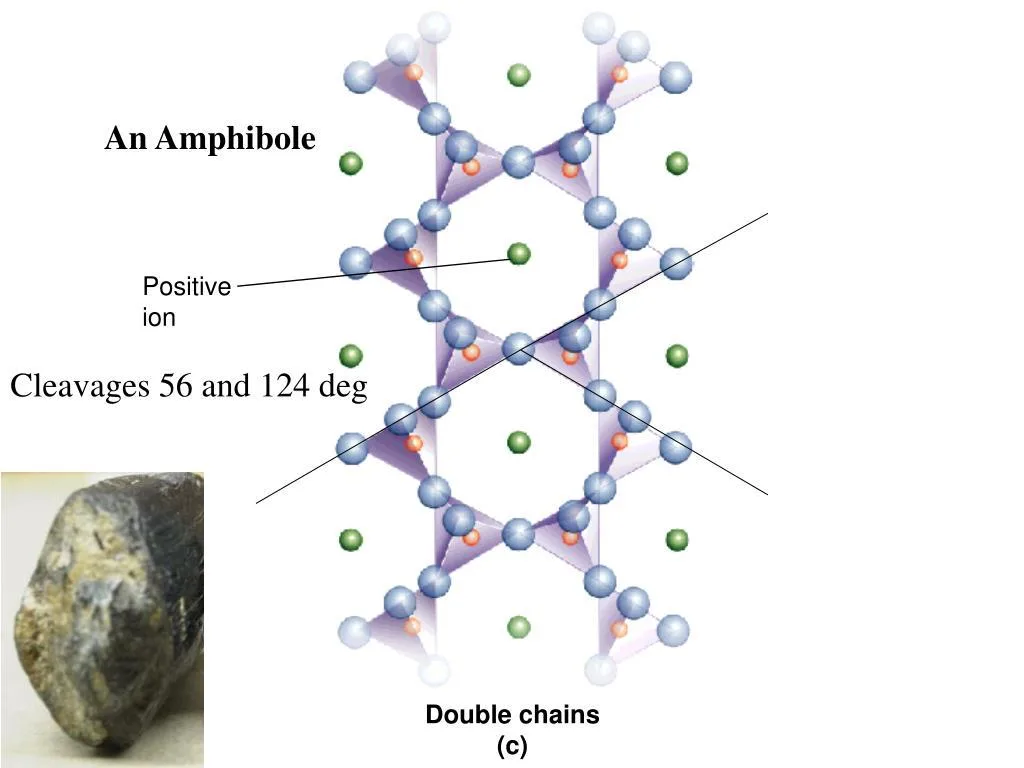
Amphiboles contain two connected chains of silicate tetrahedra extending through their crystal structures.
Each tetrahedron consists of a silicon atom surrounded by four oxygen atoms.
The double chains are linked by additional cations, creating the characteristic amphibole structure.
This arrangement influences important physical properties, including crystal shape and cleavage.
One particularly useful feature is the presence of two cleavage directions intersecting at approximately 56° and 124° in many amphiboles.
These angles are an important distinguishing characteristic when comparing amphiboles with pyroxenes.
Physical Properties of Amphibole Minerals
Amphibole minerals share several recognizable properties, although individual species can differ in color, density, hardness, and crystal habit.
Color
Many common amphiboles are black, dark green, or brown because of their iron and magnesium content.
However, color varies significantly across the supergroup.
Tremolite may be white or pale green, actinolite commonly appears green, and glaucophane is often blue to blue-gray.
Color alone is not sufficient for reliable identification.
Crystal Habit
Amphiboles commonly form elongated prismatic crystals.
Some display bladed or needle-like habits, while others occur as compact mineral masses.
Certain varieties develop fibrous habits, but not all fibrous-looking amphiboles are classified as asbestos.
Hardness and Specific Gravity
Many common amphiboles have a Mohs hardness of approximately 5–6.
Their specific gravity varies with chemical composition, particularly the relative proportions of iron and magnesium and the presence of heavier elements.
These properties can help identify amphiboles when combined with other observations.
Cleavage
Cleavage is one of the most useful diagnostic properties of amphibole minerals.
Many common amphiboles display two prominent cleavage directions meeting at approximately 56° and 124°.
On suitable crystal cross-sections, these directions may form a diamond-like or rhombic appearance.
By comparison, pyroxenes commonly show cleavage directions intersecting close to 90°.
Because cleavage may not be visible in every specimen, geologists also examine crystal habit, mineral associations, and optical properties.
Luster and Streak
Amphiboles commonly display a vitreous, or glass-like, luster on fresh crystal surfaces.
Some fibrous or finely crystalline specimens may appear silky.
Streak color varies with mineral species and may be less useful than cleavage or crystal habit for identifying dark amphiboles.
Types of Amphibole Minerals
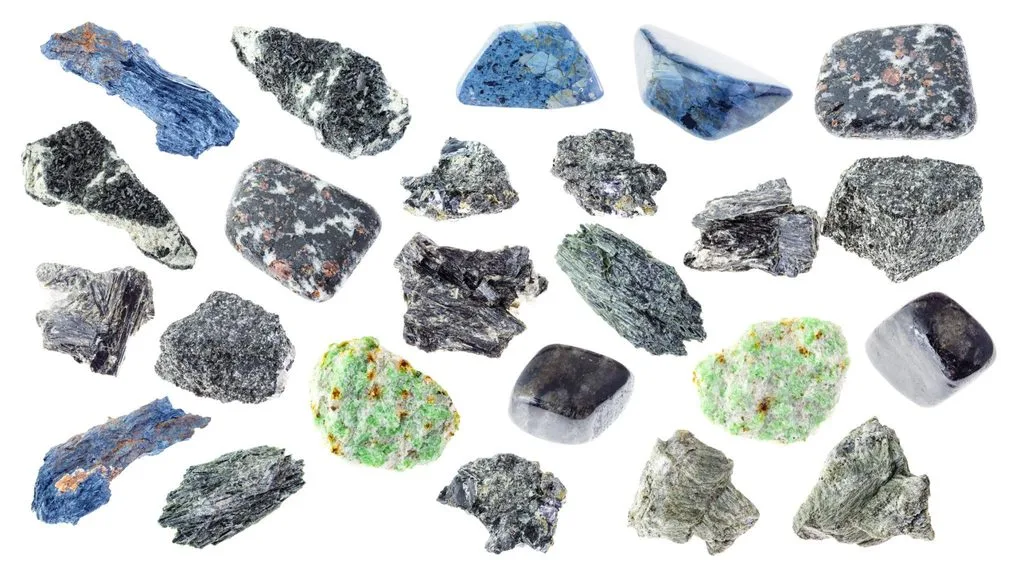
The amphibole supergroup includes numerous mineral species with different chemical compositions and geological occurrences.
The following are some of its better-known members and commonly used mineral names.
Hornblende
Hornblende is a familiar name for dark-colored amphiboles commonly found in igneous and metamorphic rocks.
It is often black, dark green, or brown and forms elongated prismatic crystals.
Hornblende-bearing rocks include diorite, granodiorite, andesite, amphibolite, and some schists and gneisses.
However, hornblende is widely used as a compositional or field term rather than as one precisely defined mineral species.
Modern mineralogical classification distinguishes specific amphibole species using detailed chemical and structural criteria.
Tremolite
Tremolite is a calcium-magnesium amphibole with the formula:
Ca₂Mg₅Si₈O₂₂(OH)₂
It commonly occurs in metamorphosed carbonate rocks, including certain marbles and calc-silicate rocks.
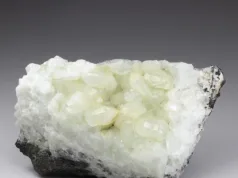
Tremolite may be white, gray, or pale green.
It can develop prismatic or fibrous habits. Some naturally occurring asbestiform varieties pose significant health hazards if their fibers become airborne.
Actinolite
Actinolite is a calcium-rich amphibole containing varying proportions of magnesium and iron.
It commonly appears green and is especially associated with some low- to medium-grade metamorphic rocks.
Actinolite occurs in greenschists, altered mafic rocks, and other suitable metamorphic environments.
It forms a compositional series with tremolite and ferro-actinolite.
Some actinolite occurs in asbestiform habits, although ordinary non-asbestiform actinolite crystals should not automatically be described as asbestos.
Glaucophane
Glaucophane is a sodium-rich amphibole best known for its blue to blue-gray color.
It is especially significant in high-pressure, relatively low-temperature metamorphic environments.
Glaucophane is a characteristic mineral of many blueschists associated with subduction zones.
Its presence can provide valuable evidence about the pressure–temperature conditions experienced by a rock.
Riebeckite
Riebeckite is a sodium- and iron-rich amphibole that commonly occurs in certain alkaline igneous rocks and metamorphic environments.
It may appear dark blue, black, or blue-gray.
An asbestiform variety of riebeckite is known as crocidolite, historically called blue asbestos.
The mineral riebeckite should not be confused with its specific asbestiform variety.
Anthophyllite
Anthophyllite is an orthorhombic amphibole commonly associated with magnesium-rich metamorphic rocks.
It may occur as prismatic, bladed, or fibrous crystals.
Like certain other amphiboles, anthophyllite can form asbestiform varieties under particular geological conditions.
Cummingtonite and Grunerite
Cummingtonite and grunerite are magnesium–iron amphiboles occurring in metamorphic rocks.
Their compositions vary along a magnesium–iron series.
Grunerite is particularly associated with certain iron-rich metamorphic rocks.
The commercial asbestos name amosite refers to an asbestiform amphibole historically associated with the cummingtonite–grunerite series.
Comparison of Common Amphiboles
| Amphibole | Typical appearance | Common geological association |
|---|---|---|
| Hornblende (field term) | Black to dark green | Diorite, andesite, amphibolite |
| Tremolite | White to pale green | Metamorphosed carbonate rocks |
| Actinolite | Green | Greenschist and altered mafic rocks |
| Glaucophane | Blue to blue-gray | Blueschist and subduction-related rocks |
| Riebeckite | Dark blue to black | Alkaline igneous and some metamorphic rocks |
| Anthophyllite | Brownish, gray, or pale | Mg-rich metamorphic rocks |
| Cummingtonite–grunerite | Gray, brown, or dark green | Fe–Mg-rich metamorphic rocks |
Amphibole vs. Pyroxene
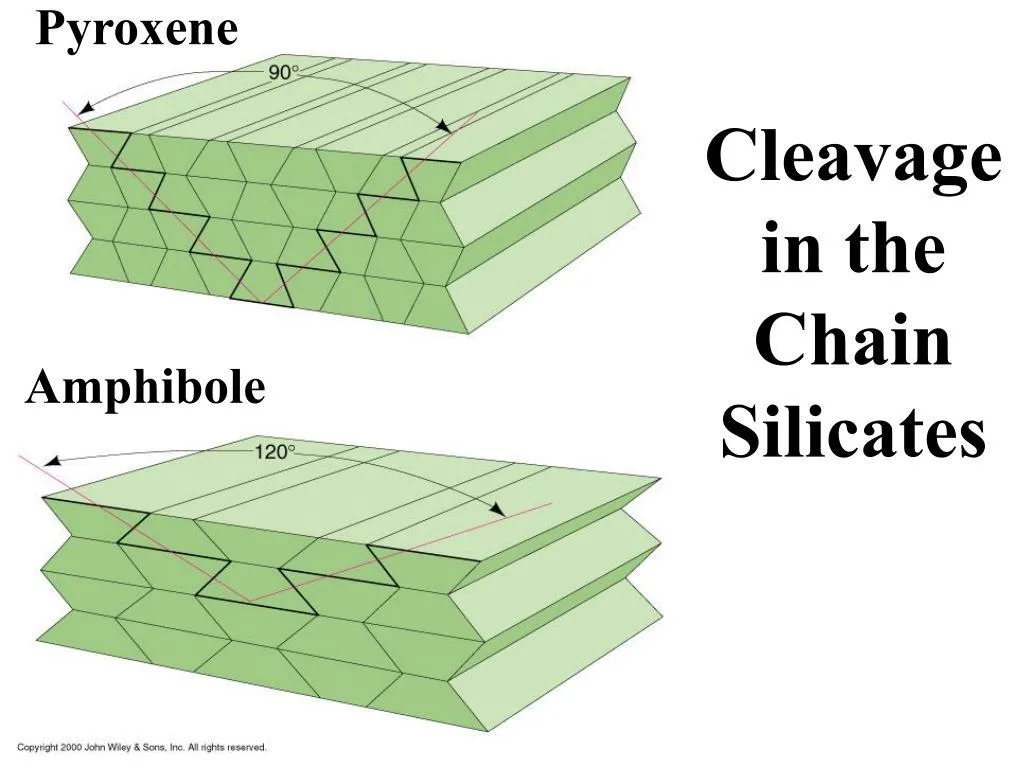
Amphiboles and pyroxenes are important rock-forming silicates that may look similar in hand specimens.
Both groups frequently contain iron and magnesium and commonly occur in igneous and metamorphic rocks.
Their crystal structures provide the fundamental distinction.
Amphiboles contain double silicate chains, while pyroxenes contain single silicate chains.
This structural difference helps explain their characteristic cleavage angles.
| Feature | Amphibole | Pyroxene |
|---|---|---|
| Silicate structure | Double-chain | Single-chain |
| Typical cleavage | Approximately 56° and 124° | Approximately 87° and 93° |
| Common crystal habit | Often elongated or bladed | Often shorter or blockier |
| Hydroxyl in common species | Common | Generally absent from common rock-forming species |
| Common examples | Hornblende-group minerals, actinolite | Augite, diopside, enstatite |
| Common rock associations | Diorite, andesite, amphibolite | Basalt, gabbro, peridotite |
How to Tell Them Apart
In hand specimens, examine a fresh mineral surface using a hand lens.
Look for two cleavage directions and estimate their intersection angles when possible.
Amphiboles commonly exhibit oblique cleavage intersections around 56° and 124°, whereas pyroxenes typically display nearly right-angle cleavage.
Crystal shape may offer additional clues, but it is not definitive.
For difficult specimens, petrographic microscopy or laboratory analysis may be required.
How Do Amphibole Minerals Form?
Amphibole minerals form in several geological environments, including igneous systems, regional metamorphic belts, and hydrothermal alteration zones.
Their formation depends on factors such as temperature, pressure, water availability, and the chemical composition of the surrounding rock.
Igneous Formation
Amphiboles can crystallize from magmas under suitable conditions, particularly when water is available.
Hornblende-bearing amphiboles are common in some intermediate to felsic igneous rocks, including diorite, granodiorite, and andesite.
Their occurrence can provide information about magma evolution, volatile content, and crystallization conditions.
However, not every hydrous magma crystallizes amphibole, and amphibole stability depends on several interacting variables.
Regional Metamorphism
Amphiboles commonly develop when existing rocks undergo changes in temperature and pressure during metamorphism.
For example, mafic rocks such as basalt and gabbro may develop amphibole-rich assemblages during regional metamorphism.
Actinolite is common in some lower-grade metamorphic assemblages, while hornblende-bearing assemblages frequently occur under amphibolite-facies conditions.
The resulting mineral combinations depend on rock chemistry and the metamorphic conditions.
High-Pressure Metamorphism
Certain amphiboles are useful indicators of high-pressure metamorphism.
Glaucophane is especially important in blueschist-facies rocks associated with subduction zones.
Its formation commonly reflects high-pressure conditions combined with relatively low temperatures.
Hydrothermal Alteration
Hot, chemically active fluids can react with existing minerals and promote the growth of amphiboles.
Actinolite and tremolite may develop during appropriate fluid–rock reactions.
The resulting mineral assemblages help geologists investigate hydrothermal systems and the history of fluid circulation through rocks.
Amphibole in Igneous and Metamorphic Rocks
Amphiboles are important components of numerous common rock types.
Diorite and Granodiorite
Diorite and granodiorite may contain hornblende-group amphiboles alongside plagioclase, quartz, biotite, and other minerals.
Dark amphibole crystals commonly contrast with lighter feldspar grains.
Their presence can help geologists describe the mineral assemblage and interpret aspects of the rock’s crystallization history.
Andesite
Andesite is an intermediate volcanic rock that may contain amphibole phenocrysts.
These larger crystals can occur within a finer-grained groundmass.
Amphibole-bearing andesites are found in some volcanic arcs associated with subduction zones.
Amphibolite
Amphibolite is a metamorphic rock composed predominantly of amphibole, commonly hornblende, and plagioclase.
It frequently forms through metamorphism of basaltic or gabbroic protoliths.
Amphibolite is a rock, whereas amphibole is a mineral supergroup.
The distinction is important because a single rock can contain several different minerals.
Schist and Gneiss
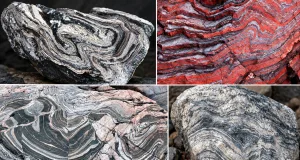
Amphibole minerals may also occur in metamorphic rocks such as schist and gneiss.
Their presence, together with other minerals and rock textures, can help reconstruct metamorphic conditions and deformation history.
Optical Properties of Amphibole in Thin Section
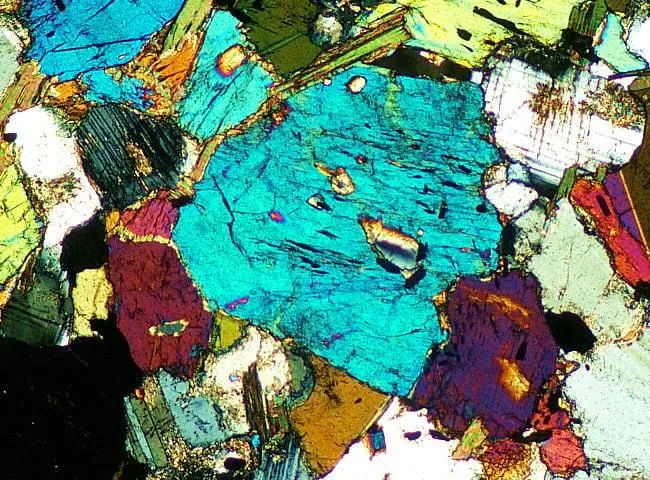
Petrographic microscopy provides valuable information for identifying amphiboles and distinguishing them from other silicate minerals.
Plane-Polarized Light (PPL)
Under plane-polarized light, many common amphiboles display noticeable color and pleochroism.
Pleochroism is the change in apparent color or absorption as a mineral grain is rotated under polarized light.
Green and brown hornblende-group amphiboles may show particularly recognizable pleochroic colors.
Other amphiboles can display blue, pale green, or nearly colorless appearances, depending on their composition.
Many amphiboles have moderate to relatively high relief.
Cross-Polarized Light (XPL)
Under crossed polarizers, amphiboles commonly show interference colors and extinction behavior useful for identification.
Many monoclinic amphiboles display inclined extinction in suitable sections.
Orthorhombic amphiboles generally show straight extinction relative to appropriate crystallographic directions.
Interference colors vary according to mineral composition, birefringence, orientation, and thin-section thickness.
Cleavage in Thin Section
Amphibole cross-sections can show two intersecting cleavage traces at approximately 56° and 124°.
These cleavage relationships are especially valuable when distinguishing amphiboles from pyroxenes.
However, not every grain is cut in the orientation required to display both cleavage directions clearly.
For reliable mineral identification, geologists combine cleavage, pleochroism, interference colors, extinction, and mineral associations.
How to Identify Amphibole Minerals
Amphiboles can often be recognized through a combination of physical features and geological context.
1. Examine the Color
Look for dark green, black, brown, blue, or pale green crystals.
Color can narrow the possibilities but should not be used as the only identification criterion.
2. Observe Crystal Shape
Many amphiboles form elongated prismatic or bladed crystals.
Their crystals may be longer and more slender than some common pyroxene crystals, although habits overlap.
3. Check Cleavage
When suitable surfaces are present, look for two cleavage directions meeting at approximately 56° and 124°.
This is one of the most useful diagnostic features.
4. Consider the Host Rock
Amphiboles commonly occur in intermediate igneous rocks, metamorphic mafic rocks, and some hydrothermally altered formations.
For example, blue amphibole in an appropriate high-pressure metamorphic assemblage may suggest glaucophane.
5. Examine Associated Minerals
Plagioclase, quartz, biotite, garnet, chlorite, epidote, and other minerals may provide clues about the environment in which an amphibole formed.
6. Use Petrographic or Laboratory Methods
Thin-section microscopy, electron microprobe analysis, Raman spectroscopy, and X-ray diffraction can provide more reliable identification when precise mineral species need to be distinguished.
Amphibole species often cannot be identified conclusively from color and crystal habit alone.
Uses and Geological Importance of Amphibole
Amphibole minerals are especially important in geological research and rock classification.
Igneous Petrology
Amphiboles can provide information about magma composition, water content, crystallization conditions, and the evolution of igneous systems.
Their compositions and relationships with neighboring minerals are useful in interpreting magmatic processes.
Metamorphic Petrology
Different amphibole minerals and mineral assemblages can reflect particular metamorphic conditions.
Glaucophane is important in blueschist environments, while hornblende-bearing assemblages are widespread in many amphibolite-facies rocks.
These mineral relationships can help geologists reconstruct tectonic and metamorphic histories.
Geological Mapping and Rock Identification
The presence of amphibole helps identify and describe mineral assemblages in igneous and metamorphic rocks.
Amphibole-rich rocks can also provide important information during geological mapping and field investigations.
Construction and Decorative Stone
Some amphibole-bearing rocks, such as amphibolite and certain gneisses, are used as construction aggregates or decorative stones.
These applications concern the rock as a whole rather than pure amphibole crystals.
The suitability of a particular rock depends on its physical properties, durability, mineral composition, and safety considerations.
Amphibole Asbestos and Health Risks
Some amphibole minerals occur in naturally fibrous, asbestiform varieties.
Historically recognized amphibole asbestos types include tremolite asbestos, actinolite asbestos, anthophyllite asbestos, amosite, and crocidolite.
Asbestiform minerals can release extremely thin fibers when disturbed.
Inhalation of airborne asbestos fibers is associated with serious diseases, including asbestosis, lung cancer, and mesothelioma.
Not all amphibole minerals are asbestos.
Many amphiboles occur as ordinary prismatic or non-asbestiform crystals. The presence of an amphibole mineral does not automatically mean that a rock contains asbestos.
However, fibrous habit cannot always be reliably evaluated from appearance alone.
If potentially asbestiform material is suspected, avoid crushing, grinding, cutting, or dry brushing it. Appropriate laboratory identification and professional handling may be necessary.
Frequently Asked Questions About Amphibole
Is amphibole a mineral or a mineral group?
Amphibole is a mineral supergroup containing numerous chemically related double-chain silicate minerals.
What is the most common amphibole?
Hornblende is one of the most familiar names used for common rock-forming amphiboles, although it is not a single precisely defined mineral species in modern classification.
What color is amphibole?
Amphiboles may be black, green, brown, blue, gray, or nearly white. Their colors depend on chemical composition and mineral species.
What is the hardness of amphibole?
Many common amphiboles have a Mohs hardness of approximately 5–6, although individual species vary.
What is the difference between amphibole and pyroxene?
Amphiboles have double-chain silicate structures and commonly show cleavage angles near 56° and 124°. Pyroxenes have single-chain structures and cleavage angles close to 90°.
Is hornblende the same as amphibole?
No. Hornblende is a commonly used name for certain dark amphiboles, while amphibole refers to the much broader mineral supergroup.
Is amphibole the same as amphibolite?
No. Amphibole is a mineral supergroup. Amphibolite is a metamorphic rock composed mainly of amphibole and plagioclase.
Where are amphibole minerals found?
They occur in igneous rocks, metamorphic rocks, and hydrothermally altered formations, including diorite, andesite, schist, gneiss, and amphibolite.
Does amphibole contain asbestos?
Some amphibole minerals occur in asbestiform varieties. Most ordinary amphibole specimens should not automatically be classified as asbestos, but suspected fibrous material requires appropriate assessment.
Why are amphiboles important in geology?
Amphiboles provide clues about magma evolution, metamorphic conditions, fluid activity, and tectonic processes.
Conclusion
Amphiboles are an important supergroup of double-chain silicate minerals found throughout Earth’s igneous and metamorphic rocks.
Their distinctive cleavage angles, variable chemical compositions, and characteristic crystal habits make them valuable for mineral identification and geological interpretation.
From hornblende-bearing igneous rocks to glaucophane-rich blueschists, amphibole minerals provide evidence of the conditions under which rocks form and change.
Understanding their structures, physical properties, and geological associations helps geologists identify rocks, interpret metamorphic environments, and reconstruct processes operating within Earth’s crust.
Scientific References and Further Reading
- Hawthorne, F. C., et al. (2012). Nomenclature of the Amphibole Supergroup. American Mineralogist, 97, 2031–2048. https://doi.org/10.2138/am.2012.4276
- Mindat.org. Amphibole Supergroup – Mineral Information and Data. https://www.mindat.org/min-207.html
- University of Lille. Groupe des Amphiboles – Mineralogy. https://minweb.univ-lille.fr/res/cours.eWeb/co/chap09_c.html
- U.S. Geological Survey. Asbestos: Geology, Mineralogy, Mining, and Uses. https://pubs.usgs.gov/of/2002/of02-149/
- Nesse, W. D. (2012). Introduction to Mineralogy, 2nd Edition. Oxford University Press.