
Summary: This article cross-checks the “swarm/RSI” rumors around Gemini 4 Neon against Google Antigravity’s release records and DeepMind’s model card, item by item. The check splits into three questions: how the multiple agents in the product actually collaborate, what training information the model discloses, and what the performance numbers can prove.
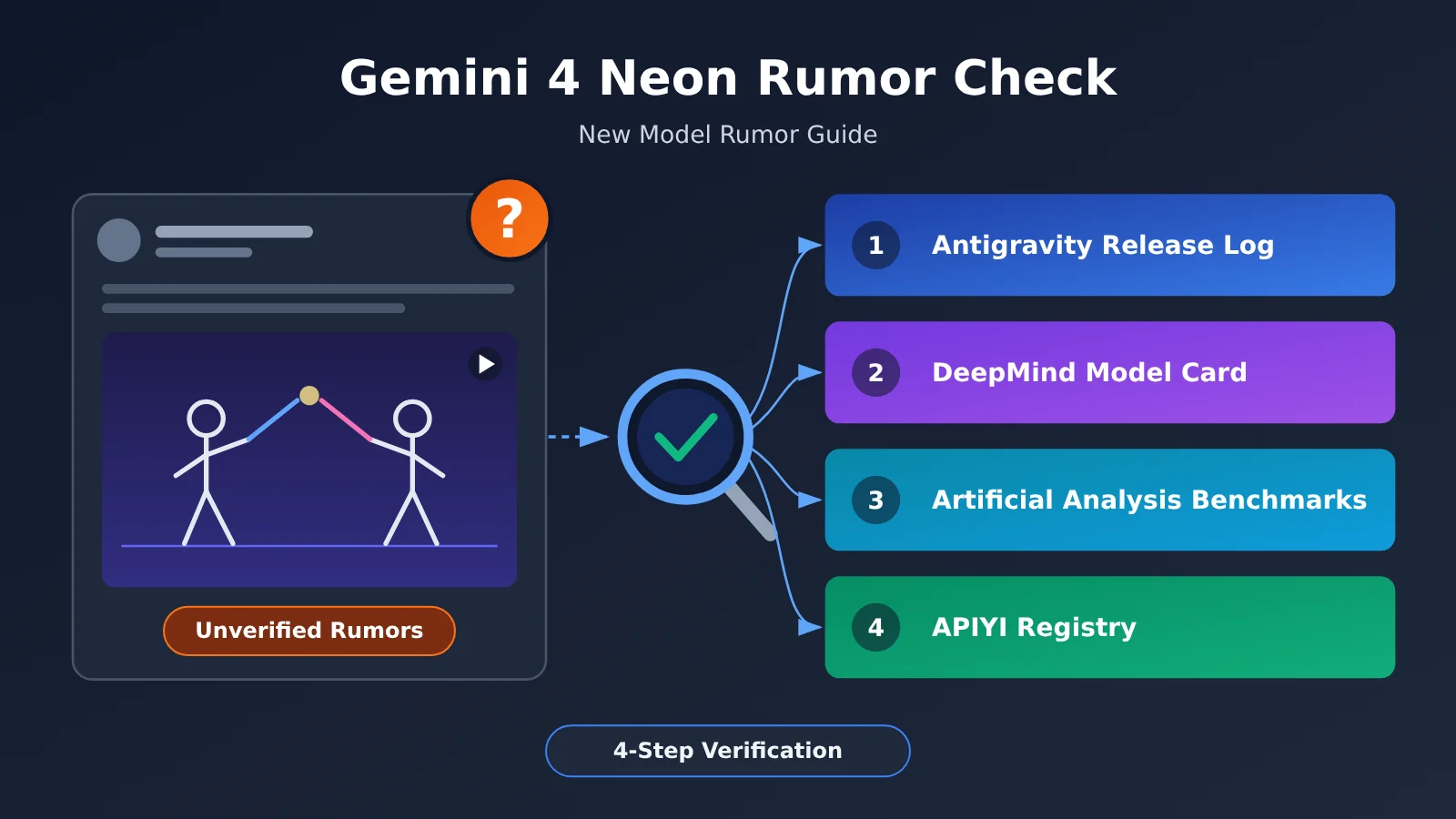
Bottom line first: as of 2026-11-20 (Beijing time), there’s exactly one thing called swarm in the public record — Google Antigravity’s /swarm product command. It handles multi-agent parallel code writing and verification, and has nothing to do with training methods. DeepMind’s model card states that Neon was adapted from Gemini 4 Carbon and mentions alignment measures such as supervised fine-tuning and reinforcement learning, but says nothing about whether distillation or so-called RSI was used during training. So the claim that “Neon was recursively trained by swarm” currently has no verifiable public disclosure backing it. It can’t be written as fact, and it’s equally wrong to call it “debunked.”
That conclusion comes with caveats. If DeepMind later publishes a Neon safety report or other official documentation disclosing new training details, the judgment has to be updated accordingly. Developers who want to use Neon in their own work can call it through APIYI apiyi.com using the exact model ID gemini-4-neon. The model went live on November 20, priced the same as the official rate: $3 for input and $15 for output (per million tokens).
Knowledge Map and Reading Order for Verifying the New Model Rumor
The table below lays out the question each of the four sections answers, the evidence each depends on, and how the sections connect. Section 1 first draws the line on what’s already confirmed, and the following three sections work within that scope.
| No. | Question answered | Key evidence | What it gives the next section |
|---|---|---|---|
| 1 | Which of the claims tied to the Gemini 4 Neon rumor have actually been confirmed | Antigravity blog post, DeepMind model card, APIYI announcement | A dated timeline of facts to serve as the baseline for later comparison |
| 2 | Where the rumor’s chain of evidence breaks down | Original social post, vendor demo, model card | What each kind of evidence can support at most, and what materials independent reproduction would need |
| 3 | What benchmarks can prove, and what they can’t | Artificial Analysis’ four-tier index, coding agent index | How to read benchmarks correctly, and the minimum approach to testing it yourself |
| 4 | How developers can check the current real status | Model card, changelog, APIYI registry | A repeatable verification workflow and current pricing |
On reading order: Sections 1 and 2 form one main thread, so read them in sequence. Section 3 is for readers who want performance data, and Section 4 is for developers getting ready to integrate — either can be read on its own.
To Know: The Terms You Need to Make Sense of the Gemini 4 Neon Rumor
| Term | Plain-English Explanation |
|---|---|
/swarm |
A product command in Google Antigravity that hands a task to multiple agents working in parallel or by division of labor |
| Worktree | Isolated working directories inside a source code repository, so multiple agents can edit code at the same time without conflicts |
| Coordinator agent | The agent responsible for splitting tasks, assigning them to worker agents, aggregating results, and scheduling verification |
| Knowledge distillation | A training method where one model learns another model’s outputs or behavior, transferring capability |
| RSI | Recursive Self-Improvement — whether a system can repeatedly improve its own capabilities or the process by which it improves |
| Supervised fine-tuning | Continuing to train a model on data that carries labels or reference outputs |
| Reinforcement learning | Adjusting model behavior based on reward signals; the specific implementation depends on what the vendor discloses |
| Model card | A document published by the developer describing a model’s provenance, capabilities, evaluation results, and limitations |
| Independent reproduction | Reaching the same result using verifiable inputs, model versions, configurations, and process logs |
1. What’s Already Confirmed in the Gemini 4 Neon Rumor
1.1 A Fact Timeline by Date
The first step in checking any new-model rumor is to list the confirmed items that come with a date and a source. The table below includes only material published by the official parties or the platform itself.
| Date (2026) | Source | Confirmed Item |
|---|---|---|
| November 10 | Google Antigravity blog post, “Gemini 4 Carbon and /swarm” | /swarm ships as a preview: a coordinator splits tasks, parallel executors work in isolated git worktrees, and adversarial verifiers run tests and challenge code changes; different roles can be assigned different models |
| November 18 | Google Antigravity blog post, “Gemini 4 Neon in Google Antigravity” | Neon is released, along with a demo video: building a multi-level two-player browser game with Neon plus /swarm, running it in the built-in browser, with an agent playing the second player |
| November 18 | Google DeepMind, “Gemini 4 Neon Model Card” | Neon is adapted from Gemini 4 Carbon; the disclosed alignment measures include supervised fine-tuning and reinforcement learning; DeepMind says a Neon safety report will follow |
| November 20, 11:45 (UTC+8) | APIYI announcement, “Gemini 4 Neon Is Live: Same Price as Official, $3/$15” | gemini-4-neon is listed on APIYI apiyi.com, and the model registry already carries the entry the same day |
1.2 What /swarm Is as a Product
According to the November 10 blog post, /swarm hands the user’s prompt to a group of agents. The coordinator spins up several specialized parallel worker agents, each editing code in its own isolated git worktree, so their changes don’t overwrite one another. Separate adversarial verifiers run tests and challenge the code diffs. The agents collaborate through a shared, append-only message board; they consume no tokens while idle and activate immediately when input is needed.
This is “swarm” in the engineering sense — parallel processes, a shared queue, and a verification stage. It describes how the Antigravity runtime organizes work, and says nothing about how Gemini 4 Neon itself was trained.
2. Breaking Down the Evidence Chain Behind the Gemini 4 Neon swarm/RSI Rumor
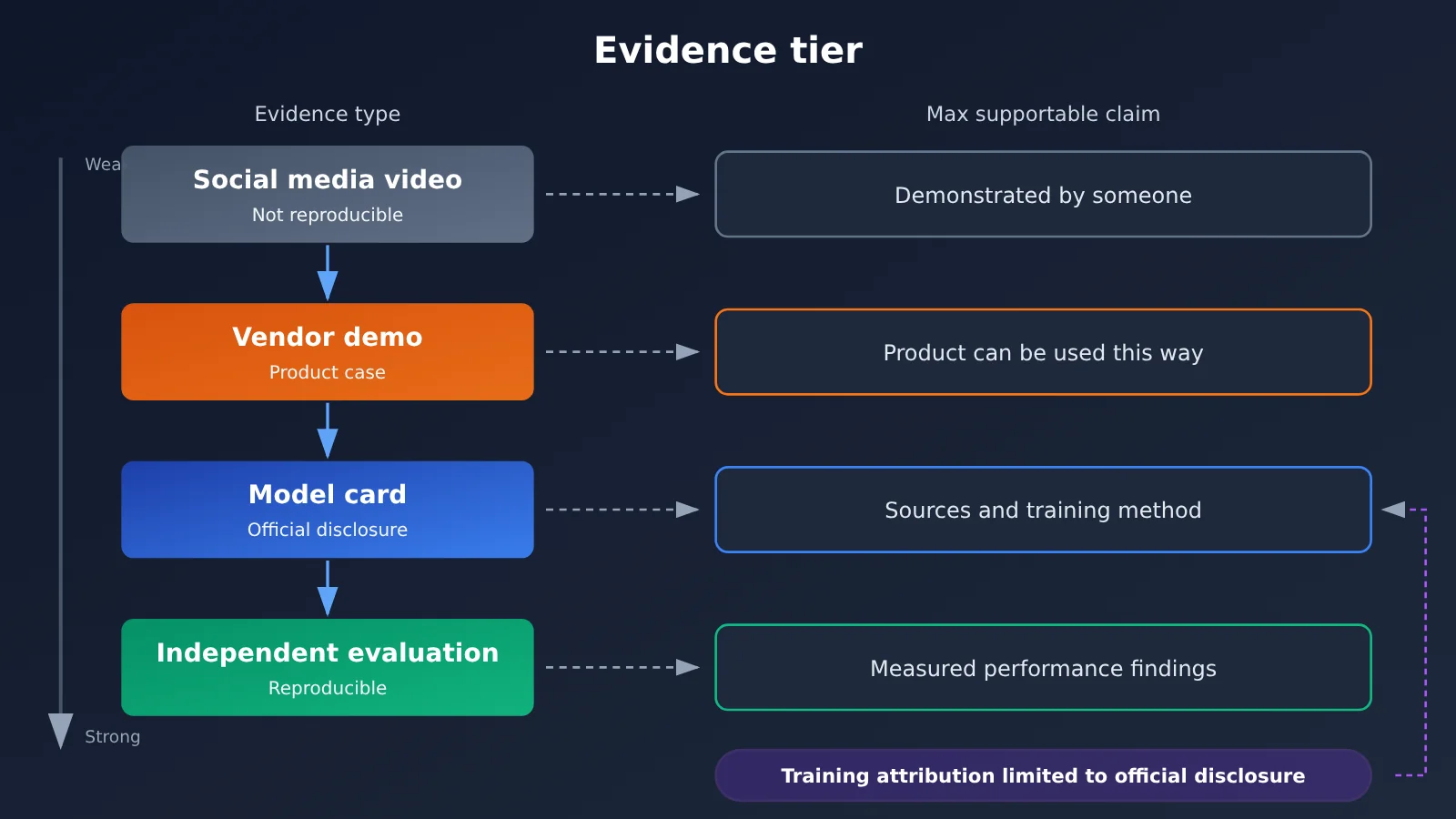
2.1 What Each of the Four Evidence Types Can Support
The rumor traces back to a social media post: a roughly 62.5-second video at 756×403 resolution showing a two-player stick-figure fighting game running in a browser, captioned as “made by swarms” with the code written in “pure JS.” OrcaRouter’s analysis points out that the post didn’t include a prompt, model version, thinking level, or token counts, nor did it indicate whether the code was generated by one agent or multiple agents.
Placing this post side by side with the surrounding materials gives us the evidence chain below.
| Evidence | Nature | Strongest claim it can support | Claim it cannot support |
|---|---|---|---|
| Original social media post video | Third-party showcase, no run log | “Someone showed a browser game allegedly generated by a swarm” | The generation process, the model used, the training method |
| November 18 Antigravity demo | The vendor’s own product showcase | “Google has shown a two-player browser game built with Neon + /swarm“ |
That the social media video was produced using the same path |
November 10 /swarm docs |
Official product documentation | “swarm is Antigravity’s multi-agent collaboration feature” | Any conclusion about model training |
| DeepMind model card | Official model disclosure | “Neon is adapted by Carbon and uses alignment measures such as supervised fine-tuning and reinforcement learning” | Whether distillation or RSI was used in training, or wasn’t |
OrcaRouter’s article also notes that Google’s vendor demo was published one day earlier than the social media video, and that it’s the only publicly demonstrated path so far for building a two-player browser game with a swarm. That only shows the two are similar in content. A vendor demo with explanatory notes and a third-party video are different types of evidence—the former can’t vouch for the latter’s execution process.
2.2 Why “Not Confirmed by Public Materials” Is the More Accurate Wording
Two claims are circulating on social media: one holds that “Neon was recursively trained on a large number of its own copies,” while the other, in rebuttal, says “this has been debunked.” Both go beyond what the available evidence can support.
The model card doesn’t mention distillation or RSI. That means the vendor hasn’t disclosed information on this front—but it doesn’t mean the vendor has ever denied it. So when writing or communicating externally, both “distillation/RSI was used in training” and “distillation/RSI was not used in training” should be rephrased as “not confirmed by public materials,” or “no verifiable disclosure supports that assertion.”
2.3 What Materials Independent Reproduction Requires
To make a “a swarm made a game” claim testable, you need at least four things: the full prompt, the model configuration (the model ID and thinking level bound to each role), a run log (how many rounds the reviewer rejected and how it finally passed), and token usage. If any one of these is missing, re-running it amounts to a different experiment.
Even with all four materials in hand, reproduction only proves product behavior: under this framework and configuration, what quality of code can be produced reliably, and how many tokens and how much time it took. Reproduction can’t reverse-engineer the model’s training process, because the same output could be reached through completely different training paths. Training attribution can only rely on the vendor’s own disclosures.
3. Reading the performance evidence for Gemini 4 Neon: don’t infer training from benchmark scores
3.1 The two kinds of indices from Artificial Analysis
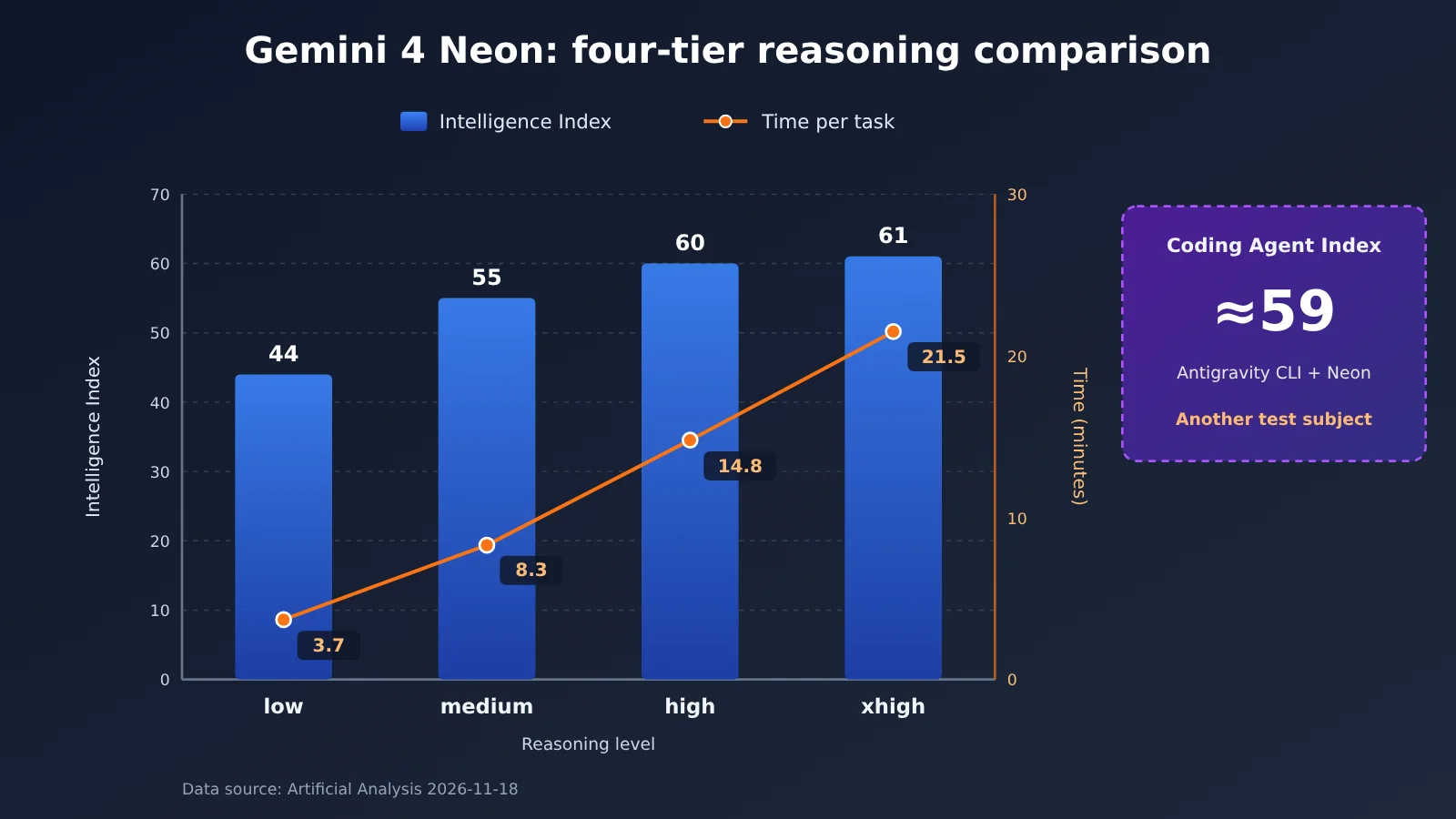
Artificial Analysis (AA) published an independent evaluation of Gemini 4 Neon on November 18. Its API composite capability index is reported separately for four reasoning tiers:
| Tier | Intelligence Index | Average time per task |
|---|---|---|
low |
44 | 3.7 minutes |
medium |
55 | 8.3 minutes |
high |
60 | 14.8 minutes |
xhigh |
61 | 21.5 minutes |
AA puts the weighted cost of the xhigh tier at $6.44 per evaluation task. According to the same version of AA’s model overview, GPT‑6.2 Sol tops out at 57 points and Gemini 4 Hydrogen at 54. Separately, AA measured the coding agent index for the Antigravity CLI + Neon combination at roughly 59. That index measures a “framework + model” combination, so its test subject differs from the API composite index — the two numbers should be cited separately and can’t be compared side by side.
3.2 What Can Each Number Answer?
The API four-tier index answers this: when you call Neon directly through the API, how do you trade off overall task performance against latency at different thinking tiers? The coding Agent index answers a different question: when you use Neon as a coding agent inside Antigravity CLI, what level can it reach overall?
Neither test measured how those social-post videos were produced, and neither touched training methods. “A high score” doesn’t imply “it must be trained with swarm recursion.” High scores can come from plenty of training routes, and benchmarks alone can’t tell them apart. On top of that, these tiers and scores all come from AA’s own evaluation pipeline. When you call through a third-party platform, end-to-end latency, success rate, and the actual bill need to be measured separately.
3.3 A Beginner’s Self-Test: Verify with the Same Task Under Fixed Conditions
If you want to know how Neon performs in your own scenario, don’t treat a vendor demo as a real measurement. A more reliable approach: pick a real task, fix the endpoint, tier, and input, run it several times, and record the results. Here’s the simplest way to call it:
import openai

client = openai.OpenAI(
    api_key="YOUR_API_KEY",
    base_url="https://api.apiyi.com/v1"  # APIYI OpenAI-compatible endpoint
)

resp = client.chat.completions.create(
    model="gemini-4-neon",
    messages=[{"role": "user", "content": "用纯 JS 写一个双人对战小游戏的核心循环"}]
)
print(resp.choices[0].message.content)
print(resp.usage)  # Record token usage
View the full script with a reproduction log
import json
import time
import openai

client = openai.OpenAI(
    api_key="YOUR_API_KEY",
    base_url="https://api.apiyi.com/v1"
)

BRIEF = {
    "model": "gemini-4-neon",          # Use the exact model ID
    "effort": "按 APIYI 文档填写档位",   # Tier parameter name follows the platform docs
    "prompt": "用纯 JS 写一个双人对战小游戏的核心循环",
}

def run_once(run_id: int) -> dict:
    start = time.time()
    resp = client.chat.completions.create(
        model=BRIEF["model"],
        messages=[{"role": "user", "content": BRIEF["prompt"]}],
        temperature=0,
    )
    return {
        "run_id": run_id,
        "brief": BRIEF,
        "elapsed_s": round(time.time() - start, 2),
        "usage": resp.usage.model_dump() if resp.usage else None,
        "output": resp.choices[0].message.content,
    }

# Run the same task 3 times and keep the log so others can review it
logs = [run_once(i) for i in range(3)]
with open("neon_runs.json", "w", encoding="utf-8") as f:
    json.dump(logs, f, ensure_ascii=False, indent=2)
This log captures the prompt, model, tier, elapsed time, token usage, and output — exactly the reproduction material listed in Section 2.3.
🎯 Technical tip: When comparing different tiers or different models, change only one variable and keep everything else constant. With APIYI apiyi.com, the same API key lets you switch between Neon, Carbon, Hydrogen, and other models, so it’s easy to compare results under identical conditions.
4. How Developers Can Check the Current Status of Gemini 4 Neon
4.1 The Order for Cross-Checking the Three Sources
After a new model launches, information updates fast. Before you write anything or ship anything, it’s worth verifying in this order:
- Google DeepMind model card: confirm the model’s origin, the training and alignment information that’s been made public, evaluation results, and limitations. Keep an eye out for whether a safety report has been added yet.
- Google Antigravity changelog: confirm the current status of product features like
/swarmand Orchestrator. - APIYI model registry and launch announcements: confirm the model ID, endpoint, group, and listed price. Always go with the latest announcement. For example, the November 19 master table didn’t include Neon yet, but the November 20 announcement and registry already listed the model — an old table missing that row doesn’t override a newer announcement.
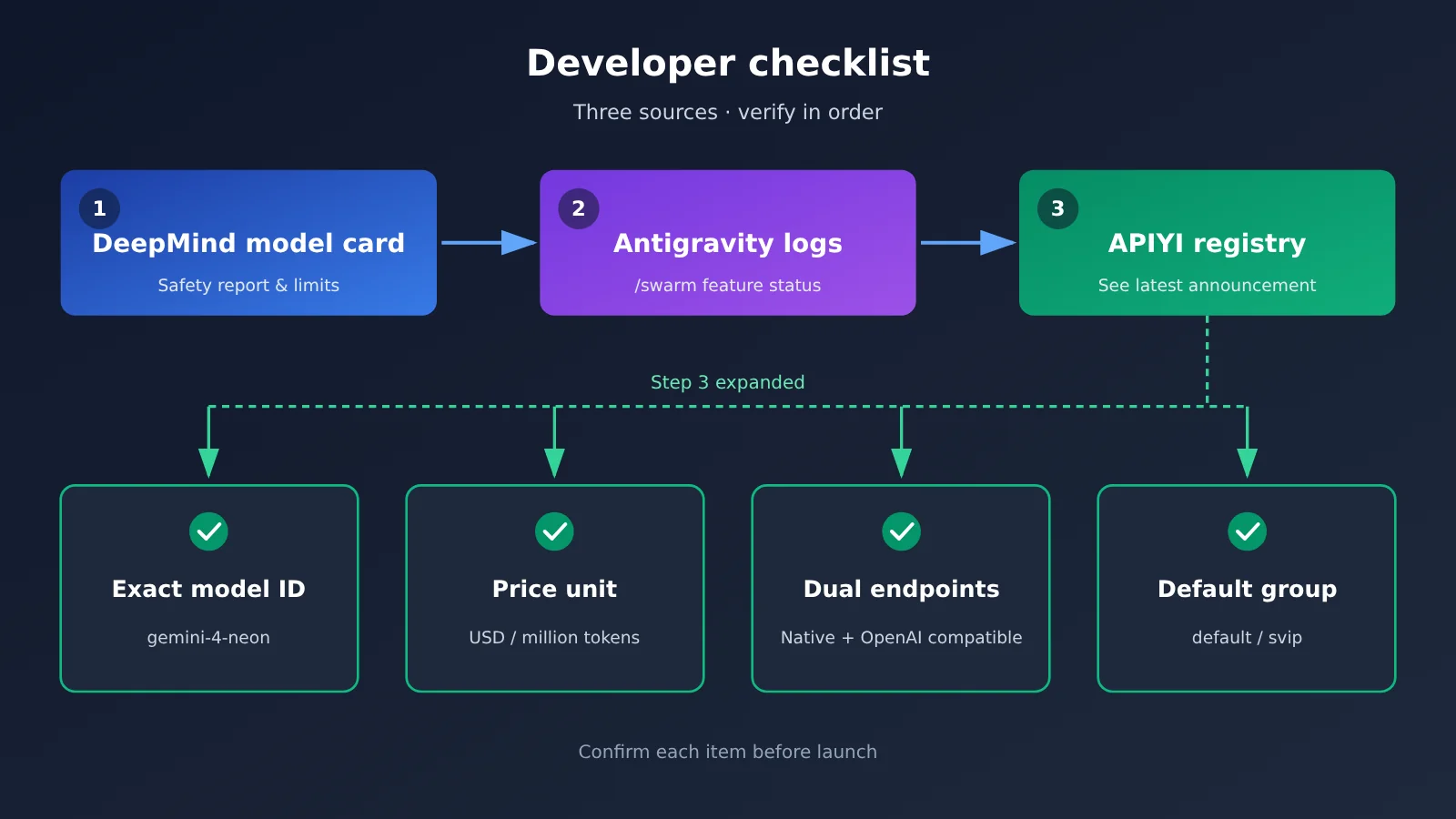
4.2 Look Up Pricing, Endpoints, and Groups by Exact Model ID
The table below shows the listed prices from the APIYI public catalog, all in USD per million tokens. Every model listed is registered with both a Google native format endpoint and an OpenAI-compatible endpoint.
| APIYI Model ID | Input | Output | Cache Read | Publicly Registered Groups |
|---|---|---|---|---|
gemini-4-neon |
3 | 15 | 0.15 | default, svip |
gemini-4-carbon |
2 | 10 | 0.10 | default, svip |
gemini-4-argon |
2 | 10 | 0.10 | default, svip |
gemini-4-hydrogen |
1.50 | 7.50 | 0.075 | default, svip |
gemini-3.8-flash |
0.75 | 3.75 | 0.075 | Gemini_Reverse, default, svip |
There are three things to keep in mind when using this table:
- Neon is the standard price. According to APIYI’s announcement, the $3/$15 figures don’t have a specified expiration date.
- Carbon and Argon are currently limited-time prices. Under the announced plan, they’ll go back to $4 input and $20 output starting December 1. That’s the plan as stated in the announcement, so double-check it when the date comes around.
- The listed price isn’t what you actually pay. Which models your account can actually see, what group discounts you get, and what your final bill comes out to all depend on your specific account. AA’s $6.44 per evaluation task is the cost of AA’s evaluation pipeline — it can’t stand in for your own bill.
As for “when the next Gemini will launch”: as of now, APIYI’s real-time updates archive, the Antigravity changelog, and the Neon launch announcement haven’t named a next model or a date, and APIYI hasn’t made any commitment about when it would be integrated. Extrapolating a date from the gaps between recent releases will just create a new rumor.
💡 Integration tip: First confirm in the APIYI apiyi.com console that your account can see
gemini-4-neon, and check which group you’re in. Then run a small sample with the script from Section 3.3 and record your real token usage and bill. New users can start with the free trial credits to get this step done.
4.3 How to Judge the Next New Model Rumor You Encounter
Condense the method in this article into a single rule: first ask which category the claim falls into — product behavior, training attribution, or performance level — then check the corresponding source. For product behavior, look at changelogs and reproducible run logs; for training attribution, look only at official disclosures such as model cards; for performance level, look at independent evaluations that state the test subject and tier. If none of the three source types offers supporting evidence, label the claim “unconfirmed by public materials.”
For Gemini 4 Neon specifically, here’s what’s certain right now: it was adapted from Carbon; /swarm is a multi-agent product feature of Antigravity; the four tiers measured by AA range from 44 to 61. On APIYI apiyi.com, gemini-4-neon is listed at the standard price of $3/$15/$0.15. The claims about swarm training and RSI will have to wait for official disclosure before we can draw conclusions.
References
-
Google Antigravity – Gemini 4 Carbon and /swarm (2026-11-10)
- Link:
antigravity.google/blog/gemini-4-carbon-in-google-antigravity - Description: Product definition of
/swarmand how the roles are divided
- Link:
-
Google Antigravity – Gemini 4 Neon in Google Antigravity (2026-11-18)
- Link:
antigravity.google/blog/gemini-4-neon-in-google-antigravity - Description: Neon launch and the two-player browser game vendor demo
- Link:
-
Google DeepMind – Gemini 4 Neon Model Card (2026-11-18)
- Link:
deepmind.google/models/model-cards/gemini-4-neon/ - Description: Model origin and publicly disclosed alignment measures
- Link:
-
Artificial Analysis – Gemini 4 Neon Evaluation and Model Page (2026-11-18, metrics updated dynamically)
- Link:
artificialanalysis.ai/models/gemini-4-neon - Description: Four-tier Intelligence Index, latency, and coding Agent index
- Link:
-
OrcaRouter – Gemini 4 Neon’s Stickman Game: The Swarm Claim (2026-11-19)
- Link:
orcarouter.ai/blog/gemini-4-neon-stickman-swarm-claim - Description: Analysis of the information gaps in the original social post video
- Link:
-
Google Antigravity Changelog (continuously updated)
- Link:
antigravity.google/docs/changelog - Description: Current status of product features
- Link:
-
APIYI – Gemini 4 Neon Launch Announcement and Model Registry (2026-11-20)
- Link:
docs.apiyi.com/live/2026-11/gemini-4-neon-launch - Description: Model ID, endpoints, groups, and pricing
- Link:
Author: APIYI Technical Team
Technical inquiries: Model and pricing changes are subject to the APIYI documentation center. For integration questions, feel free to reach us through the APIYI official website.