Memories of the Wunderkammer III — A Record of Exotica

日本語版はこちら →ヴンダーカンマーの記憶③ Exoticaの記録
Today I am cross-checking the provenance of the holdings.
Things brought from distant lands—Exotica.
Masks, textiles, vessels used in rituals.
Objects the gentleman gathered from around the world remain in this storeroom under the names used for them at the time.
The old system of classification in this museum is not as clear-cut as that of museums today.
An object may be something crafted by human hands, and at the same time something from a distant land.
In this way, a single object sometimes falls across more than one category.
These days, we do not try to force them into a new order.
The reason is that where an object was classified is itself a record of how it has been seen in this museum.
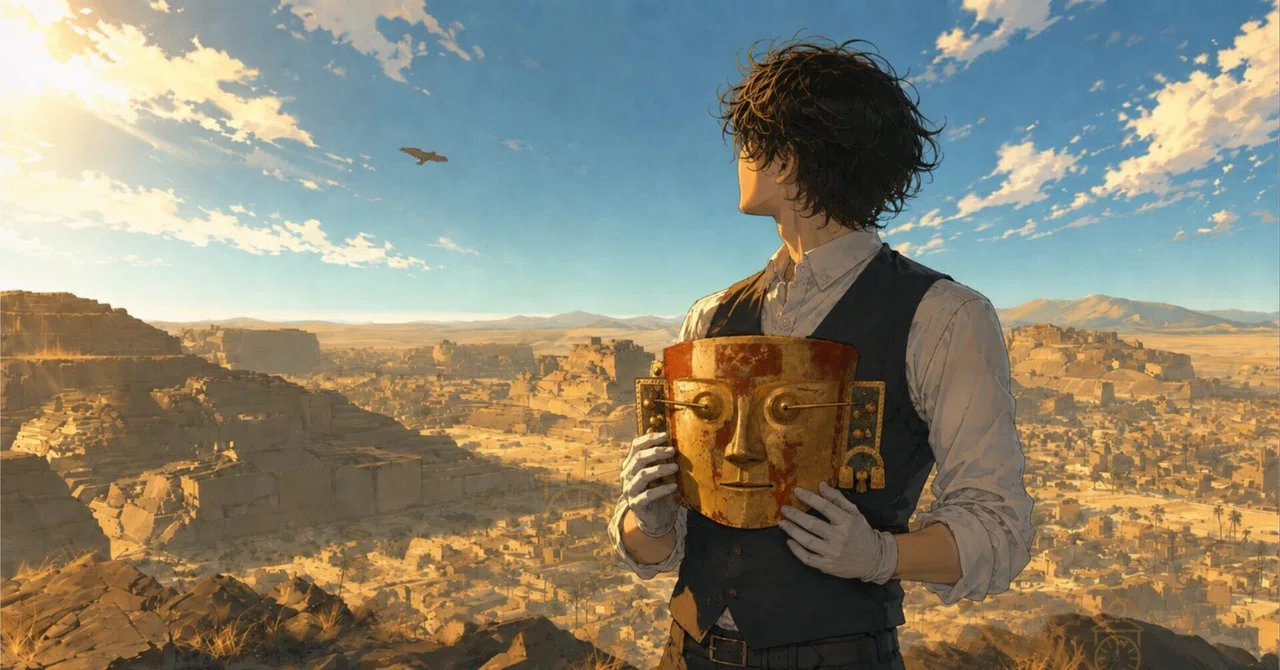
On the worktable lies a mask.
It comes from the ancient culture known as the Sicán, which flourished on the northern coast of Peru, in South America.
A face hammered from an alloy of mostly gold.
Both eyes are long and narrow, rising towards the outer corners.
Rather than copying someone’s face, it looks like the face of something not human.
According to the records, this face was originally painted red with cinnabar.
Now the red has been lost in places, and the golden skin shows through beneath it.
In the collector’s ledger, too, there is a short note about the red pigment.
But nothing more is written.
Perhaps it was not known at the time.
Recent research analysing red pigment remaining on funerary masks from this culture is said to have detected, in at least one case, components derived from human blood and from bird eggs, in addition to cinnabar.
What were they used for?
It has been suggested that they may have held some meaning connected with death or rebirth.
Beyond that, we still do not know.
It was something the gentleman could not have known when he acquired such objects.
I look at the red remaining in patches on the gold.
Though we are looking at the same thing, what we can see is different from what could be seen then.
This was not a mask meant to be worn by a living person.
It is said to have been placed over the face of a high-ranking person when they were buried.
The distinctive eyes are also thought to represent a deity worshipped in this land.
The dead person was given that face, and in time became a venerated ancestor.
So these eyes have never seen anything.
Not a face meant to see, but a face for others to see off.
I open the gentleman’s ledger kept in the museum.
The year of purchase.
The name of the merchant who acted as intermediary.
The amount paid.
The sum seems to have been extraordinary even for the time.
“The other party was pleased to hand it over.”
That is written beneath it in his meticulous hand.
The ledger did not simply list prices and merchants’ names.
On another page, of another object, it says:
“Said to be a woman’s ornament.”
On another:
“The owner was probably a person of high rank.”
Stories he seems to have heard while buying the objects are written down in small, careful script.
Some entries even read:
“So that the soul may rest.”
There were even words closer to prayer than record.
I do not think the gentleman was someone who collected without thought.
There were times when he imagined the people who had lived in those distant lands.
I have also heard that when he wanted something, he paid well for it.
When he was young, he seems to have believed that paying money meant he had acquired something legitimately.
It was also an age when objects from distant lands were spoken of brightly as rare discoveries.
I do not think it was yet taken for granted that one should trace the path an object had taken before it reached one’s own hands.
He did not steal it.
He bought it.
That is what the handwriting in the ledger seems to say.
But the ledger says nothing about what came before that.
From whom did the merchant obtain it?
Where had that person taken it from?
Grave goods were things placed in a tomb.
Something that should have remained with the dead was, at some point, taken out by someone’s hand.
What happened between that moment and its appearance on the market is not recorded in the ledger.
Looking further into it, I find that the land where this mask was made changed rulers many times over the long course of its history.
The Sicán were conquered by the Chimú.
The Chimú, in turn, were eventually incorporated into the Inca Empire.
The names of states changed, and so did those who ruled them.
Still, people went on living in that land.
They passed inherited techniques on to the next age and carried on their lives.
Then, after the Spanish conquest in the sixteenth century, the land was drawn into still greater change.
War.
Colonial rule.
Diseases brought from outside.
Forced labour.
Over the long years that followed, there were also times when old tombs were dug up and the objects placed inside them found their way onto the market.
But when this mask was taken from the tomb, by whom, and by what route it reached the gentleman, we do not know.
It did not come all this way through the hands of one person.
It passed through many periods and many hands.
In this storeroom, there are other objects whose provenance breaks off in much the same way.
Objects of prayer taken away as pagan things.
Things left without owners after war.
Things taken from tombs.
To say that something was bought legitimately does not guarantee what happened before it reached one’s hands.
In the margin of a page in the ledger, there is another note.
The same hand, a little older.
“I did not steal it.”
Below it, one more line.
“But I cannot write that it was not stolen.”
Nothing more.
No excuse, and no regret, is written there.
Should it be returned, I wonder.
It is not that returning it would be meaningless.
There are people living in that land now who carry on its culture.
There are objects for which we must keep thinking about where they ought to be.
Even so, one act of returning something cannot put everything back as it was.
A tomb once opened cannot be made into a tomb no one ever opened.
Nor can the lost form of the burial.
Nor the lost red.
Nor the memory of who placed this mask there, and with what prayer.
None of it can now be fully put back.
“I did not know” is not enough—that is how I read those two lines.
And yet the gentleman, while carrying something that could not simply be settled, did not erase it from the record either.
I peer at the mask on the worktable.
I bend until the golden face and my own are side by side.
One of my eyes overlaps the golden eye.
Strong sunlight.
Dry earth.
A great bird crossing a high sky.
The land I know exists only in photographs and books.
Even so, I can imagine the light this mask once received.
And the day when, after covering someone’s face in a dark tomb, it appeared again beneath the light it was never meant to see.
Nothing is reflected in the golden eye.
It is only my eye that sees.
The person who lay beneath this face is gone.
The people who saw that person off are gone too.
Even so, what they left behind is here.
I step away from the mask and make an entry in the provenance field.
What is known.
What is not known.
What I do not know, I leave as unknown and write it that way.
Some objects were gathered two hundred years ago simply as curiosities.
There were things the gentlemen of that time could not see.
The objects remained.
The records remained.
And so now, from the traces of pigment left on other masks of the same culture, we are able to read things that could not have been known then.
History itself does not change.
But what human beings can read from it does.
Perhaps things whose meaning we cannot understand today still contain something that someone in the future will be able to read.
They say that the treasure of the highest order in this museum is that motionless doll.
I wonder why.
There are things here older, rarer, and heavier with history than that doll.
If that doll is a treasure of the highest order, what is this mask?
I have heard that the gentleman changed after he came to know the old clockmaker.
He is said to have understood for the first time, in the truest sense, that both those who entrust something to another and those who lose it have their own span of time before they part with it.
I think those two lines in the margin were written after that.
The gentleman could not have been thinking as far ahead as what people in the future might come to know.
But at least he left it.
He left what he did not know as something he did not know.
As though even the question of whether that was right were being left to those who came after.
Because of that, I am here two hundred years later.
Looking into what the gentleman did not know,
and adding to this ledger what the gentleman did not write.
Perhaps what is called the treasure of the highest order is not the doll itself.
I think that far, but I do not put it into words yet.
What was gained, and what was caused to be lost.
I write both down without separating one from the other.
And I leave them there for what cannot yet be known.
Today, my own handwriting joins what is already in the ledger.
Previous Record ◇ Next Record — A Record of Scientifica
This story has a musical companion.
