 There is a segment that airs during commercials called "My Family Tree" on the Disney Channel. Two children travel to find where their ancestor from their father's side, Elbridge Gerry, lived. Elbridge Gerry was an American statesman, diplomat and Vice-President to the USA. When the question of slavery came before Congress, Col. Isaac Coles of Virginia voted to abolish the practice of slavery, while his brother-in-law Elbridge Gerry of Massachusetts voted to retain the same. "In his time there were not many who openly opposed slavery and he was no different, slavery was an unfortunate way of life back then." So basically he did not want to abolish slavery. The two kids' father is named after him and he is White, but their mother is Black and they look more like their mother, their skin color is similar. I think it is a quirky thing about the times, how they change. And maybe a bit ironic. Of course, the segment is short and doesn't mention slavery or how Gerry felt about it. I doubt the Disney Channel would bring it up otherwise in this sort of context.
Showing posts with label racism. Show all posts
Showing posts with label racism. Show all posts
Saturday, January 22
Interesting fact on Disney's Family Tree and Elbridge Gerry
There is a segment that airs during commercials called "My Family Tree" on the Disney Channel. Two children travel to find where their ancestor from their father's side, Elbridge Gerry, lived. Elbridge Gerry was an American statesman, diplomat and Vice-President to the USA. When the question of slavery came before Congress, Col. Isaac Coles of Virginia voted to abolish the practice of slavery, while his brother-in-law Elbridge Gerry of Massachusetts voted to retain the same. "In his time there were not many who openly opposed slavery and he was no different, slavery was an unfortunate way of life back then." So basically he did not want to abolish slavery. The two kids' father is named after him and he is White, but their mother is Black and they look more like their mother, their skin color is similar. I think it is a quirky thing about the times, how they change. And maybe a bit ironic. Of course, the segment is short and doesn't mention slavery or how Gerry felt about it. I doubt the Disney Channel would bring it up otherwise in this sort of context.

Thursday, April 8
Tracy Morgan says Black Barbies sell low in Arizona
 As a joke, Tracy Morgan's character on "30 Rock" alluded to the fact that black Barbies sell less in Arizona. Actually in real life, black Barbies sell less in Louisiana, specifically Wal-Mart, they have them on discount. Walmart spokeswoman Melissa O'Brien responded to an inquiry regarding the price discrepancy, explaining the valuation of the dolls was set "to prepare for Spring inventory, a number of items are marked for clearance. Both are great dolls. The red price sticker indicates that this particular doll was on clearance when the photo was taken, and though both dolls were priced the same to start, one was marked down due to its lower sales to hopefully increase purchase from customers." And another view is... "The implication of the lowering of the price is that's devaluing the Black doll," Thelma Dye of the Northside Center for Child Development in Harlem told ABC News. Retail analyst Lori Wachs says Walmart needed to look at the bigger picture. "I think there are certain things companies have to be sensitive about and clearly this was one of them," retail she told ABC.
 While a blogger questions the new 'So In Style Dolls,' especially the African-American ones, headline styled by designer Stacy McBride-Irby. They are not called Barbies but they are called 'So In Style.' I think it is great that there is a toyline dedicated to African-Americans, especially little African-American girls. But, I am concerned that it feeds to the stereotype that African-Americans are only good to be fashionable and musicians, it is like a positive stereotype that "Asians are smart." Comedian Chris Rock began promoting his documentary “Good Hair” a few weeks ago on Oprah which began after he observed his daughter telling her white friend that she had “good hair” implying that she had hair better than her own. That is an issue.
I have a friend that is half-Cuban and half-Dominican and her mother is of dark complexion and she came out caramel, she is stunning and beautiful. But one acquittance said she had 'nappy Black people hair,' which I find ridiculous. Why is one hair better than another? Straight hair doesn't always equal good. And sometimes I hear some racist people saying only black people have fros but I have seen plenty of white people with fros. Anyway, my point is that there should be more diverse choices for little girls.
NowPublic
Essence
Real Talk
Tuesday, December 22
Princess and the Frog: Negative Review
 With all the controversies before surrounding this movie, even with the re-writings, the movie still has plenty of negative stereotypes. The movie basically is about Tiana, a girl whose only dream is to make a big restaurant in honor of her father, who died in the war (presumably World War I). Prince Naveen of a unidentifiable race and fictional country, is a lazy playboy who has been cut off from his money and needs to marry Tiana's rich girlfriend Charlotte. The villain, the voodoo Shadowman turns Naveen into a frog and has his servant pretend to be Naveen and marry Charlotte--in order to kill her Big daddy and take over New Orleans and give it to the demons he has a debt to. Complicated Disney villain, eh? As for the stereotypes, there are redneck hunters, most of the swamp animals have less than three teeth, the sniveling fat white British butler who betrays the Prince, and the Cajun speak is unauthentic.
I went to see the movie with my friend who lived in New Orleans and she only said, "That's real," only once, and that was the slums where Tiana lived. For a movie that centers around African-Americans, they spent most of the time as frogs and there are heavy metaphors, slapping you in the face. Every time anyone sees the frogs, they scream and want to smash them, the two protagonists as frogs feel discrimination personified. Mama Ode is the epitome of the Mammy stereotype, a blind voodoo priestess. The songs are not that great, not catchy, except for the one part in her song where she goes "Mama Ode told you so!", I wish the song was called that. The only song that has stayed in my head is Tiana's, "Almost there." I don't like how Tiana has to get married in the end to order to be a princess.
All the princesses have had to get married, Cinderella was a commoner that got married & became a princess; Aurora (Sleeping Beauty) was a princess but had to get married; Jasmine (Aladdin) was already a princess but had to get married--got married in the third movie; Belle (Beauty & the Beast) was a commoner who got married to be a princess; and finally, Snow White is the only of the main Disney Princesses that didn't have to get married to be a Princess. S0, yeah I don't like how Tiana had to fall in love and get married in order to be happy and get her restaurant. Tiana works hard to get her restaurant---and the villain offers her the restaurant in exchange of the Princes' blood, he reminds her of the opposition she's had--one of the brothers she is buying the property off of says, "of your background," either to be construed as a nice way to say 'race' or 'poor.' So times Tiana even brings out the sassy black woman attitude. The main villain is a voodoo priest, the only major Black character in the movie that isn't dead is the Shadow Man. He uses voodoo dolls, demons, spirits, and blood; he even kills one of the characters.
Ray the firefly is ugly, but maybe to teach kids to make friends with ugly people. The alligator Louis is forgettable. Ray falls in love with the star Tiana and Charlotte make wishes to and spoiler alert--he dies and becomes a star, blegh, I could have gone without that. Most of the scenes with the leads as frogs are boring and obviously to build their relationship but are flimsy. Maldonia is a fictional country and Prince Naveen speaks a made up language an is voiced by a Latino. Also the white people are stereotypes, John Goodman plays Big daddy, a 2-d Southerner with no complexities. Tiana's rich friend Charlotte can be construed as a bimbo at first, but she is more than that, she is a true friend, the only positive in the movie is that if though she is a rich white girl, she doesn't forget her childhood friend Tiana and comes through for her in the end. It's not like I am looking for failures in the movie, it's just concerns and it's funny how disney writers have to fall on these things, Ron Clements & John Musker are great writers and they probably didn't notice this.
Saturday, July 18
One Bold KGB Commercial
KGB.com (Knowledge Generation Bureau) is a new internet site that you can call or whatever and the inform you on things from who won between Chuck Norris and Bruce Lee in The Way of the Dragon to Dave Buckner, a baseball player. The commercials starring James Gunn have been playing endlessly, from inside the supposed headquarters, to a husband frozen in thought thinking of the baseball player, two old men fighting in a bar, to the latest, Brain Farts. Yes, brain farts, it is a very low-brow joke and a horrible commercial. James Gunn and the girl character (that we followed since her employment to KGB) enter a university room in hazmat suits to tell the class (who are brain farting) who created "The Thinker." Anyhoo, there is a brand new commercial that can either be considered racist or bold.
The age old question... what are weaves (extensions woman put in their hair) made from? The commercial claims from an Yak. The commercial centers around black women in a beauty salon. And they did do the cliche stereotype of one woman saying "Hell nah you best not be putting no Yak hair in my weave!" Lord.
The age old question... what are weaves (extensions woman put in their hair) made from? The commercial claims from an Yak. The commercial centers around black women in a beauty salon. And they did do the cliche stereotype of one woman saying "Hell nah you best not be putting no Yak hair in my weave!" Lord.
Monday, June 9
My Take on Hilary Clinton and her Presidential Campaign
 A few months ago when Hilary Clinton appeared on "Saturday Night Live" and was interviewed via satellite on "Daily Show with Jon Stewart," I thought it was not a good move and it would be her end. Of course it wasn't, it actually helped her. Weeks later, Obama and way later McCain appeared on the Daily Show and McCain appeared on SNL. And this year, the presidential candidates have gone down to the most embarrassing low-down things gimmicks such as appearing on WWE for god's sakes. And while there was Obama's former pastor and talk of racism still being rampant in this country... gender is still a big issue and I think still a big one. There is no lie that the media really rammed into Hilary and I am not whining or complaining, it is the bare facts.
 When pundits and news anchors claim that straight married men in America claim that they won't vote for Hilary because they believe her voice is akin to 'their wife's squaking.' And even the thought of saying something relating to that in a similar stereotype to Obama will just not even be thought of. And when Obama was named the Democratic candidate and Hilary conceded, there was no breathing room and all the media were grilling Obama if he wanted Hilary as a vice-president or in the words of Katie Couric, 'would be ulgck!' And the Daily Show made a delightful parody of what America would think about the race of the vice-president of Obama related to movie box office ratings such as:
Obama with a white man = 48 hours, Lethal Weapon
Obama with a Latino man = boxing
Obama with an Asian man = Rush Hour, of course
Obama with Clinton = Driving Mrs. Daisy
 Me and my friends have feared for months that a Obama and Clinton would be in danger of an assignation attempt. I think it would be awful if anyone is even phantoming it. And Clinton would be at least fulfilling one historic role for women as a Vice-President. But I thought there would be a lot of heavy feelings of resentment through their campaigning but some insiders said they have put that away. Endorsing Obama was a smart move on Clinton's part and her speech was nice and his of course came out a bit condensing--the part about his daughters, but maybe it is coming from the heart. A lot of talk has been happening about Collin Powell becoming Obama's running mate, but many people forget that he is a conservative republican. I think he would be a good match with McCain and give his campaign a big boost--women love him and he brings gravitas. But he is also a a moderate Republican, Powell is well known for his willingness to support liberal causes so it can't be ruled out.
Sunday, November 19
Disney's Song of the South
You may know the Splash Mountain ride at the Disney parks or the famous song "Zip-A-Dee-Doo-Dah" but can you name the movie it comes from?
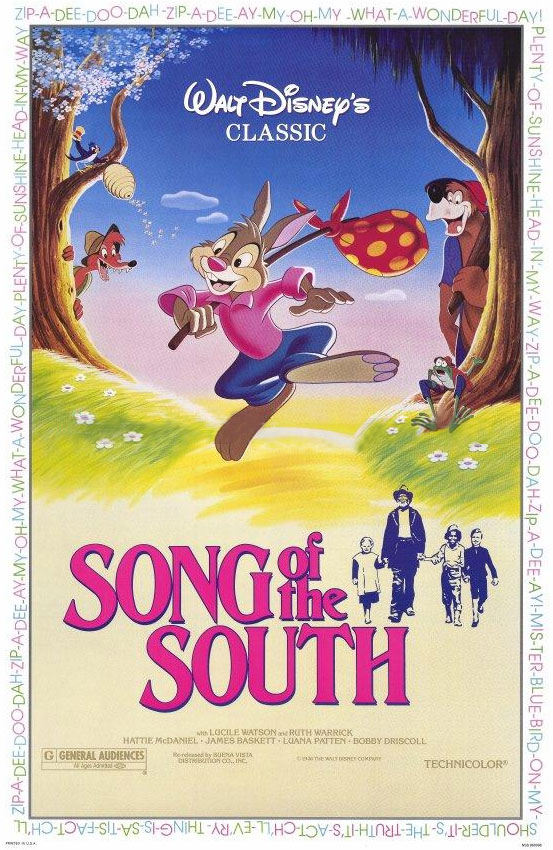
Song of the South was released in 1946 and was the first film Walt Disney attempted mixing animation with live-action. In the early 80's, they would allowed the particular song to be shown on the Disney Channel as a music video but not show the entire movie. I love seeing it, it was so beautiful but I wonder what it was.
Wikipedia: Walt Disney had long wanted to make a film based on the Uncle Remus storybook, but it wasn't until the mid-1940s that he had found a way to give the stories an adequate film equivalent, in scope and fidelity. "I always felt that Uncle Remus should be played by a living person," Disney is quoted as saying, "as should also the young boy to whom Harris' old Negro philosopher relates his vivid stories of the Briar Patch."
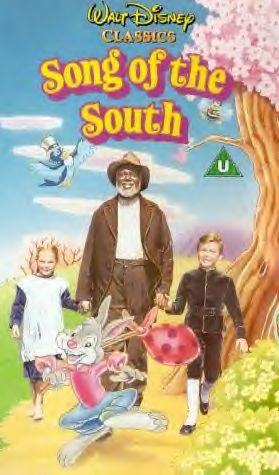 The latest release on VHS was in 1986. The above picture is of the UK 2000 VHS release. It omits the other young boy from the poster we can see on the above reissue poster from 86'. Disney has avoided releasing any more releases or even on DVD. To this day, when the corporation is asked why there aren't any new release plans, they still think it is a sensitive subject... again as mentioned in the past few posts about racist cartoons in this contemporary world. The Zip-A-Dee-Doo-Dah and Br'er Rabbit tricking Br'er Bear into the trap scenes are found in the 1950 special "One Hour in Wonderland" included on the 2004 two-disc release of Alice in Wonderland. The famous song even won an Oscar in 1947.
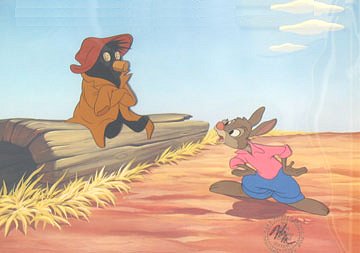 Also controversial was Tar Baby, which conveniently doesn't have a picture in Wikipedia. It was just tar and used to trap Br'er Rabbit and was changed to a honey pot for the Splash Mountain ride to avoid you know what.
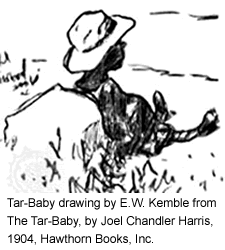 This drawing of him for a book based on the stories has him look more and more like a person. A "tar baby" in this case was metaphorical for any "sticky situation" that can only be aggravated by efforts to solve it. The term most commonly has negative connotation as a derogatory term and in some cases refers to little African-American girls.
 Tony Snow used the term ("I don't want to hug the tar baby of trying to comment on the program") in one of his first briefings as White House Press Secretary. Snow's use of the term which I guess is much like the firstly mentioned 'sticky situation' was much lampooned in the media.
 The movie was deliciously parodied in SNL as Uncle Jemima's malt liquor with Tracy Morgan. Where it was alluded to that he only saw the animated creatures because of the liquor y queestaba casado con la tal Aunt Jemima. Ay Dios. It was sorta dark tone to it which was more haunting on late night broadcast. Only when bright bright cartoons and live-action can be a good kind of creepy nostalgia. But even though they sorta avoid it exists, it doesn't stop them making money off it from the rollercoaster rides.
Ralph Bakshi's controversial animation
Ralph Bakshi is an animation director who has also done live-action (This Aint' Bebop, Babe, he calls me) has done controversial and somewhat stale for my taste/somewhat amazing animated films such as The Lord of the Rings (1978), Wizards (1977), CBS' Mighty Mouse: The New Adventures (1987), Cool World (1992) and the infamous Fritz the Cat (1972). In his movies he used retroscoping live-action to save costs.
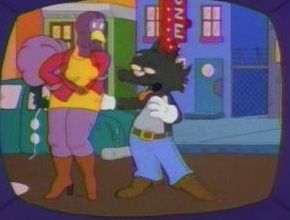 In fact, the Simpsons episode 'The Day the Violence Died' where an Itchy and Scratchy festival was held and Comic book guy showed a video Bart had never seen called "Itchy and Scratchy Meets Fritz the Cat" [I always thought the bird had a pilot cap, but it was her hair] was a parody on Bakshi's movie based on Fritz (the only animated movie evered granted an X rating) that went against the creator Robert Crumb's intention of the original comic book.
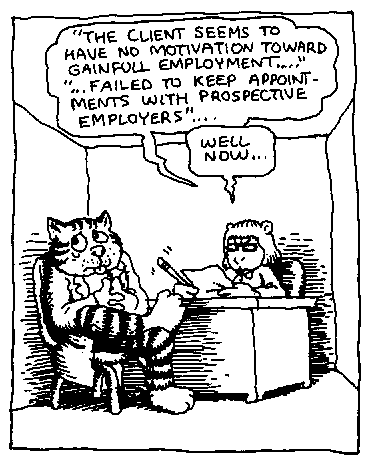 He ended up he killing off the character and never working on it again.
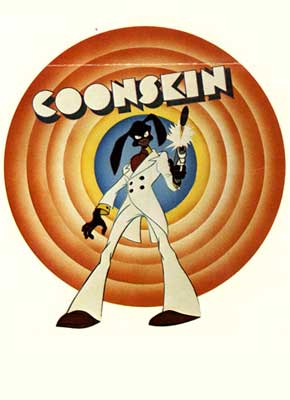 But the one I want to talk about is the rarely spoken about Coonskin, a film Al Sharpton fought against back in 1975. It was re-released on VHS under the title Street Fight, and on laserdisc under Bustin' Out. In Sweden it was under the title Rabbit: The Killer. It starred Barry White, Charles Gordone and Phillip Michael Thomas as inmates attempting to escape and a told a story about their cartoon counterparts.
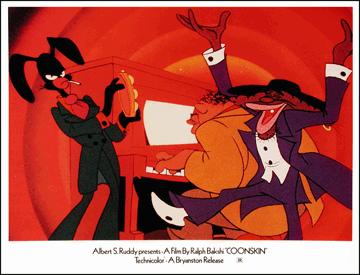 It has some elements of Uncle Remus stories by Joel Chandler Harris, which was also adapted by Walt Disney in Song of the South (which I will cover next). So this one had a rabbit, fox and bear like the other one. The film was given limited distribution, advertised as a blaxploitation film. The NAACP had written a letter describing the film as a difficult satire, but supported it. Information from Wikipedia. The DVD is now bootlegged but Bakshi Productions has recently announced it will on official DVD. I found it interesting because of the mix of animation and live-action but they weren't incoropated together.
The movie remained in obscurity for many years because of poor distribution, eventually developing a cult following through film festivals and home video. Even the Wu-Tang Clan, Spike Lee and Quentin Tarantino expressed interest in producing a sequel during the Cannes Film Festival . In 2003, the Online Film Critics Society ranked the film as the 97th greatest animated film of all time.
The Censored Eleven

As Looney Tunes Golden Collection Volume Four has been released and it has Porky uttering 'son of a bitch', a boat load of Speedy Gonzales shorts, racist stereotypes and the inclusion of a Wild E. and Sylvester teamup, there are shorts that are not awfully known that are referred to as the 'censored eleven.' United Artists that owned the distribution AAA library in 1968 banned Looney Tunes and Merrie Melodies cartoons from syndication and video that they deemed too offensive. And these are still haven't been seen by modern audiences.
Most cartoons are censored for inclusion of 'black face' or suicide (Remember Daffy wanting to one up Bugs in a theater and drank potion and became a ghost? Well that has been cut out in recent airings.) but these particular shorts aren't seen at all in any official way. One of them 'All This And Rabbit Stew' includes with Bugs Bunny and a Elmer-sque black caricature. I was able to find it on YouTube, it is like any Bugs cartoon from the 40's and one of the gags was reused for 'fat Elmer'.
The Censored Eleven:
1. Hittin' the Trail to Hallelujah Land (1931, directed by Rudolph Ising)
2. Sunday Go to Meetin' Time (1936, directed by Friz Freleng)
3. Clean Pastures (1937, directed by Freleng)
4. Uncle Tom's Bungalow (1937, directed by Tex Avery)
5. Jungle Jitters (1938, directed by Freleng)
6. The Isle of Pingo Pongo (1938, directed by Avery)
7. All This and Rabbit Stew (1941, directed by Avery)
8. Coal Black and de Sebben Dwarfs (1943, directed by Robert Clampett)
9. Tin Pan Alley Cats (1943, directed by Clampett)
10. Angel Puss (1944, directed by Chuck Jones)
11. Goldilocks and the Jivin' Bears (1944, directed by Freleng)
 One that is most interesting and most famous is Coal Black and de Sebben Dwarfs version of Snow White where "So White" and her friends are an example of racist dark iconography. Even with its racist controversial blaxploitation, some art historians consider it the best cartoon ever made. Some say it's Bob Clampett's ode to African-American Jazz musicians of the day, which composed and performed the music in the cartoon.
 So White was unique to the other characters because she wasn't the usual stereotype but was oversexualized like most females in cartoons in those days. Tiny Toons Adventures producer Tom Ruegger denied that African-American 'normal girl' character Mary Melody was a reference to So White in a 2003 interview. I still have my mixed feelings about such content but I am curious to see what all the fuss is about.

More of these themes are to be visited in other posts.
Most cartoons are censored for inclusion of 'black face' or suicide (Remember Daffy wanting to one up Bugs in a theater and drank potion and became a ghost? Well that has been cut out in recent airings.) but these particular shorts aren't seen at all in any official way. One of them 'All This And Rabbit Stew' includes with Bugs Bunny and a Elmer-sque black caricature. I was able to find it on YouTube, it is like any Bugs cartoon from the 40's and one of the gags was reused for 'fat Elmer'.
The Censored Eleven:
1. Hittin' the Trail to Hallelujah Land (1931, directed by Rudolph Ising)
2. Sunday Go to Meetin' Time (1936, directed by Friz Freleng)
3. Clean Pastures (1937, directed by Freleng)
4. Uncle Tom's Bungalow (1937, directed by Tex Avery)
5. Jungle Jitters (1938, directed by Freleng)
6. The Isle of Pingo Pongo (1938, directed by Avery)
7. All This and Rabbit Stew (1941, directed by Avery)
8. Coal Black and de Sebben Dwarfs (1943, directed by Robert Clampett)
9. Tin Pan Alley Cats (1943, directed by Clampett)
10. Angel Puss (1944, directed by Chuck Jones)
11. Goldilocks and the Jivin' Bears (1944, directed by Freleng)
 One that is most interesting and most famous is Coal Black and de Sebben Dwarfs version of Snow White where "So White" and her friends are an example of racist dark iconography. Even with its racist controversial blaxploitation, some art historians consider it the best cartoon ever made. Some say it's Bob Clampett's ode to African-American Jazz musicians of the day, which composed and performed the music in the cartoon.
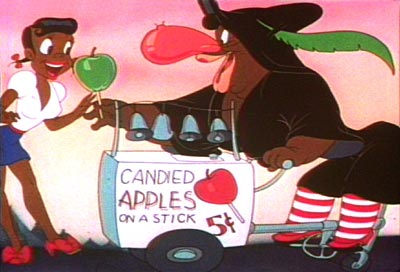 So White was unique to the other characters because she wasn't the usual stereotype but was oversexualized like most females in cartoons in those days. Tiny Toons Adventures producer Tom Ruegger denied that African-American 'normal girl' character Mary Melody was a reference to So White in a 2003 interview. I still have my mixed feelings about such content but I am curious to see what all the fuss is about.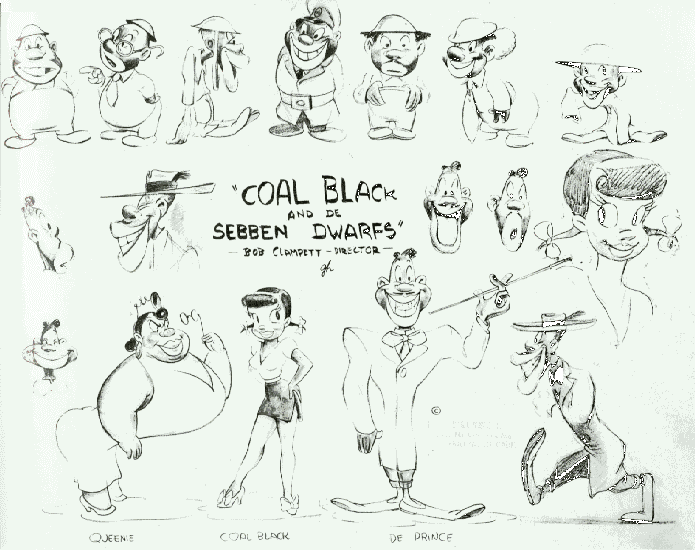
More of these themes are to be visited in other posts.
Subscribe to:
Posts (Atom)
