

Deep Reinforcement Learning (DRL) is one of the most exciting areas of Artificial Intelligence (AI) that combines the decision-making ability of Reinforcement Learning (RL) with the pattern recognition capabilities of Deep Learning.
- Enables intelligent systems to learn through interaction without requiring labeled training data.
- Solves complex sequential decision-making problems where each action influences future outcomes.
- Handles high-dimensional inputs such as images, videos and sensor data using deep neural networks.
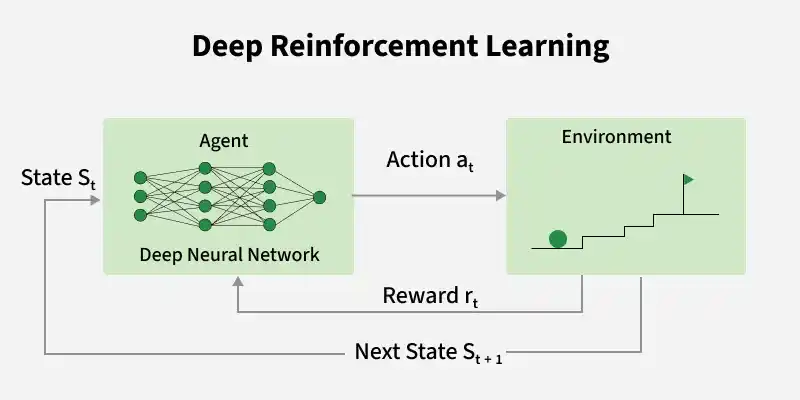
Components
Core Components of Deep Reinforcement Learning
1. Agent
- The agent is the learning entity or decision-maker that interacts with the environment to achieve a specific goal.
- It observes the current state, selects actions based on its policy, receives rewards as feedback and continuously updates its learning strategy to maximize long-term rewards.
Examples: Self-driving car, robotic arm, game-playing AI.
2. Environment
- The environment represents everything outside the agent with which it interacts.
- It receives the agent's actions, updates its state accordingly and provides the next state along with a reward signal, enabling the agent to learn from its decisions.
Examples: Road traffic, robotic simulation, video game, chess board.
3. State
- The state represents the current condition of the environment at a particular time and provides the information needed for decision-making.
- Unlike traditional Reinforcement Learning, Deep Reinforcement Learning can use high-dimensional states such as images, videos or sensor readings directly as input to a neural network.
Examples: Current game screen, robot position, vehicle speed and direction.
4. Action
- An action is the decision made by the agent that changes the environment's state.
- The set of possible actions depends on the problem being solved and can be either discrete or continuous.
Examples: Move left, accelerate, brake, pick up an object.
5. Reward
- A reward is the numerical feedback provided by the environment after the agent performs an action.
- Positive rewards encourage desirable behavior, while negative rewards penalize poor decisions, guiding the agent toward an optimal policy.
6. Policy
- A policy defines the strategy the agent follows to select an action for a given state.
- During training, the objective is to learn an optimal policy that maximizes the cumulative reward over time.
7. Value Function
- The value function estimates the expected cumulative reward that can be obtained from a particular state or state-action pair.
- It helps the agent evaluate how beneficial future decisions are likely to be.
8. Q-Value Function
- The Q-value function estimates the expected cumulative reward of taking a specific action in a given state and then following the learned policy.
- In Deep Reinforcement Learning, this function is typically approximated using a deep neural network instead of storing values in a lookup table.
Mathematical Formulation of Deep Reinforcement Learning
Deep Reinforcement Learning aims to learn a policy that maximizes the cumulative reward over time. The foundation of this learning process is the Bellman Equation, which expresses the value of a state as the immediate reward plus the discounted value of future states.
V(s)=\max_a\left[R(s,a)+\gamma V(s')\right]
Where:
- V(s) = Expected cumulative reward of the current state
- R(s,a) = Immediate reward received after taking action a
\gamma = Discount factor(0 \leq \gamma \leq 1) , which determines the importance of future rewards- V(s′) = Expected value of the next state
Working
The working of Deep Reinforcement Learning can be summarized in the following steps:
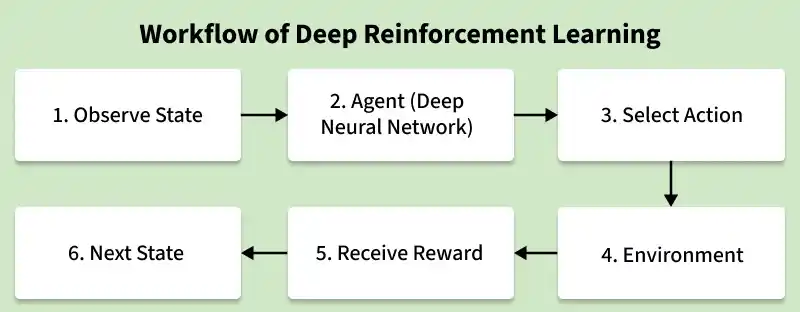
Step 1: Initialize the Environment
- Initialize the environment and place the agent in its initial state.
- Create a deep neural network with random parameters.
Step 2: Observe the Current State
- The agent observes the current state of the environment.
- The state may include numerical data, images, videos or sensor readings.
Step 3: Select an Action
- The agent selects an action using its current policy.
- During training, it balances exploration and exploitation.
Step 4: Execute the Action
- The selected action is applied to the environment.
- The environment transitions to a new state.
Step 5: Receive a Reward
- The environment returns a reward based on the action taken.
- The reward helps the agent learn better actions.
Step 6: Store the Experience
- Store the current state, action, reward and next state.
- Reuse these experiences to improve training stability.
Step 7: Update the Neural Network
- Train the neural network using the stored experiences.
- Update the network parameters to improve the policy.
Step 8: Repeat the Process
- Repeat the interaction over multiple episodes.
- Continue updating the policy until the agent maximizes long-term rewards.
Types of Deep Reinforcement Learning
Deep Reinforcement Learning algorithms can be broadly classified into four categories based on how the agent learns to make decisions. Each category follows a different learning approach and is suitable for different types of problems.
1. Value-Based Methods
Value-based methods learn the expected value (reward) of taking different actions in a given state. The agent selects the action with the highest estimated value and gradually improves these estimates through interaction with the environment. These methods are primarily used for problems with discrete action spaces.
Common Algorithms:
- Deep Q-Network (DQN)
- Double Deep Q-Network (Double DQN)
- Dueling Deep Q-Network (Dueling DQN)
- Rainbow DQN
Best Suited For:
- Atari games
- Board games
- Navigation problems with discrete actions
2. Policy-Based Methods
Policy-based methods learn the policy directly by determining the probability of selecting each action for a given state instead of estimating action values. Since they optimize the policy itself, they can naturally handle both discrete and continuous action spaces.
Common Algorithms:
- REINFORCE
- Policy Gradient
Best Suited For:
- Continuous control tasks
- Robotic manipulation
- Complex optimization problems
3. Actor-Critic Methods
Actor-Critic methods combine the strengths of value-based and policy-based learning. The Actor is responsible for selecting actions based on the current policy, while the Critic evaluates those actions by estimating their expected rewards. This combination generally provides faster convergence and more stable learning than using either approach alone.
Common Algorithms:
- Advantage Actor-Critic (A2C)
- Asynchronous Advantage Actor-Critic (A3C)
- Deep Deterministic Policy Gradient (DDPG)
- Twin Delayed Deep Deterministic Policy Gradient (TD3)
- Proximal Policy Optimization (PPO)
- Soft Actor-Critic (SAC)
Best Suited For:
- Continuous control tasks
- Robotics and autonomous systems
- Game playing and complex sequential decision-making
4. Model-Based Deep Reinforcement Learning
Model-based methods learn or utilize a model of the environment to predict future states and rewards before taking actions. Instead of relying solely on trial-and-error interactions, the agent can plan ahead, making these methods more sample-efficient.
Common Algorithms:
- MuZero
- Dreamer
- World Models
Best Suited For:
- Planning and decision-making tasks
- Autonomous driving and robotics
- Resource-constrained environments requiring high sample efficiency
Popular Libraries for Deep Reinforcement Learning
Several open-source libraries simplify the development, training and evaluation of Deep Reinforcement Learning models by providing ready-to-use algorithms, benchmark environments and training utilities. Some of the most widely used DRL libraries are:
- Stable-Baselines3: A PyTorch-based library that provides reliable implementations of popular DRL algorithms such as DQN, PPO, A2C, SAC and TD3.
- Ray RLlib: A scalable reinforcement learning library built on Ray that supports distributed training, multi-agent learning and large-scale DRL applications.
- Gymnasium: A standard toolkit for creating and evaluating reinforcement learning environments, widely used for benchmarking and training DRL agents.
- PettingZoo: A library that provides standardized environments for developing and evaluating multi-agent reinforcement learning algorithms.
- TorchRL: A PyTorch ecosystem library that offers reusable components, data pipelines and utilities for building reinforcement learning applications.
- TensorFlow Agents (TF-Agents): A TensorFlow-based library that provides modular implementations of reinforcement learning algorithms, environments and training workflows.
Applications
- Autonomous Vehicles: Enables vehicles to make real-time driving decisions such as lane keeping, obstacle avoidance and route planning.
- Robotics: Trains robots to perform navigation, object manipulation and industrial automation tasks through continuous interaction.
- Healthcare: Optimizes personalized treatment plans, drug dosing and medical resource allocation based on patient outcomes.
- Finance: Supports algorithmic trading, portfolio optimization and risk management by adapting to changing market conditions.
- Recommendation Systems: Learns user preferences over time to deliver personalized product, movie and content recommendations.
- Gaming: Develops intelligent game-playing agents capable of learning winning strategies without predefined rules.
Advantages
- Learns optimal decision-making without requiring labeled training data.
- Handles complex and high-dimensional data such as images and sensor inputs effectively.
- Adapts its strategy continuously as the environment changes.
- Optimizes long-term rewards instead of focusing only on immediate outcomes.
- Reduces the need for manually designed decision-making rules.
Limitations
- Requires extensive interaction with the environment, making training time-consuming.
- Demands high computational resources and specialized hardware for efficient learning.
- Designing an appropriate reward function is often difficult and problem-specific.
- Training stability depends heavily on careful hyperparameter tuning.
Reinforcement Learning vs. Deep Reinforcement Learning
| Feature | Reinforcement Learning (RL) | Deep Reinforcement Learning (DRL) |
|---|---|---|
| State Representation | Uses value tables (Q-tables) to represent states. | Uses deep neural networks to approximate value or policy functions. |
| State Space | Suitable for small and discrete state spaces. | Handles large, continuous and high-dimensional state spaces. |
| Input Data | Works mainly with structured numerical data. | Processes complex inputs such as images, videos and sensor data. |
| Scalability | Performance decreases as the state space grows. | Scales well to complex real-world environments. |
| Computational Requirement | Requires relatively low computational resources. | Requires higher computational power and GPU acceleration for training. |
| Typical Applications | Grid-world problems, simple games and control tasks. | Autonomous driving, robotics, gaming, healthcare and recommendation systems. |
