

Blood groups are an important feature of human blood and play a crucial role in blood transfusions, organ transplantation, and medical diagnosis. They are determined by the presence or absence of specific antigens on the surface of red blood cells, which are inherited from parents. The discovery of blood groups has greatly improved the safety and success of modern medical treatments.
ABO Blood Group System
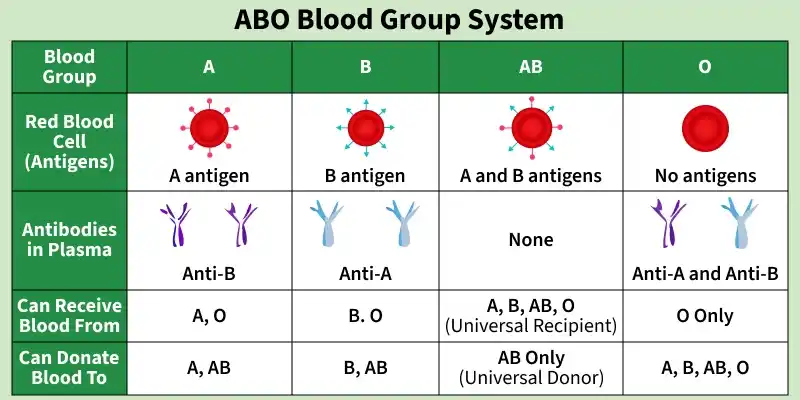
The ABO blood group system is the most important and widely recognised blood group classification system in humans. It is based on the presence or absence of two antigens, namely antigen A and antigen B, on the surface of red blood cells. According to this system, human blood is classified into four main blood groups:
Blood Group A
- Individuals with blood group A possess A antigens on the surface of their red blood cells and have anti-B antibodies in their blood plasma.
- If they receive blood containing B antigens, their immune system will recognise the B antigens as foreign and produce a reaction against them.
Blood Group B
- Individuals with blood group B possess B antigens on the surface of their red blood cells and have anti-A antibodies in their plasma.
- Therefore, they cannot safely receive blood from individuals having A antigens.
Blood Group AB
- Individuals with blood group AB possess both A and B antigens on the surface of their red blood cells and do not have anti-A or anti-B antibodies in their plasma.
- Because they lack these antibodies, they can receive blood from all ABO blood groups and are therefore known as universal recipients.
Blood Group O
- Individuals with blood group O do not possess either A or B antigens on their red blood cells, but they have both anti-A and anti-B antibodies in their plasma.
- Since their red blood cells lack A and B antigens, they can donate blood to all ABO blood groups and are therefore known as universal donors.
Rh Blood Group System
- In addition to the ABO blood group system, another important blood grouping system is the Rh factor system.
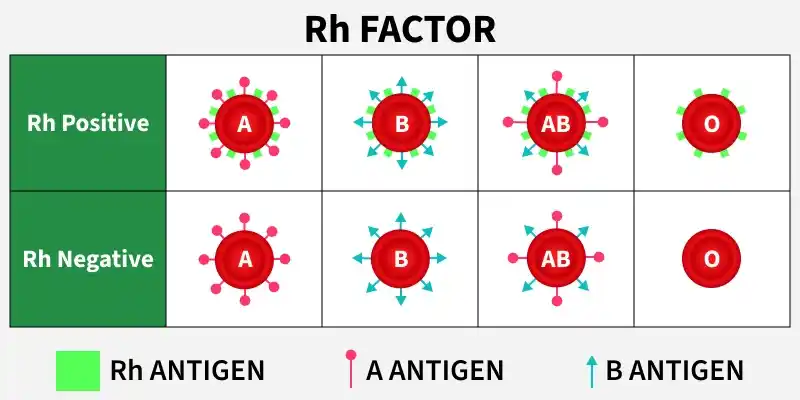
- The Rh system is based on the presence or absence of a specific antigen called the Rh antigen or D antigen on the surface of red blood cells.
- Individuals who possess the Rh antigen are classified as Rh-positive (Rh⁺), whereas individuals who lack the Rh antigen are classified as Rh-negative (Rh⁻).
- Thus, the ABO and Rh systems combine to form the commonly known blood groups A⁺, A⁻, B⁺, B⁻, AB⁺, AB⁻, O⁺, O⁻.
- Among these, O⁻ blood is considered the universal donor blood type because it lacks the A antigen, B antigen, and Rh antigen, making it suitable for emergency transfusions when the recipient's blood group is unknown.
- Similarly, AB⁺ individuals are considered universal recipients because they can receive blood from all ABO and Rh blood groups.
Genetics of Blood Groups
- Blood groups are inherited characteristics controlled by genes passed from parents to their offspring.
- The ABO blood group system is determined by a gene located on chromosome 9, which exists in three allelic forms: IA, IB, and i.
- The alleles IA and IB are codominant, meaning both are expressed when present together, while the allele i is recessive. The various combinations of these alleles produce different blood groups.
- The inheritance of blood groups follows Mendelian principles and is often used in genetic studies and paternity analysis.
Genotype | Blood Group |
|---|---|
IAIA or IAi | A |
IBIB or IBi | B |
IAIB | AB |
ii | O |
Importance of Blood Groups
- Blood groups help determine compatibility between donor and recipient blood, preventing harmful transfusion reactions.
- Matching blood groups avoids clumping and destruction of red blood cells that can occur when incompatible blood is transfused.
- Blood group compatibility reduces the risk of organ rejection and increases the success rate of transplants.
- Blood group and Rh factor testing help prevent complications such as Rh incompatibility between the mother and foetus.
- Knowing a patient's blood group allows doctors to provide compatible blood quickly during accidents, surgeries, and severe blood loss.
- Blood groups help blood banks store, classify, and distribute blood efficiently according to patient needs.
- Identification of rare blood groups is important for providing suitable blood during emergencies.
- Blood groups are inherited traits and are useful for studying patterns of inheritance and human genetics.
- Blood group analysis can assist in the identification of individuals and the investigation of criminal cases.
