
The V8 engine is a core component of Node.js that executes JavaScript code. It compiles JavaScript directly into machine code to improve performance and execution speed.
- Developed by Google and written in C++, designed to efficiently execute JavaScript code.
- Used in both Google Chrome and Node.js, enabling JavaScript to run in browsers and on the server side.
- Compiles JavaScript directly into machine code, which improves execution speed compared to traditional interpretation.
Role of the V8 Engine in Node.js
Node.js uses the Chrome V8 engine to execute JavaScript code. While Node.js provides the runtime environment and APIs, the actual execution of JavaScript is handled by the V8 engine.
- Node.js is built on the Chrome V8 engine, which executes JavaScript code.
- V8 converts JavaScript into machine code that the system’s processor can execute.
- Node.js provides the runtime environment and APIs for server-side development.
- This architecture enables high performance and scalable network applications.
Working of V8 Engine
The V8 engine works by following these basic steps:
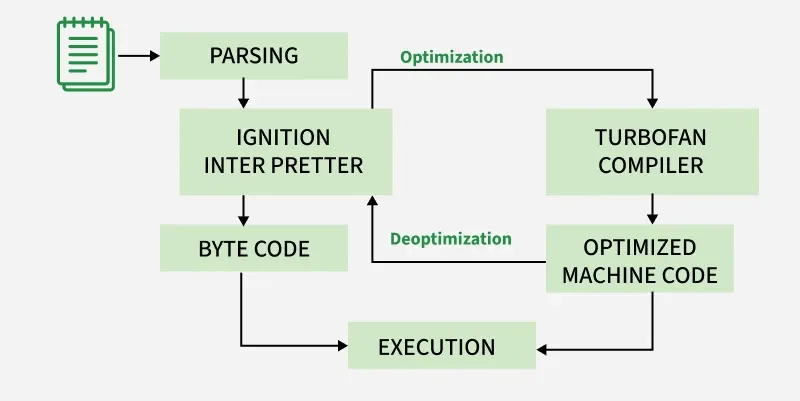
Step 1. Parsing
- The JavaScript code is initially read by the V8 engine.
- It undergoes parsing, where the code is broken down into smaller units (tokens) such as keywords, variables, and operators.
Step 2. Ignition Interpreter
- After parsing, the engine uses the Ignition Interpreter to convert the tokens into ByteCode.
- ByteCode is an intermediate, low-level representation of the code. This allows for quick execution without waiting for full compilation.
Step 3: Optimization
- While executing JavaScript, the Ignition interpreter runs the code initially.
- The Turbofan compiler analyzes the code to detect frequently executed sections such as loops and functions.
- These frequently used parts are optimized into machine code for faster execution.
Step 4: Turbofan Compiler
- The Turbofan compiler identifies frequently executed code during program execution.
- It compiles these code sections into optimized machine code.
- This hardware-specific machine code runs faster than bytecode, improving overall performance.
Step 5: Execution
- The machine code generated by the Turbofan compiler is executed by the system’s processor.
- This execution allows the JavaScript program to run and produce the desired output.
Step 6: Deoptimization
- If runtime changes occur (e.g., variable types change), the optimized machine code may become invalid.
- V8 deoptimizes the affected code and sends it back to the Ignition interpreter for recompilation.
- This deoptimization process ensures correctness and efficiency as the code changes during execution.
This cycle continues, with V8 optimizing, executing, and occasionally deoptimizing the code to ensure high performance during runtime.
Importance of V8 Engine
The V8 engine enables fast and efficient execution of JavaScript in Node.js by compiling code directly into machine code.
- Compiles JavaScript into machine code at runtime using Just-In-Time (JIT) compilation for faster execution.
- Optimizes frequently executed code to improve performance.
- Automatically manages memory through garbage collection, reducing memory leaks.
- Supports modern JavaScript (ES6+) features such as classes, promises, template literals, and async functions.
- Works with Node.js's non-blocking architecture to handle multiple operations efficiently.
- Enables high-performance execution for applications handling large numbers of requests.
V8 Optimization Techniques
V8 uses a variety of optimization techniques to improve the performance of JavaScript execution in Node.js:
- JIT Compilation: V8 compiles JavaScript into machine code at runtime to improve execution speed.
- In-place Updates: Updates memory objects directly, reducing memory allocation overhead.
- Inline Caching: Optimizes property lookups by caching frequently accessed object properties.
