

Node.js is a runtime that enables JavaScript to run on the server side using an event-driven, non-blocking architecture.
- Designed for building fast and scalable web applications.
- Efficiently handles multiple requests using asynchronous processing.
- Suitable for real-time applications like chat apps and APIs.
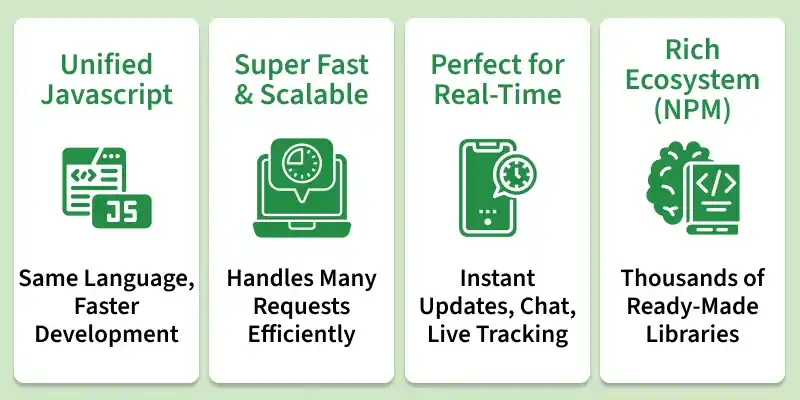
Need of Node.js
Node.js has become essential in modern web development because it addresses the demands of speed, scalability, and real-time interaction in today’s applications.
- Handles Real-Time Applications: Modern apps like chat systems, live tracking, and streaming need instant data updates. Node.js supports real-time communication efficiently using event-driven architecture.
- Single Language (JavaScript): Developers can use JavaScript for both frontend and backend, simplifying development and improving productivity.
- Efficient Data Handling: Its non-blocking, asynchronous nature allows it to process multiple requests simultaneously without slowing down.
- Strong Ecosystem: With tools like npm, developers get access to thousands of libraries, speeding up development.
Features
It is known for performance, scalability, and an extensive ecosystem. Below are some key features:
- Executes operations asynchronously without blocking the main thread, allowing multiple requests to be handled efficiently.
- Uses an event-driven architecture with an event loop to manage concurrent connections effectively.
- Built on Google's V8 JavaScript engine, providing fast execution and high performance.
Use Cases
Here are some use cases of Node.js:
- Real-Time Applications: Ideal for chat platforms, gaming, and collaborative tools that require instant data updates.
- API Development: Efficiently handles multiple simultaneous requests, making it suitable for building RESTful APIs.
- Streaming Applications (Netflix): Node.js processes large data streams without buffering, perfect for video and audio streaming.
- Command-line Tools: Node.js allows building powerful CLI tools using npm libraries and cross-platform support.
Node.js Vs Other Backend Technologies
Each has its strengths and weaknesses, making them suitable for different projects.
| Node.js | Spring Boot | Django |
|---|---|---|
| JavaScript runtime | Java-based backend framework | Python-based web framework |
| Dynamically typed | Statically typed | Dynamically typed |
| Single-threaded, event-driven, non-blocking I/O | Multi-threaded, primarily blocking I/O (supports reactive programming) | Primarily synchronous (supports async features in newer versions) |
| High performance for I/O-bound tasks | Strong performance for enterprise and large-scale applications | Good performance for web applications; slower for CPU-intensive tasks |
| Highly suitable for real-time and scalable network apps | Highly scalable for enterprise-grade and microservice architectures | Scalable for web applications with proper deployment and caching |
| Commonly used for APIs, real-time apps, microservices | Enterprise applications, REST APIs, microservices | Web applications, REST APIs, content management systems |
Advantages of Using Node.js
- High Performance: Uses a non-blocking I/O model and V8 engine for fast execution, ideal for real-time and large-scale applications.
- Scalable: Event-driven architecture handles many concurrent connections efficiently.
- Cross-Platform: Runs on Windows, macOS, and Linux.
- Active Community: Strong community support with a large ecosystem of open-source libraries and tool.
Industry Usage of Node.js
Node.js is popular for its scalability, speed, and real-time capabilities across multiple industries:
- Used by fast-growing startups for rapid development and real-time applications (e.g., Uber, Netflix, Trello).
- Powers finance platforms with secure, high-performance transaction processing (e.g., PayPal, Intuit).
- Handles high-traffic e-commerce websites and real-time updates (e.g., Walmart, eBay).
- Supports media and entertainment platforms with smooth streaming and live interactions (e.g., Spotify, BBC).
