


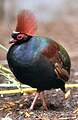
Torquéole de Java
Systématique
- OrdreGalliformes
- FamillePhasianidés
- GenreArborophila
- Espèce javanica
Statut de conservation
LCPréoccupation mineureDistribution

Description de la famille
La famille des Phasianidés, qui inclut les oiseaux qu'on a l'habitude d'appeler les gallinacés, est la principale famille de l'ordre des Galliformes. Les mots gallinacés et galliformes sont tirés du latin « gallus » qui est taxonomiquement un nom de genre, Gallus, celui des coqs, dont notre coq... lire la suite
Noms étrangers
- Chestnut-bellied Partridge,
- Arborófila de Java,
- perdiz-javanesa,
- Javabuschwachtel,
- jávai erdeifogoly,
- Javaanse Bospatrijs,
- Pernice panciacastana,
- javasånghöna,
- Javahøne,
- kurička hnedobruchá,
- koroptev jávská,
- Javaskovhøne,
- jaavanpyy,
- perdiu forestal de Java,
- pstropiór jawajski,
- Яванская лесная куропатка,
- Puyuh-gonggong jawa,
- ジャワミヤマテッケイ,
- 棕腹山鹧鸪,
- 栗腹山鷓鴣,
Nomenclature
La première description de ce taxon est due à Gmelin, JF en 1789. Sur Oiseaux.net, le nom français retenu pour cette espèce est « Torquéole de Java ».
La nomenclature française s'appuie sur la liste CINFO (rév. 2013).
Genre grammatical du nom français : féminin.
Sous-espèces (2) :
Identification

sp. Arborophila javanica
Confusion possible
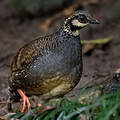
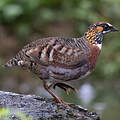
Distribution
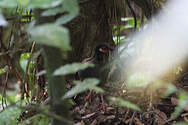
sp. Arborophila javanica
Données complémentaires
| Migration | non migrateur | sédentaire | Bird et al. 2020, Tobias et al. 2021 |
|---|---|---|
| Domaine biogéographique | Indo_Malay | Pigot et al. 2020 |
| Aire | 36961.99 km² | Bird et al. 2020, Tobias et al. 2021 |
| Latitudes de reproduction | -8,3 à -6,5 ° | Tobias et al. 2021 |
| Aire restreinte | Y | Birdlife's Worldbird Database |
Voix chant et cris
- 0:24Gunung Halimun National Park, Java (Indonésie)Brian CoxCC BY-NC-ND
- 0:14Gunung Gede National Park, Java (Indonésie)Mike NelsonCC BY-NC-SA
- 0:22Kecamatan Bumiaji, Kota Batu, Jawa Timur (Indonésie)Waskito WibowoCC BY-NC-SA
- 0:16Gunung Halimun National Park, Java (Indonésie)Frank LambertCC BY-NC-ND
- 1:13Gunung Gede National Park, Java (Indonésie)Teus LuijendijkCC BY-NC-ND
- 0:27Gunung Gede National Park, Java (Indonésie)David EdwardsCC BY-NC-ND
- 0:18Promasan, Kendal, Jawa Tengah (Indonésie)Karyadi BaskoroCC BY-NC-SA
- 0:46Ranu Tompe Bromo Tengger Semeru National Park_East Java (Indonésie)Heru CahyonoCC BY-NC-SA
- 0:39Gede Pangrango National Park, West Java Province, Java (Indonésie)Paulo AlvesCC BY-NC-SA
Tous les sons (20)
- 0:30Gunung Halimun National Park, Java (Indonésie)Brian CoxCC BY-NC-ND
- 0:37Gunung Gede National Park, Java (Indonésie)David EdwardsCC BY-NC-ND
- 0:21Java; probably Cibodas (Indonésie)Frank LambertCC BY-NC-ND
- 0:25Gunung Halimun National Park, Java (Indonésie)Frank LambertCC BY-NC-ND
- 1:29Gunung Halimun National Park, Java (Indonésie)Frank LambertCC BY-NC-ND
- 0:23Bendolawang, Bromo-Tengger-Semeru National Park (Indonésie)Heru CahyonoCC BY-NC-SA
- 1:28Gunung Gede National Park, Java (Indonésie)Mike NelsonCC BY-NC-SA
- 0:21Gunung Gede National Park, Java (Indonésie)Mike NelsonCC BY-NC-SA
- 1:40Gede Pangrango National Park, West Java Province, Java (Indonésie)Frank LambertCC BY-NC-ND
- 1:06Gunung Gede National Park, Java (Indonésie)Teus LuijendijkCC BY-NC-ND
- 0:25Gunug Gede National Park, java (Indonésie)Mike NelsonCC BY-NC-SA
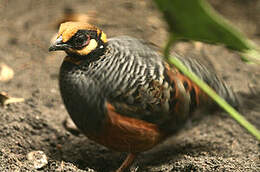
sp. Arborophila javanica
Vol - déplacement
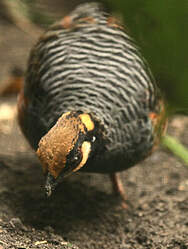
sp. Arborophila javanica
Capacité de vol : HWI = 25,4 (vol moyen, dispersion locale)
Habitat
Données complémentaires
| Habitat | montane forests and open patches ; mountains | forêt | Bird et al. 2020, Tobias et al. 2021, http://www.noord.bart.nl/~edcolijn/bird.html |
|---|---|---|
| Densité | Dense habitats | Tobias et al. 2021 |
| Mode de vie | diurne | terrestre | Bird et al. 2020 |
| Altitude | 300 à 3000 m |
Alimentation - mode et régime
Données complémentaires
| Niveau trophique | herbivore | Pigot et al. 2020, Tobias et al. 2021 |
|---|---|---|
| Niche trophique | omnivore | Pigot et al. 2020, Tobias et al. 2021 |
| Alimentation | omnivore | Bird et al. 2020 |
Reproduction nidification
Données complémentaires
| âge première reproduction | 1,8 ans | Bird et al. 2020 |
|---|---|---|
| Ponte | 4 oeufs | Bird et al. 2020, Myhrvold et al. 2015 |
Menaces - protection
Statut de conservation IUCN
mineure
à l'état sauvage
menacé
évalué

Phylogénie
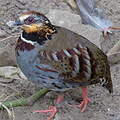
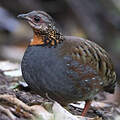
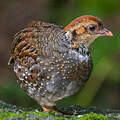
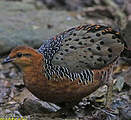
Voici les 6 plus proches parents évolutifs de Arborophila javanica, d'après l'arbre phylogénétique BirdTree (Jetz et al. 2012). L'âge indiqué (en millions d'années, Ma) correspond à l'époque où les deux lignées se sont séparées d'un ancêtre commun.
Sources des données
- Bird et al. 2020
- Birdlife's Worldbird Database
- IOC 12.1
- Myhrvold et al. 2015
- Pigot et al. 2020
- S. M. Billerman, B. K. Keeney, P. G. Rodewald, & T. S. Schulenberg (Eds.). (2022). Birds of the World. Cornell Laboratory of Ornithology. https://birdsoftheworld.org/bow/home
- Tobias et al. 2021
- http://www.noord.bart.nl/~edcolijn/bird.html
Autres références utiles
- Birdlife
- IUCN Red List — IUCN Red List of Threatened species, IUCN
- GBIF — GBIF - Global Biodiversity Information Facility, GBIF Secretariat
- Wikidata — Wikidata, la base de connaissances libre, Wikimedia Foundation
- Encyclopedia of Life — Encyclopedia of life, Encyclopedia of Life
- NCBI Taxonomy — NCBI Taxonomy Database, National Center for Biotechnology Information
- eBird — eBird, Cornell Lab of Ornithology et National Audubon Society
- Birds of the World — Birds of the World, The Cornell Lab of Ornithology
- Xeno-Canto
© 1996-2026 Oiseaux.net
