Log In


Minerva No. 1 Mine, Ozark-Mahoning group, Cave-In-Rock Mining Sub-District, Hardin County, Illinois, USAi
| Regional Level Types | |
|---|---|
| Minerva No. 1 Mine | Mine (Abandoned) |
| Ozark-Mahoning group | Group of Mines |
| Cave-In-Rock Mining Sub-District | Mining Sub-district |
| Hardin County | County |
| Illinois | State |
| USA | Country |
Minerva No. 1 Mine, Ozark-Mahoning group, Cave-In-Rock Mining Sub-District, Cave-in-Rock Mining Sub-District, Hardin County, Illinois, USA
Minerva No. 1 Mine, Ozark-Mahoning group, Cave-In-Rock Mining Sub-District, Illinois-Kentucky Fluorspar District, USA
Sponsorship for this page has expired!



Latitude & Longitude (WGS84):
37° 32' 35'' North , 88° 9' 22'' West
Latitude & Longitude (decimal):
Type:
Mine (Abandoned) - last checked 2022
Deposit first discovered:
1940
Köppen climate type:
Nearest Settlements:
| Place | Population | Distance |
|---|---|---|
| Cave-in-Rock | 318 (2011) | 8.3km |
| Sturgis | 1,912 (2017) | 15.2km |
| Elizabethtown | 287 (2017) | 17.0km |
| Old Shawneetown | 178 (2017) | 17.2km |
| Shawneetown | 1,164 (2017) | 19.1km |
Other/historical names associated with this locality:
Ozark-Mahoning No. 1 Mine
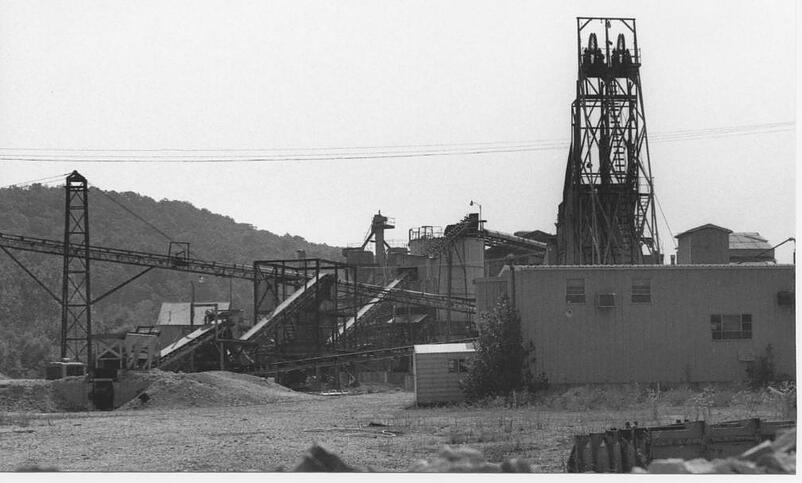
The Minerva No. 1 Mine was a former zinc and fluorspar mine located north of Cave-in-Rock, Illinois. The mine was classified as a bedding replacement type mine (also known as a “manto”), that exploited the Cave-in-Rock orebody. The orebody, according to Alan Goldstein (1997) was approximately 20,000 feet long. It was also the largest bedding replacement orebody in the United States (Goldstein, 1997).
The Minerva Oil Company discovered the Minerva No. 1 orebody in 1940 (Goldstein, 1997), though exploration work officially began in 1939 (Weller et al. 1952). In 1942, a 645 foot shaft was sunk, named the “Ledbetter Shaft” and was finally completed in September 1943 (Weller et al., 1952). In 1949, the Minerva Oil Company decided to sink a second shaft, approximately 580 foot in depth, in 1949 to serve as a service and a possible escape route. The Minerva No. 1 Mine was the deepest operational mine in the Illinois-Kentucky Fluorspar District.
According to Alan Goldstein (1997), the southeast orebody was shallow and predominantly held sphalerite. At greater depths, fluorite became dominant. As mining progresses, inclined shafts needed to be built to access the Rosiclare and Sub-Rosiclare Levels where the fluorite was being mined. During times when the price of fluorspar was low, production resumed at the upper levels for zinc (Goldstein, 1997). The major orebody was also slightly tilted to the northeast, most likely because of its approximate location close to Hick’s Dome.
In February 1944, a differential flotation mill was constructed on site to handle ore. The mill produced hydrofluoric acid-grade concentrates, but also ceramic fluorspar concentrates as well. Concentrates from sphalerite revealed that it contained a very small percentage of cadmium as well, from .8 to 1 percent (Weller et al. 1952). Operation began later on the northeast portion of the orebody that same year.
In 1975, the Allied Chemical Corporation purchased the mine, but chose to shut down the operation in 1976. After a few years of being idle, the Inverness Mining Company in 1982 (itself a subsidiary of Seaforth Minerals and Ore Company)(Evans and Hellier, 1986, Goldstein, 1997), operated the Minerva No. 1 Mine until at least 1986 when it was sold to Ozark-Mahoning Mining Company in 1988 (Pennwalt Corporation purchased Ozark-Mahoning in 1974 and it remained a subsidiary of that company [Evans and Hellier, 1986]).
After Ozark-Mahoning purchased the mine, it needed to be dewatered, before operation could resume there. According to Eric Livingston, (personal communication to Alan Goldstein) an estimated 1 billion gallons of water needed to be removed before Ozark-Mahoning could resume mining. Mining resumed at the Minerva No. 1 Mine in 1989, which also received a name change to Ozark-Mahoning No. 1. Specimens recovered before Ozark-Mahoning resumed operation are labeled are typically labeled as “Minerva No. 1”, while specimens recovered during Ozark-Mahoning’s tenure of the mine are typically labeled as “Mahoning No. 1 or Ozark-Mahoning No. 1”. Under Ozark-Mahoning’s tenure of the property, several of the mine's best specimens were extracted during this time. The majority of these fluorite specimens came from the productive Rosiclare and Sub-Rosiclare Levels.
One of the most surprising finds for the Ozark-Mahoning Company included the Cross-Cut Ore Body. According to Ross Lillie (2010), the ore body was not on the plan map and no reserves were accounted for in this section of the mine. The ore was accidentally found by following a small exposure in an old drift that was left by previous mining. Instead of the ore thinning and typically running out, it persisted into uncharted territory neither mapped, nor drilled. It ultimately proved to be of enormous benefit to Ozark-Mahoning and lasted three to four years. The name ‘Cross-Cut’ was used since the mineralized zone transected at near right angles to the main Minerva trend.
The hallmark of this ore body was abundant hydrocarbons in the mineralized section that influenced everything from the formation of minerals to the milling process. In some localized sections, the hydrocarbons were so abundant it upset the effective recovery of fluorspar in the flotation mill.
Fluorite crystals were commonly formed in brown or pale yellow groups with highly distorted and etched morphology. However, in some cases there was a late-stage overgrowth of transparent, strikingly zoned fluorite on the early etched phase. The contrast of the glassy overgrowth with the distorted matrix formed exquisite specimens.
The best of these were found in one isolated pocket in September 1990 in a pocket coined ‘The Blue Cap Pocket’. Some two flats of specimens were recovered once and only of this color and combination. The minerals in the cross-cut ore body were mined from 1990-1994.
By 1995, Ozark-Mahoning realized that it was difficult to justify keeping the mine open when cheaper fluorite was available from China. During this time, “pillar robbing” of the Minerva No. 1 occurred between 1995 and 1996 and a small amount of specimens were once again available. On the last day of January 1996, Ozark-Mahoning finally decided to shut down the Minerva No. 1 Mine (Smith, 1996). Shortly thereafter the shaft and mill plant were both demolished.
Today the Minerva No. 1 Mine holds an important legacy for the Cave-in-Rock District and the Illinois-Kentucky Fluorspar District as a whole. Besides fluorite, the orebody produced excellent witherite, alstonite, benstonite, strontianite and baryte (Goldstein, 1997).
Note: The property where the former Minerva mine is currently patrolled by the Hardin County Sheriff. Collecting on the former tailings is highly inadvisable at this time [Chris Clemens, Pers. Communication, 2022].
Select Mineral List Type
Standard Detailed Gallery Strunz Chemical ElementsCommodity List
This is a list of exploitable or exploited mineral commodities recorded at this locality.Mineral List
21 valid minerals. 1 (TL) - type locality of valid minerals.
Detailed Mineral List:
| ⓘ Alstonite Formula: BaCa(CO3)2 Habit: sharpely terminated pseudo-hexagonal pyramids up to 2 mm in length Colour: colorless to grey, transparent Description: Lining cavities in veins of waxy benstonite, finegrained calcite and witherite crystals. References: |
| ⓘ Anglesite Formula: PbSO4 |
| ⓘ Azurite Formula: Cu3(CO3)2(OH)2 |
| ⓘ Baryte Formula: BaSO4 |
| ⓘ Barytocalcite Formula: BaCa(CO3)2 References: |
| ✪ Benstonite Formula: Ba6Ca6Mg(CO3)13 |
| ⓘ Calcite Formula: CaCO3 References: Kevin Conroy CollectionIdentified by Kevin Conroy: Dealer/Collection Label |
| ⓘ Calcite var. Strontium-rich Calcite Formula: (Ca,Sr)CO3 References: Kevin Conroy CollectionIdentified by Kevin Conroy: Dealer/Collection Label |
| ⓘ Celestine Formula: SrSO4 |
| ⓘ Chalcopyrite Formula: CuFeS2 |
| ⓘ Dolomite Formula: CaMg(CO3)2 |
| ✪ Fluorite Formula: CaF2 |
| ⓘ Galena Formula: PbS References: |
| ⓘ Gypsum Formula: CaSO4 · 2H2O |
| ⓘ Hemimorphite Formula: Zn4Si2O7(OH)2 · H2O |
| ⓘ Malachite Formula: Cu2(CO3)(OH)2 |
| ⓘ Paralstonite (TL) Formula: BaCa(CO3)2 Type Locality: |
| ⓘ 'Petroleum' Description: Crude oil in cavities |
| ⓘ 'Petroleum var. Bitumen' Description: Crude oil in cavities |
| ⓘ Pyrite Formula: FeS2 References: John Sobolewski collectionIdentified by John Sobolewski: Visual Identification, Wet Chemical |
| ⓘ Quartz Formula: SiO2 |
| ⓘ Sphalerite Formula: ZnS |
| ✪ Strontianite Formula: SrCO3 |
| ⓘ 'Wad' |
| ✪ Witherite Formula: BaCO3 Habit: Complex tapered prismatic Colour: White, off-white. Fluorescence: Bright creamy-white (LW & SW UV) Description: World class specimens, including single crystals to 4 inches (10 cm) long. References: |
Gallery:

List of minerals arranged by Strunz 10th Edition classification
| Group 2 - Sulphides and Sulfosalts | |||
|---|---|---|---|
| ⓘ | Sphalerite | 2.CB.05a | ZnS |
| ⓘ | Chalcopyrite | 2.CB.10a | CuFeS2 |
| ⓘ | Galena | 2.CD.10 | PbS |
| ⓘ | Pyrite | 2.EB.05a | FeS2 |
| Group 3 - Halides | |||
| ⓘ | Fluorite | 3.AB.25 | CaF2 |
| Group 4 - Oxides and Hydroxides | |||
| ⓘ | Quartz | 4.DA.05 | SiO2 |
| Group 5 - Nitrates and Carbonates | |||
| ⓘ | Calcite | 5.AB.05 | CaCO3 |
| ⓘ | var. Strontium-rich Calcite | 5.AB.05 | (Ca,Sr)CO3 |
| ⓘ | Dolomite | 5.AB.10 | CaMg(CO3)2 |
| ⓘ | Strontianite | 5.AB.15 | SrCO3 |
| ⓘ | Witherite | 5.AB.15 | BaCO3 |
| ⓘ | Alstonite | 5.AB.35 | BaCa(CO3)2 |
| ⓘ | Paralstonite (TL) | 5.AB.40 | BaCa(CO3)2 |
| ⓘ | Barytocalcite | 5.AB.45 | BaCa(CO3)2 |
| ⓘ | Benstonite | 5.AB.55 | Ba6Ca6Mg(CO3)13 |
| ⓘ | Azurite | 5.BA.05 | Cu3(CO3)2(OH)2 |
| ⓘ | Malachite | 5.BA.10 | Cu2(CO3)(OH)2 |
| Group 7 - Sulphates, Chromates, Molybdates and Tungstates | |||
| ⓘ | Anglesite | 7.AD.35 | PbSO4 |
| ⓘ | Baryte | 7.AD.35 | BaSO4 |
| ⓘ | Celestine | 7.AD.35 | SrSO4 |
| ⓘ | Gypsum | 7.CD.40 | CaSO4 · 2H2O |
| Group 9 - Silicates | |||
| ⓘ | Hemimorphite | 9.BD.10 | Zn4Si2O7(OH)2 · H2O |
| Unclassified | |||
| ⓘ | 'Wad' | - | |
| ⓘ | 'Petroleum var. Bitumen' | - | |
| ⓘ | '' | - | |
List of minerals for each chemical element
Other Regions, Features and Areas containing this locality
North AmericaContinent
North America PlateTectonic Plate
- Granite-Rhyolite ProvinceMagmatic Province
- Illinois BasinBasin
- Shawnee DomainDomain
USA
- Illinois-Kentucky Fluorspar DistrictMining District
- Illinois
- Hardin County
- Cave-in-Rock Mining Sub-DistrictMining Sub-district
- Hardin County
- Rough Creek GrabenBasin
This page contains all mineral locality references listed on mindat.org. This does not claim to be a complete list. If you know of more minerals from this site, please register so you can add to our database. This locality information is for reference purposes only. You should never attempt to
visit any sites listed in mindat.org without first ensuring that you have the permission of the land and/or mineral rights holders
for access and that you are aware of all safety precautions necessary.
References
Weller, J. Marvin, Grogan, Robert M., Tippie, Frank E. (1952) Geology of the Fluorspar Deposits of Illinois. Bulletin 76. Illinois State Geological Survey
Brecke, E. A. (1962) Ore genesis of the Cave-In-Rock Fluorspar District, Hardin County, Illinois. Economic Geology, 57 (4) 499-535 doi:10.2113/gsecongeo.57.4.499
Lillie, Ross C. (1988) Minerals of the: Harris Creek Fluorspar District, Hardin County, Illinois. Rocks & Minerals, 63 (3). 210-226 doi:10.1080/00357529.1988.11761839

Minerva No. 1 Mine, Ozark-Mahoning group, Cave-In-Rock Mining Sub-District, Hardin County, Illinois, USA