
Fanwood Quarry (Weldon Quarry), Watchung, Somerset County, New Jersey, USAi
| Regional Level Types | |
|---|---|
| Fanwood Quarry (Weldon Quarry) | Quarry |
| Watchung | Borough |
| Somerset County | County |
| New Jersey | State |
| USA | Country |
This page is currently not sponsored. Click here to sponsor this page.



Latitude & Longitude (WGS84):
40° 39' 38'' North , 74° 24' 24'' West
Latitude & Longitude (decimal):
Type:
Köppen climate type:
Nearest Settlements:
| Place | Population | Distance |
|---|---|---|
| Scotch Plains | 23,584 (2017) | 1.5km |
| Fanwood | 7,651 (2017) | 3.0km |
| Plainfield | 51,217 (2017) | 3.0km |
| North Plainfield | 22,140 (2017) | 3.8km |
| Berkeley Heights | 14,179 (2017) | 3.9km |
Nearest Clubs:
Local clubs are the best way to get access to collecting localities
Local clubs are the best way to get access to collecting localities
| Club | Location | Distance |
|---|---|---|
| New Jersey Mineralogical Society, Inc | Mountainside, New Jersey | 4km |
| Morris Museum Mineralogical Society | Morristown, New Jersey | 16km |
| North Jersey Mineralogical Society, Inc. | Paterson, New Jersey | 35km |
| New York Mineralogical Club | New York, New York | 37km |
| New York Paleontological Society | NYC, New York | 47km |
Other/historical names associated with this locality:
Fanwood Mine; Fanwood Stone Crushing and Quarry Co. Quarry; Fanwood Crushed Stone Co. Quarry; Scotch Plains Quarry
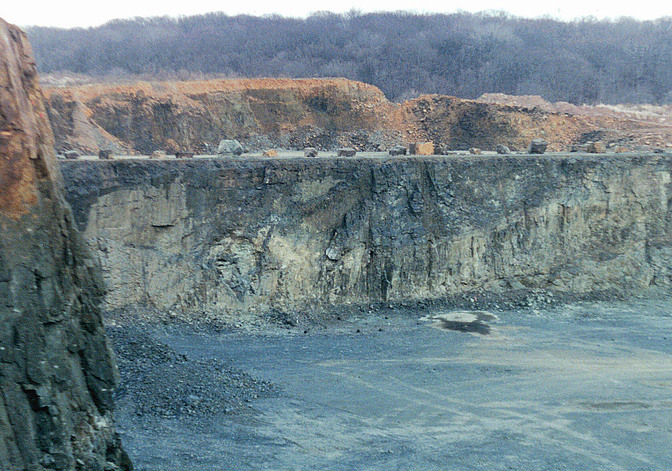
A large quarry in the Orange Mountain (First Watchung) basalt, which has been owned and operated by the Weldon family since the 1890's. Owned by the Fanwood Crushed Stone Company (1981). MRDS database stated accuracy for this location is 1,000 meters.
Mineralization principally occurs in cavities within three amygdaloidal horizons, in fractures, in breccia pockets of the scoria, and in isolated cavities, sometimes large, in the interior of the flows. These latter structures are probably related to cooling of the lava. Locally, structures have been observed in mostly weathered outcrops of the scoriaceous basalt just below the basal part of the third flow unit, that may be pillows or, more likely, pah hoe hoe toes.
The Orange Mountain Basalt is a dark-greenish-gray to greenish-black basalt composed mostly of calcic plagioclase (typically An65) and clinopyroxene (augite and pigeonite); crystals are generally less than 1 mm (0.04 inch) long. Consists of three major flows. The flows are separated in places by a weathered zone or by a thin, up to 3-meters (10-feet) thick bed of red siltstone (not shown on map) or volcaniclastic rock. Lowest flow is generally massive and has widely spaced curvilinear joints; columnar joints in lowest flow become more common toward the northeast. Middle flow is massive or has columnar jointing. Lower part of the uppermost flow has pillow structures; upper part has pahoehoe flow structures. Tops and bottoms of flow layers are vesicular. Maximum thickness is about 182 meters (597 feet).
On first observation the abundant mineralization in this quarry is very apparent and the immediate impression is that it exudes potential. In fact, good specimens are much harder to find here than in they were in the equivalent horizon in the nearby Summit Quarry. So many of the amygdules are partially filled with a scoria-like material that open spaces tend strongly to be restricted in size and exhibit a geometry that makes specimen extraction difficult.
Select Mineral List Type
Standard Detailed Gallery Strunz Chemical ElementsCommodity List
This is a list of exploitable or exploited mineral commodities recorded at this locality.Mineral List
16 valid minerals.
Rock Types Recorded
Note: data is currently VERY limited. Please bear with us while we work towards adding this information!
Select Rock List Type
Alphabetical List Tree DiagramDetailed Mineral List:
| ⓘ Albite Formula: Na(AlSi3O8) Description: Occurs in fractures and cavities in Watchung basalt. |
| ⓘ Anhydrite Formula: CaSO4 Description: Occurs in fractures and cavities in Watchung basalt. |
| ⓘ 'Apophyllite Group' Formula: AB4[Si8O22]X · 8H2O |
| ⓘ Bornite Formula: Cu5FeS4 Description: Occurs in fractures in Watchung basalt. |
| ⓘ Calcite Formula: CaCO3 Description: Occurs in fractures and cavities in Watchung basalt. |
| ⓘ Chalcopyrite Formula: CuFeS2 Description: Occurs in fractures and cavities in Watchung basalt. |
| ⓘ 'Chlorite Group' Description: Occurs in fractures and cavities in Watchung basalt. |
| ⓘ Datolite Formula: CaB(SiO4)(OH) Description: Occurs in cavities in Watchung basalt. |
| ⓘ Epidote Formula: (CaCa)(AlAlFe3+)O[Si2O7][SiO4](OH) Description: Occurs in fractures and cavities in Watchung basalt. |
| ⓘ Fluorapophyllite-(K) Formula: KCa4(Si8O20)(F,OH) · 8H2O Description: Occurs in fractures and cavities in Watchung basalt. |
| ⓘ Galena Formula: PbS Habit: modified cubic Colour: silver Description: Specimens are micro in size, usually on prehnite |
| ⓘ 'Gmelinite Subgroup' Description: Occurs in fractures and cavities in Watchung basalt. |
| ⓘ Hematite Formula: Fe2O3 Description: Occurs in fractures and cavities in Watchung basalt. |
| ⓘ 'Heulandite Subgroup' Formula: (Na/Ca/K)5-6[Al8-9 Si27-28 O72] · nH2O Description: Occurs in cavities in Watchung basalt. |
| ⓘ Natrolite Formula: Na2Al2Si3O10 · 2H2O |
| ⓘ Pectolite Formula: NaCa2Si3O8(OH) Description: Occurs in fractures and cavities in Watchung basalt. |
| ⓘ Prehnite Formula: Ca2Al2Si3O10(OH)2 Habit: yellow gree, green Colour: botryoidal linings or spherical groups Description: Prehnite is distributed in a central, horizontal band of the amygdaloids located at the top of each of the three flows exposed at the Fanwood or Weldon quarry in Watchung. Most of this material is in the form of thin crusts or isolated small spheres which are either light green, vivid green or occasionally yellow in color. A small percentage of the prehnite in these horizons will form thicker botryoidal linings or spherical groups which can be quite attractive. The best prehnite is found in diapirs, as coined by Puffer and Laskowich, in the basal columnar basalt of the second flow. These large dome-like structures contain a myriad of irregularly shaped cavities of varying size. Three of the best known diapirs were located by Mark Bianch; the first in late 1987; the second in 2002 and the third in 2007. All contained prehnite after glauberite or rarely prehnite after anhydrite, each with a slightly different appearance. The 1987 find consisted of mainly two large voids at the base of a bench, filled with a light green prehnite, some covered with calcite crystals, to 5 cm or greater. The largest epimorphs take the shape of french fries. The 2002 diapir, located half-way up the side of a bench, consisted of at least 10 cavities. Many hundreds of specimens were recovered. One of the smaller prehnite pockets was coated with acicular natrolite crystals, up to 2 cm. The 2007 diapir was found in a wall approximately 3 m above a quarry access road. Although the formation contained numerous cavities, few quality specimens were collected. Prehnite from this pocket was unique. Many of the pieces were darker green in color and quite thick, similar to prehnite from the Paterson area. |
| ⓘ 'Pumpellyite Subgroup' Formula: Ca2XAl2[Si2O6(OH)][SiO4](OH)2A Description: Occurs in fractures and cavities in Watchung basalt. |
| ⓘ Pyrite Formula: FeS2 Description: Occurs in fractures and cavities in Watchung basalt. |
| ⓘ Quartz Formula: SiO2 Description: Occurs in cavities in Watchung basalt. |
| ⓘ Quartz var. Chalcedony Formula: SiO2 Description: Occurs in cavities in Watchung basalt. |
| ⓘ Stellerite Formula: Ca4(Si28Al8)O72 · 28H2O Description: Occurs in fractures and cavities in Watchung basalt. |
| ⓘ 'Stilbite Subgroup' Formula: M6-7[Al8-9Si27-28O72] · nH2O Description: Occurs in fractures and cavities in Watchung basalt. |
Gallery:

List of minerals arranged by Strunz 10th Edition classification
| Group 2 - Sulphides and Sulfosalts | |||
|---|---|---|---|
| ⓘ | Bornite | 2.BA.15 | Cu5FeS4 |
| ⓘ | Chalcopyrite | 2.CB.10a | CuFeS2 |
| ⓘ | Galena | 2.CD.10 | PbS |
| ⓘ | Pyrite | 2.EB.05a | FeS2 |
| Group 4 - Oxides and Hydroxides | |||
| ⓘ | Hematite | 4.CB.05 | Fe2O3 |
| ⓘ | Quartz var. Chalcedony | 4.DA.05 | SiO2 |
| ⓘ | 4.DA.05 | SiO2 | |
| Group 5 - Nitrates and Carbonates | |||
| ⓘ | Calcite | 5.AB.05 | CaCO3 |
| Group 7 - Sulphates, Chromates, Molybdates and Tungstates | |||
| ⓘ | Anhydrite | 7.AD.30 | CaSO4 |
| Group 9 - Silicates | |||
| ⓘ | Datolite | 9.AJ.20 | CaB(SiO4)(OH) |
| ⓘ | Epidote | 9.BG.05a | (CaCa)(AlAlFe3+)O[Si2O7][SiO4](OH) |
| ⓘ | Pectolite | 9.DG.05 | NaCa2Si3O8(OH) |
| ⓘ | Prehnite | 9.DP.20 | Ca2Al2Si3O10(OH)2 |
| ⓘ | Fluorapophyllite-(K) | 9.EA.15 | KCa4(Si8O20)(F,OH) · 8H2O |
| ⓘ | Albite | 9.FA.35 | Na(AlSi3O8) |
| ⓘ | Natrolite | 9.GA.05 | Na2Al2Si3O10 · 2H2O |
| ⓘ | Stellerite | 9.GE.15 | Ca4(Si28Al8)O72 · 28H2O |
| Unclassified | |||
| ⓘ | 'Apophyllite Group' | - | AB4[Si8O22]X · 8H2O |
| ⓘ | 'Chlorite Group' | - | |
| ⓘ | 'Gmelinite Subgroup' | - | |
| ⓘ | 'Heulandite Subgroup' | - | (Na/Ca/K)5-6[Al8-9 Si27-28 O72] · nH2O |
| ⓘ | 'Pumpellyite Subgroup' | - | Ca2XAl2[Si2O6(OH)][SiO4](OH)2A |
| ⓘ | 'Stilbite Subgroup' | - | M6-7[Al8-9Si27-28O72] · nH2O |
List of minerals for each chemical element
| H | Hydrogen | |
|---|---|---|
| H | ⓘ Apophyllite Group | AB4[Si8O22]X · 8H2O |
| H | ⓘ Datolite | CaB(SiO4)(OH) |
| H | ⓘ Epidote | (CaCa)(AlAlFe3+)O[Si2O7][SiO4](OH) |
| H | ⓘ Fluorapophyllite-(K) | KCa4(Si8O20)(F,OH) · 8H2O |
| H | ⓘ Heulandite Subgroup | (Na/Ca/K)5-6[Al8-9 Si27-28 O72] · nH2O |
| H | ⓘ Natrolite | Na2Al2Si3O10 · 2H2O |
| H | ⓘ Pectolite | NaCa2Si3O8(OH) |
| H | ⓘ Prehnite | Ca2Al2Si3O10(OH)2 |
| H | ⓘ Pumpellyite Subgroup | Ca2XAl2[Si2O6(OH)][SiO4](OH)2A |
| H | ⓘ Stellerite | Ca4(Si28Al8)O72 · 28H2O |
| H | ⓘ Stilbite Subgroup | M6-7[Al8-9Si27-28O72] · nH2O |
| B | Boron | |
| B | ⓘ Datolite | CaB(SiO4)(OH) |
| C | Carbon | |
| C | ⓘ Calcite | CaCO3 |
| O | Oxygen | |
| O | ⓘ Albite | Na(AlSi3O8) |
| O | ⓘ Anhydrite | CaSO4 |
| O | ⓘ Apophyllite Group | AB4[Si8O22]X · 8H2O |
| O | ⓘ Calcite | CaCO3 |
| O | ⓘ Quartz var. Chalcedony | SiO2 |
| O | ⓘ Datolite | CaB(SiO4)(OH) |
| O | ⓘ Epidote | (CaCa)(AlAlFe3+)O[Si2O7][SiO4](OH) |
| O | ⓘ Fluorapophyllite-(K) | KCa4(Si8O20)(F,OH) · 8H2O |
| O | ⓘ Hematite | Fe2O3 |
| O | ⓘ Heulandite Subgroup | (Na/Ca/K)5-6[Al8-9 Si27-28 O72] · nH2O |
| O | ⓘ Natrolite | Na2Al2Si3O10 · 2H2O |
| O | ⓘ Pectolite | NaCa2Si3O8(OH) |
| O | ⓘ Prehnite | Ca2Al2Si3O10(OH)2 |
| O | ⓘ Pumpellyite Subgroup | Ca2XAl2[Si2O6(OH)][SiO4](OH)2A |
| O | ⓘ Quartz | SiO2 |
| O | ⓘ Stellerite | Ca4(Si28Al8)O72 · 28H2O |
| O | ⓘ Stilbite Subgroup | M6-7[Al8-9Si27-28O72] · nH2O |
| F | Fluorine | |
| F | ⓘ Fluorapophyllite-(K) | KCa4(Si8O20)(F,OH) · 8H2O |
| Na | Sodium | |
| Na | ⓘ Albite | Na(AlSi3O8) |
| Na | ⓘ Heulandite Subgroup | (Na/Ca/K)5-6[Al8-9 Si27-28 O72] · nH2O |
| Na | ⓘ Natrolite | Na2Al2Si3O10 · 2H2O |
| Na | ⓘ Pectolite | NaCa2Si3O8(OH) |
| Al | Aluminium | |
| Al | ⓘ Albite | Na(AlSi3O8) |
| Al | ⓘ Epidote | (CaCa)(AlAlFe3+)O[Si2O7][SiO4](OH) |
| Al | ⓘ Heulandite Subgroup | (Na/Ca/K)5-6[Al8-9 Si27-28 O72] · nH2O |
| Al | ⓘ Natrolite | Na2Al2Si3O10 · 2H2O |
| Al | ⓘ Prehnite | Ca2Al2Si3O10(OH)2 |
| Al | ⓘ Pumpellyite Subgroup | Ca2XAl2[Si2O6(OH)][SiO4](OH)2A |
| Al | ⓘ Stellerite | Ca4(Si28Al8)O72 · 28H2O |
| Al | ⓘ Stilbite Subgroup | M6-7[Al8-9Si27-28O72] · nH2O |
| Si | Silicon | |
| Si | ⓘ Albite | Na(AlSi3O8) |
| Si | ⓘ Apophyllite Group | AB4[Si8O22]X · 8H2O |
| Si | ⓘ Quartz var. Chalcedony | SiO2 |
| Si | ⓘ Datolite | CaB(SiO4)(OH) |
| Si | ⓘ Epidote | (CaCa)(AlAlFe3+)O[Si2O7][SiO4](OH) |
| Si | ⓘ Fluorapophyllite-(K) | KCa4(Si8O20)(F,OH) · 8H2O |
| Si | ⓘ Heulandite Subgroup | (Na/Ca/K)5-6[Al8-9 Si27-28 O72] · nH2O |
| Si | ⓘ Natrolite | Na2Al2Si3O10 · 2H2O |
| Si | ⓘ Pectolite | NaCa2Si3O8(OH) |
| Si | ⓘ Prehnite | Ca2Al2Si3O10(OH)2 |
| Si | ⓘ Pumpellyite Subgroup | Ca2XAl2[Si2O6(OH)][SiO4](OH)2A |
| Si | ⓘ Quartz | SiO2 |
| Si | ⓘ Stellerite | Ca4(Si28Al8)O72 · 28H2O |
| Si | ⓘ Stilbite Subgroup | M6-7[Al8-9Si27-28O72] · nH2O |
| S | Sulfur | |
| S | ⓘ Anhydrite | CaSO4 |
| S | ⓘ Bornite | Cu5FeS4 |
| S | ⓘ Chalcopyrite | CuFeS2 |
| S | ⓘ Galena | PbS |
| S | ⓘ Pyrite | FeS2 |
| K | Potassium | |
| K | ⓘ Fluorapophyllite-(K) | KCa4(Si8O20)(F,OH) · 8H2O |
| K | ⓘ Heulandite Subgroup | (Na/Ca/K)5-6[Al8-9 Si27-28 O72] · nH2O |
| Ca | Calcium | |
| Ca | ⓘ Anhydrite | CaSO4 |
| Ca | ⓘ Calcite | CaCO3 |
| Ca | ⓘ Datolite | CaB(SiO4)(OH) |
| Ca | ⓘ Epidote | (CaCa)(AlAlFe3+)O[Si2O7][SiO4](OH) |
| Ca | ⓘ Fluorapophyllite-(K) | KCa4(Si8O20)(F,OH) · 8H2O |
| Ca | ⓘ Heulandite Subgroup | (Na/Ca/K)5-6[Al8-9 Si27-28 O72] · nH2O |
| Ca | ⓘ Pectolite | NaCa2Si3O8(OH) |
| Ca | ⓘ Prehnite | Ca2Al2Si3O10(OH)2 |
| Ca | ⓘ Pumpellyite Subgroup | Ca2XAl2[Si2O6(OH)][SiO4](OH)2A |
| Ca | ⓘ Stellerite | Ca4(Si28Al8)O72 · 28H2O |
| Fe | Iron | |
| Fe | ⓘ Bornite | Cu5FeS4 |
| Fe | ⓘ Chalcopyrite | CuFeS2 |
| Fe | ⓘ Epidote | (CaCa)(AlAlFe3+)O[Si2O7][SiO4](OH) |
| Fe | ⓘ Hematite | Fe2O3 |
| Fe | ⓘ Pyrite | FeS2 |
| Cu | Copper | |
| Cu | ⓘ Bornite | Cu5FeS4 |
| Cu | ⓘ Chalcopyrite | CuFeS2 |
| Pb | Lead | |
| Pb | ⓘ Galena | PbS |
Other Databases
| Link to USGS MRDS: | 10074111 |
|---|---|
| Link to USGS MRDS: | 10126126 |
Other Regions, Features and Areas containing this locality
This page contains all mineral locality references listed on mindat.org. This does not claim to be a complete list. If you know of more minerals from this site, please register so you can add to our database. This locality information is for reference purposes only. You should never attempt to
visit any sites listed in mindat.org without first ensuring that you have the permission of the land and/or mineral rights holders
for access and that you are aware of all safety precautions necessary.

Fanwood Quarry, Watchung, Somerset County, New Jersey, USA