 duckprintspress
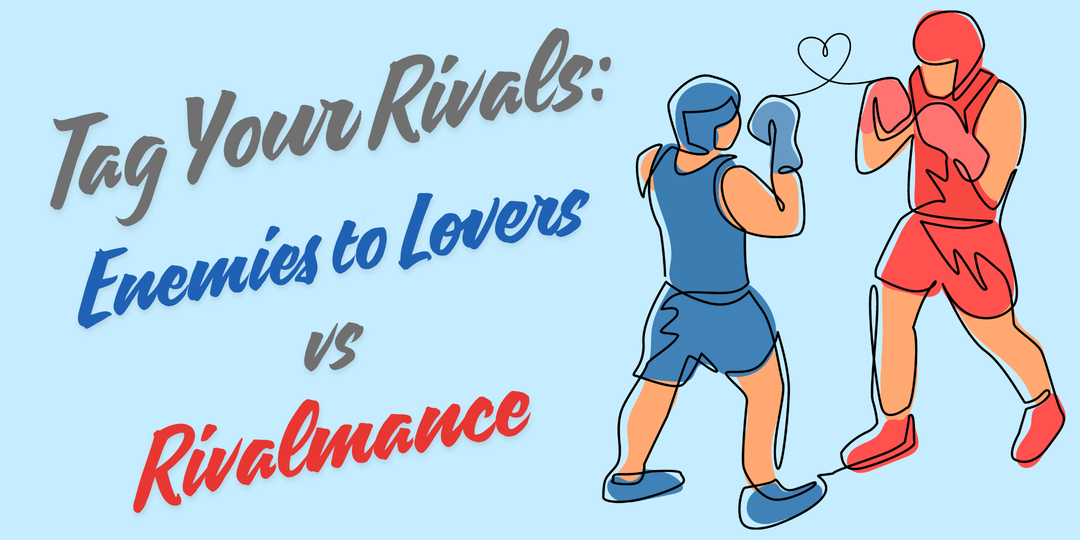
a guest post by Nicola Kapron.
Enemies to lovers is one of the most popular tropes a writer can attach to their work, so why are readers so often disappointed when they crack that work open?
There are many reasons that a story tagged “enemies to lovers” can fail to impress its intended audience. One of those reasons may be that the story is being marketed to the wrong audience entirely.
Sometimes, when people talk about “enemies to lovers,” what they’re actually describing is rivalmance. This clash of expectations can lead to readers abandoning an otherwise good read.
What is Rivalmance?
Enemies to lovers is fairly self-explanatory: it’s about people who are antagonistic towards each other, but end up romantically involved.
Rivalmance is a little more complicated.
The word “rivalmance” is a portmanteau of “rival” and “romance,” and it refers to narratives where rivals become romantically involved. Sounds a lot like enemies to lovers, right? So what’s the problem?
In short, the expectations people have for enemies and rivals are different. A good rivalmance often features fierce competition, hot-blooded outbursts, and a struggle to prove oneself in the other’s eyes.
Sometimes, the rivals start out hating or not respecting each other, but their gradual development to viewing each other as equals—perhaps each other’s only equal—is key to a satisfying read. However, the second a writer introduces a major and consistent power imbalance or drain the competition out of things, they run into a problem.
Fans of rivalmance are invested in seeing sparks fly between characters who care deeply about what they’re doing, whether they’re playing a children’s card game, competing at tennis, or performing business warfare. Those same fans are not necessarily going to be interested in captivity narratives, political drama, or even ideological conflict.
What is Enemies to Lovers Then?
Okay, I know I said enemies to lovers was pretty self-explanatory, but I lied. Let’s go over what makes a good enemies to lovers narrative and what can make the trope fall flat.
When the main characters are the villains of each other’s story, it can be difficult to keep the narrative both sympathetic and engaging. The key to a compelling story here is a sense of mutual respect.
A good enemies to lovers narrative usually keeps a strong sense of grey morality, or at least highlights the ambiguity of the situation. If one side is clearly right and the other clearly wrong, then the realization of wrongdoing is often at the core of what allows the characters to become lovers.
In other words, the core of enemies to lovers is the clash between one’s ideals and one’s heart.
An enemies to lovers narrative doesn’t need the same sense of competition. In fact, they often involve captivity, powerplay, and other methods of forced vulnerability. Meanwhile, rivalmance lives and dies on how electric the competition feels.
As one might expect, reading enemies to lovers when expecting rivalmance—and vice versa—is a jarring experience.
How Do We Fix This?
Well, for starters, we as writers and readers could start labeling rival romances as rivalmance rather than enemies to lovers. And that means keeping an eye open for the differences. Here are some examples.
If two knights whose kingdoms are at war fall in love with each other across the battlefield, that’s probably enemies to lovers. However, if the knights are competing in a tournament or protecting the same princess while falling in love, that might be rivalmance.
If a pair of hockey players on opposing teams fall in love, that’s probably rivalmance. But if there’s a grudge between them, like a cheating scandal or a personal betrayal, it could wind up in enemies to lovers territory.
A superhero and supervillain falling in love is usually enemies to lovers by default. A sufficiently friendly enemy dynamic may cross the line into rivalmance, however.
As a general rule, the stakes of rivalmance are lower, but the emotional tension is higher. Fans may also expect a degree of honesty from rivalmance which may be absent—sometimes for important plot reasons—from enemies to lovers. And if an enemies to lovers story doesn’t give its leads good reason to be enemies, the whole conceit may collapse.
All in all, this is a fairly complex issue with a pretty simple solution: tag your rivals. Because as any fan of these tropes could tell you, rivalmance and enemies to lovers are not different names for the same thing.


