"Princess Mononoke" Through the Lens of Environmental Sociology and Political Ecology

My books are available as e-books; I would be very grateful if you read them. I am also on X, so I would be delighted if you followed me there.
■ Overview
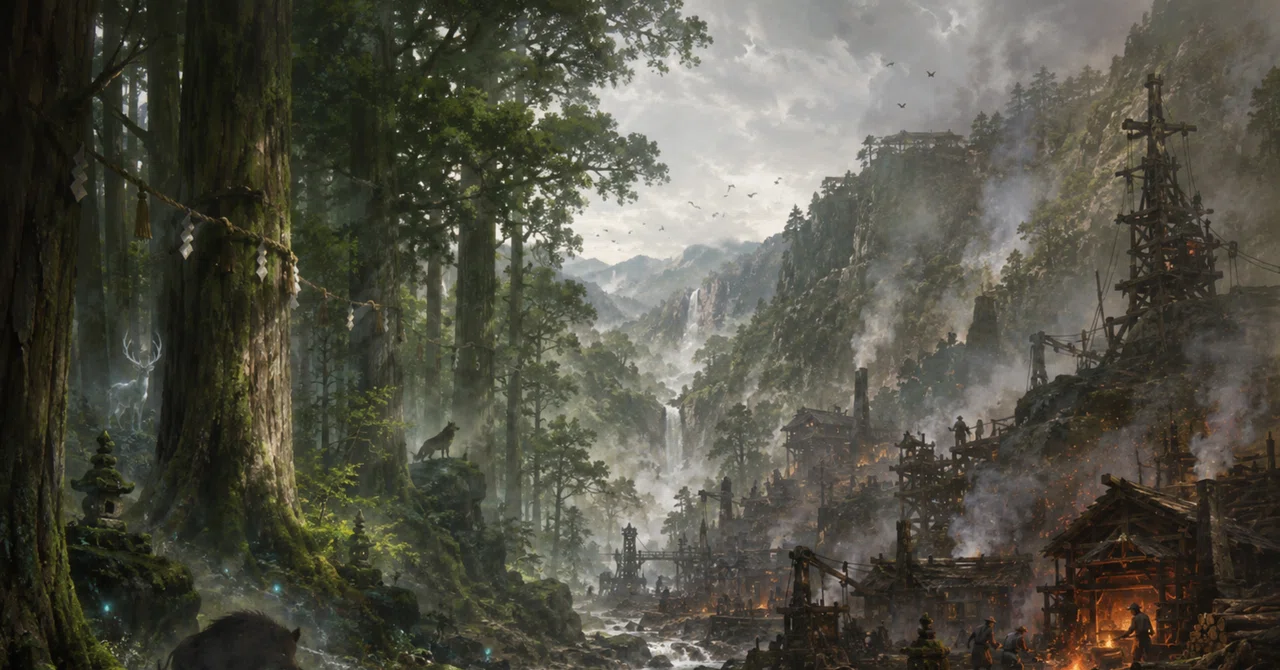
Directed by Hayao Miyazaki and released in 1997, "Princess Mononoke" is a feature-length animated film set in a period reminiscent of medieval Japan. It depicts the conflict between Iron Town (Tatara-ba), a settlement that clears the forest to produce iron, and the animal gods who inhabit the Forest Spirit’s domain.
The film is often understood as a confrontation between "humans who destroy nature" and "animals who defend it." Reducing it to such an environmentalist allegory, however, obscures the social complexity it portrays.
Iron Town is a center of forest destruction, but it is also a sphere of livelihood that takes in women who had been sold and people who had been cast out of their communities because of illness.
Lady Eboshi is a developmentalist who kills gods with firearms, yet she is also a leader who gives work, shelter, and dignity to people excluded by the existing social order.
The gods of the forest, for their part, do not represent an unconditionally peaceful nature. Moro harbors an intense hatred of humans, while Lord Okkoto leads his clan into a ruinous battle.
Nago, the boar god, is wounded by a gunshot and transformed by rage and pain into a demon god. The forest is not a harmonious paradise, but a world in which survival, territory, predation, and death form an unbroken continuum.
Studio Ghibli itself has described this morally irreducible depiction of Iron Town as one of the features that gives the film its modern relevance.
Environmental sociology and political ecology provide useful frameworks for examining the film.
Environmental sociology understands environmental problems not merely as biophysical changes described by the natural sciences, but also in relation to labor, everyday life, inequality, culture, and political judgment.
Political ecology goes further by asking who uses natural resources, who receives the benefits, and who is made to bear the costs of destruction and exposure to risk.
From these perspectives, "Princess Mononoke" does not portray a war between nature and humanity. It portrays an environmental conflict that arises where different domains of survival overlap and where iron, forests, labor, weapons, state power, bodies, and hatred become entangled.
■ 1. Rejecting the Nature–Civilization Binary
In the world of "Princess Mononoke", humanity and nature are not clearly separate.
Iron Town was built by clearing the forest, yet its iron production cannot exist without natural resources such as timber, water, soil, and iron sand. Humans are not attacking nature from somewhere outside it. They live by using the forest’s materials and intervening in its cycles.
Nor is the forest a pure realm isolated from humanity. The iron pellet fired by Eboshi remains lodged in Nago’s body, and the pain it causes is carried as far as Ashitaka’s village. A human weapon enters an animal’s body, and the animal’s hatred passes into a human body as a curse.
Matter and emotion circulate here across the boundary between human society and the ecosystem.
This structure cannot be explained if environmental problems are treated only as one-way effects exerted by humans on nature. When humans alter the forest, the altered forest, in turn, feeds back into human society.
Deforestation narrows the animals’ habitat. Attacks by animals driven into a corner threaten the residents of Iron Town, and that fear encourages further militarization.
Destruction does not end with a single act; it intensifies through reciprocal interaction.
Accordingly, the film offers no prospect of restoring an earlier harmony simply by protecting nature. Neither a return to nature untouched by human hands nor the complete management and conversion of nature into a safe, controllable resource is possible.
Humans and animals have already been changed by one another’s actions. Resolving the conflict therefore requires not erasing either side from the world, but reconstructing their relations under altered conditions.
■ 2. Iron Town: The Nexus of Environmental Destruction and Social Inclusion
Iron Town is the film’s most contradictory space.
Iron production requires large quantities of timber and iron sand. Forests are cut for fuel, while mountains become sites of extraction. Iron is made into agricultural tools and everyday goods, but also into guns and swords, and is used in warfare. The growth of Iron Town enriches human life while diminishing the conditions under which the forest can survive.
Yet Iron Town cannot be treated merely as a center of exploitation.
The women who work there have been taken in by Eboshi after being sold and have become participants in collective labor. They are not passive figures compelled only to work. They produce iron, handle weapons, joke with the men, and participate in defending the community.
People affected by illness are likewise not isolated from society. They are given specialized work manufacturing firearms. Eboshi does not treat their bodies as objects of disgust, but recognizes them as members who possess technical expertise.
In this respect, Iron Town is a place where those excluded by an older status order can build another way of life.
The social inclusion it provides, however, is sustained by the intensive use of forest resources. The rescue of vulnerable people within human society and the displacement of burdens onto animals and forests positioned outside the moral and political bounds of human society proceed through the same productive activity.
From the perspective of political ecology, the question is not whether development is good or evil. It is who gains freedom through development and who bears the cost of that freedom.
The women of Iron Town gain freedom, but the iron and charcoal that make it possible are extracted from the forest. People affected by illness gain work and dignity, but their technical skills are also used to produce firearms used to shoot the animal gods.
The film does not conceal the possibility that social good may be entangled with environmental violence.
■ 3. Lady Eboshi: The Duality of Liberator and Developmentalist
Lady Eboshi is not a simple villain who personifies human arrogance.
She does not fear the gods, regards the forest as a resource, and attempts to kill the animal gods with firearms. She also participates in the scheme to take the Forest Spirit’s head and ultimately fires the shot herself. Her actions are an extreme expression of developmentalism—the conviction that humanity can possess and control an entire ecosystem.
At the same time, she rescues people whom the existing society would not protect. She gives women a voice, touches the bodies of people affected by illness without revulsion, and creates work for them. She protects Iron Town from samurai forces and local warrior bands and assumes responsibility for sustaining the lives of its residents.
Defeating Eboshi would therefore not solve the environmental conflict.
The forest is not being destroyed by her personal desire alone. An economy that needs iron, a political situation that requires military force, and a society that gives marginalized people no place to live all make the expansion of Iron Town necessary.
Eboshi organizes these demands and puts them into practice. Removing her would eliminate neither the demand for iron nor the livelihood problems faced by women and people affected by illness.
This is where the film’s realism lies.
Environmental destruction does not arise only because a malicious individual hates nature. Legitimate demands—employment, safety, improved living conditions, and freedom from discrimination—can also drive the expansion of resource use.
Environmental policy is difficult because stopping destruction may also deprive someone of the means to live.
Eboshi’s error is not that she tries to protect human lives. It is that, in creating the conditions for those lives, she fails to recognize the forest side as a negotiating party with its own claims to survival, treating those claims instead as obstacles that can be eliminated by force.
■ 4. The Gods of the Forest: Not Spokespersons for Nature, but Another Political Community
Moro, Lord Okkoto, Nago, and the other gods are not abstract symbols of "nature." They are political actors with distinct memories, judgments, pride, and fears.
Moro hates humans, but she does not indiscriminately attack every human being. She speaks with Ashitaka, accepts San’s choice, and, knowing that her own death is near, seeks to take revenge on Eboshi.
Lord Okkoto wants the boars to survive, yet his pride prevents him from retreating. Although he knows that the younger boars are heading into a human trap, he chooses a final battle.
The forest gods do not represent a single, unified will of the forest. The wolf gods and the boar gods make different judgments, while the apes believe that eating humans will give them human strength. The forest itself contains conflict, misrecognition, and generational difference.
This depiction rejects the idea that nature is inherently harmonious and that humans alone disturb it.
The forest also has politics. Decisions must be made about where to live, when to fight, whom to recognize as an ally, and which losses to accept. The animal gods are not merely flora and fauna; they are portrayed as communities with territories and histories of their own.
The conflict between humanity and the forest is therefore more than a technical problem of conservation. It is a territorial conflict between different communities.
For Iron Town, the forest is a resource base for expanding production. For the animal gods, it is the basis of survival and ancestral memory. The same land carries different meanings within different understandings of the world.
The conflict intensifies because both sides look upon the same forest while refusing to recognize the meanings attributed to it by the other.
■ 5. The Curse: The Circulation of Violence Across Bodies
The curse that remains in Ashitaka’s right arm embodies the core of the film’s environmental-sociological argument.
The curse is not punishment for an individual sin. Ashitaka kills Nago to protect his village and has taken no part in either the destruction of the forest or the manufacture of firearms. Even so, his body is made to bear the consequences of violence committed elsewhere.
This absurdity resembles a defining feature of environmental harm.
Pollution, climate change, resource depletion, and environmental destruction caused by war do not necessarily burden the same people who caused them. The effects of an act committed in one place reach other humans and other organisms across time and space.
Eboshi shoots Nago, but Ashitaka is cursed. The iron pellet enters Nago’s body and is transformed into hatred, which then passes into Ashitaka’s arm.
Although supernatural, the curse makes visible the way social violence spreads through unforeseen pathways.
The curse also gives Ashitaka superhuman strength. Hatred not only consumes the body but also grants the power to kill enemies with ease.
Here lies the temptation of violence. Those who have been injured can acquire, through that injury, the power to inflict new violence. Yet the more Ashitaka uses that power, the more deeply the curse invades his body.
Violence does not end when the opponent is eliminated. It crosses the boundary between perpetrator and victim and remains as a capacity to produce further harm.
Ashitaka’s task is not to erase the curse completely. It is to acknowledge the hatred within him without allowing it to lead directly to the killing of others.
■ 6. Ashitaka: Not a Neutral Observer, but a Translating Figure at the Boundary
Ashitaka sets out in order to "see with unclouded eyes." He is not, however, a neutral judge standing outside the conflict.
He is a marginal figure exiled from his Emishi village and a victim of Nago’s curse. He helps the humans at Iron Town, rescues San in the forest, and receives life from the Forest Spirit. His body is constituted through relations with both the human and forest worlds.
Ashitaka’s role is not to determine which side is right. It is to convey each side’s words and suffering to the other when the parties can no longer see one another as anything but enemies.
He communicates the logic of the forest to the residents of Iron Town and tries to explain to San the circumstances of those who live there. He speaks with Moro and urges Eboshi to stop using force.
His mediation repeatedly fails.
San does not abandon her hatred of humans; Eboshi shoots the Forest Spirit, severing its head; Lord Okkoto refuses to halt the battle; and the samurai attack Iron Town. The fact that Ashitaka speaks the right words does not mean that everyone will understand one another.
The conflict arises not only from misunderstanding, but also from a conflict between the material conditions required for each side’s survival.
Even so, Ashitaka’s actions matter. Although he cannot produce complete agreement, he refuses to reduce the other side to a single attribute.
He does not see Eboshi only as a destroyer, San only as a savage beast, or the forest as either a resource or a sacred domain fixed once and for all. Mediation does not eliminate conflict. It is the practice of keeping the other from becoming nothing more than an enemy.
■ 7. San: A Subject on the Human–Animal Boundary
San was born human, raised by wolves, and understands herself as a wolf.
She cannot be classified simply as belonging either to humanity or to nature. Her body is human, and she shares human language. Yet her sense of belonging, intimate relations, subsistence skills, and distinctions between friend and enemy all place her on the side of the forest.
San’s existence shows that identity is not determined by biological origin alone.
Who a person becomes depends not only on the body into which they are born, but also on who raises them, whose suffering they respond to, and which place they choose to defend.
The film therefore cannot support the conclusion that "San is really human and should return to human society." Human society is the side that abandoned her; the forest is the side that raised her.
At the same time, San cannot become wholly a wolf. She uses human language, forms a relationship with Ashitaka, and expresses her hatred of Eboshi in a distinctly human mode of revenge.
San’s suffering does not lie simply in being caught between two communities. It lies in the fact that the two communities seek to exterminate one another, making it impossible for her to maintain her ties to both communities at the same time.
Near the end, San acknowledges that she loves Ashitaka while saying that she cannot forgive the humans.
This is not a failure of reconciliation. It shows that the establishment of an intimate relationship does not automatically erase historical harm or conflict between communities.
The film’s uncompromising quality lies in its refusal to let personal affection conceal political conflict.
■ 8. The Forest Spirit’s Head: Central Authority and the Conversion of Life into a Resource
The conflict between the forest and Iron Town is further intensified by Jigo and the central authority behind him.
Jigo and his associates seek neither to preserve the forest’s order nor to save the residents of Iron Town. Their aim is to obtain the Forest Spirit’s head as a rare object believed to grant immortality and deliver it to those in power.
Here, the Forest Spirit is treated not first as the lord of the forest, but as a tradable resource.
A being that grants and takes life is reduced to a single function and understood as a means of prolonging human life. The web of relations through which the Forest Spirit helps constitute the forest is disregarded.
This configuration parallels forms of resource development in which a local environment is exploited by distant centers of power.
The losses caused by the forest’s destruction are borne by the animal gods, the residents of Iron Town, and those who live nearby. Those who expect to benefit from the Forest Spirit’s head, however, assume no responsibility for life in that place.
The places where benefits accrue are separated from the places where risks are borne.
Eboshi and the forest gods are enemies, but they at least depend on the same land for their survival. Jigo and his followers, by contrast, exploit a local conflict in order to extract what is valuable and carry it elsewhere.
From the perspective of political ecology, environmental conflicts are not confined to local residents and nature. The intervention of distant actors—states, military forces, commercial interests, and religious authorities—changes both the meaning of a resource and the scale of the conflict.
The struggle over the Forest Spirit’s head is a process through which life itself is turned into something political power can own.
■ 9. The Forest Spirit: Life and Death Beyond Human Good and Evil
The Forest Spirit is not portrayed as a benevolent god who protects the forest.
It saves the wounded Ashitaka while taking life from Nago and Lord Okkoto. Flowers bloom beneath its steps and wither immediately afterward. At night it becomes the immense Night-Walker, moving as a being that transcends individual life.
For the Forest Spirit, life and death are not opposites. Death is not a punishment for being alive, but part of an ecological cycle.
Humans and animal gods alike project their desires onto the Forest Spirit. The gods of the forest expect salvation, while humans expect immortality. The Forest Spirit conforms to neither expectation.
Its impersonality reveals the limits of understanding nature as a moral subject.
Nature does not bestow bounty because it loves humanity, nor does it cause disaster in order to punish humanity. Natural processes unfold according to temporalities and causalities different from human ideas of justice and malice.
When the Forest Spirit is decapitated, the being that had granted life becomes a catastrophe that indiscriminately absorbs the life around it.
This is less an act of divine revenge than the collapse of an entire web of relations after the center of the circulation of life has been severed and treated as a discrete object.
Humans attempt to possess only the Forest Spirit’s power. That power, however, is connected to the forest, animals, water, plants, death, and reproduction; it cannot be extracted as a single detachable part.
The attempt to isolate the powers of nature destroys not only the object of extraction but also the extractors’ own conditions of survival.
■ 10. Reconstruction After Catastrophe: Coexistence as the Negotiation of Distance, Not Fusion
After the Forest Spirit’s head is returned, greenery spreads across the land once more. The forest that was lost, however, has not been fully restored.
Moro, Lord Okkoto, and the boars are dead, and the age of the old gods has ended. The renewed greenery is not the restoration of a previous order, but a sign of a different ecosystem emerging after the catastrophe.
The same is true of Iron Town. Its buildings are destroyed, and its residents lose the material basis of their lives. Confronted with this situation, Eboshi says, "We will start again from the beginning. We will build a better town here."
Her words do not necessarily mean rebuilding the same Iron Town as before. Once the policy of conquering the forest and expanding iron production has failed, the question of what kind of community should be built must be posed anew.
The film provides no concrete answer.
Whether iron production should cease entirely, whether forest use should be restricted, how the boundary with the forest should be drawn, and who should negotiate with the animals all remain unresolved.
This lack of resolution is not a defect. Coexistence has no final form.
Ashitaka lives in Iron Town, while San remains in the forest. Rather than merging into a single community, they choose to continue meeting while belonging to different places.
Coexistence here does not mean erasing difference and becoming one. It means continuing to search for a distance at which different spheres of life and systems of value can be maintained without either side exterminating the other.
The same applies to agreements over environmental issues. Not everyone must share the same conception of nature. What is required is negotiation that coordinates the demands of livelihood, labor, and culture with the ecological requirements of ecosystems, without concentrating losses on a single group.
The ending of "Princess Mononoke" does not depict a reconciliation between humanity and nature. It depicts people who cannot fully forgive one another but nevertheless refuse to sever their relationship and begin again from different places in order to avoid the next conflict.
■ Conclusion
Viewed through environmental sociology and political ecology, "Princess Mononoke" emerges as more than a work advocating the protection of nature. It asks how benefits, risks, labor, and the right to survival are distributed in environmental conflict.
Iron Town destroys the forest. At the same time, it takes in women and people affected by illness who have been excluded from the existing society. The gods of the forest resist human encroachment. At the same time, hatred and pride lead them toward their own destruction.
Eboshi is both liberator and developmentalist. San is both human and wolf. Ashitaka tries to understand both sides, yet he is never entirely free of either world.
The film contains neither an innocent nature nor a purely evil civilization.
What it presents instead is a plurality of actors with different conditions of survival, each seeking to defend its own world. The conflict does not arise because one side is ignorant. It arises because incompatible demands converge upon the same forest, the same iron, the same water, and the same land.
Ashitaka’s search for "a way to live together" therefore cannot remain a moral slogan.
Living together requires us to keep asking: Who receives the benefits? Who bears the risks? Whose voice is excluded from negotiation?
It also requires treating forests, animals, water, and land not merely as objects but as participants in the relations that make life possible, alongside the pursuit of equality among humans.
What "Princess Mononoke" presents is neither a life that leaves nature wholly unchanged nor the preservation of the forest at the expense of human life.
Humans cannot live without using nature. Yet using nature is not the same as claiming total ownership over it. The forest also has a history and claims to survival. When those claims are dismissed as obstacles, violence returns to human society in the form of a curse.
Environmental ethics in the film does not mean that humans should simply be kind to nature. It means recognizing the burdens that human ways of life impose on other forms of life, distant communities, and future generations, and accepting responsibility for bringing those burdens into negotiation.
The Forest Spirit’s forest will not return to what it was. Iron Town will not return to what it was. Nor will San and Ashitaka live in the same place.
Even so, the absence of complete reconciliation does not make coexistence impossible.
The hope offered by "Princess Mononoke" is not a harmony in which every conflict has been resolved. It is an incomplete and continuing negotiation: an attempt to rebuild the world together after catastrophe without erasing the other, while allowing wounds and differences to remain.
