ペリー艦隊の印刷機 ― 航海・外交・演芸を支えた日本遠征隊印刷

黒船の軍楽隊 その21
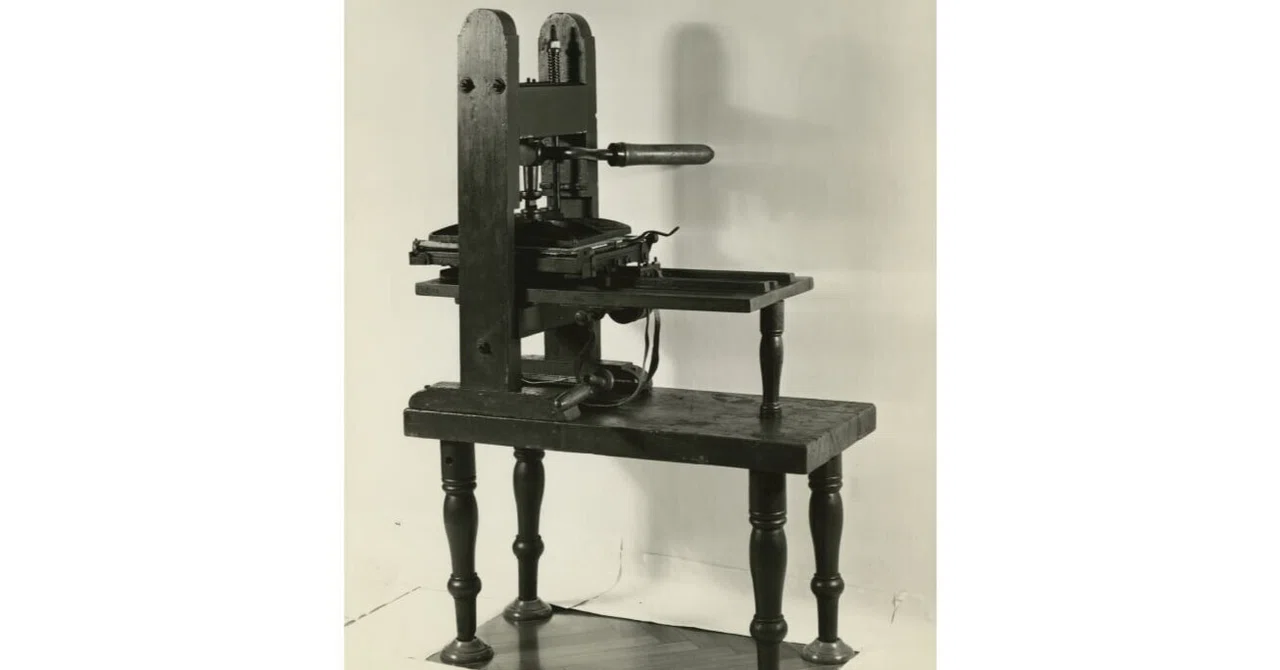
マシュー・ペリーが1852年11月24日にアメリカ東海岸のノーフォーク港を出港した時には搭載できなかった印刷機が、1853年12月下旬になって、補給船レキシントン号により、香港に碇泊中のペリー艦隊に届けられました。
見出し画像は、1850年頃に製造された小型印刷機(Adam Ramage作) です。ペリー艦隊に届けられた印刷機の製造元や機種は不明ですが、画像に示したものと同系統の印刷機であった可能性があると考えられます。
*1 ) 高さ160.02 cm 幅91.44 cm 奥行き118.11 cm
日本遠征隊印刷
マシュー・ペリー が率いた日本遠征隊には、アメリカ国務省から提供された印刷機・活字・インクが搭載されていて、艦隊内で各種印刷物の作成が実際に行われていました。現存する印刷物の中には「日本遠征隊印刷(Japan Expedition Press)」と明記されたものがあり、船上における印刷機能の運用が確認できます。
この印刷機は、遠征の遂行にあたって次の三つの目的で使用されましたた。
(1)日本近海および寄港地に関する航海指示書の作成
(2)外交交渉や艦隊運用に関わる各種文書の印刷
(3)船上で行われた演劇・演芸のためのプログラムの印刷
印刷用紙については、国務省が十分な準備を行っていなかったため、ペリーは香港において紙を調達しています。具体的には、薄手の楮紙、青色の繊維紙、低品質の白紙などです。《* 2)》なお、使用された印刷機は一度に約6×8インチ(約15×20cm)程度の小型印刷しか行えなかったので、紙を二枚重ねて二度刷りすることで、より大きな印刷物を作成する工夫がなされていました。
* 2) Commodore Perry’s Japan Expedition Press and Shipboard Theatre By S. E. Morison
日本近海や寄港地に関す航海指示書
日本近海や寄港地に関する測量成果に基づき、航海の安全に資するための航路図や航海案内が印刷されました。
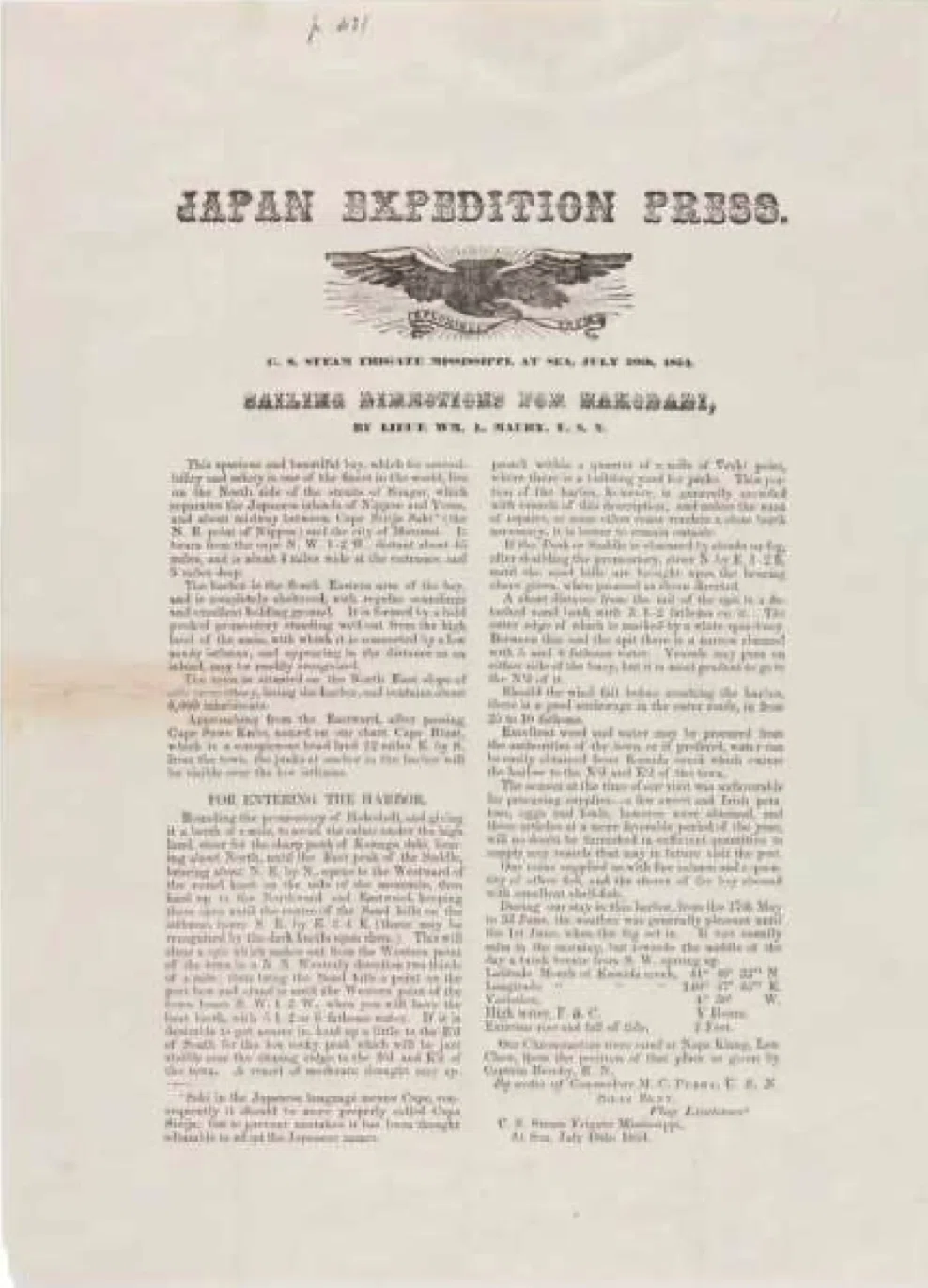
JAPAN EXPEDITION PRESS.
(鷲の紋章)
U. S. STEAM FRIGATE MISSISSIPPI, AT SEA, JULY 20th, 1854.
SAILING DIRECTIONS FOR HAKODADI,
BY LIEUT. WM. L. MAURY, U. S. N.
This spacious and beautiful bay, which for accessibility and safety is one of the finest in the world, lies on the North side of the straits of Nangur, which separates the Japanese islands of Nippon and Yesso, and about midway between Cape Sirika Saki* (the N. E. point of Nippon) and the city of Matsmai. It bears from the cape N. W. 1-2 W. distant about 40 miles, and is about 4 miles wide at the entrance, and 5 miles deep.
The harbor is the South Eastern arm of the bay, and is completely sheltered, with regular soundings and excellent holding ground. It is formed by a bold peaked promontory standing well out from the high land of the main, with which it is connected by a low rocky isthmus, and appearing in the distance as an island, may be readily steered.
The town is situated on the North East slope of the promontory, lining the harbor, and contains about 4,000 inhabitants.
Approaching from the Eastward, after passing Cape Siwa Kabe, named on our chart Cape Bizai, which is a conspicuous head land 12 miles E. by N. from the town, the junk at anchor in the harbor will be visible over the low isthmus.
FOR ENTERING THE HARBOR.
Rounding the promontory of Hakodadi, and giving it a berth of a mile, to avoid the shoal under the high land, steer for the sharp peak of Konago dake, bearing about North, until the first peak of the Saddle, bearing about N. E. by N., opens to the Westward of the round knob on the side of the mountain, then haul up to the Northward and Eastward, keeping these open until the outline of the Sand hills on the isthmus, bears N. E. by E. 2-4 E. (these may be recognized by the dark knolls upon them.) This will show a spit which makes out from the Western point of the town in a N. S. Westerly direction two thirds of a mile; then bring the Sand hills a point on the port bow and stand in until the Western point of the town bears N. W. 1-2 W., when you will have the best berth, with 4 1-2 or 5 fathoms water. If it is desirable to go nearer in, haul up a little to the E'd of South, for the low rocky point, which will be just visible over the sloping ridge to the Ed and Ed of the town. A vessel of moderate draught may approach within a quarter of a mile of Tojki point, where there is a bathing pool for junks. This portion of the harbor, however, is generally crowded with vessels of this description, and unless the need of repairs, or some other cause renders a short berth necessary, it is better to remain outside.
If the Peak or Saddle is obscured by clouds or fog, after doubling the promontory, steer N. by E. 1-2 E. until the sand hills are brought upon the bearing there given, when proceed as above directed.
A short distance from the end of the spit is a detached sand bank with 2 1-2 fathoms on it. The outer edge of which is marked by a white spar-buoy. Between this and the spit there is a narrow channel with 3 and 4 fathoms water. Vessels may pass on either side of the buoy, but it is most prudent to go to the N'd of it.
Should the wind fail before reaching the harbor, there is a good anchorage in the outer roads, in from 20 to 30 fathoms.
Excellent wood and water may be procured from the authorities of the town or if preferred, water may be easily obtained from Konoda creek which enters the harbor to the N'd and E'd of the town.
The season at the time of our visit was unfavorable for procuring supplies, as few sweet and Irish potatoes, eggs and fowls, however were obtained, and those articles at a more favorable period of the year, will no doubt be furnished in sufficient quantities to supply any vessels that may in future visit the port.
Our time supplied us with fine salmon and a quantity of other fish, and the shores of the bay abounded with excellent shell-fish.
During our stay in this harbor, from the 17th May to 3d June, the weather was generally pleasant until the 1st June, when the fog set in. It was usually calm in the morning, but towards the middle of the day a brisk breeze from S. W. sprang up.
Latitude North of Konoda creek: 41° 46' 22" N Longitude: 140° 47' 40" E Variation: 4° 26' W. High water, F. & C.: V Hours Extreme rise and fall of tide: 2 feet.
The Chronometer times used at Napa Kong, Lew Chew, from the position of that place as given by Captain Basily, R. N.
By order of Commodore M. C. PERRY, U. S. N. SILAS BENT, Flag Lieutenant U. S. Steam Frigate Mississippi, At Sea, July 20th, 1854.
* Saki is the Japanese language means Cape, consequently it should to more properly called Sirika Sirija, but to prevent mistakes it has been thought advisable to adopt the Japanese name.
--------------------------------------------------------------------------------------------------
日本遠征隊印刷
米国蒸気フリゲート艦ミシシッピ号 艦上にて(1854年7月20日)
箱館航海指針
米国海軍中尉 ウィリアム・L・モーリー記
この広大で美しい湾は、接近のしやすさと安全性において世界で最も優れた港の一つであり、日本列島の本州と蝦夷を隔てる津軽海峡の北側に位置している。尻屋崎(本州の北東端)と松前のほぼ中間に位置し、同岬から北西微西に約40マイルの距離にある。湾口の幅は約4マイル、奥行きは約5マイルである。
港(船舶の停泊地)は湾の南東端にあり、周囲を完全に遮蔽され、水深の変化は規則的で、底質(錨の掛かり)も極めて良好である。この港は、本土から突き出た険しく尖った岬(函館山)によって形成されており、本土とは低い岩だらけの地峡でつながっている。遠方からは島のように見えるため、これを目標に容易に操舵することができる。
町は岬の北東斜面に位置して港に面しており、約4,000人の住民を擁している。
東方から接近する場合、町から東微北へ12マイルの地点にある、海図上でビザイ岬(Cape Bizai)と名付けた顕著な岬(潮首岬)を通過すると、低い地峡越しに港内に停泊している日本船が見えてくる。
入港手順
箱館の岬(函館山)を回り込む際は、高地の下にある浅瀬を避けるために1マイルの間隔を保ち、北の方角にある駒ヶ岳の鋭い峰を目指して進む。横津岳付近の第一峰(北東微北)が山腹にある丸い突起の西側に見えるまで進んだら、北東方向へ転舵する。地峡にある砂丘の輪郭が北東微東 3/4 東の方位に見えるまで、この視界を維持すること(砂丘は上部にある暗い丘で識別できる)。
これにより、町の西端から北西微西方向に3分の2マイル突き出した砂嘴(さし)を確認できる。次に砂丘を左舷船首に見て進み、町の西端が北西微西に見える位置まで進むと、水深4.5〜5尋(約8.2〜9.1メートル)の最適な停泊地に到達する。
さらに奥へ進む場合は、町の東南東にある低い岩礁(傾斜した尾根越しにかろうじて見えるもの)を目指して、やや南寄りに進むこと。喫水の浅い船であれば、日本船の船溜まりがある築地(埋立地)付近から4分の1マイル以内まで接近可能である。ただし、この区域は通常日本船で混雑しているため、修理などの特別な理由がない限りは、外側の停泊地にとどまるのが賢明である。
駒ヶ岳や横津岳が雲や霧で隠れている場合は、岬を回り込んだ後、砂丘が指定の方位に見えるまで北微東 1/2 東へ進み、その後は上記の手順に従うこと。
砂嘴の先端から少し離れた場所に、水深2.5尋(約4.6メートル)の孤立した砂堆(さたい)があり、その外縁には白い円柱ブイが設置されている。この砂堆と砂嘴の間には水深3〜4尋(約5.5〜7.3メートル)の狭い水路がある。ブイのどちら側を通ってもよいが、北側を通過するのが最も安全である。
港に到達する前に風が止まった場合は、外側の停泊地に水深20〜30尋(約36.6〜54.9メートル)の良好な錨地がある。
良質な薪と水は町当局から入手できる。また、希望すれば、町の北東で港に注ぐ願乗寺川周辺から容易に水を得ることも可能である。
我々の訪問時は物資の調達には不向きな季節であり、サツマイモ、ジャガイモ、卵、鶏などはわずかしか入手できなかった。しかし、より好ましい時期であれば、将来この港を訪れる船舶に対し、これらの品々は十分な量が供給されることは疑いない。滞在中は良質なサケをはじめとする多種の魚が得られ、湾の沿岸には優れた貝類が豊富であった。
5月17日から6月3日までの滞在中、6月1日に霧が出るまでは概ね快晴であった。午前中は通常穏やかだが、日中になると南西から強い風が吹き始めた。
・願乗寺川付近の北緯: 41° 46' 22" N
・東経: 140° 47' 40" E
・磁気偏差: 4° 26' W
・満潮(新月・満月時): 5時
・潮位差: 最大2フィート(約60センチメートル)
合衆国海軍准将 M. C. ペリーの命による サイラス・ベント(旗艦副官) 合衆国蒸気フリゲート艦ミシシッピ号 艦上にて(1854年7月20日)
*注:日本語の「サキ(Saki)」は「岬(Cape)」を意味するため、本来は「シリカ岬(Sirika Cape)」と呼ぶのが適切であるが、混乱を避けるため日本側の名称を採用することとした。
外交公式文書
大統領書簡や通達文書など、外交および艦隊運用に関わる文書の複製が作成されました。
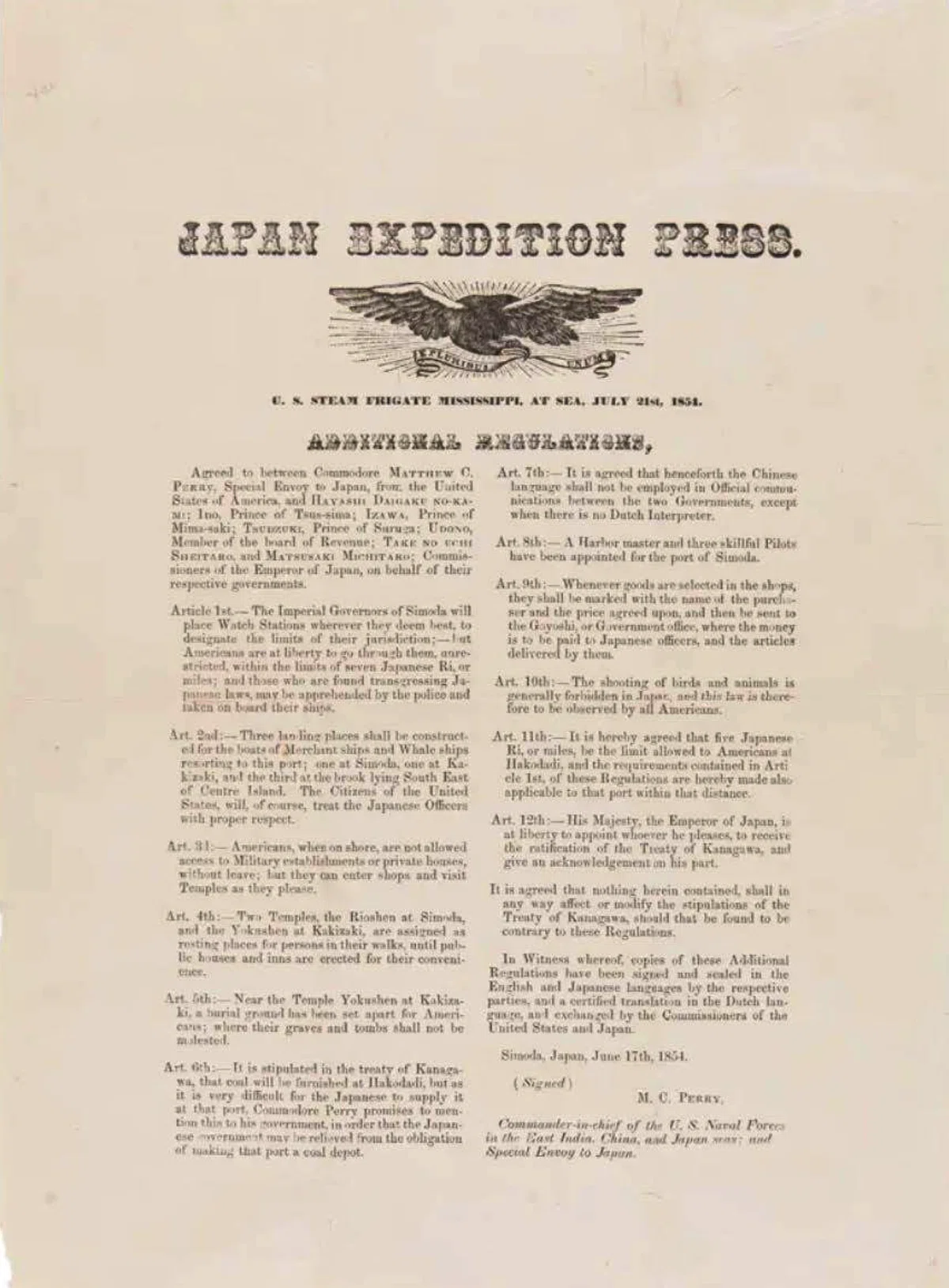
JAPAN EXPEDITION PRESS.
U. S. STEAM FRIGATE MISSISSIPPI, AT SEA, JULY 21st, 1854.
ADDITIONAL REGULATIONS,
Agreed to between Commodore MATTHEW C. PERRY, Special Envoy to Japan, from the United States of America, and HAYASHI DAIGAKU NO-KAMI; INO, Prince of Tsus-sima; IZAWA, Prince of Mima-saki; TSUDZUKI, Prince of Suruga; UDONO, Member of the board of Revenue; TAKE NO UCHI SHEITARO, and MATSUSAKI MICHITARO; Commissioners of the Emperor of Japan, on behalf of their respective governments.
・Article 1st. — The Imperial Governors of Simoda will place Watch Stations wherever they deem best, to designate the limits of their jurisdiction; — but Americans are at liberty to go through them, unrestricted, within the limits of seven Japanese Ri, or miles; and those who are found transgressing Japanese laws, may be apprehended by the police and taken on board their ships.
・Art. 2nd: — Three landing places shall be constructed for the boats of Merchant ships and Whale ships resorting to this port; one at Simoda, one at Kakizaki, and the third at the brook lying South East of Centre Island. The Citizens of the United States, will, of course, treat the Japanese Officers with proper respect.
・Art. 3d. — Americans, when on shore, are not allowed access to Military establishments or private houses, without leave; but they can enter shops and visit Temples as they please.
・Art. 4th: — Two Temples, the Rioshen at Simoda, and the Yokushen at Kakizaki, are assigned as resting places for persons in their walks, until public houses and inns are erected for their convenience.
・Art. 5th: — Near the Temple Yokushen at Kakizaki, a burial ground has been set apart for Americans; where their graves and tombs shall not be molested.
・Art. 6th: — It is stipulated in the treaty of Kanagawa, that coal will be furnished at Hakodadi, but as it is very difficult for the Japanese to supply it at that port, Commodore Perry promises to mention this to his government, in order that the Japanese government may be relieved from the obligation of making that port a coal depot.
・Art. 7th: — It is agreed that henceforth the Chinese language shall not be employed in Official communications between the two Governments, except when there is no Dutch Interpreter.
・Art. 8th: — A Harbor master and three skillful Pilots have been appointed for the port of Simoda.
・Art. 9th: — Whenever goods are selected in the shops, they shall be marked with the name of the purchaser and the price agreed upon, and then be sent to the Gayoshi, or Government office, where the money is to be paid to Japanese officers, and the articles delivered by them.
・Art. 10th: — The shooting of birds and animals is generally forbidden in Japan, and this law is therefore to be observed by all Americans.
・Art. 11th: — It is hereby agreed that five Japanese Ri, or miles, be the limit allowed to Americans at Hakodadi, and the requirements contained in Article 1st, of these Regulations are hereby made also applicable to that port within that distance.
・Art. 12th: — His Majesty, the Emperor of Japan, is at liberty to appoint whoever he pleases, to receive the ratification of the Treaty of Kanagawa, and give an acknowledgement on his part.
It is agreed that nothing herein contained, shall in any way affect or modify the stipulations of the Treaty of Kanagawa, should that be found to be contrary to these Regulations.
In Witness whereof, copies of these Additional Regulations have been signed and sealed in the English and Japanese languages by the respective parties, and a certified translation in the Dutch language, and exchanged by the Commissioners of the United States and Japan.
Simoda, Japan, June 17th, 1854.
(Signed)
M. C. PERRY,
Commander-in-chief of the U. S. Naval Forces in the East India, China, and Japan seas; and Special Envoy to Japan.
--------------------------------------------------------------------------------------------------
日本遠征隊印刷
1854年7月21日、洋上、アメリカ合衆国蒸気フリゲート艦ミシシッピ
追加規則
アメリカ合衆国特使マシュー・C・ペリー提督と、林大学守(はやし だいがくのかみ)、井戸対馬守(いど つしまのかみ)、伊沢美作守(いざわ みまさかのかみ)、駿河藩王津月、鵜殿民部少輔(うどの みんぶのしょう)、竹内秀太郎(たけのうち しゅうたろう)、松崎満太郎(まつざき みちたろう)いずれも日本天皇の勅命を受けた者との間で合意された。
第1条 ― 下田奉行は、管轄区域の境界を示すため監視所を設置する。アメリカ国民は、七里(マイル)の範囲内であれば自由に通行できる。日本の法律に違反した者は、警察に逮捕され、船に乗せられることがある。
第2条―この港に寄港する商船および捕鯨船の船のために、3か所の船着場が建設される。1か所は下田、1か所は柿崎、そして3か所目はセンター島の南東にある小川である。アメリカ合衆国国民は、当然のことながら、日本の将校に適切な敬意を払わなければならない。
第3条―アメリカ国民は、上陸中は、許可なく軍事施設や民家に立ち入ることはできない。しかし、商店や寺院には自由に立ち入ることができる。
第4条―下田の了仙寺と柿崎の玉泉寺の2か所は、宿泊施設や宿屋が建設されるまでの間、散策中の人々の休憩所として指定される。
第5条:柿崎の玉泉寺の近くに、アメリカ人のための墓地が設けられ、その墓や墓所は荒らされてはならない。
第6条:神奈川条約では箱田に石炭を供給することが規定されているが、日本側が同港で石炭を供給することは極めて困難であるため、ペリー提督は日本政府に対し、同港を石炭貯蔵所とする義務から日本政府が免除されるよう、この旨を伝えることを約束する。
第7条:今後、両政府間の公式通信においては、オランダ語通訳がいない場合を除き、中国語を使用しないことに合意する。
第8条:下田港に港長1名と熟練水先案内人3名が任命された。
第9条:― 商品を購入する際は、代役所(役所)を通じて日本人職員に代金を支払い、商品を受け取るものとする。代金は代役所の日本人職員に支払われ、商品は職員によって引き渡される。(※直接売買の禁止)
第10条:― 日本では鳥類および動物の狩猟は一般的に禁止されており、すべてのアメリカ人はこの法律を遵守しなければならない。
第11条:― 箱田港におけるアメリカ人の居住制限区域は、日本里5マイル(約8キロメートル)以内とし、本規則第1条に規定する事項は、この距離内の同港にも適用されるものとする。
第12条:― 天皇陛下は、神奈川条約の批准書を受領し、その旨を表明する者を自由に任命することができる。
本規則に規定されるいかなる条項も、神奈川条約の規定が本規則に反すると判断された場合であっても、その規定に何ら影響を与えず、また変更するものではないことに合意する。
以上の証として、本追加規則の写しは、両当事者により英語及び日本語で署名捺印され、オランダ語の認証翻訳が米国及び日本の委員間で交換された。
日本、下田、1854年6月17日
(署名)
M・C・ペリー
東インド海、中国海及び日本海における米国海軍総司令官、並びに日本特使
公演プログラム
印刷機が搭載後に艦内で行われた演芸会に際して、プログラムが印刷され、娯楽活動にも印刷機が活用されました。
現在、横浜・箱館・下田・那覇の4箇所で開催された公演のプログラムを確認することができます。
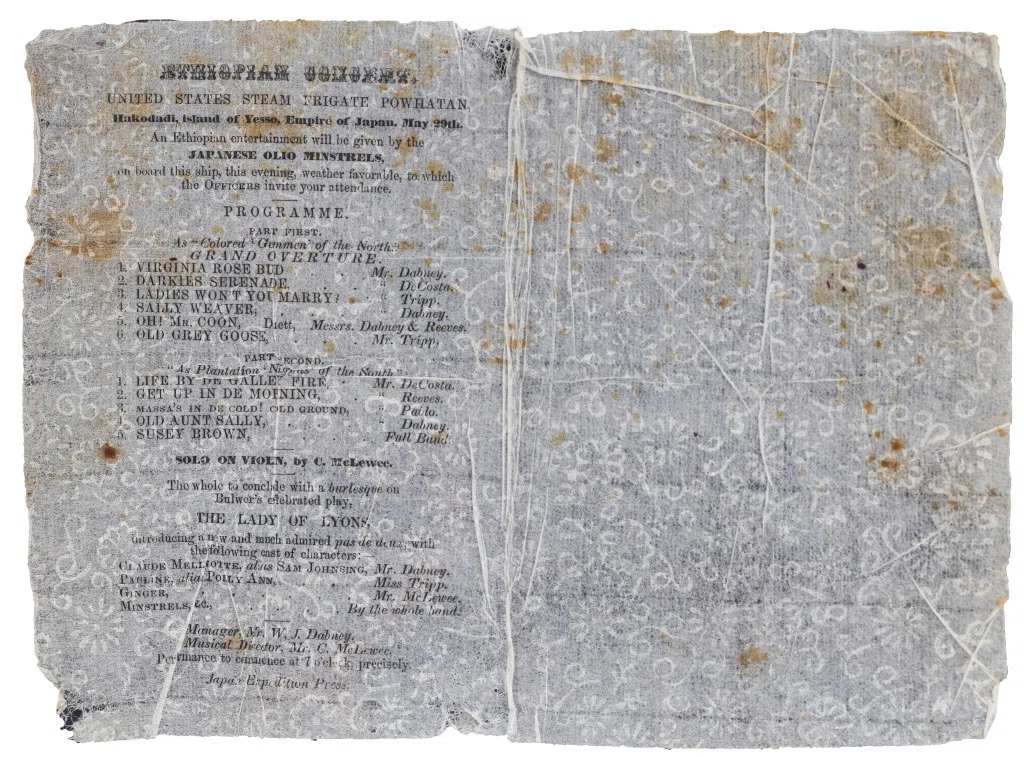
ETHIOPIAN CONCERT.
UNITED STATES STEAM FRIGATE POWHATAN,
Hakodadi, Island of Yesso, Empire of Japan. May 29th.
An Ethiopian entertainment will be given by the
JAPANESE OLIO MINSTRELS,
On board this ship, this evening, weather favorable, to which
The Officers invite your attendance.
------
PROGRAMME.
PART FIRST.
As “Colored ‘Gemmen’ of the North.”
GRAND OVERTURE.
1. VIRGINIA ROSE BUD ・ ・ Mr. Dabney.
2. DARKIES’ SERENADE ・ ・ “ DeCosta.
3. LADIES WON’T YOU MARRY ・“ Tripp.
4. SALLY WEAVER ・ ・ ・ “ Dabney.
5. OH! Mr. COON, Duett, Messrs. Dabney & Reeves.
6. OLD GREY GOOSE, ・ ・ ・Mr.Tripp.
PART SECOND.
“As Plantation ‘Niggas’ of the South.”
1. LIFE BY DE GALLEY FIRE ・ Mr. DeCosta.
2. GET UP IN DE MORNING ・ “ Reeves.
3. MASSA’S IN DE COLD! COLD GROUND “ Pablo
4. OLD AUNT SALLY ・ ・ ・ “ Dabney.
5. SUSEY BROWN ・ ・ ・Full Band.
SOLO ON VIOLIN, by C. McLewee.
------
The whole to conclude with a burlesque on
Bulwer’s celebrated play,
THE LADY OF LYONS,
introducing a new and much admired pas de deux, with
the following cast of characters : ----
CLAUDE MELLNOTTE, alias SAM JOHNSING, Mr.Dabney
PAULINE, alias POLLY ANN, ・ ・ Miss Tripp.
GINGER, ・ ・ ・ ・ ・ Mr.McLewee.
MINSTRELS, &C., ・ ・ ・ By the whole Band.
------
Manager, Mr. W. J. Dabney.
Musical Director, Mr. C. McLewee.
Performance to commence at 7 o’clock, precisely.
Japan Expedition Press.
--------------------------------------------------------------------------------------------------
エチオピアン(黒人風)演芸会
合衆国蒸気フリゲート艦パウハタン号
日本帝国、蝦夷島(エゾ島)箱館、5月29日
本日夕刻、天候が許せば、本船艦上においてジャパニーズ・オリオ・ミンストレルズ(日本遠征隊バラエティ一座)によるエチオピアン(黒人風)演芸を開催します。士官一同、謹んで皆様のご出席をお待ちしております。
------
プログラム
第1部
北部の“黒人紳士”風に
大序曲
1.バージニアの薔薇のつぼみ:ダブニー氏
2.黒人たちのセレナーデ:デコスタ氏
3.ご婦人方、結婚なさいませんか:トリップ氏
4.サリー・ウィーバー:ダブニー氏
5.おお、ミスター・クーン[二重唱]:ダブニー氏 & リーヴス氏
6.年老いた灰色ガチョウ:トリップ氏
第2部
南部農園の“黒人”風に
1.調理場の火のそばの暮らし:デコスタ氏
2.朝起きて:リーヴス氏
3.主人は冷たい土の中に:パブロ氏
4.サリーおばさん:ダブニー氏
5.スージー・ブラウン:楽団全員
ヴァイオリン独奏:C.マクルーイー氏
------
全体は、ブルワーの有名戯曲『リヨンの淑女』をもとにしたパロディ喜劇で締めくくられます。新作としてパ・ド・ドゥ(二人舞踊)を交え、配役は以下の通りです。
クロード・メルノート(別名サム・ジョンシング) : ダブニー氏
ポーリーヌ(別名ポリー・アン) : トリップ嬢
ジンジャー : マクルーイー氏
一座、その他:楽団全員
------
マネージャー : W.J.ダブニー氏.
音楽監督 : マクルーイー氏
開演 : 午後7時ちょうど
日本遠征隊印刷
1.Ethiopian 19世紀アメリカの演芸においては、アフリカ系黒人そのものではなく、**白人によるブラックフェイス芸(ミンストレル・ショー)**を指す慣用語。
2. Olio バラエティ的な寄せ集め演目。ミンストレル・ショーの中間部(雑芸部)にも用いられる語。
3. “Gemmen” “Gentlemen”の意図的な訛り表記。 黒人英語を誇張したミンストレル特有の言語表現。
4. “Coon” 19世紀アメリカにおける黒人に対する蔑称。 当時のミンストレル楽曲に頻出。
5. “Niggas” 極めて強い差別語。 本史料では舞台上の役柄(黒人像の演技)を示す文脈で使用。
6. “De” “the”の発音を模した表記。 黒人英語のステレオタイプ的再現。
7. MASSA’S IN DE COLD GROUND スティーブン・フォスター作の有名歌曲 (主人の死を悼む黒人奴隷の歌)
8. Burlesque 単なる風刺ではなく、誇張・戯画化・パロディを含む喜劇形式
9. Pas de deux バレエ用語。「二人舞踊」 この時代のミンストレルにも舞踊要素が組み込まれていたことを示す
10. The Lady of Lyons エドワード・ブルワー=リットンの戯曲(1838) 当時広く知られた人気演目

HIRAIDE HISASHI
他の黒船の軍楽隊シリーズ
黒船の軍楽隊 その00ゼロ 【改訂版】
日本の吹奏楽はどこから始まったのか?
黒船の軍楽隊 その1
黒船とペリー来航
黒船の軍楽隊 その2
琉球王国訪問が先
黒船の軍楽隊 その3
半年前倒しで来航
黒船の軍楽隊 その4
歓迎夕食会の開催
黒船の軍楽隊 その5
オラトリオ「サウル」HWV 53 箱館での演奏会
黒船の軍楽隊 その6
下田上陸
黒船の軍楽隊 その7
下田そして那覇での音楽会開催
黒船の軍楽隊 その8
黒船絵巻 - 1
黒船の軍楽隊 その9
黒船絵巻 - 2
黒船の軍楽隊 その10
黒船絵巻 - 3
黒船の軍楽隊 その11
ペリー以外の記録 – 1 (阿蘭陀)
黒船の軍楽隊 その12
ペリー以外の記録 – 2 (阿蘭陀の2)
黒船の軍楽隊 その13
ペリー以外の記録 – 3 (魯西亜)
黒船の軍楽隊 その14
ペリー以外の記録 – 4 (魯西亜の2)
黒船の軍楽隊 その15
ペリー以外の記録 – 5 (魯西亜の3)
黒船の軍楽隊 その16
ペリー以外の記録 – 6 (魯西亜の4)
黒船の軍楽隊 番外編 1
ロシアンホルンオーケストラ
黒船の軍楽隊 番外編 2
ヘ ン デ ル の 葬 送 行 進 曲
黒船の軍楽隊 その17
ペリー以外の記録 -7 (英吉利)
黒船の軍楽隊 その18
ペリー以外の記録 -8 (仏蘭西)
黒船の軍楽隊 番外編 3
ドラムスティック
黒船の軍楽隊 その19
黒船絵巻 - 4 夷人調練等之図
黒船の軍楽隊 その20
石版画から読み解く軍楽隊の実像
黒船の軍楽隊 その21
ペリー艦隊の印刷機 ― 航海・外交・演芸を支えた日本遠征隊印刷
