

SUBSCRIBE TO OUR FREE NEWSLETTER
Daily news & progressive opinion—funded by the people, not the corporations—delivered straight to your inbox.
5
#000000
#FFFFFF
To donate by check, phone, or other method, see our More Ways to Give page.
Daily news & progressive opinion—funded by the people, not the corporations—delivered straight to your inbox.
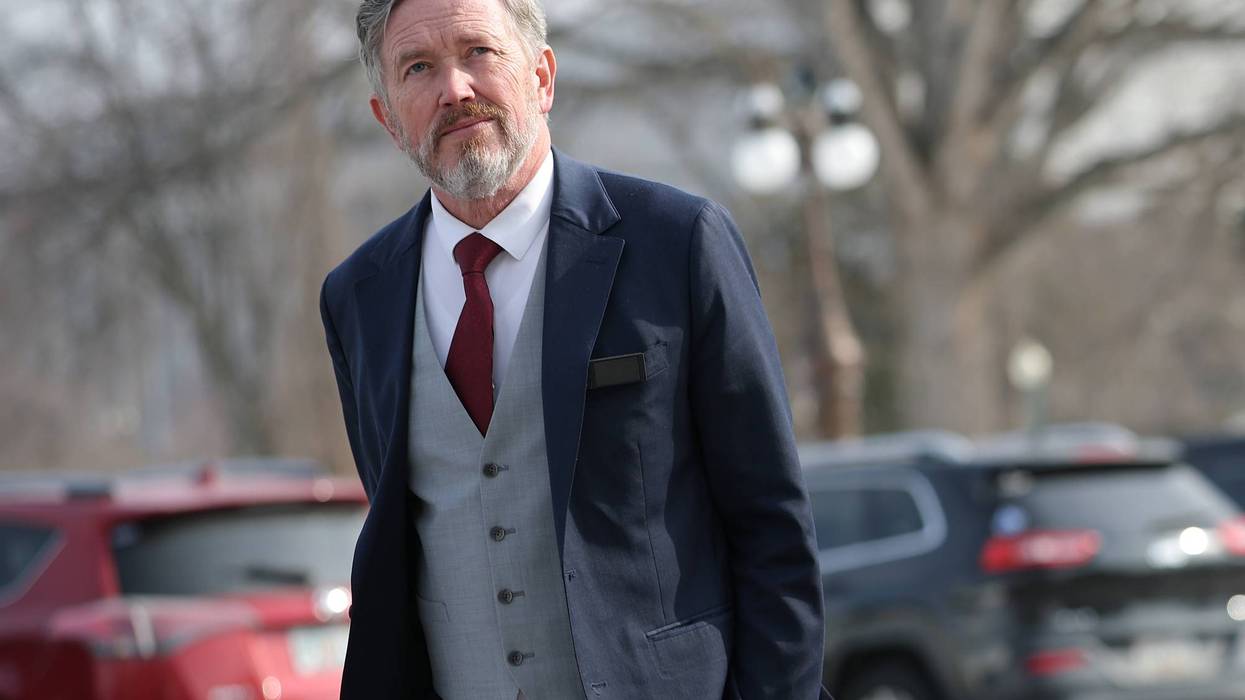
Today’s Republican rebellion against Trump does not necessarily stem from opposition to Trumpism itself. In many cases, it arises precisely because some Republicans believe Trumpism is drifting away from its own founding principles.
The Republican revolt against President Donald Trump began over an issue that was never supposed to become a crisis: another war in the Middle East.
In recent weeks, a group of Republican members of Congress has openly challenged the White House—not over taxes, immigration, or even the budget, but over the most fundamental power of any president: the authority to lead the country into war. When several Republicans chose to stand alongside Democrats and support efforts to limit the president’s war powers, something greater than a routine legislative vote took place. This was not merely a legal disagreement over the interpretation of the Constitution; it was a sign of a deeper fracture emerging at the core of a movement that was once united around Trump’s leadership.
In Washington, politicians have often voted against presidents from opposing parties. But when members of a party are willing to confront their own president on the most sensitive issue imaginable—war and peace—we are no longer dealing with a tactical disagreement. This is the moment when intellectual and ideological divisions begin to reveal themselves through political behavior.
The central question is not why a handful of Republicans have found themselves at odds with Trump. The more important question is why this disagreement has emerged precisely over an issue that was once one of the foundational pillars of Trump’s political project.
Iran today is more than just a foreign-policy issue; it is a test of Trumpism’s political credibility.
To understand the significance of this development, one must return to 2016.
Trump’s success was not simply the product of economic frustration or public dissatisfaction with political elites. He was able to build a new coalition because he was willing to challenge one of the most sacred assumptions of Washington’s foreign-policy establishment. While many Republicans continued to defend the legacy of two decades of American military interventions, Trump called the Iraq War a disaster. He argued that the United States had spent trillions of dollars in the Middle East, lost thousands of its soldiers, and still failed to achieve the security and stability it had been promised.
For millions of voters, these remarks were not merely a critique of a single war. They represented the declaration of the end of an era.
Trump promised them that America would no longer become entangled in endless wars. He pledged to separate foreign policy from idealistic nation-building projects and open-ended missions, and to refocus it on tangible American interests. It was precisely from this promise that the slogan “America First” drew much of its power.
A significant portion of Trump’s political base was neither isolationist nor anti-power. They believed America should remain strong, but that strength should not require perpetual involvement in distant conflicts. They supported a president who claimed to have learned the lessons of Iraq and Afghanistan.
That is why Iran today is more than just a foreign-policy issue; it is a test of Trumpism’s political credibility.
For many Republicans, the primary concern is not Iran itself, but the memory of Iraq. Once again, they see familiar warning signs: escalating tensions, gradually expanding objectives, requests for broader executive authority, and arguments that tie American security to the complex dynamics of the Middle East. These similarities are enough to prompt some conservatives to warn against repeating the mistakes of the past.
This is why the votes cast by some Republicans in favor of restricting presidential war powers have acquired symbolic significance. These votes were not merely attempts to restrain a specific policy decision; they were efforts to prevent a return to a pattern that Trump himself once claimed to oppose.
In reality, a segment of the Republican Party now faces a paradox that few would have imagined in 2016. They find themselves in the position of having to oppose certain decisions by Trump in order to defend the very principles that originally drew them toward him.
This is the point at which political disagreements evolve into an identity crisis.
At the same time, the issue extends beyond war itself. In the United States, wars have never been purely military phenomena. They shape the economy, influence domestic politics, affect public spending, and alter the balance of power within government. Major wars often lead to the expansion of executive authority, the growing influence of security institutions, and shifts in national political priorities.
From this perspective, Republican resistance to expanding presidential war powers is not driven solely by geopolitical concerns. Many are also worried about the domestic consequences of such a trajectory. Some conservatives believe that the deeper America becomes involved in foreign crises, the greater the concentration of power in Washington—a result that stands in direct contradiction to the original promises of the America First movement.
Here, the great contradiction of the Trump era becomes visible.
Trump rose to power by presenting himself as an opponent of two trends: endless wars and the increasing concentration of power in the nation’s capital. Yet today, some Republicans feel that both trends are reemerging. From their perspective, the issue is not simply that America may be entering another Middle Eastern crisis; it is that such a crisis could revive the very political and security structures that Trumpism was supposed to rebel against.
For this reason, recent disagreements should not be interpreted merely as a temporary dispute between the White House and Congress. What is unfolding today is a clash between two competing interpretations of “America First.”
In the first interpretation, presidential authority and greater freedom of action in foreign policy are considered necessary for safeguarding national security. In the second, fidelity to the movement’s founding principles requires avoiding a slide into new wars and subjecting presidential war powers to stricter oversight.
This divide is likely to deepen in the months ahead because Iran is not merely a regional crisis. It has become a mirror in which Republicans see their own past—the promises they made, the wars they criticized, and the movement that claimed it would redefine American foreign policy.
Perhaps the most important point is this: Today’s Republican rebellion against Trump does not necessarily stem from opposition to Trumpism itself. In many cases, it arises precisely because some Republicans believe Trumpism is drifting away from its own founding principles.
Ultimately, the current crisis is less about Iran than about identity.
It is about whether the America First movement remains the same movement that once promised to end endless wars, or whether it is gradually becoming a new version of the very foreign-policy establishment it once rose up against.
And perhaps that is why the most dangerous challenge facing Trump is not emerging in Tehran, but within the Republican Party itself—where some of his former allies are no longer certain that loyalty to Trump still means loyalty to the original ideals of Trumpism.

"There's nothing more Orwellian than voting to send 18-year-olds to die in another forever war—and then blaming them for it."
Republican US Sen. Susan Collins of Maine was widely dragged Thursday after she responded to upstart Democratic challenger Graham Platner's criticism of her vote for the Iraq War by trying to make the issue about him.
Platner—a Marine Corps combat veteran turned staunch opponent of illegal wars of choice—told The New York Times earlier this month that "we destroyed Iraq and we destroyed Afghanistan, and all the suffering, all the killing, all the dying, all the displacement—we, the United States, did that."
"The anger that I feel is for the people that sent me, who are frankly still the same people who are sending people off right now to be in harm’s way so we can have this stupid war with Iran," the presumptive Democratic nominee continued. "Susan Collins voted to send me to Iraq, and she’s also there to help [President] Donald Trump continue this absolutely insane conflict in the Strait of Hormuz."
"If I have any anger, it is reserved for the political system itself and the people in it who view war not as a thing that has a human toll but as a political game," Platner added.
Collins, who is trailing Platner by nearly double-digits in head-to-head polling, told The Maine Wire on Thursday that the Democrat "not only enlisted twice after the war was started, but he also went to work for a security company, a controversial one, named Blackwater, after his term in the service was over."
"So I respect anyone who steps forward to serve their country," Collins added, "but the fact is, that was Platner's decision to serve. He was not drafted."
Collins has voted for US wars fought in countries including Afghanistan, Pakistan, Iraq, Libya, Somalia, and Yemen. The Costs of War Project at Brown University's Watson Institute for International and Public Affairs estimates that more than 940,000 people—including over 432,000 civilians—were killed in Iraq, Afghanistan, Syria, Yemen, and Pakistan between 2001 and 2023.
More than 7,000 US service members died in the post-9/11 wars, which cost American taxpayers more than $8 trillion.
Collins has also backed the illegal US-Israeli war of choice on Iran and supported the invasion of Venezuela and abduction of Venezuelan President Nicolás Maduro.
The senator faced immediate backlash for her remarks.
"It was your decision as a senator to send Americans to fight in a dumb and pointless Iraq War," Rep. Chris Deluzio (D-Pa.) said on social media. "You voted for it. Do you tell the kids and widows of the Iraq War dead that it was their fallen hero’s fault for enlisting?"
Independent journalist Nathan Bernard said on X that "voting to send thousands of soldiers to die and then blaming them for dying doesn't seem like a great way to win over voters, especially veterans."
David Sirota, founder and editor-in-chief of The Lever, also took to X, writing: "While [Platner] was deployed in Iraq in 2007, Collins cast one of the deciding votes to block legislation to create a timetable for ending the war and bringing Platner and other troops home. She literally voted to *keep* Platner in Iraq."
Sam Seder, host of "The Majority Report With Sam Seder," accused Collins of "a stunning abdication."
"If she regrets her support of the illegal invasion and occupation of Iraq, she should say so instead of pretending the all-volunteer military owns all responsibility," he wrote.
Platner responded to Collins' attack by noting that the senator "voted to support starting the war in Iraq."
He continued:
On three occasions after that, she voted against withdrawing troops. On at least two occasions, she voted to fund the war. Now, all these years later, instead of acknowledging that she was wrong, she's decided that she's going to blame those of us, who in our late teens and early 20s, signed up to serve our country. That somehow it's our fault that she and establishment politicians like her wanted to abuse our willingness to serve, to go send us off to fight in stupid wars that did nothing but make some people very, very rich at the expense of American taxpayer dollars.
"It's no surprise to me, because even today, she continues to not stand up against the stupid war in Iran," Platner said. "She continues to not stand up against any of the abuses or the idiocy coming out of the Trump administration."
"This is very, very expected from establishment Republican politicians who love to talk about supporting the troops, but in the end, will always desert us," he added.
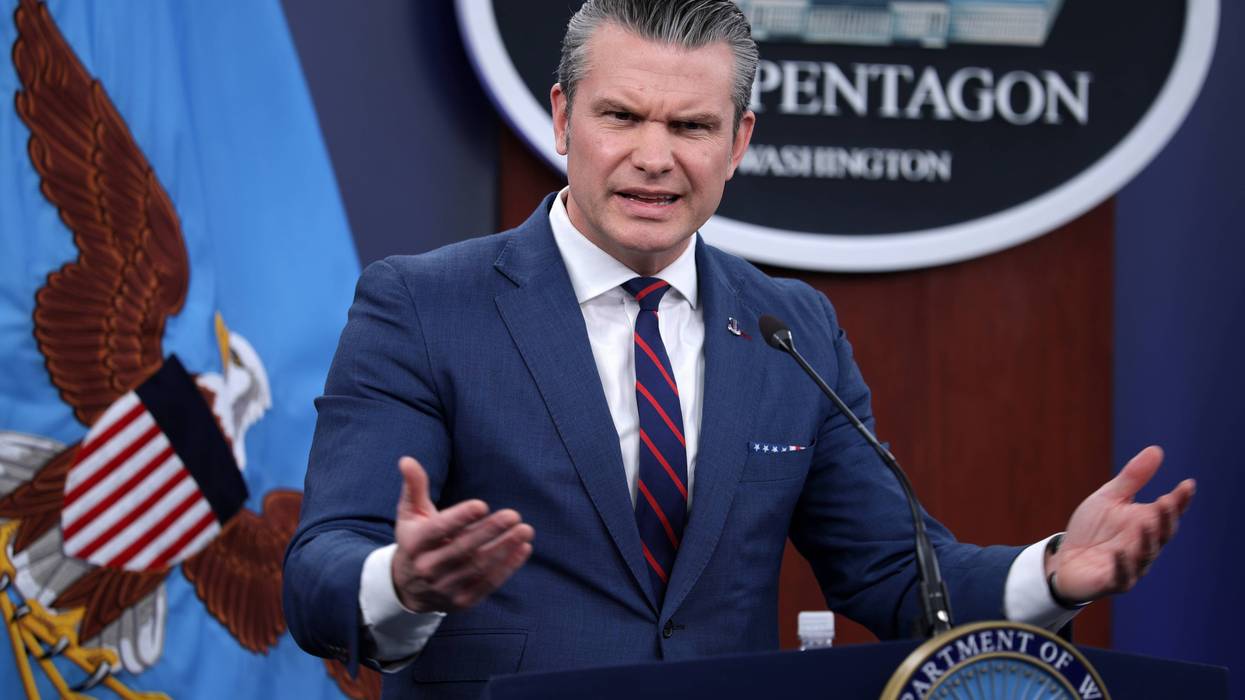
While Hegseth’s rhetoric on the post-9/11 wars often reflects mainstream Republican talking points, his zeal indicated something deeper.
Earlier this year, President Donald Trump surveyed his top military brass on the prospect of making war in Iran. Chairman of the Joint Chiefs of Staff General Dan Caine urged caution, presciently predicting that a ramped-up campaign against Iran could lead its leaders to close the Strait of Hormuz. However, Pete Hegseth, Trump’s self-styled “Secretary of War,” jumped at the prospect of such a conflict.
“Pete, I think you were the first one to speak up,” Trump recently recalled at a press event. “And you said, ‘Let’s do it, because you can’t let them have a nuclear weapon.’”
Americans join the military for any number of reasons: to serve their country, gain economic stability, or simply join a community. For Hegseth, a thirst for martial victory and a desire for a masculine metamorphosis seemed to surpass all else.
Much to Hegseth’s chagrin, however, his career as an Army officer corresponded to a series of distinctly failed military campaigns. After graduating from Princeton in 2003, he deployed to two doomed military locales—Afghanistan and Iraq—and then relentlessly defended the Pentagon’s occupation of parts of those places in essays, speeches, and, ultimately, as a weekend host on Fox News. While Hegseth’s rhetoric on those wars long reflected mainstream Republican talking points—papering over chaos and death in the Middle East and beyond with pledges that stable democracies were close at hand—his zeal indicated something deeper: a desperation, it seemed, to wring some sort of personal validation from his time in uniform.
“The rank and file, and even some of the officers, have accepted the gravity of the war’s failures,” Adam Weinstein, a Marine Corps veteran and deputy director for Middle East policy at the Quincy Institute, a nonpartisan think tank focused on peace and diplomacy, told me, speaking of Iraq and Afghanistan. “There’s a deep sense of sacrifice and loss for nothing. And that can lead to fatalistic beliefs, it can lead to Islamophobia. In its healthier form, it can lead to questioning the principles of interventionism and the U.S. foreign policy establishment.”
Hegseth, for his part, chose to totally avoid any personal or geopolitical reckoning. Once the Global War on Terror became politically untenable to defend, he cast about for excuses that wouldn’t implicate his own career in the military. Rather than zero in on tactical or intelligence failures, his rhetoric took a dark turn, increasingly inflected by Islamophobia, misogyny, and a distinctly toxic version of masculinity.
As his profile rose, Hegseth argued ever more forcefully that the Pentagon was weak-willed, insufficiently lethal, and overrun by incompetent and cowardly leaders, many of them women or minorities who (in his eyes) had been unfairly promoted. His proposed remedy was as blunt and dense as his diagnosis: America simply needed to fight harder in the Middle East until the mission was accomplished and “Islamic extremism” was eliminated. As one of his former co-workers told me, “I never got the feeling that he wanted to abandon the Middle East.”
I asked Weinstein if, during his own 2012 deployment to Afghanistan, he saw Islamophobia bubbling below the surface. “It was right on the surface,” he responded. “But what do you think the World War II generation was saying about the Japanese? Dehumanization is a natural outgrowth of war.”
“If You Want Something, You Go After It”
As a boy growing up in Minnesota, Hegseth appeared to be a perfect version of the American male. He was religious, athletic, well-spoken, and remarkably handsome. He was ashamed, however, of his self-perceived softness. “I didn’t get in fights as a kid and shied from confrontation because, frankly, I was scared of it,” he wrote in his 2016 book In the Arena, Good Citizens, a Great Republic, and How One Speech Can Reinvigorate America . In it, he went on to hail his father, Brian, for his “integrity” and “Scandinavian work ethic,” before evincing thinly veiled resentment for not having been reared effectively in the masculine art of aggression. “My father was—and is—an incredible man,” he reflected, “but confrontation isn’t necessarily his forte.”
Military service, Hegseth figured, would imbue him with some much needed and previously missing manliness. It was also his best path to class mobility and prestige. When it came time for college, he applied to West Point, America’s most prestigious service academy, and Princeton, where he was gunning for a ROTC scholarship. He got into both schools and chose the latter, touching down on its verdant New Jersey campus in 1999.
In deciding on Princeton, Hegseth launched himself on a path eerily paralleling that of another Minnesota native of a previous era, novelist F. Scott Fitzgerald. Both of them were working-class lads who attended Princeton, where they bristled at the elitism while craving its validation. Both developed a writing voice on campus and then joined the Army. Both also struggled with the bottle and with women, though Fitzgerald, unlike Hegseth, was somewhat reflective about his vices. He initially called his first novel The Romantic Egotist (later, This Side of Paradise). It followed a handsome, middle-class Princeton man whose greed and social ambition inhibited his ability to find true love. Hegseth himself expressed a similar ambition in a 2015 interview: “If you want something, you go after it—you’re willing to sleep a little less, put up with more, put up with a little insanity and do things you don’t want to do.”
In a widely read 1927 essay on his alma mater, Fitzgerald asserted that Princeton men “resent any attempt at analysis.” Hegseth also did his best to make such analysis impossible. At Princeton, he was deemed a man with “many faces,” loudly endorsing the Iraq war and attacking feminist groups on campus (even if, in quieter moments, he showed a capacity for nuance and kindness).
One of his former professors has pointed out that Hegseth’s current persona and his Princeton one “don’t fit.” Part of the disconnect stems from the fact that his puffed-up, bellicose military posturing in the Trump era doesn’t match either his Ivy League education or his actual service record. Hegseth came away from the war in Iraq with a Bronze Star that, it’s worth noting, was issued “without valor.” (It was, in short, a lesser version of the medal that, according to the Washington Post, was “issued somewhat liberally” during the War on Terror years. Some enlisted personnel joked that such a decoration was little more than a “participation trophy” for needy officers.)
Hegseth’s award citation was indeed dry and formulaic, chock-full of the soaring platitudes then used by the White House to sell the American public on the disastrous war in Iraq. It asserted (in what was, historically speaking, a fantasy) that he had “contributed immeasurably to the success of building a free and democratic nation for the citizens of Iraq.”
In reality, the supposed heroes of Hegseth’s war were generally not pedigreed Army National Guard officers like him, but door-busting, ass-kicking Green Berets and Navy SEALs. This was largely thanks to movies like American Sniper and Zero Dark Thirty that lionized their contributions.
After returning home, Hegseth made inroads with such operators via his advocacy work at a series of astro-turf veterans groups, including the “Concerned Veterans of America” (backed by the billionaire Koch brothers), which advocates for the privatization of the Veterans Administration. As part of his duties, he embarked on a 10-city “Defend Freedom” tour in 2014. Such events featured Madison Rising, billed as “America’s most patriotic rock band,” as well as speeches from decorated military heroes and family members.
On that tour, Hegseth connected with Karen Vaughn, a Gold Star mother whose son, Aaron, a SEAL Team Six member, had been killed in Afghanistan. Vaughn told me that she supports Hegseth mostly because he listens to those who have experienced conflict up close. “His friends are the people who fought these wars,” she said. “They are not the people who sat around white linen tablecloths with glasses of wine discussing them.”
Vaughn later introduced Hegseth to Eddie Gallagher, a SEAL who ignited a simmering debate over the military’s rules of engagement when he was accused of killing civilians and fatally stabbing a wounded captive. Hegseth used the case of Gallagher and two others accused of grisly war crimes against civilians in an attempt to move the Overton window on what should be deemed acceptable rules of wartime engagement. “These are men who went into the most dangerous places on earth with a job to defend us and made tough calls on a moment’s notice,” he brashly asserted. “They’re not war criminals, they’re warriors.” Ultimately, President Trump agreed with him and reversed Gallagher’s demotion after he was acquitted of the most serious charges, while pardoning other troops who had been convicted of war crimes.
It was through this work that Hegseth earned serious credibility among that badass class of warfighters and ultimately came to embody the essential Trumpian soldier archetype of this moment: White, male, and god-fearing.
The Jerusalem Cross Secretary of War
According to 2019 Department of Defense data, approximately 70% of active-duty service members were Christian (and that undoubtedly hasn’t changed in the era of Donald Trump). It’s the people who look, talk, and pray like Hegseth who also seem most receptive to opposing women serving in combat roles and in favor of Islamophobic war rhetoric. “If we’re going to send our boys to fight—and it should be boys,” he wrote in his memoirs, “we need to unleash them to win. [America needs] them to be the most ruthless.”
But the United States had already sent too many boys into harm’s way in disastrous wars and its citizens were becoming exhausted by conflict. By 2013, as Hegseth’s star was rising, 53% of polled Americans already saw the Iraq war as a mistake. That same year, Hegseth first ventured to Jerusalem, where, in a piece penned for the National Review, he hailed “Israel’s sense of purpose.” Unlike other nations, Hegseth observed, Israel maintained “an ever-present understanding that the fragile peace they enjoy and their nation itself are preserved only through intentional, purposeful, and courageous action.”
Here was a nation that could satisfy Hegseth’s unquenched thirst for military dominance in the Arab world. And unlike the United States, which sought technocratic rationales for war, Israel had the advantage of framing everything in biblical terms. “I find myself envious,” Hegseth concluded, “of the gravity and substance of the Israelis’ task.”
He repeatedly visited Israel in the years that followed, something that helped rejuvenate his faith in both God and war. In Israel, Hegseth consulted with conservative political figures and soldiers of the Israeli Defense Forces; visited military bunkers on that country’s northern border; and toured Hebron, a Palestinian city in the West Bank that Israel has targeted with attacks and settlements. He also produced a series of on-the-ground, pro-Israel documentaries for Fox News’s streaming service, including “Battle in the Holy Land,” “Battle in Bethlehem,” and “Life of Jesus.” While filming one of those projects, he first spotted a Jerusalem Cross, a symbol once used by the medieval crusaders, and had it tattooed on his chest “to show that my religion is front and center in my life.”
Hegseth’s skin would come to perfectly illustrate his signature version of hyper-aggressive Christian masculinity. His collage of body ink today includes an American flag, an assault rifle, and the words “Deus Vult” or “God wills it”—a motto from the Crusades that has been adopted by White supremacists and was seen at the deadly 2017 march in Charlottesville, Virginia. Hegseth also inked the word “kafir,” meaning “infidel” or “non-believer,” on his right bicep.
By 2016, he had come to see Israel’s success as inexorably bound to that of the United States. That January, when President Barack Obama ratified a historic nuclear deal with Iran, Hegseth saw a cowardly capitulation to a country that, he argued then, “would wipe both Israel and America off the map if it could.” During a visit to Israel that year, he pledged to an audience that the United States was forever prepared to “lock arms and shields with all of you in defense of freedom and western civilization.”
It’s this history, as much as anything, that helps explain America’s current war with Iran. In Secretary of War Hegseth, America now has a man with a bone-deep desire for national revenge, one largely animated by his poorly disguised sense of embarrassment at, and personal emasculation over, the utter failures of the wars he fought in.
These are, of course, profoundly flimsy, deeply egotistical excuses for sending American troops into harm’s way yet again. Not surprisingly, then, there have even been a series of public rejections and defections by former Trump administration figures frustrated by the conflict with Iran. The most notable of these is Joe Kent, a former counterterrorism official in the Trump administration who resigned his post, citing “no imminent threat to our nation” from that country. Director of National Intelligence Tulsi Gabbard and CIA Director John Ratcliffe have also tacitly acknowledged that the war in Iran was not launched by an actual threat index.
As Hegseth has made clear in his words and deeds, the latest American war is largely animated by emotional factors, plus (as reporting has shown) intense pressure from Israel. Now being in charge of the Pentagon, and with a renewed opportunity to pummel the Middle East, he has dropped all institutional pretense to compassion or caution. “We are punching them while they’re down,” he recently told reporters, “which is exactly how it should be.” In practice, this has meant a brutal bombing campaign in conjunction with Israel that targeted, among many other things, a girl’s primary school and oil tankers in the Strait of Hormuz, acts that respectively killed children and polluted the region. Hegseth also pledged not to offer quarter to enemy combatants in violation of international law.
He certainly hopes that faith and masculine posturing alone can secure success. Absent tangible intelligence, he has taken a page out of Israel’s book by injecting religiosity across the ranks, recently promising on CBS News that “the providence of our almighty God is there protecting those troops, and we’re committed to this mission.” Asked directly if he views this conflict as a religious one, Hegseth said, “Obviously, we’re fighting religious fanatics who seek a nuclear capability in order for some religious Armageddon.”
To bolster such an atmosphere, he has hosted Pentagon prayer services involving fiery Christian nationalist pastors and a Grammy-award-winning religious singer. His department’s promotional videos have displayed Bible verses alongside military footage. Watchdogs further claimed that U.S. commanders have counseled troops that the war is fulling biblical prophecies around Armageddon. Hegseth’s fusion of strength, religion, and violence was encapsulated in a poster allegedly displayed at a U.S. military installation in recent days. It featured Jesus Christ firing a mortar round.
Hegseth’s 2024 book, The War on Warriors, further sketches out his theory for reinvigorating the military’s masculine ethos, often through half-assed aphorisms that could fit on a Ford F-350 bumper. Sprinkled in are mythical tales, most of which have Hegseth or another aggrieved White guy at their center. The military has become so warped and woke, he writes, that it has diluted standards to allow women in combat while simultaneously kicking out “good soldiers for having naked women tattooed on their arms.” In Hegseth’s eyes, of course, women should only be on the front lines if they’re naked and in ink.
