

SUBSCRIBE TO OUR FREE NEWSLETTER
Daily news & progressive opinion—funded by the people, not the corporations—delivered straight to your inbox.
5
#000000
#FFFFFF
To donate by check, phone, or other method, see our More Ways to Give page.
Daily news & progressive opinion—funded by the people, not the corporations—delivered straight to your inbox.

Trump claimed to have "59% approval" while not a single pollster even has him above water. Meanwhile, oil prices are shooting back up after he restarted the war in Iran.
It is once again Opposite Day for President Donald Trump, who claimed in a late-night social media post that his approval rating is high and oil prices are dropping, neither of which is actually true.
"59 percent Approval Rating. Prices coming down along with the lowering of oil and gas. Thank you! President DJT," Trump wrote Sunday night on Truth Social.
Trump did not specify what poll had him at 59% approval, presumably because it does not exist. Not a single one of the polls tracked by The New York Times or RealClearPolling's aggregators shows Trump even breaking even with the public.
The Times average as of Monday morning has his approval rating at 39%, with 58% disapproval—on par with the worst metrics of his second term. RCP’s average is only slightly more merciful, showing the president’s approval at just under 40% and his disapproval at 57%.
Even the GOP-friendly pollster Rasmussen shows him with just 44% approval and 54% disapproval—generous outlier numbers for the president.
It is, of course, possible that Trump was referring to some heavily massaged poll that only he has seen, though he has a long history of inflating his popularity while claiming that polls showing otherwise are "fake news."
The price of oil, on the other hand, is something that can't be faked, though it didn't stop Trump from trying.
This weekend, Trump launched a new series of attacks against Iran, after declaring earlier in the week that the peace framework signed last month was “over” and saying negotiations were a “waste of time.”
Iran responded by announcing late Saturday night that it would seal off the Strait of Hormuz to most traffic, once again choking off a main route for global oil and gas transport.
Asked about the closure on Sunday, Trump told reporters, "I don't want to talk about it."
His post seems to reveal a further commitment to denying reality. Contrary to his claim about the "lowering of oil and gas," US gas prices on Monday averaged $3.87 per gallon, up from $3.80 a week earlier.
Meanwhile, the price of Brent crude has shot up by more than 9% over the past week, from $72 per barrel last Monday to nearly $79 as of this writing. At the time of Trump’s tweet, oil prices had already climbed by about 4% and continued to increase into Monday morning.
Prices are down from the war's height in the springtime, when gas surpassed $4.50 per gallon and a barrel of oil cost more than $110. But crude prices are still 9% higher than prewar, while gas is up about 31%, with companies capitalizing on the war to pad their profit margins at the expense of consumers and businesses.
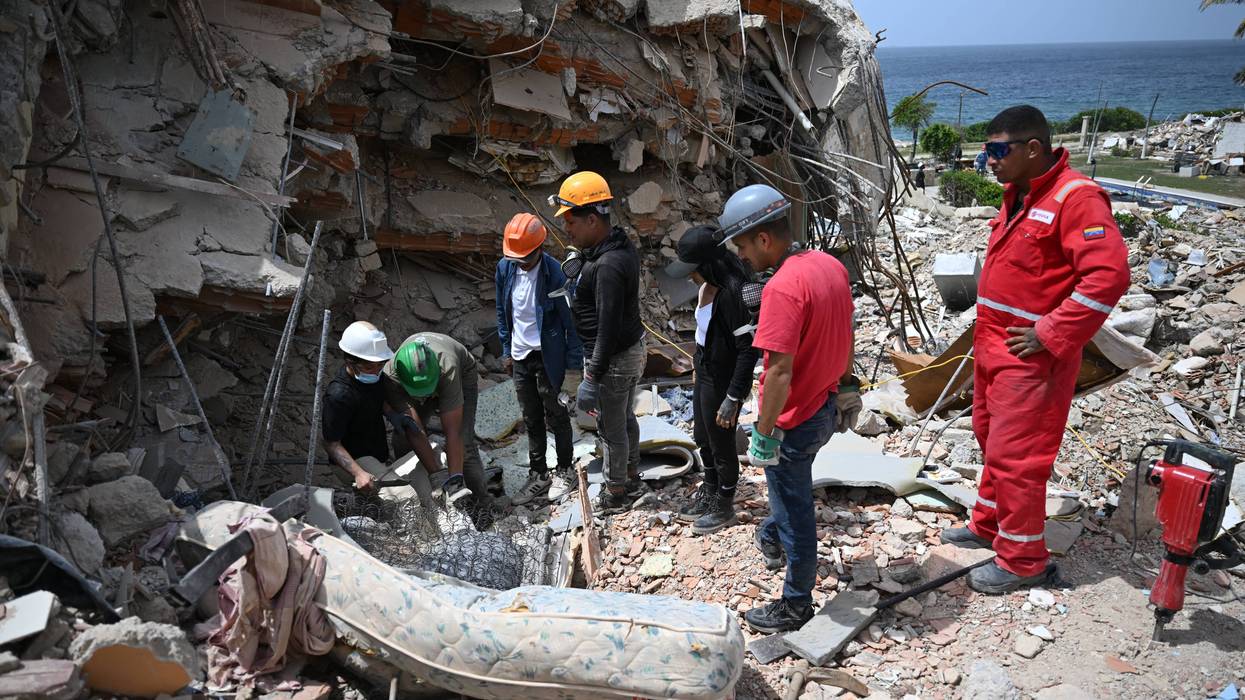
"Will these funds be released for the disaster response?” asked a former US ambassador to Venezuela.
The Trump administration has seized at least $8 billion worth of Venezuela's oil wealth since it overthrew President Nicolás Maduro in January, according to the New York Times.
Now, as Venezuela struggles to cope with a catastrophic pair of earthquakes late last month that killed at least 3,300 people and left tens of thousands more injured and homeless, and 41,000-50,000 people are reported missing, the US is providing just $300 million in humanitarian aid, a small fraction of the money it purloined.
The Associated Press reported on Monday that international rescue teams have begun to pull out as hopes of finding missing loved ones alive dwindle each day after the disaster.
Shortly after deposing Maduro, US President Donald Trump declared that the US "took over Venezuela... and the oil is flowing.”
Economist Francisco Rodriguez has found that during the first quarter of 2026, after Trump overthrew Maduro and the US began expropriating Venezuelan oil, the country experienced the lowest rate of economic growth since 2021, even as oil exports rose.
As Roxanna Vigil, a former senior sanctions policy adviser at the US Treasury Department’s Office of Foreign Assets Control, explained in an article for the Council on Foreign Relations last month, "almost 100 million barrels of oil worth an estimated $8 billion have flowed through a process marked by no transparency and minimal oversight."
"While the Trump administration has repeatedly framed this control as benefiting both countries, it has not publicly disclosed how much Venezuelan oil it has sold, how much revenue it has collected, or how it has used those funds," she added.
According to an initial report by the United Nations Development Program, the quakes caused $6.7 billion worth of damage.
Former US Ambassador to Venezuela Jimmy Story credited what he said was a “robust” US effort to provide aid. But he told Reuters that it called into question "the transparency over the oil fund," and asked, "Will these funds be released for the disaster response?”
The Times noted that the Trump administration's response to the Venezuela quakes is dwarfed by the humanitarian response to the earthquake that struck Haiti in 2010, when the US launched a more than $3 billion relief effort and deployed more than 7,000 troops.
Just 900 US troops are on the ground in Venezuela, with another 800 positioned in Puerto Rico and Curaçao to support the operation.
The Times' Simon Romero, who has reported on earthquakes in both countries, noted that the Haiti earthquake was more destructive, but said:
The parallels between the disasters are also haunting: Pancaked multistory concrete buildings, bodies flooding into overwhelmed morgues, survivors disparaging government responses, and civilians leading desperate rescues of people trapped in the rubble.
Viewed against cityscapes clouded by dust from pulverized structures, the images speak to hollowed-out first responder agencies, generalized impoverishment, and political dysfunction in both Haiti and Venezuela.
Beyond the $8 billion taken out of Venezuela since January, anti-war and human rights groups in the US have urged the Trump administration to lift the economic sanctions that have crippled the Venezuelan government, arguing that they have hobbled the recovery effort.
The Washington Office on Latin America (WOLA) estimated that during just four years, between 2017-20, US sanctions caused the Venezuelan state to lose between $17 billion and $31 billion in revenue.
A more recent report by the Tricontinental Institute for Social Research found that between 2017-24, Venezuela suffered an estimated $226 billion in lost oil revenue due to US sanctions, equivalent to 213% of its total gross domestic product.
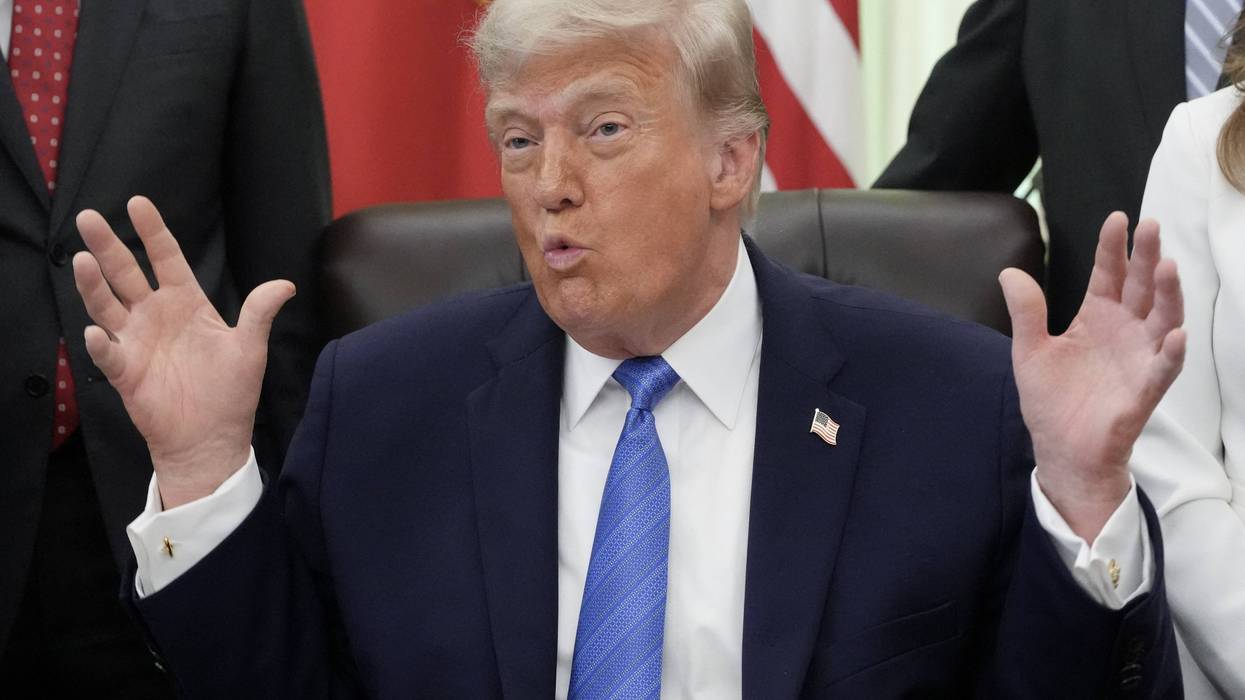
Senior officials have warned that an invasion of Iran’s Kharg Island could cause many American casualties. But Trump said the US would “make a fortune.”
While promising more strikes against Iran on Thursday, President Donald Trump suggested that the US would soon be "taking" Kharg Island in an imperialist bid to seize "total control" of the country's oil and gas market, an operation that would likely require ground troops.
“The United States will be hitting Iran (Whose Navy, Air Force, Radar, Anti Aircraft, and all other forms of Defense, together with most of its offensive capability, are GONE!), VERY HARD TONIGHT,” the president wrote in a Truth Social post, following days of strikes that hit military infrastructure and also damaged a pair of reservoirs that left around 20,000 people without drinking water.
“At some point in the not too distant future, we will be taking Kharg Island, and other oil infrastructure points, and assume total control of their Oil and Gas Markets, much like we have with Venezuela, which is working out brilliantly for both Venezuela and the United States of America,” he added.
It's not the first time Trump has threatened to take the island, which handles about 90% of Iran's crude oil exports and is of paramount importance, as Iran's blockade of the Strait of Hormuz in retaliation for the US-Israeli war has sent oil prices skyrocketing and resulted in the most severe inflation the US has seen in over three years.
Like in Venezuela, where Trump said the point of the US operation to overthrow President Nicolás Maduro was to "get the oil flowing" to US corporations, the president said his objective in taking Kharg Island was explicitly about enriching the US by using raw force to commandeer Iran's natural resources.
Trump: "My preference has always been to take Kharg Island. I don't know that America has the stomach for it, to be honest with it. You'd make a fortune." pic.twitter.com/5ub1HK4WMH
— Aaron Rupar (@atrupar) June 11, 2026
"My preference has always been to take Kharg Island," he said on a phone interview with Fox News on Thursday morning. "I don't know that America has the stomach for it, to be honest with you. You'd make a fortune..."
“We did it with Venezuela,” he continued. "Venezuela’s worked out great for everybody. We’ve taken millions and millions of barrels of oil out of Venezuela. We’ve brought them to Houston and various other places, Louisiana. Refineries that we have that are incredible, they’ve gone 24 hours a day. Making a fortune.“
However, he said he wasn't sure that the country, which is strongly opposed to strikes against Iran according to recent polls, "has the appetite" for it.
As senior CNN political correspondent Aaron Blake explained, "it's widely assumed that taking and keeping Kharg Island would require ground troops," an idea that just 18% of Americans said they supported in a May survey from the Institute for Global Affairs. Even Republicans were more likely to oppose boots on the ground than to support them, according to that poll.
The Trump administration has had plans drawn up to invade the island as far back as March, but they were reportedly shelved as US officials feared large numbers of American casualties, especially as Iran had prepared for an invasion by laying anti-personnel and armor mines.
Despite being aware of the plan's unpopularity with the American public, Trump said on Thursday that taking Kharg Island would be "a guarantee if I want to do it."
President Trump is now publicly claiming that the United States will SEIZE KHARG ISLAND. What are the advantages to doing so, what are the disadvantages, and is this a viable strategy?
Let’s start with the disadvantages first, because… it’s grim. And stupid.
One of the key… pic.twitter.com/yZeVAPRB3D
— Brett Erickson (@BrettErickson28) June 11, 2026
Brett Erickson, a sanctions and geopolitical-risk expert who serves as managing principal of Obsidian Risk Advisors, said the idea was "grim and stupid."
“Their exports [from the island] are not even close to what they were prior to the war, or even throughout March and the first half of April,” he explained. “In the last five weeks, Iran has loaded a whopping one vessel at Kharg Island.”
He added that since the island is a "fixed position," it "would constantly come under fire from drones and missile barrages."
"We would likely, in the absolute best case, lose hundreds of lives," he said. Worst case? Well into the thousands. Would it change anything about the war? No. It literally would not matter."
The only thing to be gained, he added, would be "a lot of Americans dying for an oil export hub that is not being used, and that is blockaded anyway."
Asked by reporters on Capitol Hill about Trump's threats to invade the island, House Speaker Mike Johnson (R-La.) hardly seemed bullish on the idea. He said he believed Trump was "communicating directly with our adversaries over there," adding, "I would not put too much stock in the details of that right now."
But the idea does have its cheerleaders. Sen. Lindsey Graham (R-SC), who is credited with helping Israel persuade Trump to launch the war in the first place.
The notorious war hawk, who previously compared taking Kharg Island favorably to the World War II Battle of Iwo Jima, where the US suffered 26,000 casualties, said on Thursday that Trump was “right to put on the table the taking of Kharg Island” and thanked the president for “going the extra mile to obtain a diplomatic solution to the Iranian conflict.”
US Rep. Ted Lieu (D-Calif.) argued that invading the island without approval from Congress "would be brazenly unconstitutional."
"American troops would die during the invasion," he said. "And then every day Iran would try to kill more American troops on Kharg Island."
Four Republicans joined every Democrat last week to pass a war powers resolution meant to halt Trump's ability to wage war against Iran without approval from Congress.
In the wake of Trump's threats to invade the Island, Lieu said the "Senate must pass the House’s war powers resolution."
