

SUBSCRIBE TO OUR FREE NEWSLETTER
Daily news & progressive opinion—funded by the people, not the corporations—delivered straight to your inbox.
5
#000000
#FFFFFF
To donate by check, phone, or other method, see our More Ways to Give page.
Daily news & progressive opinion—funded by the people, not the corporations—delivered straight to your inbox.
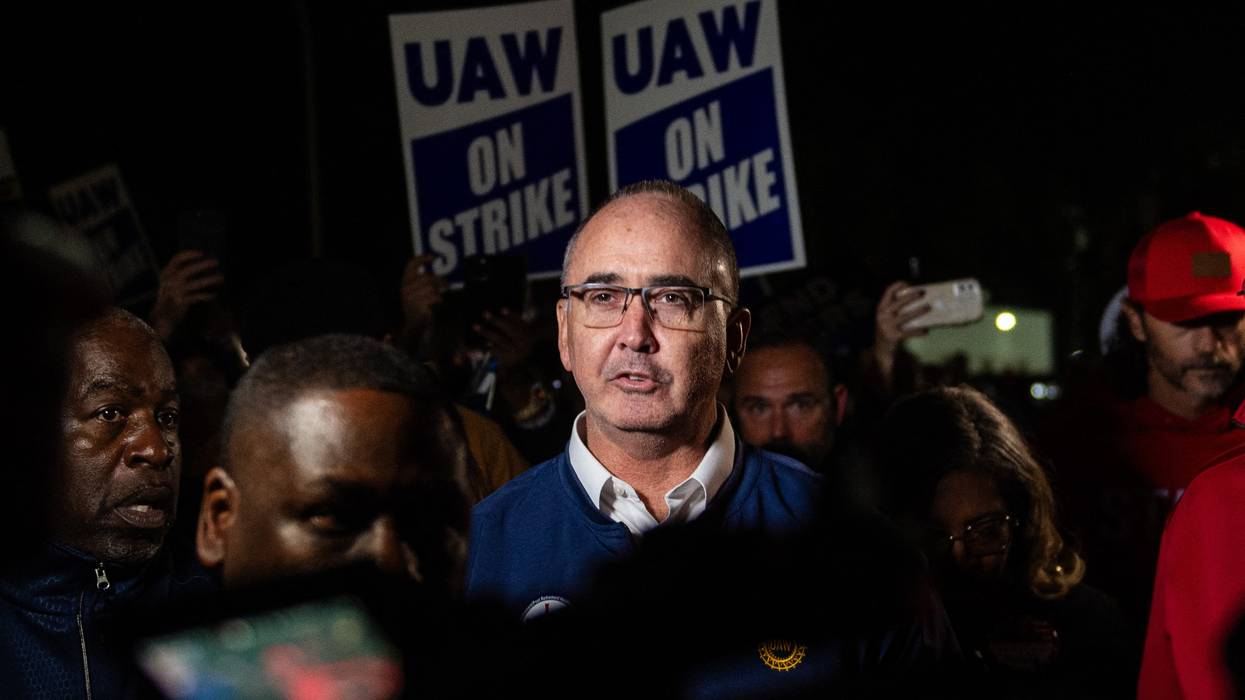
"This is what happens when you go against corporate America and their allies," said the United Auto Workers president.
United Auto Workers president Shawn Fain issued a fiery statement on Sunday vowing to "fight back hard" as President Donald Trump's Justice Department launched a probe into allegations that the union leader abused his authority to seek benefits for his fiancée and her sister.
Fain rejected the claims as "false" and accused UAW vice president Rich Boyer, who is vying for the union presidency, of "trying to weaponize these bogus allegations to steal the upcoming UAW election." Fain also hit out at court-appointed federal monitor Neil Barofsky, whom the union president accused of harboring "a political grudge against me because the UAW took an anti-war stance about what was happening in Gaza."
"Rich Boyer has fed the monitor false allegations about me," said Fain. "We're going to fight back hard."
In 2023, Fain emerged as one of the most prominent union leaders in the nation during the UAW's weeks-long "Stand Up Strike" against the Big Three automakers, which yielded historic contracts for UAW members. On Sunday, Fain suggested that the union's successes under his leadership are fueling his opponents' attacks.
"This is what happens when you go against corporate America and their allies," said Fain, "and I'm not going to be intimidated or harassed out of serving our membership."
Bloomberg reported Sunday that the US Justice Department has launched a grand jury probe into allegations that Fain "sought a financial bonus for his fiancée and pushed for a worker’s compensation claim for her sister."
"He allegedly retaliated against Boyer for refusing to approve the benefits by stripping the official of his duties as chief negotiator with Stellantis NV, the maker of Jeep and Ram vehicles," Bloomberg noted. "The allegations became public last month in a report by the court-appointed monitor."
Fain on Sunday denied retaliating against Boyer. "The truth when it comes to Boyer," Fain said, "is that I didn't want him running the Stellantis Department because he wasn't doing a good job for our members."
The UAW president went on to accuse Boyer of trying to "hire family members into UAW positions" and failing to enforce the union's contract with Stellantis.
"Boyer is bad for our union and I'm not going to let him use the monitor's bogus investigation so he can try to fail upwards into a bigger title," said Fain. "Our election is in six weeks. Neil Barofsky will not run our union, no matter how hard he tries. And no company sellout like Boyer is going to dictate our elections."
Barofsky was appointed as UAW monitor in 2021—around two years before Fain was sworn in as union president—as part of a consent decree with the Justice Department in the wake of a corruption investigation.
Relations between Fain and Barofsky have reportedly been strained since late 2023, when the UAW became the largest union in the US to call for a ceasefire in Gaza as the Palestinian enclave faced a massive Israeli assault.
Shortly after the UAW's demand, according to The Detroit News, Barofsky "called Fain for a personal conversation related to the ceasefire statement and other issues around the war—a call Fain would later indicate made him uncomfortable, and that a union lawyer told Barofsky was out of line."
In February 2024, weeks after the UAW's ceasefire call, Fain and Barofsky had an "expletive-laden discussion" that Fain says "led to the monitor launching an investigation into him," The Detroit News reported last week. Fain reportedly said at one point during the February phone meeting that Barofsky accused the union leader of being antisemitic, which Fain furiously denied.
"For anybody to ever f------ say I'm antisemitic, brother, I'll fight your ass in front of this building in a heartbeat," Fain said, according to The Detroit News. "I do not f------ like that, and I don't appreciate it."

"Working Americans increasingly report that their paychecks can't keep up with Trump's high prices, but are not confident they’ll be able to find better opportunities," noted one Groundwork Collaborative expert.
As President Donald Trump's team on Thursday tried to paint the June jobs report as positive, economists and congressional Democrats called it "weak" and "disappointing," with some also ripping the Republican administration's harmful policies, from sweeping tariffs and the Iran War to the mass detention and deportation of immigrants.
The nation's economy added just 57,000 jobs in June, or roughly half of what economists had anticipated, according to the latest monthly report from the US Bureau of Labor Statistics. BLS noted that "both the unemployment rate, at 4.2%, and the number of unemployed people, at 7.1 million, changed little in June."
The Department of Labor (DOL) agency also revised job gains down for May by 43,000 and April by 31,000, and said that "over the year, average hourly earnings have increased by 3.5%." That's notably lower than the 4.2% annual inflation rate detailed by BLS a few weeks ago, as Americans struggle to afford groceries, housing, and other basic necessities during Trump's second term.
"Today's weak jobs numbers are grim warning signs of a struggling labor market," Alex Jacquez, a former Obama administration official who is now Groundwork Collaborative's chief of policy and advocacy, said in a statement.
"Job gains reflect temporary seasonal hires and other workers separated from the broader economy while the majority of the labor force is frozen," he explained. "Working Americans increasingly report that their paychecks can't keep up with Trump's high prices, but are not confident they'll be able to find better opportunities. They're instead focused on trying to keep up with the president's price hikes."
Angela Hanks, a former DOL senior official who's now chief of policy programs at The Century Foundation, similarly called the report "yet more evidence of a fragile economy under President Trump, with job growth coming in well below expectations and sizable downward revisions to the last two months."
"While the unemployment rate dipped slightly to 4.2%, this number only tells us how many people are working—it doesn't tell you whether people can afford to live," she stressed. "The reality behind today's jobs numbers is that the cost of living continues to outpace paychecks: 43% of Americans now say they're worse off financially than they were a year ago, and year-over-year wage growth came in at 3.5%, below overall inflation of 4.2%—meaning that real wages are falling."
"Looking beyond the topline numbers, more than half of all June job growth was concentrated in healthcare and social assistance, continuing a trend of these sectors propping up much of our economy," she pointed out. "The labor force participation rate declined sharply and widely, with nearly every demographic group seeing declines, which partially explains the drop in the unemployment rate. Moreover, certain racial and age disparities actually worsened: Black youth unemployment rate rose to a whopping 26.8%, as did Hispanic youth unemployment, coming in at 20.1%—a reminder that this economy is not delivering for workers who are struggling the most."
Hanks added that “while Trump will surely tout this moderate job growth as a win, not long ago numbers like today's would have prompted serious concern. But families aren't grading Trump on a curve: They feel the impacts of this administration's chaotic and costly economic policies every day. Until working people can actually afford their lives—groceries, housing, healthcare, childcare—claims of a 'strong economy' will continue to ring hollow."
In line with Hanks' prediction, Trump's messengers attempted to frame the figures positively, with his press secretary, Karoline Leavitt, celebrating the declining foreign-born labor force amid the administration's deadly crackdown on immigrants, and her deputy, Kush Desai, claiming the report "reinforces that the American labor market remains solid."
Acting Secretary of Labor Keith Sonderling—whom the president earlier this week nominated for the permanent post—said that "Trump's America first agenda continues to provide greater wages for workers and certainty to the sectors which will fuel the next 250 years of US economic security."
Meanwhile, with the midterm elections just four months away, the Democratic National Committee's rapid response director, Kendall Witmer, declared that "Donald Trump's failed economic agenda has driven working families into a corner as Americans worry about how to find a job and keep up with sky-high prices. The reality for working families is undeniable: Trump has wrecked the economy, leaving millions wondering how they will make ends meet with no relief in sight."
"But Trump doesn't give a shit—he's only focused on building his vanity projects and using the power of the presidency to get even richer," added Witmer, just two days after the president's annual financial disclosures revealed that he pocketed an unprecedented $2.2 billion—over half of it from his family’s cryptocurrency grift—during his first year back in the Oval Office.
Congressman Ted Lieu (D-Calif.) took to social media over "another disappointing jobs report" and also called out GOP priorities, from erecting a giant arch in Trump's honor to putting his name on various items, including passports and the $250 bill.
As Lieu concluded, "November is coming."
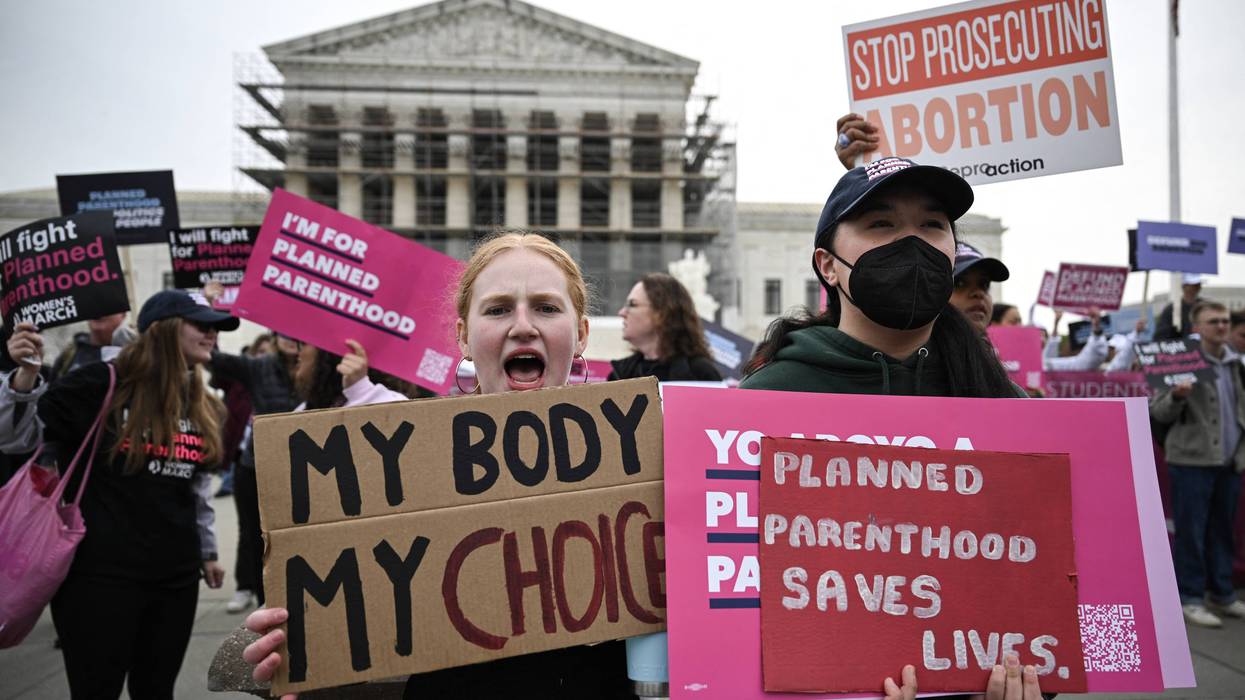
States that deny people's bodily autonomy limit "their ability to pursue the education and career options that are right for them, and to build financial stability," said the Institute for Women's Policy Research president.
Reproductive rights advocates and experts have long highlighted the dangers of abortion bans to people's health, but amid a wave of new state-level restrictions in the wake of Roe v. Wade's reversal, some have also recently emphasized the economic impact, as detailed in an analysis published Tuesday by the Institute for Women's Policy Research.
"IWPR's latest estimates show that states with the most restrictive abortion policies could cost the national economy nearly $68 billion annually in lost earnings, up from $64 billion in last year's estimate," according to the analysis. "Historically, legal abortion access has increased women's labor force participation and earnings. IWPR's analyses suggest that abortion restrictions continue to erode those gains nationwide, reducing women's labor force participation and earnings potential while weakening state and national economies in the process."
"Those losses—amounting to billions of dollars—could otherwise support what families actually need: affordable healthcare, caregiving, higher wages, business growth, and new jobs that strengthen local communities and state economies," the report notes. "This $68 billion estimate reflects only the impact of the most severe restrictions, including total bans and six-week gestational bans, that were in effect in 16 states in 2025."
The publication points out that "many other states may not have banned abortion outright, but still impose barriers that make abortion care harder to access, like waiting periods, mandated counseling, or targeted regulations on abortion providers that delay or deny care altogether. When accounting for all state-level restrictions on abortion access, combined with the federal funding prohibitions and the absence of federal protections, the annual average economic cost now exceeds $140 billion nationwide."
The overall figure is nearly $7 billion more than IWPR's estimate from last year. Putting that figure into context, the report explains that $7 billion "could fund Supplemental Nutrition Assistance Program (SNAP) benefits for about 1 million American families with children for an entire year. This is a striking figure considering the so-called 'One Big Beautiful Bill's' cuts to the program, which are projected to reduce or eliminate benefits for many low-income households."
Removing barriers to reproductive care on a national scale "could mean nearly 325,000 more women participating in the labor force each year, with the largest increases concentrated in states with some of the most restrictive abortion policies," IWPR estimated. For example, in Alabama, Kentucky, and Louisiana, their labor force participation could be over 1.3% higher, while in Mississippi, it could be up 1.5%.
If more women joined the workforce thanks to policies allowing reproductive freedom, IWPR projected that "national gross domestic product (GDP) could rise by 0.5%, and the economic gains would be largest in states such as Alabama, Arkansas, South Carolina, and West Virginia, which rank poorly on both abortion protections and per capita GDP. These states could potentially see their GDP grow by nearly 1% annually."
Like previous analyses, the publication also acknowledges that "Black and Latina women are more likely to experience the consequences of restrictive abortion policies and confront additional economic and structural barriers to accessing care that their White counterparts do not—even as abortion restrictions harm all women and the economy more broadly."
IWPR president and CEO Jamila K. Taylor stressed in a Tuesday statement that "this is fundamentally about human rights and economic justice."
"We know that legal access to abortion care increases women's autonomy to be able to participate in the labor force, which supports the stability of our entire economy," Taylor said. "When states deny people their bodily autonomy, they're also limiting their ability to pursue the education and career options that are right for them and to build financial stability for their family and community. Abortion restrictions don't just harm those who may become pregnant—they harm everyone."
President Donald Trump delivered mixed messages during the last campaign cycle: bragging about being the one to appoint the justices who helped reverse Roe with the Dobbs v. Jackson Women's Health Organization decision, but also suggesting that he wasn't in favor of a nationwide ban on abortion and that the issue doesn't really matter to Americans.
Since returning to the White House, the Republican and his allies in Congress have taken steps to reduce access to reproductive healthcare, and although the right-wing Supreme Court last month declined to restrict access to mifepristone, at least for now, Trump's Food and Drug Administration (FDA) is currently reviewing the medication, which is commonly used in abortion and miscarriage care.
Reproductive rights advocates have sounded the alarm over the FDA review. In response to reporting on it earlier this month, Planned Parenthood CEO Alexis McGill Johnson called it "a politically motivated farce."
"Mifepristone is safe and effective. We know it, the FDA knows it, and the more than 7.5 million people who've used mifepristone for abortion and miscarriage care over the past 25 years know it too," Johnson said. "But the Trump administration is bulldozing the overwhelming body of medical research and evidence to try to make it harder for everyone, everywhere to get an abortion. It's time for every American to take this threat seriously."
