Log In


Satsuma-Ioujima (Satsuma-Iwojima; Iou island), Mishima village, Kagoshima District, Kagoshima Prefecture, Japani
| Regional Level Types | |
|---|---|
| Satsuma-Ioujima (Satsuma-Iwojima; Iou island) | Island |
| Mishima village | Village |
| Kagoshima District | District |
| Kagoshima Prefecture | Prefecture |
| Japan | Country |
This page is currently not sponsored. Click here to sponsor this page.


Area:
12 km2
Type:
Other Languages:
French:
Iōjima, Mishima, district de Kagoshima, Kagoshima, Japon
Italian:
Iōjima, Mishima, Distretto di Kagoshima, prefettura di Kagoshima, Giappone
Japanese:
硫黄島, 三島村, 鹿児島郡, 鹿児島県, 日本
Russian:
остров Ио, Мисима, Округ Кагошима, Кагосима, Япония
Simplified Chinese:
硫磺島, 三島村, 鹿兒島郡, 鹿儿岛县, 日本
Spanish:
Iōjima, Mishima, Distrito de Kagoshima, prefectura de Kagoshima, Japón
Bengali:
ইয়োজিমা , কাগোশিমা প্রশাসনিক অঞ্চল, জাপান
Cebuano:
Iō-jima , Mishima Mura, Kagoshima-gun, Kagoshima-ken, Hapon
Czech:
Iódžima, Prefektura Kagošima, Japonsko
Dutch:
Iōjima, Mishima, Kagoshima District, Kagoshima, Japan
Swedish:
Io-jima, Mishima, Kagoshima prefektur, Japan
Traditional Chinese:
硫磺島, 三島村, 鹿兒島郡, 鹿兒島縣, 日本
Ukrainian:
Іодзіма , Місіма, Префектура Каґошіма, Японія
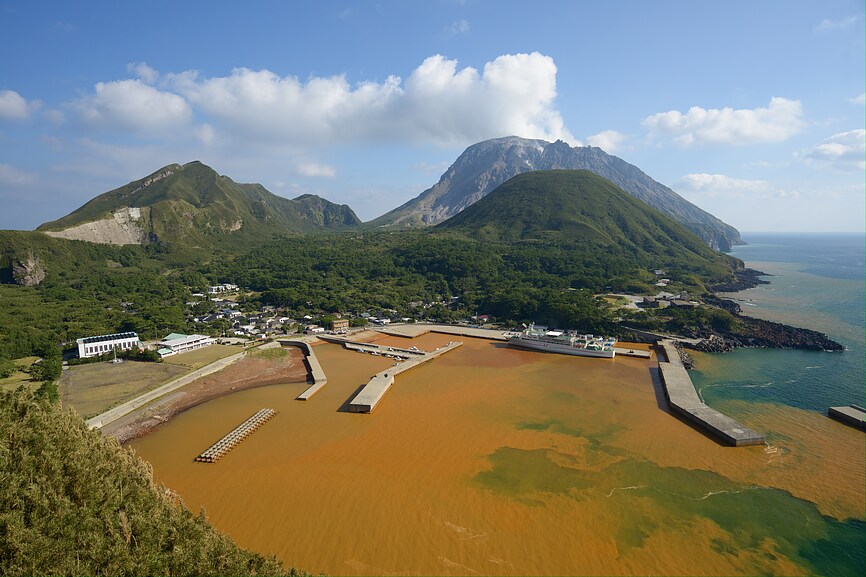
Small volcanic island with very high-temperature fumaroles (up to 945 °C, Matsuo et al. 1974). Rhyolite leached out by acid fumaroles was mined for silica (up to 97% SiO₂). Fumarole gases here have the highest content of molybdenum vapour (1 ppm) and gold vapour (32 ppb) of any volcano (Hedenquist et al. 1994).
(Note: This is NOT the same Iwo-jima that became famous in WW2 - See under Tokyo Prefecture.)
Select Mineral List Type
Standard Detailed Gallery Strunz Chemical ElementsMineral List
Mineral list contains entries from the region specified including sub-localities43 valid minerals.
Rock Types Recorded
Rock list contains entries from the region specified including sub-localities
Select Rock List Type
Alphabetical List Tree DiagramDetailed Mineral List:
Gallery:

List of minerals arranged by Strunz 10th Edition classification
| Group 1 - Elements | |||
|---|---|---|---|
| ⓘ | Clinosulphur | 1.CC. | S8 |
| ⓘ | Native Sulphur | 1.CC.05 | S8 |
| Group 2 - Sulphides and Sulfosalts | |||
| ⓘ | Sphalerite | 2.CB.05a | ZnS |
| ⓘ | Pyrrhotite | 2.CC.10 | Fe1-xS |
| ⓘ | Molybdenite | 2.EA.30 | MoS2 |
| ⓘ | Pyrite | 2.EB.05a | FeS2 |
| Group 3 - Halides | |||
| ⓘ | Halite | 3.AA.20 | NaCl |
| ⓘ | Sylvite | 3.AA.20 | KCl |
| ⓘ | Challacolloite | 3.AA.55 | KPb2Cl5 |
| ⓘ | Cotunnite | 3.AB.85 | PbCl2 |
| Group 4 - Oxides and Hydroxides | |||
| ⓘ | Goethite | 4.00. | Fe3+O(OH) |
| ⓘ | Magnetite | 4.BB.05 | Fe2+Fe3+2O4 |
| ⓘ | Hematite | 4.CB.05 | Fe2O3 |
| ⓘ | Ilmenite | 4.CB.05 | Fe2+TiO3 |
| ⓘ | Quartz | 4.DA.05 | SiO2 |
| ⓘ | Opal | 4.DA.10 | SiO2 · nH2O |
| ⓘ | Tridymite | 4.DA.10 | SiO2 |
| ⓘ | Opal var. Opal-AG | 4.DA.10 | SiO2 · nH2O |
| ⓘ | var. Hyalite | 4.DA.10 | SiO2 · nH2O |
| ⓘ | Cristobalite | 4.DA.15 | SiO2 |
| ⓘ | Cassiterite | 4.DB.05 | SnO2 |
| ⓘ | Tugarinovite | 4.DB.05 | MoO2 |
| ⓘ | Ferberite | 4.DB.30 | FeWO4 |
| ⓘ | Anatase | 4.DD.05 | TiO2 |
| ⓘ | Molybdite | 4.E0.10 | MoO3 |
| ⓘ | Ferrihydrite | 4.FE.35 | Fe3+10O14(OH)2 |
| ⓘ | Ilsemannite | 4.FJ.15 | Mo3O8 · nH2O |
| ⓘ | 'Buserite' | 4.FL.35 | Na4Mn14O27 · 21H2O |
| Group 6 - Borates | |||
| ⓘ | Sassolite | 6.AA.05 | H3BO3 |
| Group 7 - Sulphates, Chromates, Molybdates and Tungstates | |||
| ⓘ | Aphthitalite | 7.AC.35 | K3Na(SO4)2 |
| ⓘ | Thénardite | 7.AD.25 | Na2SO4 |
| ⓘ | Anhydrite | 7.AD.30 | CaSO4 |
| ⓘ | Anglesite | 7.AD.35 | PbSO4 |
| ⓘ | Palmierite | 7.AD.40 | K2Pb(SO4)2 |
| ⓘ | Alunite | 7.BC.10 | KAl3(SO4)2(OH)6 |
| ⓘ | Hydroniumjarosite | 7.BC.10 | (H3O)Fe3+3(SO4)2(OH)6 |
| ⓘ | Jarosite | 7.BC.10 | KFe3+3(SO4)2(OH)6 |
| ⓘ | Gypsum | 7.CD.40 | CaSO4 · 2H2O |
| ⓘ | Wulfenite | 7.GA.05 | Pb(MoO4) |
| Group 9 - Silicates | |||
| ⓘ | Fayalite | 9.AC.05 | Fe2+2(SiO4) |
| ⓘ | Roedderite | 9.CM.05 | K(◻Na)Mg2Mg3[Si12O30] |
| ⓘ | Ferrosilite | 9.DA.05 | Fe2+2Si2O6 |
| ⓘ | Augite | 9.DA.15 | (CaxMgyFez)(Mgy1Fez1)Si2O6 |
| ⓘ | Aegirine | 9.DA.25 | NaFe3+Si2O6 |
| ⓘ | Kaolinite | 9.ED.05 | Al2(Si2O5)(OH)4 |
| ⓘ | Albite | 9.FA.35 | Na(AlSi3O8) |
| ⓘ | var. Anorthoclase | 9.FA.35 | (Na,K)AlSi3O8 |
| Unclassified | |||
| ⓘ | 'Hypersthene' | - | (Mg,Fe)SiO3 |
| ⓘ | 'Limonite' | - | |
| ⓘ | 'Siderogel' | - | ~FeO(OH) · nH2O |
| ⓘ | 'Clinopyroxene Subgroup' | - | |
| ⓘ | 'Fayalite-Forsterite Series' | - | |
| ⓘ | 'Garnet Group' | - | X3Z2(SiO4)3 |
| ⓘ | 'Copiapite Group' | - | |
| ⓘ | 'Sulfurite' | - | S |
| ⓘ | 'Wollastonite Group' | - | |
| ⓘ | 'Coquimbite Group' | - | |
| ⓘ | 'Unnamed (Tl-Bi Sulphide)' | - | Tl-Bi-S |
List of minerals for each chemical element
| H | Hydrogen | |
|---|---|---|
| H | ⓘ Alunite | KAl3(SO4)2(OH)6 |
| H | ⓘ Ferrihydrite | Fe103+O14(OH)2 |
| H | ⓘ Goethite | Fe3+O(OH) |
| H | ⓘ Gypsum | CaSO4 · 2H2O |
| H | ⓘ Hydroniumjarosite | (H3O)Fe33+(SO4)2(OH)6 |
| H | ⓘ Ilsemannite | Mo3O8 · nH2O |
| H | ⓘ Jarosite | KFe33+(SO4)2(OH)6 |
| H | ⓘ Kaolinite | Al2(Si2O5)(OH)4 |
| H | ⓘ Opal | SiO2 · nH2O |
| H | ⓘ Sassolite | H3BO3 |
| H | ⓘ Siderogel | ~FeO(OH) · nH2O |
| H | ⓘ Buserite | Na4Mn14O27 · 21H2O |
| H | ⓘ Opal var. Opal-AG | SiO2 · nH2O |
| H | ⓘ Opal var. Hyalite | SiO2 · nH2O |
| B | Boron | |
| B | ⓘ Sassolite | H3BO3 |
| O | Oxygen | |
| O | ⓘ Aegirine | NaFe3+Si2O6 |
| O | ⓘ Albite | Na(AlSi3O8) |
| O | ⓘ Alunite | KAl3(SO4)2(OH)6 |
| O | ⓘ Anatase | TiO2 |
| O | ⓘ Anglesite | PbSO4 |
| O | ⓘ Anhydrite | CaSO4 |
| O | ⓘ Albite var. Anorthoclase | (Na,K)AlSi3O8 |
| O | ⓘ Aphthitalite | K3Na(SO4)2 |
| O | ⓘ Augite | (CaxMgyFez)(Mgy1Fez1)Si2O6 |
| O | ⓘ Cassiterite | SnO2 |
| O | ⓘ Cristobalite | SiO2 |
| O | ⓘ Fayalite | Fe22+(SiO4) |
| O | ⓘ Ferberite | FeWO4 |
| O | ⓘ Ferrihydrite | Fe103+O14(OH)2 |
| O | ⓘ Ferrosilite | Fe22+Si2O6 |
| O | ⓘ Goethite | Fe3+O(OH) |
| O | ⓘ Gypsum | CaSO4 · 2H2O |
| O | ⓘ Hematite | Fe2O3 |
| O | ⓘ Hydroniumjarosite | (H3O)Fe33+(SO4)2(OH)6 |
| O | ⓘ Hypersthene | (Mg,Fe)SiO3 |
| O | ⓘ Ilmenite | Fe2+TiO3 |
| O | ⓘ Ilsemannite | Mo3O8 · nH2O |
| O | ⓘ Jarosite | KFe33+(SO4)2(OH)6 |
| O | ⓘ Kaolinite | Al2(Si2O5)(OH)4 |
| O | ⓘ Magnetite | Fe2+Fe23+O4 |
| O | ⓘ Molybdite | MoO3 |
| O | ⓘ Opal | SiO2 · nH2O |
| O | ⓘ Palmierite | K2Pb(SO4)2 |
| O | ⓘ Quartz | SiO2 |
| O | ⓘ Roedderite | K(◻Na)Mg2Mg3[Si12O30] |
| O | ⓘ Sassolite | H3BO3 |
| O | ⓘ Siderogel | ~FeO(OH) · nH2O |
| O | ⓘ Thénardite | Na2SO4 |
| O | ⓘ Tridymite | SiO2 |
| O | ⓘ Tugarinovite | MoO2 |
| O | ⓘ Wulfenite | Pb(MoO4) |
| O | ⓘ Fayalite-Forsterite Series | |
| O | ⓘ Buserite | Na4Mn14O27 · 21H2O |
| O | ⓘ Garnet Group | X3Z2(SiO4)3 |
| O | ⓘ Opal var. Opal-AG | SiO2 · nH2O |
| O | ⓘ Opal var. Hyalite | SiO2 · nH2O |
| Na | Sodium | |
| Na | ⓘ Aegirine | NaFe3+Si2O6 |
| Na | ⓘ Albite | Na(AlSi3O8) |
| Na | ⓘ Albite var. Anorthoclase | (Na,K)AlSi3O8 |
| Na | ⓘ Aphthitalite | K3Na(SO4)2 |
| Na | ⓘ Halite | NaCl |
| Na | ⓘ Roedderite | K(◻Na)Mg2Mg3[Si12O30] |
| Na | ⓘ Thénardite | Na2SO4 |
| Na | ⓘ Buserite | Na4Mn14O27 · 21H2O |
| Mg | Magnesium | |
| Mg | ⓘ Augite | (CaxMgyFez)(Mgy1Fez1)Si2O6 |
| Mg | ⓘ Hypersthene | (Mg,Fe)SiO3 |
| Mg | ⓘ Roedderite | K(◻Na)Mg2Mg3[Si12O30] |
| Mg | ⓘ Fayalite-Forsterite Series | |
| Al | Aluminium | |
| Al | ⓘ Albite | Na(AlSi3O8) |
| Al | ⓘ Alunite | KAl3(SO4)2(OH)6 |
| Al | ⓘ Albite var. Anorthoclase | (Na,K)AlSi3O8 |
| Al | ⓘ Kaolinite | Al2(Si2O5)(OH)4 |
| Si | Silicon | |
| Si | ⓘ Aegirine | NaFe3+Si2O6 |
| Si | ⓘ Albite | Na(AlSi3O8) |
| Si | ⓘ Albite var. Anorthoclase | (Na,K)AlSi3O8 |
| Si | ⓘ Augite | (CaxMgyFez)(Mgy1Fez1)Si2O6 |
| Si | ⓘ Cristobalite | SiO2 |
| Si | ⓘ Fayalite | Fe22+(SiO4) |
| Si | ⓘ Ferrosilite | Fe22+Si2O6 |
| Si | ⓘ Hypersthene | (Mg,Fe)SiO3 |
| Si | ⓘ Kaolinite | Al2(Si2O5)(OH)4 |
| Si | ⓘ Opal | SiO2 · nH2O |
| Si | ⓘ Quartz | SiO2 |
| Si | ⓘ Roedderite | K(◻Na)Mg2Mg3[Si12O30] |
| Si | ⓘ Tridymite | SiO2 |
| Si | ⓘ Fayalite-Forsterite Series | |
| Si | ⓘ Garnet Group | X3Z2(SiO4)3 |
| Si | ⓘ Opal var. Opal-AG | SiO2 · nH2O |
| Si | ⓘ Opal var. Hyalite | SiO2 · nH2O |
| S | Sulfur | |
| S | ⓘ Alunite | KAl3(SO4)2(OH)6 |
| S | ⓘ Anglesite | PbSO4 |
| S | ⓘ Anhydrite | CaSO4 |
| S | ⓘ Aphthitalite | K3Na(SO4)2 |
| S | ⓘ Gypsum | CaSO4 · 2H2O |
| S | ⓘ Hydroniumjarosite | (H3O)Fe33+(SO4)2(OH)6 |
| S | ⓘ Jarosite | KFe33+(SO4)2(OH)6 |
| S | ⓘ Molybdenite | MoS2 |
| S | ⓘ Palmierite | K2Pb(SO4)2 |
| S | ⓘ Pyrite | FeS2 |
| S | ⓘ Pyrrhotite | Fe1-xS |
| S | ⓘ Sphalerite | ZnS |
| S | ⓘ Native Sulphur | S8 |
| S | ⓘ Thénardite | Na2SO4 |
| S | ⓘ Sulfurite | S |
| S | ⓘ Clinosulphur | S8 |
| S | ⓘ Unnamed (Tl-Bi Sulphide) | Tl-Bi-S |
| Cl | Chlorine | |
| Cl | ⓘ Cotunnite | PbCl2 |
| Cl | ⓘ Halite | NaCl |
| Cl | ⓘ Sylvite | KCl |
| Cl | ⓘ Challacolloite | KPb2Cl5 |
| K | Potassium | |
| K | ⓘ Alunite | KAl3(SO4)2(OH)6 |
| K | ⓘ Albite var. Anorthoclase | (Na,K)AlSi3O8 |
| K | ⓘ Aphthitalite | K3Na(SO4)2 |
| K | ⓘ Jarosite | KFe33+(SO4)2(OH)6 |
| K | ⓘ Palmierite | K2Pb(SO4)2 |
| K | ⓘ Roedderite | K(◻Na)Mg2Mg3[Si12O30] |
| K | ⓘ Sylvite | KCl |
| K | ⓘ Challacolloite | KPb2Cl5 |
| Ca | Calcium | |
| Ca | ⓘ Anhydrite | CaSO4 |
| Ca | ⓘ Augite | (CaxMgyFez)(Mgy1Fez1)Si2O6 |
| Ca | ⓘ Gypsum | CaSO4 · 2H2O |
| Ti | Titanium | |
| Ti | ⓘ Anatase | TiO2 |
| Ti | ⓘ Ilmenite | Fe2+TiO3 |
| Mn | Manganese | |
| Mn | ⓘ Buserite | Na4Mn14O27 · 21H2O |
| Fe | Iron | |
| Fe | ⓘ Aegirine | NaFe3+Si2O6 |
| Fe | ⓘ Augite | (CaxMgyFez)(Mgy1Fez1)Si2O6 |
| Fe | ⓘ Fayalite | Fe22+(SiO4) |
| Fe | ⓘ Ferberite | FeWO4 |
| Fe | ⓘ Ferrihydrite | Fe103+O14(OH)2 |
| Fe | ⓘ Ferrosilite | Fe22+Si2O6 |
| Fe | ⓘ Goethite | Fe3+O(OH) |
| Fe | ⓘ Hematite | Fe2O3 |
| Fe | ⓘ Hydroniumjarosite | (H3O)Fe33+(SO4)2(OH)6 |
| Fe | ⓘ Hypersthene | (Mg,Fe)SiO3 |
| Fe | ⓘ Ilmenite | Fe2+TiO3 |
| Fe | ⓘ Jarosite | KFe33+(SO4)2(OH)6 |
| Fe | ⓘ Magnetite | Fe2+Fe23+O4 |
| Fe | ⓘ Pyrite | FeS2 |
| Fe | ⓘ Pyrrhotite | Fe1-xS |
| Fe | ⓘ Siderogel | ~FeO(OH) · nH2O |
| Fe | ⓘ Fayalite-Forsterite Series | |
| Zn | Zinc | |
| Zn | ⓘ Sphalerite | ZnS |
| Mo | Molybdenum | |
| Mo | ⓘ Ilsemannite | Mo3O8 · nH2O |
| Mo | ⓘ Molybdenite | MoS2 |
| Mo | ⓘ Molybdite | MoO3 |
| Mo | ⓘ Tugarinovite | MoO2 |
| Mo | ⓘ Wulfenite | Pb(MoO4) |
| Sn | Tin | |
| Sn | ⓘ Cassiterite | SnO2 |
| W | Tungsten | |
| W | ⓘ Ferberite | FeWO4 |
| Tl | Thallium | |
| Tl | ⓘ Unnamed (Tl-Bi Sulphide) | Tl-Bi-S |
| Pb | Lead | |
| Pb | ⓘ Anglesite | PbSO4 |
| Pb | ⓘ Cotunnite | PbCl2 |
| Pb | ⓘ Palmierite | K2Pb(SO4)2 |
| Pb | ⓘ Wulfenite | Pb(MoO4) |
| Pb | ⓘ Challacolloite | KPb2Cl5 |
| Bi | Bismuth | |
| Bi | ⓘ Unnamed (Tl-Bi Sulphide) | Tl-Bi-S |
Fossils
This region is too big or complex to display the fossil list, try looking at smaller subregions.Other Databases
| Wikipedia: | https://en.wikipedia.org/wiki/I%C5%8Djima_(Kagoshima) |
|---|---|
| Wikidata ID: | Q705894 |
| GeoNames ID: | 1861524 |
Localities in this Region
- Kagoshima Prefecture
- Kagoshima District
- Mishima village
- Satsuma-Ioujima (Satsuma-Iwojima; Iou island)
- Mishima village
- Kagoshima District
- Kagoshima Prefecture
- Kagoshima District
- Mishima village
- Satsuma-Ioujima (Satsuma-Iwojima; Iou island)
- Iodake (Iwodake; Ioudake)
- Nagahama Bay
- Satsuma-Ioujima (Satsuma-Iwojima; Iou island)
- Mishima village
- Kagoshima District
Other Regions, Features and Areas that Intersect
This page contains all mineral locality references listed on mindat.org. This does not claim to be a complete list. If you know of more minerals from this site, please register so you can add to our database. This locality information is for reference purposes only. You should never attempt to
visit any sites listed in mindat.org without first ensuring that you have the permission of the land and/or mineral rights holders
for access and that you are aware of all safety precautions necessary.
References
Okano, Takeo (1962) Sassolite from Iwo-zima Island. Kagoshima Prefecture. The Journal of the Japanese Association of Mineralogists, Petrologists and Economic Geologists, 47 (5) 188-191 doi:10.2465/ganko1941.47.188
Honda, Fumihiro, Mizutani, Yoshihiko (1968) Silicon content of fumarolic gases and the formation of a siliceous sublimate. GEOCHEMICAL JOURNAL, 2 (1) 1-9 doi:10.2343/geochemj.2.1
Kusakabe, Minoru (1969) Atomic composition and chemical equilibrium of volcanic gases. GEOCHEMICAL JOURNAL, 3 (2) 141-151 doi:10.2343/geochemj.3.141
Matsuo, Sadao, Suzuoki, Tetsuro, Kusakabe, Minoru, Wada, Hiroaki, Suzuki, Masaru (1974) Isotopic and chemical compositions of volcanic gases from Satsuma-Iwojima, Japan. GEOCHEMICAL JOURNAL, 8 (4) 165-173 doi:10.2343/geochemj.8.165
Kanzaki, Tadao, Yoshida, Minoru, Nomura, Masao, Kakihana, Hidetake, Ozawa, Takejiro (1979) Boron isotopic composition of fumarolic condensates and sassolites from Satsuma Iwo-jima, Japan. Geochimica et Cosmochimica Acta, 43 (11) 1859-1863 doi:10.1016/0016-7037(79)90035-8
Ueda, Akira, Itaya, Tetsumaru (1981) Microphenocrystic pyrrhotite from dacite rocks of Satsuma-Iwojima, southwest Kyushu, Japan and the solubility of sulfur in dacite magma. Contributions to Mineralogy and Petrology, 78 (1) 21-26 doi:10.1007/bf00371140
Hedenquist, Jeffrey W.; Aoki, Masahiro; Shinohara, Hiroshi (1994) Flux of volatiles and ore-forming metals from the magmatic-hydrothermal system of Satsuma Iwojima volcano. Geology, 22 (7). p.585-588. doi:10.1130/0091-7613(1994)022<0585:fovaof>2.3.co;2
Tazaki, Kazue (2000) Formation of Banded Iron-Manganese Structures by Natural Microbial Communities. Clays and Clay Minerals, 48 (5) 511-520 doi:10.1346/ccmn.2000.0480503
Hamasaki, S. (2002) Volcanic-related alteration and geochemistry of Iwodake volcano, Satsuma-Iwojima, Kyushu, SW Japan. Earth, Planets and Space, 54 (3) 217-229 doi:10.1186/bf03353021
Kanda, Wataru, Mori, Sin’yo (2002) Self-potential anomaly of Satsuma-Iwojima volcano. Earth, Planets and Space, 54 (3) 231-237 doi:10.1186/bf03353022
Kawanabe, Yoshihisa, Saito, Genji (2002) Volcanic activity of the Satsuma-Iwojima area during the past 6500 years. Earth, Planets and Space, 54 (3) 295-301 doi:10.1186/bf03353029
Le Cloarec, M. F., Pennisi, M. (2002) Radionuclide behavior in high-temperature gases from Satsuma Iwojima volcano, Japan. Earth, Planets and Space, 54 (3) 287-294 doi:10.1186/bf03353028
Shimoike, Y., Kazahaya, K., Shinohara, H. (2002) Soil gas emission of volcanic CO2 at Satsuma-Iwojima volcano, Japan. Earth, Planets and Space, 54 (3) 239-247 doi:10.1186/bf03353023
Uchida, Naokuni, Sakai, Takayuki (2002) Analysis of peculiar volcanic earthquakes at Satsuma-Iojima volcano. Earth, Planets and Space, 54 (3) 197-209 doi:10.1186/bf03353019
Africano, F., Van Rompaey, G., Bernard, A., Le Guern, F. (2002) Deposition of trace elements from high temperature gases of Satsuma-Iwojima volcano. Earth, Planets and Space, 54 (3) 275-286 doi:10.1186/bf03353027
Kazahaya, Kohei, Shinohara, Hiroshi, Saito, Genji (2002) Degassing process of Satsuma-Iwojima volcano, Japan: Supply of volatile components from a deep magma chamber. Earth, Planets and Space, 54 (3) 327-335 doi:10.1186/bf03353031
Mori, Toshiya, Sato, Masanori, Shimoike, Yoichi, Notsu, Kenji (2002) High SiF4/HF ratio detected in Satsuma-Iwojima volcano’s plume by remote FT-IR observation. Earth, Planets and Space, 54 (3) 249-256 doi:10.1186/bf03353024
Saito, Genji, Stimac, James A., Kawanabe, Yoshihisa, Goff, Fraser (2002) Mafic-felsic magma interaction at Satsuma-Iwojima volcano, Japan: Evidence from mafic inclusions in rhyolites. Earth, Planets and Space, 54 (3) 303-325 doi:10.1186/bf03353030
Sato, Masanori, Mori, Toshiya, Shimoike, Yoichi, Nagao, Keisuke, Notsu, Kenji (2002) Carbon isotope systematics of CO2, CO and CH4 in fumarolic gases from Satsuma-Iwojima volcanic island, Japan. Earth, Planets and Space, 54 (3) 257-263 doi:10.1186/bf03353025
Shinohara, Hiroshi, Kazahaya, Kohei, Saito, Genji, Matsushima, Nobuo, Kawanabe, Yoshihisa (2002) Degassing activity from Iwodake rhyolitic cone, Satsuma-Iwojima volcano, Japan: Formation of a new degassing vent, 1990–1999. Earth, Planets and Space, 54 (3) 175-185 doi:10.1186/bf03353017
Snyder, G. T., Fehn, U., Goff, F. (2002) Iodine isotope ratios and halide concentrations in fluids of the Satsuma-Iwojima volcano, Japan. Earth, Planets and Space, 54 (3) 265-273 doi:10.1186/bf03353026
Urai, Minoru (2002) Heat discharge estimation using satellite remote sensing data on the Iwodake volcano in Satsuma-Iwojima, Japan. Earth, Planets and Space, 54 (3) 211-216 doi:10.1186/bf03353020
NITTA, Eriko, KIMATA, Mitsuyoshi, HOSHINO, Mihoko, ECHIGO, Takuya, HAMASAKI, Satoshi, SHINOHARA, Hiroshi, NISHIDA, Norimasa, HATTA, Tamao, SHIMIZU, Masahiro (2006) High-temperature volcanic sublimates from Iwodake volcano, Satsuma-Iwojima, Kyushu, Southwestern Japan. Japanese Magazine of Mineralogical and Petrological Sciences, 35 (6) 270-281 doi:10.2465/gkk.35.270
KIYOKAWA, SHOICHI, NINOMIYA, TOMOMI, NAGATA, TOMOAKI, OGURI, KAZUMASA, ITO, TAKASHI, IKEHARA, MINORU, YAMAGUCHI, KOSEI E. (2012) Effects of tides and weather on sedimentation of iron-oxyhydroxides in a shallow-marine hydrothermal environment at Nagahama Bay, Satsuma Iwo-Jima Island, Kagoshima, southwest Japan. Island Arc, 21 (2). 66-78 doi:10.1111/j.1440-1738.2012.00808.x
Shinohara, Hiroshi, Tanaka, Hiroyuki K.M. (2012) Conduit magma convection of a rhyolitic magma: Constraints from cosmic-ray muon radiography of Iwodake, Satsuma-Iwojima volcano, Japan. Earth and Planetary Science Letters, 349. 87-97 doi:10.1016/j.epsl.2012.07.002
Hedenquist, J. W., Taran, Y. A. (2013) Modeling the Formation of Advanced Argillic Lithocaps: Volcanic Vapor Condensation Above Porphyry Intrusions. Economic Geology, 108 (7) 1523-1540 doi:10.2113/econgeo.108.7.1523

Satsuma-Ioujima, Mishima village, Kagoshima District, Kagoshima Prefecture, Japan