

“A thousand roads lead men forever to Rome”; Alain de Lille, 1175
All content © Roman Roads Research Association 2024, all rights reserved; unless otherwise stated.

a charity registered in England & Wales, no 1163854.
 JOIN US
CONTACT US


Thursday 25 September 2025 Paddy Lambert (Oxford Archaeology); Populus: The Real People of Roman Britain
Thursday 23 October 2025 Frank Giecco (Wardell-
Thursday 13 November 2025 Mike Haken (RRRA); A New Digital Map of Roman Britain: how to access it, how to use it, and what comes next….
Thursday 27 November 2025 John Poulter; The Case for a Possible Roman canal running into Leicester
Thursday 11 December 2025 Dr. Eljas Oksanen & Dr. Stuart Brookes (UCL); Insights from the fifteenth-
Thursday 8 January 2026 Dr. Roger White; Tabula rasa, or building on the past? Thoughts on the genesis and development of the Roman road system in Shropshire
Thursday 22 January 2026 Ian Jackson; What did rocks ever do for the Romans?
Thursday 19 February 2026 Becky Haslam; Conquest and change in the hinterland of Roman Alchester: impact, development and legacy.
Thursday 19 March 2026 Prof. Tony King; On the road in the Western Roman Empire: ancient motels, caravanserai and emporia.
From Hadrian to the Severan Palace: The Story of Carlisle’s Monumental Roman Complex
Tabula rasa, or building on the past? Thoughts on the genesis and development of the Roman road system in Shropshire

What did rocks ever do for the Romans?
Thursday 22 January, 2026
Ian Jackson
Since 2017, the excavations beneath Carlisle Cricket club have uncovered layers of internationally significant history, beginning with the discovery of a 3rd Century Monumental Severan Palace. This archaeologically rich complex has yielded unique high-
Discover how these findings illuminate Carlisle's importance, connecting military, ritual and domestic spheres. This talk offers a glimpse into life at the edge of Roman Britain and the Imperial influence that transformed it.
Frank is a trustee and the Archaeological Director of Uncovering Roman Carlisle since the beginning. A highly experienced archaeologist with over 25 years running and managing projects throughout the UK and overseas. Frank has a particular interest in community archaeology.
Insights from the fifteenth-
Thursday 11 December, 2025
Dr. Eljas Oksanen & Dr. Stuart Brookes
A New Digital Map of Roman Britain: how to access it, how to use it, and what comes next….
Thursday 13 November 2025 & Wednesday 19 November 2025
Mike Haken
We live in a digital world where seemingly unlimited information is literally at our fingertips. It is therefore both surprising and perturbing that the only readily accessible maps of Roman Britain are the unwieldy and woefully out of date paper offering from the Ordnance Survey, and Mike Bishop's digitisations based mainly on Ivan Margary's mapping from the 1950s.
For the last two years, Mike has been working on producing a new and up to date digital map of Roman Britain, which presents (as far as possible) an overview of our current understanding of the road network, along with the locations of military installations and nucleated settlement. In this talk, Mike will illustrate the finished mapping, run through the methodology used to compile the data from multiple sources, illustrate some of the issues encountered, and most importantly show how you can access this freely available work.
Finally, he will show that far from being the finished product, this work provides a baseline on which to build in the future.
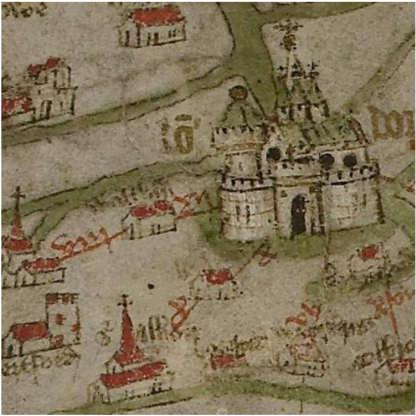
This paper presents new research on travel and communications routes in England and Wales derived from the medieval Gough Map of Great Britain, dated c. fifteenth century. Taking this as a very partial, but important, sample of the fuller medieval travel networks, we evaluate the survival of Roman routeways. Using computational and qualitative approaches, we consider route character, regionality and relative quantity, shedding light into the complex transformations of human landscapes that occurred both at macro (national) and micro (regional, local) scales across approximately one thousand years. The presentation is based on an article published at https://doi.org/10.1016/j.jas.2025.106227.
The case for a Roman transport canal running into Leicester by Steve Mitchell and John Poulter was published in Itinera volume III, but this talk will provide more details and analyses of the authors' thinking in reaching their conclusions about this intriguing possibility.

The Case for a possible Roman Canal running into Leicester
Thursday 27 November, 2025
John Poulter
One of the famous stone heads being removed from site
We are pleased to announce another outstanding list of speakers for our fifth season. As usual, all talks are online, open to the public and free of charge, although donations towards running costs are always welcomed. Please note that this season bookings can be made through Ticket Tailor as well as Eventbrite, with links posted on this page as they become available. As usual, talks will be recorded and made viewable after the event on YouTube.
On the road in the Western Roman Empire: ancient motels, caravanserai and emporia.
Thursday 19 March, 2026
Prof. Tony King
There have been roadside settlements since the beginning of Roman road construction in Italy, and probably also long before the Via Appia, Via Flaminia, etc. were formally constituted. This introductory talk starts in Italy with the Forum sites found along several of the major roads, and looks at excavations at Bedriacum and elsewhere. We then move to Gaul, where major sites emerged on some of the well-
Thursday 8 January, 2026
Dr. Roger White
The accepted position on Roman road construction in the territory that later became Shropshire has been presented as the imposition of Roman military control on an area devoid of previous development. Archaeology is beginning to suggest otherwise. The purpose of this lecture is to explore the pre-
Roger White is a Shropshire-
What did rocks ever do for the Romans? The answer is pretty much everything. From defining the line of their defences, to providing the materials and implements they depended on. For the Roman army an understanding of the landscape, its rocks and their resources was not just desirable, it was essential. What can a better understanding of geology do for archaeologists? A lot more than it currently does.
Populus: The Real People of Roman Britain
Thursday 25 September, 2025
Paddy Lambert
'Roman Britain was not a single monolith, but a bewilderingly complex series of human experiences which will never be fully understood. The actual people who lived there, in all of their complex dynamism, poignant similarities and bewildering strangeness can be lost under the weight of archaeological 'big data'. However, archaeological works reveal evidence for those real lives every day, from scratched graffiti on pots to scientific analysis of their remains. Hidden in these are the weird, wonderful and fascinating real people and their real lives, which present a complex view of many different 'Roman Britains'
This presentation will present some of the tales of the practicalities of living, working and dying in the province of Britannia -
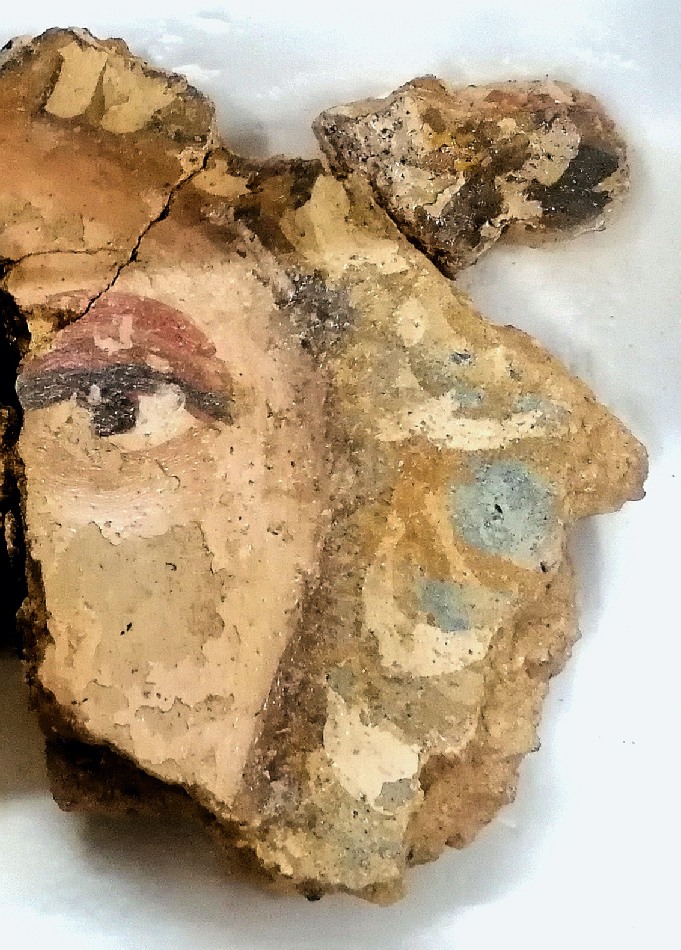
Fragment of decorated Roman Wall plaster

Thursday 26 February, 2026
(postponed from Thursday 19 February)
Becky Haslam
Becky Haslam (AOC Archaeology Group)

Our 2025/6 schedule is currently in preparation. If you may be a potential future speaker, or have any suggestions for future talks and seminars, please contact us.
Conquest and Change in the Hinterland of Roman Alchester: impact, development and legacy
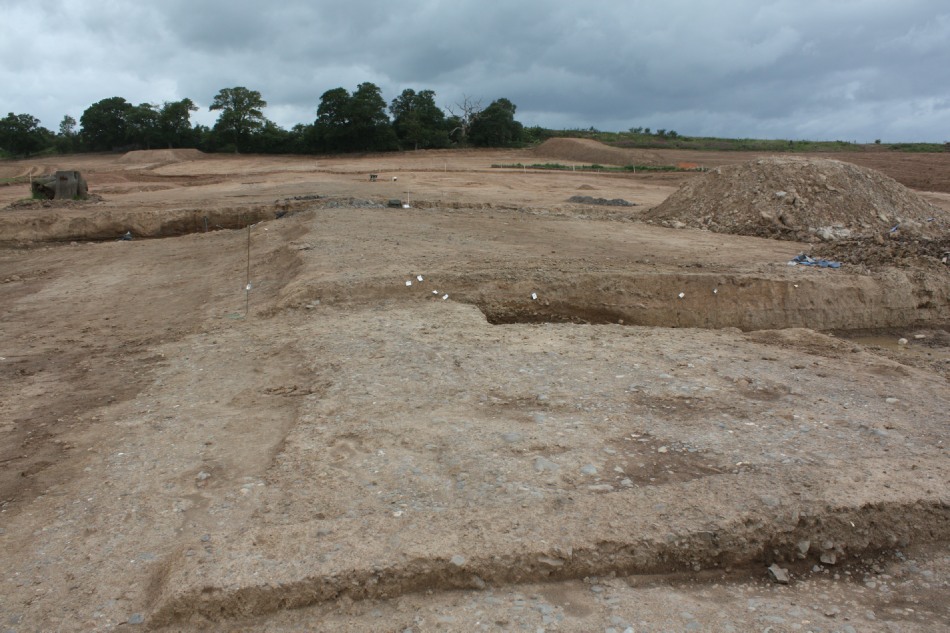
Between April 2020 and April 2021, AOC Archaeology Group undertook seven excavations to the north, west and east of the village of Launton, located to the southeast of Bicester in east Oxfordshire. The works were undertaken on behalf of the East West Rail Alliance and Network Rail as part of the East West Rail (EWR) Phase 2 route. Early Neolithic to Late Bronze/Early Iron Age activity was found, however it was not until the Middle to Late Iron Age that the landscape was used more intensively, evidenced by the discovery of a series of large enclosure complexes that may have played a role in stock control and perhaps settlement. In the wake of the Roman Conquest, the sites were situated in the hinterland of a substantial Roman fort at Alchester, which transitioned into a civilian 'small town' during the late first century AD. These events appear to have contributed to a great deal of change with regards to land use and sub-


Image shows Roman road Margary 64 heading north over Sharpstones Hill, Shrewsbury.


Raw Dykes
London on the Gough Map (north is to the left)



Cuddy’s Crags
Aerial photograph of some of the excavations


A comparison in Eastern England. The current Ordnance Survey Map of Roman Britain is on the left, the new Map is on the right -

takes a look at some of the settlements that developed along Roman roads from Italy, through Gaul, and finally to Britain.


| Lecture & Seminar Series |
| RRRA GEOPHYSICS PROJECT |
| EXCAVATIONS |
| REPORTS |
| Conferences |
| 2026-7 Lectures & Seminars |
| 2025-6 Lectures & Seminars |
| 2024-5 Lectures & Seminars |
| 2023-4 Lectures & Seminars |
| 2022-3 Lectures & Seminars |
| 2022 Lectures & Seminars |
| 2021 Lectures & Seminars |
| Roads of Roman Britain Project |
| Portsmouth Programme, Sat. 3/9/16 |
| Portsmouth Programme, Sun. 4/9/16 |
| York Programme, Sat. 12/11/16 |
| York Programme, Sun. 13/11/16 |
| A Selection of Conference Papers |
| RRRA NEWSLETTERS |
| ITINERA, the Journal of the RRRA |
| JOIN US |
| Forum |
| Roman Roads in Britain PDF |
| Roman Roads in Britain PDF |
| OS Roman Road Files (Margary) |
| OS Roman Road Files (RRX) |
| Forum Terms & Conditions |
