

SUBSCRIBE TO OUR FREE NEWSLETTER
Daily news & progressive opinion—funded by the people, not the corporations—delivered straight to your inbox.
5
#000000
#FFFFFF
To donate by check, phone, or other method, see our More Ways to Give page.
Daily news & progressive opinion—funded by the people, not the corporations—delivered straight to your inbox.

Saying the phrase “two-state solution” has become little more than a way of dodging key facts that exist on the ground.
Creation of a Palestinian state next to Israel seemed feasible when President Bill Clinton hosted the signing of the Oslo accords at the White House in September 1993. The goal was reaffirmed in 2011 when 90 percent of the Senate co-sponsored a resolution supporting “a two-state solution to the Palestinian-Israeli conflict.”
But today, the two-state scenario is far-fetched to the point of delusion if not evasion.
For politicians, it has become a box to check. According to data from the American Jewish Congress, every Democrat and most Republicans on the Senate Foreign Relations Committee currently say they support “the two-state solution.”
Whatever the rhetoric, ending Israeli control over Palestinians in the territories occupied since 1967 is not on the table.
A grim truth is that no one really knows what a genuine “solution” might be for the mega-tragedy that continues to unfold in Palestine.
“Nobody who talks about a so-called ‘two-state solution’ talks about an end to settlements and colonization, and an end to the occupation,” Palestinian-American historian Rashid Khalidi said in an interview this year. “If you don’t have those as the preconditions, it’s not a state—it’s some reshuffling of a status quo of colonization and occupation.”
At best, only such reshuffling is on the horizon. The essence of colonization and occupation is baked into Israel’s Jewish nationalism that has hardened into systemic cruelty toward Palestinians undergoing genocide.
Yet the boilerplate refrain for a two-state solution has great political utility in the United States. For most politicians, it’s very handy for virtue signaling. The same holds true for pro-Israel pressure groups. Even AIPAC, while incapable of faulting the Israeli government for anything, blames Palestinians for refusing “to negotiate on the basis of the Trump peace framework—which envisions a two-state solution.”
Especially for politicians eager to have the deep-pocketed Israel lobby on their side at election time, saying “two-state solution” has become little more than a way of dodging key facts that exist on the ground. The Israeli military now controls 70 percent of Gaza after reducing it to rubble that has buried an unknown number of bodies. The 2.1 million Palestinians still alive in the enclave are confined to just 30 percent of its 141 square miles, under terrible living conditions.
Meanwhile, the proliferation of settlements in the West Bank has pushed Palestinian people into smaller and smaller fragmented areas, divided by hundreds of checkpoints, while they face lawless violence from Israelis akin to the KKK’s terrorizing of blacks in the Jim Crow South. Several hundred settlements and outposts in the West Bank are now home to upward of 730,000 Israelis, with more arriving all the time.
Given such realities, advocates for a two-state solution have no credible answer to a basic question that is rarely asked: Where would the putative Palestinian state actually be located?
When Britain, Canada, and Australia announced their formal recognition of a Palestinian state last fall, putting the number of nations doing so over 150, they were recognizing a phantom. “Israelis and Palestinians alike say the possibility of a two-state solution seems more remote than ever,” the New York Times reported at the time. “Israel’s military campaign in Gaza has devastated the enclave. Israeli settlements have become ever more entrenched in the West Bank.”
But in US politics, the routine is to maintain the convenient fantasy of a two-state solution. Democratic presidential nominee Kamala Harris was simply offering up requisite platitudes during a CNN interview in August 2024 when she declared her commitment to “work toward a two-state solution, where Israel is secure and in equal measure the Palestinians have security and self-determination and dignity.”
David Mandel, a Sacramento chapter leader of Jewish Voice for Peace, told me: “In light of demographic and political realities, a ‘two-state solution’ has become a mostly empty mantra, frequently mouthed by politicians who did nothing to bring it about when it might have been a viable path to end violence and build toward something better.” He added: “It has also become a political refuge for many Americans, including a great many Jews, who are generally progressive and want to differentiate themselves from Benjamin Netanyahu and his ilk, but only performatively, without joining efforts to end real violations of Palestinian rights like occupation, ethnic cleansing, apartheid, and genocide.”
A grim truth is that no one really knows what a genuine “solution” might be for the mega-tragedy that continues to unfold in Palestine. Unhelpful from Americans is the facile prescription of a two-state solution or, for that matter, any other supposed remedy. Claiming to know what’s best for Palestinians is built into a colonial mindset that has propelled intervention in the region for more than a hundred years.
The pivotal role for Americans is to end their government’s enabling of ethnic cleansing and genocide. The obvious step in that direction is to halt US weapons shipments to Israel, but much more is involved. “I want to stop American aid,” Prime Minister Netanyahu said during a June 30 interview on Israeli television. “It’s like welfare. I don’t want it.” Earlier in the month, Netanyahu wrote about his plan to “draw down US financial military assistance over the next decade” in a letter to Republican Representative Marlin Stutzman. “The time has now arrived for us to move from aid recipient to partner.”
Netanyahu touted what the congressman described as a “new framework of joint defense cooperation, co-development, coproduction and mutual investment in areas including advanced missile defense, artificial intelligence unmanned systems, cybersecurity and next generation military platforms.” That Israeli wish list is in line with Section 219 of the National Defense Authorization Act now pending in the House. “The provision would speed efforts to embed Israeli technologies into US weapons systems in ways almost never codified into law, even for allies,” Human Rights Watch warns.
While Israel’s disrepute is now widespread among Americans, and more members of Congress are voting to cut off US weapons shipments, current moves to integrate the US and Israeli militaries are aiming to bypass public opinion and the political process. Increasingly, the pro-Israel mission in the United States is to circumvent democracy.
Is a two-state solution the best possibility for Palestine? That’s not for Americans to say. But there is a “two-state solution” that the United States could and should impose—on itself and Israel.
In this decade, the catastrophic US-Israel alliance has enabled not only genocide and ethnic cleansing of Palestinians but also the ongoing wars of aggression on Iran and Lebanon. The alliance should not morph. It should end.
American refusal to support the genocidal state of Israel would be a “two-state solution.” And it might lead to solutions in Palestine.
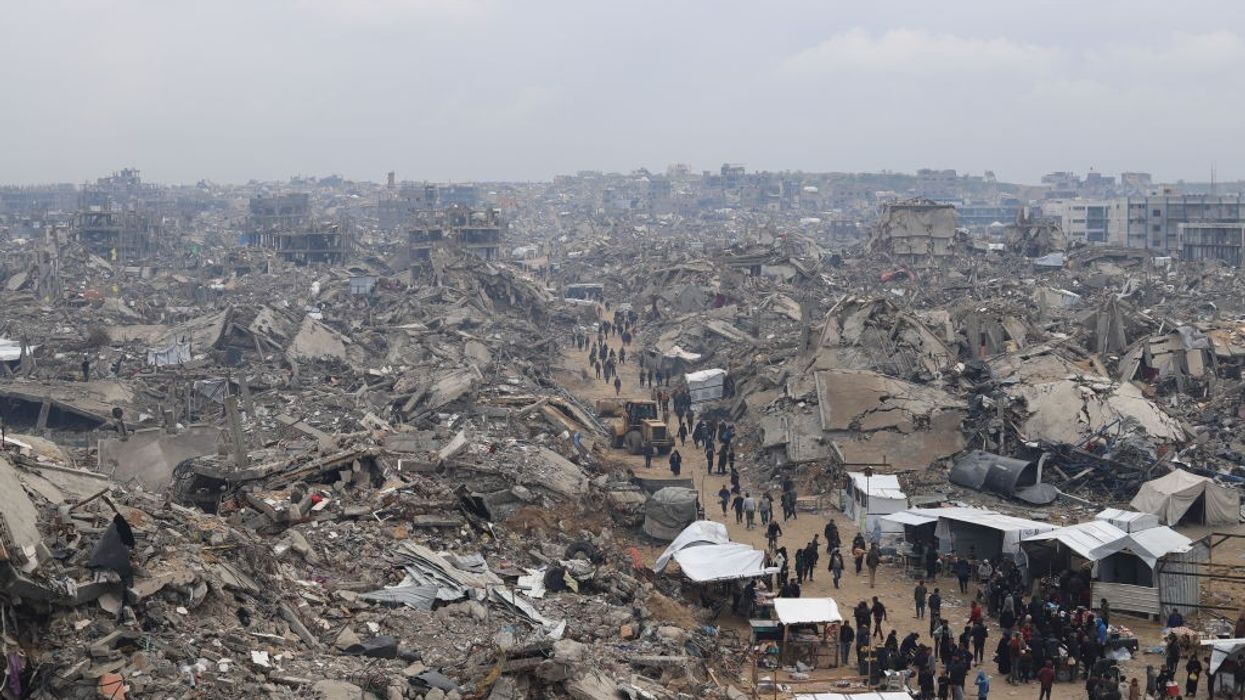
"This should be a blaring wake-up call for Democratic leaders," said one campaigner. "The political tide is clearly turning against unconditional US military support for Israel."
Nearly half of all Democrats in the House of Representatives voted Wednesday to cut off US military aid to Israel, a move that underscored a dramatic shift away from the US support the Mideast ally has enjoyed for nearly 60 years.
While House lawmakers ultimately rejected Rep. Thomas Massie's (R-Ky.) amendment to a national security spending bill that would have eliminated the $3.3 billion in annual foreign military financing provided to Israel’s military, the details of the vote were viewed as an encouraging sign by defenders of Palestine and the rule of law.
Massie and 103 Democrats voted for the measure, while 215 Republicans and 98 Democrats rejected it. The overall tally was 104 for, 314 against, and 10 "present" votes, with 9 absences.
"I cannot vote for aid to a country that committed genocide and has used tax dollars to detain Americans like me," Rep. Ro Khanna (D-Calif.) said ahead of the vote, referring to an incident in which heavily armed residents of an Israeli settler colony stopped and surrounded him last week in the illegally occupied West Bank of Palestine.
Speaking to reporters after the vote, Congressional Progressive Caucus Chair Greg Casar (D-Texas)—who had urged colleagues to support Massie's amendment—noted, "It used to be that just a small number of House Democrats would vote against sending taxpayer dollars to weapons for the Israeli military."
"Today, over 100 House Democrats voted for a measure to block billions of dollars in weapons to [Israeli Prime Minister Benjamin] Netanyahu," he continued. "That is enormous progress. That is a victory for our movement, for security, peace, and justice for all people."
The vote, Casar said, "sasends a strong message to Netanyahu that the days are over of an unaccountable blank check to his wars and his war crimes, at least from the Democratic Party."
"So this is an important moment because nothing will be the same on this issue ever again, I think, after this vote," he added.
CPC Chair @RepCasar, Deputy Chair @Ilhan Omar and @USProgressives on the historic vote by a majority of House Democrats to block $3 billion in weapons to Israel pic.twitter.com/T58q6J5LHZ
— Keane Bhatt (@KeaneBhatt) July 15, 2026
Speaking after Casar, Rep. Ilhan Omar (D-Minn.) said that she was "surprised" by many of her colleagues' votes in favor of the amendment, "and I am proud of them."
"I am proud that they have finally decided to lead with their morals, that they finally dared to stand up, and that we are all finally listening to our constituents, who have been asking us to do the right thing for many years," she added.
The high vote count in favor of Massie's amendment came after a "dear colleague" letter from House Minority Leader Hakeem Jeffries' (D-NY) expressing his opposition to the measure.
Palestine and human rights defenders hailed Wednesday's vote.
“Today’s vote reflects a seismic shift in US politics. What was once unquestioning bipartisan consensus to fund Israel’s atrocities against Palestinians is now breaking apart," Jewish Voice for Peace Action political director Beth Miller said in a statement. "While it is shameful that the House failed to pass this amendment, it is also now clear that it is impossible for Congress to ignore our voices."
"The overwhelming majority of Democratic voters are demanding that we halt US military funding to Israel, and every Democrat who ignored these calls should fear for their seat,” Miller added.
Margaret DeReus, executive director of policy projects at the Institute for Middle East Understanding (IMEU), said Wednesday's vote "reflects the popular will of Americans, and the overwhelming majority of Democratic voters who do not want to see another penny of our tax dollars fund Israel’s genocidal military."
"No more weapons to Israel is a principled demand, a legal obligation, and now a political necessity for any Democrat in office," DeReus added. "Democratic lawmakers who continue to stand with [the American Israel Public Affairs Committee's] fringe agenda of funding to Israel, and against their voters on the moral issue of our time, are inviting a primary challenge.
The United Nations' International Court of Justice is currently weighing a genocide case against Israel filed by South Africa and formally supported by nearly 20 nations. A UN panel of experts concluded last year that Israel is committing genocide in Gaza.
Meanwhile, the International Criminal Court has issued arrest warrants for Netanyahu and Yoav Gallant, his former defense minister, for alleged crimes against humanity and war crimes in Gaza, where more than 250,000 Palestinians have been killed or wounded, most of them civilians, since the Hamas-led attack of October 7, 2023, including over 9,000 people who are missing and presumed dead and buried beneath rubble.
In addition to the $3.3 billion in annual military aid the US gives Israel under a 2016 memorandum of understanding signed by then-President Barack Obama, the Biden and Trump administrations have provided billions of dollars in additional armed aid to Israel since it began waging its US-backed war on Gaza.
All told, the US has provided approximately $174 billion in direct bilateral assistance and missile defense funding—over $300 billion when adjusted for inflation—since the modern Israeli state's atrocity-laden founding in 1948. This makes Israel the largest overall beneficiary of US foreign aid since World War II.
US aid dramatically increased after the 1967 Israeli occupation of the West Bank, East Jerusalem, and Gaza, and the attack that same year by Israeli forces on the USS Liberty, which killed or wounded more than 200 Navy sailors in what numerous senior US officials believed was a deliberate attack. Last month, Massie introduced a resolution honoring the 34 Americans killed and 174 wounded in the Liberty attack.
Demand Progress senior policy adviser Cavan Kharrazian said in a statement that "congressional Democrats are finally starting to catch up to the American people, who no longer want to give Israel a blank check."
"This should be a blaring wake-up call for Democratic leaders," Kharrazian added. "The political tide is clearly turning against unconditional US military support for Israel. Leadership can no longer dismiss this position as marginal or politically untenable. Members should listen to their constituents, stop shielding Israel’s government from accountability, and support future efforts to end the flow of US weapons and military financing."
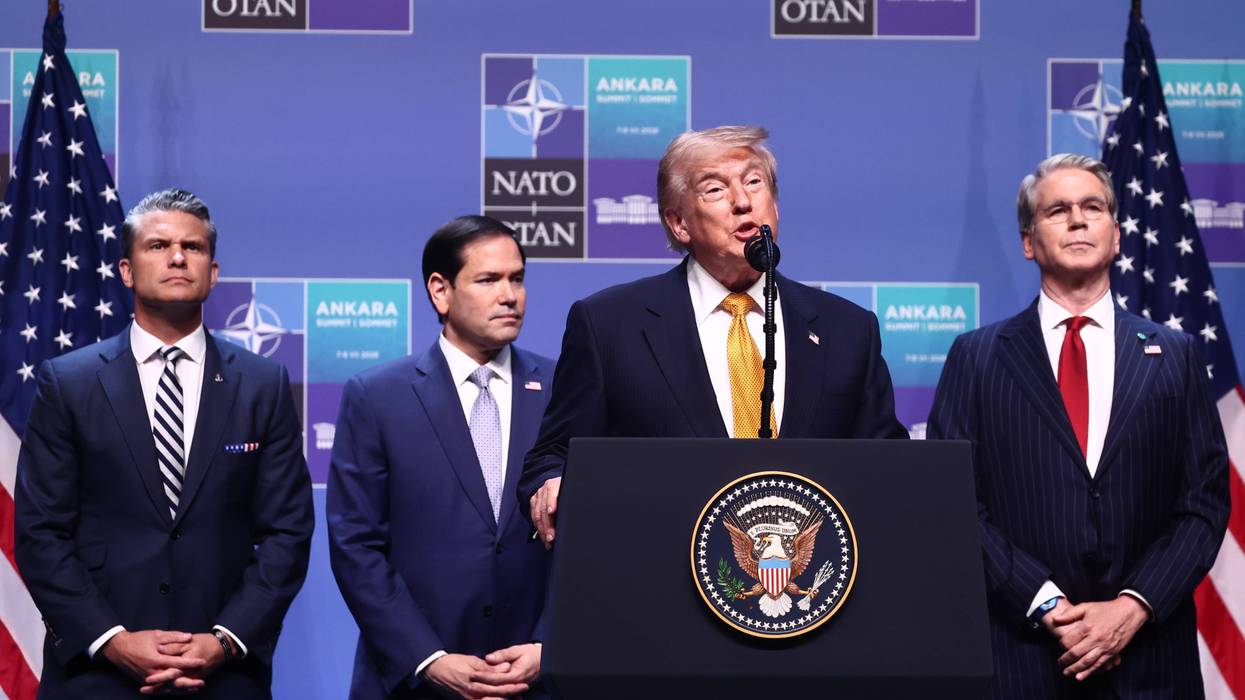
"The government is violating the constitutional rights of American citizens in order to shield officials of a foreign government who have committed a genocide."
A pair of advocacy organizations on Wednesday sued President Donald Trump and top members of his administration over sanctions targeting the International Criminal Court and its supporters, arguing the punitive measures violate the First Amendment of the US Constitution and illegally "muzzle Palestine advocacy."
The lawsuit, filed in federal court in Manhattan by Democracy for the Arab World Now (DAWN) and the Taxpayer Alliance Against Genocide (TAAG), contends that Trump's Executive Order 14203 unlawfully restricts Americans' ability to seek "justice on Palestine at the ICC" and work with human rights organizations sanctioned "solely for calling on the ICC to investigate Israeli and American nationals."
"The Trump administration is using the blunt instrument of economic sanctions not only to punish human rights defenders but to police the political expression of millions of Americans," said Omar Shakir, executive director of DAWN. "The government is violating the constitutional rights of American citizens in order to shield officials of a foreign government who have committed a genocide."
DAWN notes that, under Trump's February 2025 executive order, the administration has sanctioned ICC officials "as well as leading Palestinian human rights groups al-Haq, al-Mezan, and the Palestinian Center for Human Rights (PCHR)," as well as Francesca Albanese, the United Nations' special rapporteur for the human rights in the occupied Palestinian territories.
Trump's order authorizes sanctions against "any foreign person" deemed to have "materially assisted, sponsored, or provided financial, material, or technological support for, or goods or services to or in support of," ICC efforts to "investigate, arrest, detain, or prosecute" Americans or officials from allied nations, such as Israel.
The organizations behind the new lawsuit explain that "because the government can interpret the term 'service' to encompass anything that confers a benefit on the recipient, groups like DAWN and TAAG could face civil and criminal charges if they engage in routine advocacy with the sanctioned parties—for example, filing a brief with the ICC encouraging it to investigate possible crimes, sharing evidence or advocacy ideas with Palestinian human rights groups or Ms. Albanese, or working with them on a campaign to lift the sanctions."
“The chilling effect on plaintiffs has been profound,” the lawsuit states. “They now face prison terms and ruinous fines if, in their interactions with the designated parties, they provide or receive anything that defendants could plausibly characterize as a ‘service’—an extraordinarily capacious term that potentially reaches any act that confers a benefit on its recipient. Fearing liability, plaintiffs—and countless others like them—have turned to self-censorship.”
Tarik Kanaana, president of TAAG, said that "with this executive order, Trump has put himself and those in the U.S. government above the law, shielding them from any accountability for their roles in the genocide in Palestine and Lebanon and for war crimes around the globe funded by US taxpayers."
"As US taxpayers, we have the right to hold our government accountable for how it uses this public resource," said Kanaana. "That right cannot be taken away."
The lawsuit comes days after the US State Department launched a sweeping broadside against the ICC, an independent tribunal based in The Hague that investigates and prosecutes individuals for war crimes, crimes against humanity, and other atrocities. In late 2024, the ICC issued arrest warrants for Israeli Prime Minister Benjamin Netanyahu and his former defense minister, Yoav Gallant, for alleged war crimes committed in Gaza.
US Secretary of State Marco Rubio, one of the Trump administration officials named as a plaintiff in the new lawsuit, vowed on Monday to "dismantle" the ICC with increasingly aggressive sanctions against the court and its supporters and international pressure. (Neither the US nor Israel are party to the Rome Statute, which established the ICC.)
Agnès Callamard, Amnesty International's secretary-general, warned in a statement on Tuesday that if nations fail to fight back against the US assault on the ICC, "they will acquiesce to a new era of lawlessness, impunity, and rampant injustice."
"Now is not the time to appease. Now is the time to resist," said Callamard. "For the good of humanity, victims’ hopes of justice, and the prospect of lasting global security, the international community must come together, stand up to the bullies in the White House and State Department and protect the international rule of law. We must not accept a reality where the most powerful have the least legal responsibility.”
