

SUBSCRIBE TO OUR FREE NEWSLETTER
Daily news & progressive opinion—funded by the people, not the corporations—delivered straight to your inbox.
5
#000000
#FFFFFF
To donate by check, phone, or other method, see our More Ways to Give page.
Daily news & progressive opinion—funded by the people, not the corporations—delivered straight to your inbox.
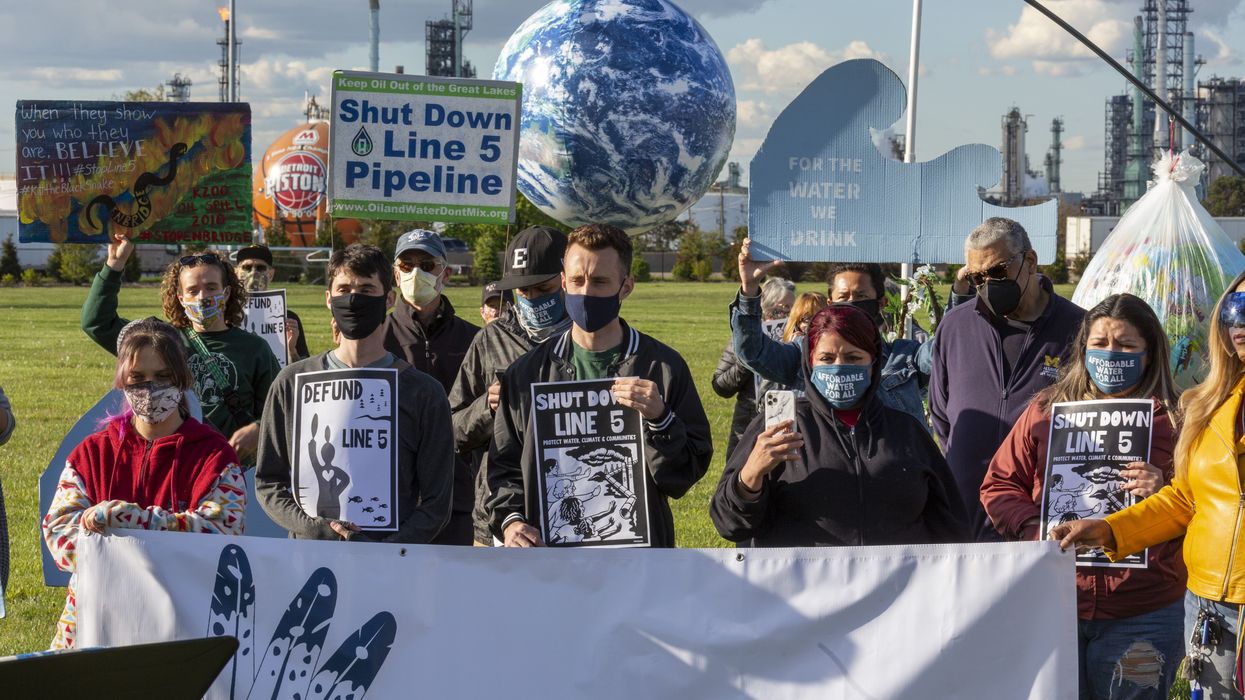
State regulators said the permits for a tunnel under the Straits of Mackinac would have "significant impacts" on wildlife and sacred Indigenous burial grounds, but issued them nonetheless.
Anti-fossil fuel campaigners on Wednesday emphasized that Michigan state regulators had issued key permits for the Enbridge Line 5 tunnel in the Straits of Mackinac on the same day that "wildfire smoke from climate change blotted out the Mackinac Bridge from view" and as the US and other countries faced extreme heatwaves.
Despite the mounting evidence that—as energy and climate experts have long warned—continued fossil fuel extraction is heating the planet and causing dangerous extreme weather, Michigan's Department of Environment, Great Lakes, and Energy handed down a permit Wednesday to allow the Canadian company Enbridge to construct a tunnel that EGLE officials acknowledged will likely have "significant impacts" on threatened or endangered species and Indigenous burial ground in the Straits.
“The magnitude of impacts to recognized historic and cultural values of this proposed project exceeds that of any other that EGLE has reviewed,” said EGLE in its statement on the permits.
Enbridge has sought to build a tunnel around its Line 5 pipeline in the Straits for years, following a massive oil spill from its Line 6B pipeline in the Kalamazoo River. Line 5 has been struck by ships' anchors numerous times, heightening concerns.
EGLE said in its explanation that the oil spill risk was found to be "unacceptable" and that the need for the tunnel outweighed its risks.
But opponents who have argued that Line 5 should be permanently shut down, including the Bay Mills Indian Community, condemned the agency for "rewarding" Enbridge with new permits even after its fossil fuel infrastructure has caused hazardous oil spills.
“Enbridge has spilled oil, committed safety violations, trespassed on lands, shattered ecosystems, pierced aquifers, violated our laws, and repeatedly shown contempt for tribal sovereignty," said Whitney Gravelle, president of the Bay Mills Indian Community. "They have left devastation in their wake, and now they’re being rewarded with responsibility over one of the most precious and sacred resources in our state. The Great Lakes are not safe in their hands. This decision is a deep betrayal of our Great Lake State, and we will confront it immediately, fiercely, and without hesitation.”
The state Department of Natural Resources also issued a permit following EGLE's decision, granting permission for the tunnel despite its potential impact on rare plants and animal habitats.
According to Michigan Bridge, about 1.53 acres of wetlands in Mackinac County would be impacted by the tunnel project, as well as 0.17 acres of Lake Michigan bottomlands in Emmet County, where Enbridge is expected to build a water intake structure.
The environmental legal organization Earthjustice, which has helped represent the Bay Mills Indian Community in its legal challenges against Enbridge, said that with the permits, the company will "transform the Straits of Mackinac into an industrial construction zone for at least six years, destroying views, displacing wildlife, and interrupting tourism dollars."
“Our environmental laws, the looming climate crisis, and simple common sense tells us that an oil pipeline doesn’t belong in the Great Lakes,” said Earthjustice managing attorney Debbie Chizewer. “Today’s decision is a setback, but we’re not giving up. A future without oil in the Great Lakes is still possible.”
EGLE is also expected to rule by September 30 on an Enbridge request to discharge millions of gallons of treated wastewater per day into Lake Michigan while it is constructing the tunnel, and the Michigan Supreme Court is considering a lawsuit brought by four Tribal Nations, including Bay Mills, alleging that the Michigan Public Service Commission improperly issued a key tunnel permit in 2023.
The state is also fighting Enbridge over Democratic Gov. Gretchen Whitmer's 2020 order to shut down Line 5 over oil spill concerns. She had campaigned in 2018 on a promise to shut down the pipeline. A federal judge ruled last year that the state had no authority to terminate the use of the pipeline, and the state appealed that ruling.
Advocates expressed anger on Wednesday at Whitmer as her government issued the permits.
“It’s incredibly disappointing that a governor who ran on a commitment to the climate and protecting the Great Lakes has now decided to instead endorse a Canadian industrial tunnel project that still threatens the Great Lakes and will contribute fossil fuels to the climate,” David Holtz, coalition coordinator for the anti-Line 5 group Oil & Water Don’t Mix, told Bridge Michigan.
David Gover, managing attorney for the Native American Rights Fund, said that "the Straits of Mackinac are not a piece of Enbridge oil infrastructure; they are the heart of creation for Anishinaabe people and a vital source of life for all who depend on the Great Lakes."
“We will pursue every legal avenue," Gover said, "to defend treaty rights, protect drinking water, and preserve tribal lifeways from another Enbridge disaster.”
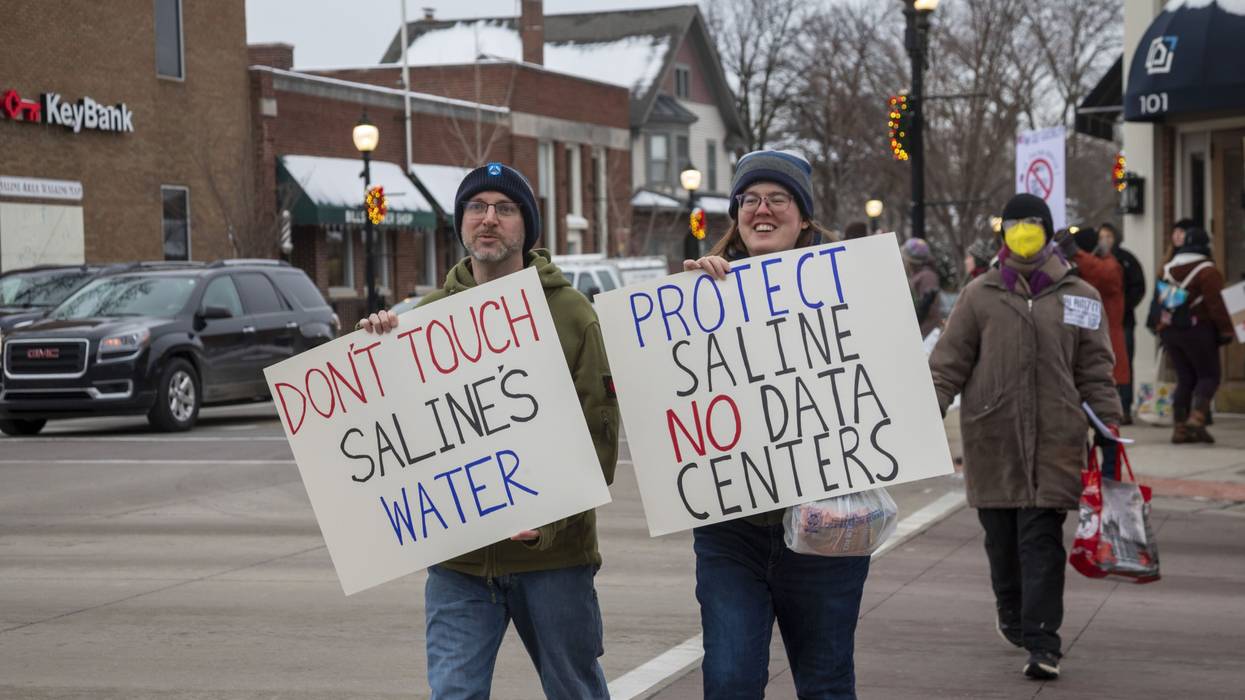
Data center development depends on imported critical conflict minerals and massive amounts of electricity generated by fossil fuels, which contribute directly to US-backed conflicts and war.
“We’re used to people saying ‘fuck no’ and doing it anyway.” These words were seemingly spoken by our very own Gov. Gretchen Whitmer earlier this month, caught on a hot mic chatting with Oracle executive Clay Magouryk. The two were celebrating breaking ground on the controversial new AI data center in rural Saline, Michigan—currently the largest data center project in the country. Gov. Whitmer is apparently happy to sell Michigan out to military tech giants OpenAI and Oracle.
This is the latest in a series of data center projects being forced into communities that have made their opposition crystal clear. Michiganders are "fighting like hell" because they understand exactly what is at stake; Southwest Michigan residents have already filed a class-action lawsuit for the 24/7 noise nuisance that disrupts daily life and reduces property values.
The development of AI data centers creates harm and destruction. The companies that drive this development, such as OpenAI and Palantir, have contracts with the US military and government agencies like Immigration and Customs Enforcement. Locally, the influx of these data centers provides infrastructure for mass surveillance and diverts municipal resources. Globally, the push for data center expansion demands massive amounts of minerals and fossil fuels from resource-rich countries in the Global South, which are obtained through US military intervention and US-backed militia groups. As such, we as Michiganders must continue to oppose these data center projects.
The harm these data centers inflict ripples across the world. Data center development depends on imported critical conflict minerals and massive amounts of electricity generated by fossil fuels, which contribute directly to US-backed conflicts and war on Venezuela, Iran, and in Congo. Tantalum, tin, tungsten, and gold, referred to as 3TG, are essential, and their extraction is linked to financing armed groups and militias. The struggle for control over mineral-rich areas has led to prolonged violence in Congo, contributing to millions of deaths and leaving entire regions destabilized.
Gov. Whitmer’s hot mic comment confirmed what we already suspected: Our voices and opposition are flat out ignored in favor of destructive corporations.
Detroit is becoming a hub for technology, manufacturing, and the military-industrial complex, where events like the annual Reindustrialize conference bring together defense contractors, surveillance firms, and policymakers to strategize a future built on automated warfare and mass data extraction. Palantir, Lockheed Martin, and Boeing attended, representing key pillars of the US defense and surveillance industry. Palantir’s Project Maven and Where’s Daddy track individuals and automate kill chain recommendations with little human oversight. Lockheed Martin and Boeing produce the missiles, bombs, warcraft, and strike systems that turn algorithmic targeting into genocide.
It’s understandable that some Michiganders might think the development of AI data centers is a good thing, or at least an inevitability. Gov. Whitmer, for one, claims that if Michigan does not lead the charge on these data centers, “they’ll be done elsewhere… with lower wages in a way that abuses the natural resources and jacks up energy prices.” Thus far, this seems to mean that companies that develop these data centers can receive tax breaks and circumvent public input, which sets a disadvantageous precedent.
These data centers, furthermore, are not an inevitability, and they can drastically impact resource usage in their regions. At the Saline data center, even with the closed-loop cooling system to reduce on-site water consumption, water will be consumed indirectly: Increased electricity needs increase the need for water and oil consumption for local power plants. There is also no guarantee that any jobs created will be given to local residents. None of the reported advantages are worth the imperialism needed to supply resources to these data centers, nor the mass surveillance apparatus that comes with them.
Gov. Whitmer’s hot mic comment confirmed what we already suspected: Our voices and opposition are flat out ignored in favor of destructive corporations. Michiganders across the state have stood up and said, "Fuck no" to data centers and more war, yet projects keep moving forward. Residents deserve better than politicians who prioritize tech billionaires and war profiteers over their own people.
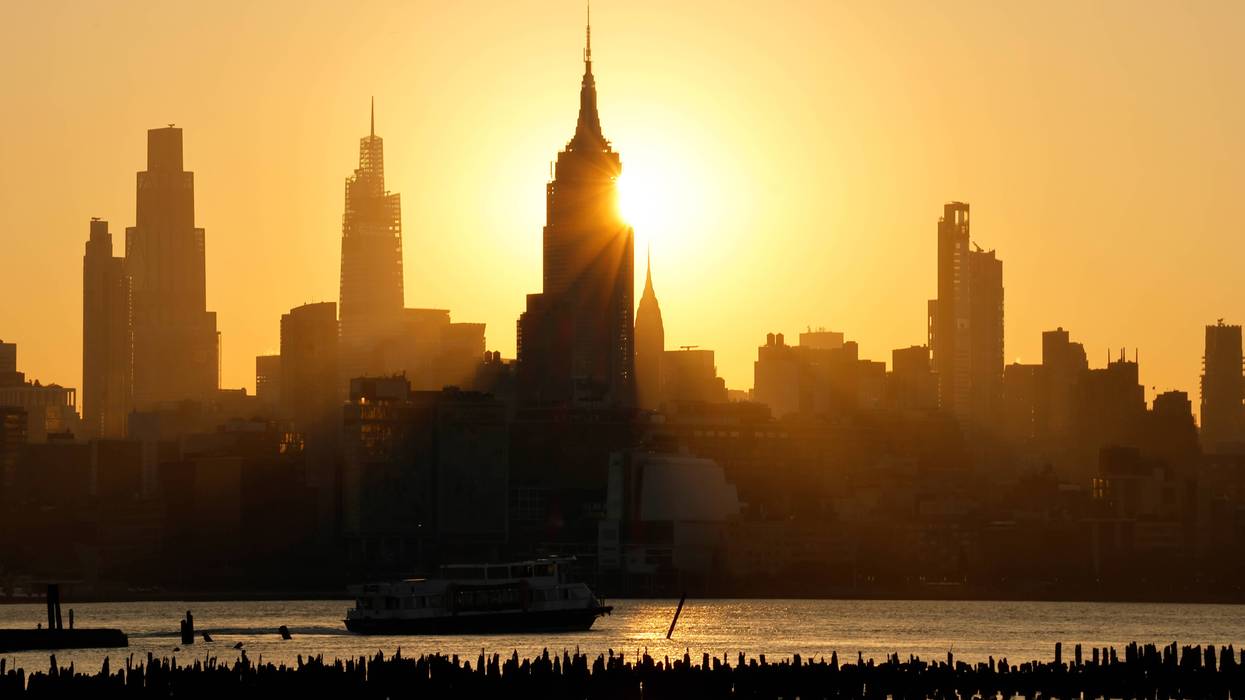
Instead of speeding the conversion to clean cheap energy, which would save households huge amounts of money, we’re instead shoveling taxpayer cash to the fossil fuel industry, and in the process overheating the Earth.
I write this under an ashy, yellow northeast sky; smoke from wildfires in Ontario and Minnesota swept across the region in the middle of the night, and I awoke at 3:00 am (as I too often do in these parlous times) with stinging eyes. But I will try to see clearly enough to discern some of the latest numbers in the climate and energy battle—numbers which prove to me the economic folly of staying on our current course.
To me, I admit, these are secondary—there’s not enough money on Earth to make me want to condemn people to a few centuries of waking up in smoke, and I know without calculation that a clear blue sky is worth almost any price. But I also know how the world works, and so I want to provide people with the ammunition they need to carry on this fight—and the last few weeks have seen that ammunition piling up in the arsenals of logic and thrift. There is at this point no doubt that the world would operate more cheaply on clean energy, which is a lucky thing, and one that needs to be hammered home till the conventional wisdom (that sun and wind and batteries are a luxury) is finally routed.
The most basic point, of course, and yet one often lost in the debate is that once you’ve installed renewable energy you no longer have to pay for fuel. IRENA, the International Renewable Energy Agency, put a number on that in its annual report at the end of last month.
In 2025, renewables helped to avoid an estimated USD 480 billion in fossil fuel costs and around 8.4 gigatonnes of carbon dioxide emissions.
If we round the number of our fellow humans off to about 8 billion, that’s $60 for every man, woman, and child on the face of the planet, even though we’re still fairly early on the adoption curve for clean power. The numbers are stark:
Since 2010, the cost of solar PV has fallen by 89%, onshore wind by 71%, and offshore wind by 63%. This highlights how renewables are now the cheapest source of new electricity in most markets. In 2025, more than 90% of newly commissioned, utility-scale capacity delivered power at a lower cost than the cheapest, newly-installed fossil-fuel-based alternative.
If you move from energy generation to energy efficiency, the numbers are just as interesting. Mark Gongloff, in a charming essay that begins by noting GOP umbrage at New York City Mayor Zohran Mamdani’s suggestion that during a heatwave 78°F would be a good setting for the AC, goes on to show how the Trump administration is gutting the ongoing federal effort to make appliances more efficient. Cost?
Higher standards available to the DOE could save the average US household $160 a year and all US businesses $15 billion a year in electricity costs between 2030 and 2050, according to the Appliance Standards Awareness Project (ASAP), a nonprofit research and advocacy group.
And what about making money? Dan McCarthy describes a new study from the “business-focused” think tank E2 that shows that the clean energy projects—at least 216 in number—cancelled since President Donald Trump took office would have supplied at least half a million good jobs:
Trump took office amid an unprecedented surge in the clean energy economy. The 2022 Inflation Reduction Act spurred the rapid construction of both renewable power projects and domestic factories intended to build solar panels, electric vehicles, batteries, and other crucial cleantech.
But the boom went bust pretty much as soon as Trump won the election in late 2024.
Just as an example, here’s a story from a few days ago about the administration stymieing four wind power projects in Minnesota that would have produced not just a gigawatt of badly needed clean electricity, enough for several hundred thousand homes, but also 1,100 construction and 4,400 “indirect jobs,” for a total economic hit of $168 million.
If you want to try to add it all up, here’s another analysis, from the people at Energy Innovation. Their model shows that, taken together, the result of the major Trump era moves on energy policy will be that
Households will pay an additional $650 billion for energy—an average of $460 per household in 2035 and $490 in 2040.
And their attacks on EVs, which mean that more Americans get to shell out at the gas pump year after year, will
inflate gasoline prices 14% in 2035 and 26% in 2040, atop near-term upward pressure from the Iran war and other market forces.
and the One Big Beautiful Bill, by removing incentives for a quick energy transition, will
cost the US economy 820,000 jobs per year on average over the next decade, in addition to the 144,000 clean energy jobs lost within the past 18 months.
And
Slowing down electrification and domestic energy manufacturing will lower GDP in all years, totaling $2.3 trillion cumulative lost GDP, with effects flowing into other economic sectors. The US economy will lose $150 billion in GDP in 2030, peaking at a $250 billion net loss in 2032, then reverting to losses of $200 billion in 2035 and $120 billion in 2040.
This all amounts to setting money on fire—almost unbelievable amounts. And real money—not notional SpaceX shares, now plummeting; not weird Kalshi bets. It’s money that families have to fork over, month after month, if they want to keep the lights on and the minivan trundling down the road.
And of course the numbers grow exponentially larger if you even try to calculate the public health and climate costs of burning ever more fossil fuel. The Energy Innovation study again:
Worsening local air pollution will raise healthcare costs by $43 billion, with annual increases of $4 billion in 2035 and $4.5 billion in 2040, contributing to rising household costs alongside rising energy prices and goods inflation.
And here’s a new report in the premier science journal Nature from Anders Levermann on the economic costs of a heating planet even before we hit the biggest and most expensive tipping points:
By definition, tipping points are reached when a series of interlinked changes amplify one another until the whole system becomes unstable and shifts uncontrollably into a different state. Loss of sea ice at the poles, for example, reduces the amount of sunlight reflected into space, further heating Earth’s surface, which then accelerates ice loss. These vicious cycles of change define a tipping point, at which the climate cannot return to its former patterns.
Before that point, the climate system becomes increasingly unstable. It fluctuates considerably—a rise in variability is a well-established property of such "non-linear dynamical systems" approaching a critical threshold. That society will face these fluctuations and that they will intensify through the tipping transition hasn’t been realized by scientists and policymakers, so far.
Earth will experience an increasingly erratic climate: more and stronger fluctuations in flows of melt water, ocean circulations, and the extent of sea ice. These changes will lead to more frequent and intense extremes in temperature, precipitation, and storms—leading not only to more heatwaves and droughts, but also to more cold spells and floods.
Modern economies are adapted to relatively stable climatic baselines. Agricultural productivity, infrastructure design, insurance pricing, and financial risk management all rely not only on expected mean conditions but also on the predictability of variability.
Farmers need to factor in lost harvests; architects and urban planners need to account for extremes of temperature, wind and rainfall; and financiers and insurers need to consider the cost and scale of damages. But once these factors are no longer predictable, all bets are off—life becomes uninsurable and the world becomes unsafe.
In case you think scientists are the only ones worrying, Richard Partington discusses new analyses from leading bankers that attempt to put some numbers on these emerging dangers: The rapidly approaching El Niño, for instance, is threatening massive “food shocks” that will stretch into at least 2028:
“El Niño puts ‘climateflation’ back on the agenda,” analysts at the Italian bank UniCredit wrote in a research note. “Europe’s recent heatwaves are a reminder that the climate baseline is already shifting. El Niño could add a new layer of pressure later this year, as it amplifies the effects of global warming.”
According to analysts at Goldman Sachs, the strength of this El Niño could cause a 15.8% surge in global food commodity prices. That would have a knock-on effect worldwide, including for consumers in Europe, where it predicted food prices could rise by 1.3% across the eurozone.
Unlike politicians, bankers actually try to do something to limit their risk. As Ishika Mookerjee reports, private equity funds are unleashing an increasing army of “heat detectives” to figure out the climate risks of their investments:
A Bloomberg Green analysis of the latest sustainability reports published by 12 of the largest alternative asset managers show overall mentions of physical climate risks and related terms nearly doubled from a year before, with Carlyle Group Inc., General Atlantic LP, KKR & Co. and Partners Group AG seeing large increases. Funds tend to identify floods and cyclones as the most immediate risks. Most are now screening their portfolios for vulnerabilities to heat and treating it as a long-term, chronic risk, especially for their combined private equity assets totaling more than $700 billion.
Given all that, the endlessly maddening question is why are we still headed down this path. Why is Gov. Kathy Hochul not listening to the private equity sleuths headquartered in her state’s financial capital and instead signing up New Yorkers for 40 years of new natural gas pipelines, and why is Hawaii flirting with liquefied natural gas? Why is the Trump administration doing everything it can to run our bill ever higher?
If you think the answer must be that there’s some competing policy formulation that comes up with different numbers, think again. Here’s the remarkable account from Jonathan Swan and Maggie Haberman of the first meeting between the oil industry and the Trump White House after the 2024 election:
At one point during the meeting, the executives began complaining about the Climate Superfund bills that had recently passed in Vermont and New York. As they spoke, Trump’s policy adviser, Stephen Miller was texting the attorney general Pam Bondi. “I’m on it,” Miller told the group. Less than two months later, the administration sued both states seeking to block enforcement of the laws.
In another instance, the ExxonMobil chief executive, Darren Woods, voiced concerns about European Union regulations that required big companies to monitor and reduce the environmental effects of their activities and develop “climate transition plans.”
Haberman and Swan report that, upon hearing this, Trump instructed Commerce Secretary Howard Lutnick to impose additional tariffs on the EU until they abandoned those regulations.
At another point in the meeting, held in the Cabinet Room on March 19, 2025, Miller asked the executives in attendance for a list of 10 projects the White House could help fast-track and requested that they “highlight how much more energy the projects would produce in the United States during the Trump presidency.”
And in one of the most fateful exchanges, the Chevron chief executive, Mike Wirth, pushed for an extension of the firm’s license to operate in Venezuela.
Less than a year later, the Trump administration had seized the country’s leader, Nicolás Maduro. Shortly after that, Chevron expanded its presence in Venezuela.
Yesterday I called Swan to discuss this reporting, and he described to me a room filled with some of the most powerful executives in the world, stunned by what they were witnessing.
“They were almost in awe,” Swan told me. “There was no semblance of a policy process, but rather the CEOs were raising their grievances, and Trump was essentially saying, ‘Make it so, it shall be done.’”
Indeed, as David Fickling reports, Big Oil has no choice but to rely on gaming political systems, because private investors have shifted most of their money to clean energy. That means that subsidies are ever more important:
The cost of these measures looks set to rise to about $1.1 trillion this year, according to a study last week by the United Nations Development Programme. If crude averages $110 a barrel over the full year, it could climb as high as $1.43 trillion. That’s almost as much as was spent on such subsidies during the year the Ukraine war started in 2022.
Whatever the final figure, the amount of government cash support pumped into the fossil fuel system this year will be running close to the amount that both public and private investors were prepared to invest in it. It’s an extraordinary situation for an industry that claims to be governed by capitalist laws of supply and demand, rather than statist central planning.
Just to reiterate: Instead of speeding the conversion to clean cheap energy, which would save households huge amounts of money, we’re instead shoveling taxpayer cash to the fossil fuel industry, and in the process overheating the Earth, which will be the most expensive thing that ever happened, by orders of magnitude. The most important thing the planet’s leaders could possibly do is flip this switch, and reverse these flows—we’ve clearly got the money, since we’re shelling out these huge sums in subsidies. Fickling again:
This support is so pervasive that in most places we don’t even notice or question it. That has to change. Governments must stop throwing sand in the gears of the energy transition. Far from reducing as the climate emergency intensifies and heatwaves claim thousands of lives, they have been doubling down on counterproductive support for polluting fuels, while loading tariffs and regulations onto clean energy.
The horrible irony here is that markets are coming much closer to getting things right than our political institutions, which are currently doing all they can to maintain the status quo. Our next real chance to disrupt that madness? November 3.
