

SUBSCRIBE TO OUR FREE NEWSLETTER
Daily news & progressive opinion—funded by the people, not the corporations—delivered straight to your inbox.
5
#000000
#FFFFFF
To donate by check, phone, or other method, see our More Ways to Give page.
Daily news & progressive opinion—funded by the people, not the corporations—delivered straight to your inbox.
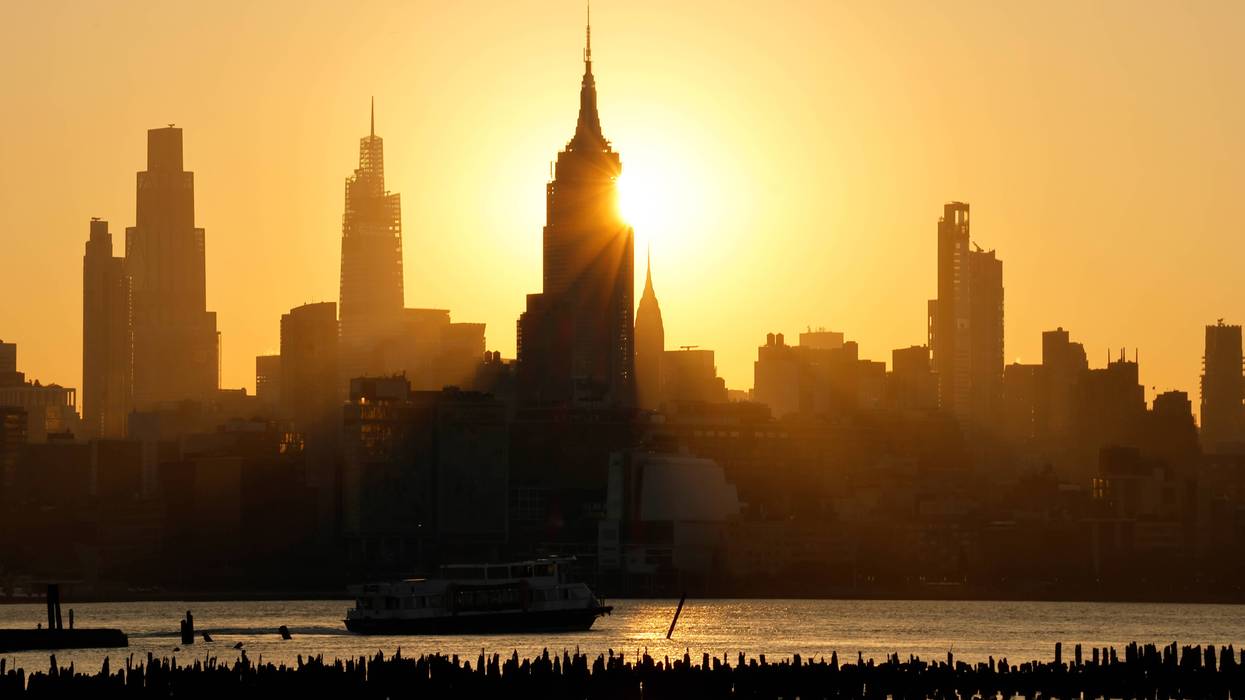
Instead of speeding the conversion to clean cheap energy, which would save households huge amounts of money, we’re instead shoveling taxpayer cash to the fossil fuel industry, and in the process overheating the Earth.
I write this under an ashy, yellow northeast sky; smoke from wildfires in Ontario and Minnesota swept across the region in the middle of the night, and I awoke at 3:00 am (as I too often do in these parlous times) with stinging eyes. But I will try to see clearly enough to discern some of the latest numbers in the climate and energy battle—numbers which prove to me the economic folly of staying on our current course.
To me, I admit, these are secondary—there’s not enough money on Earth to make me want to condemn people to a few centuries of waking up in smoke, and I know without calculation that a clear blue sky is worth almost any price. But I also know how the world works, and so I want to provide people with the ammunition they need to carry on this fight—and the last few weeks have seen that ammunition piling up in the arsenals of logic and thrift. There is at this point no doubt that the world would operate more cheaply on clean energy, which is a lucky thing, and one that needs to be hammered home till the conventional wisdom (that sun and wind and batteries are a luxury) is finally routed.
The most basic point, of course, and yet one often lost in the debate is that once you’ve installed renewable energy you no longer have to pay for fuel. IRENA, the International Renewable Energy Agency, put a number on that in its annual report at the end of last month.
In 2025, renewables helped to avoid an estimated USD 480 billion in fossil fuel costs and around 8.4 gigatonnes of carbon dioxide emissions.
If we round the number of our fellow humans off to about 8 billion, that’s $60 for every man, woman, and child on the face of the planet, even though we’re still fairly early on the adoption curve for clean power. The numbers are stark:
Since 2010, the cost of solar PV has fallen by 89%, onshore wind by 71%, and offshore wind by 63%. This highlights how renewables are now the cheapest source of new electricity in most markets. In 2025, more than 90% of newly commissioned, utility-scale capacity delivered power at a lower cost than the cheapest, newly-installed fossil-fuel-based alternative.
If you move from energy generation to energy efficiency, the numbers are just as interesting. Mark Gongloff, in a charming essay that begins by noting GOP umbrage at New York City Mayor Zohran Mamdani’s suggestion that during a heatwave 78°F would be a good setting for the AC, goes on to show how the Trump administration is gutting the ongoing federal effort to make appliances more efficient. Cost?
Higher standards available to the DOE could save the average US household $160 a year and all US businesses $15 billion a year in electricity costs between 2030 and 2050, according to the Appliance Standards Awareness Project (ASAP), a nonprofit research and advocacy group.
And what about making money? Dan McCarthy describes a new study from the “business-focused” think tank E2 that shows that the clean energy projects—at least 216 in number—cancelled since President Donald Trump took office would have supplied at least half a million good jobs:
Trump took office amid an unprecedented surge in the clean energy economy. The 2022 Inflation Reduction Act spurred the rapid construction of both renewable power projects and domestic factories intended to build solar panels, electric vehicles, batteries, and other crucial cleantech.
But the boom went bust pretty much as soon as Trump won the election in late 2024.
Just as an example, here’s a story from a few days ago about the administration stymieing four wind power projects in Minnesota that would have produced not just a gigawatt of badly needed clean electricity, enough for several hundred thousand homes, but also 1,100 construction and 4,400 “indirect jobs,” for a total economic hit of $168 million.
If you want to try to add it all up, here’s another analysis, from the people at Energy Innovation. Their model shows that, taken together, the result of the major Trump era moves on energy policy will be that
Households will pay an additional $650 billion for energy—an average of $460 per household in 2035 and $490 in 2040.
And their attacks on EVs, which mean that more Americans get to shell out at the gas pump year after year, will
inflate gasoline prices 14% in 2035 and 26% in 2040, atop near-term upward pressure from the Iran war and other market forces.
and the One Big Beautiful Bill, by removing incentives for a quick energy transition, will
cost the US economy 820,000 jobs per year on average over the next decade, in addition to the 144,000 clean energy jobs lost within the past 18 months.
And
Slowing down electrification and domestic energy manufacturing will lower GDP in all years, totaling $2.3 trillion cumulative lost GDP, with effects flowing into other economic sectors. The US economy will lose $150 billion in GDP in 2030, peaking at a $250 billion net loss in 2032, then reverting to losses of $200 billion in 2035 and $120 billion in 2040.
This all amounts to setting money on fire—almost unbelievable amounts. And real money—not notional SpaceX shares, now plummeting; not weird Kalshi bets. It’s money that families have to fork over, month after month, if they want to keep the lights on and the minivan trundling down the road.
And of course the numbers grow exponentially larger if you even try to calculate the public health and climate costs of burning ever more fossil fuel. The Energy Innovation study again:
Worsening local air pollution will raise healthcare costs by $43 billion, with annual increases of $4 billion in 2035 and $4.5 billion in 2040, contributing to rising household costs alongside rising energy prices and goods inflation.
And here’s a new report in the premier science journal Nature from Anders Levermann on the economic costs of a heating planet even before we hit the biggest and most expensive tipping points:
By definition, tipping points are reached when a series of interlinked changes amplify one another until the whole system becomes unstable and shifts uncontrollably into a different state. Loss of sea ice at the poles, for example, reduces the amount of sunlight reflected into space, further heating Earth’s surface, which then accelerates ice loss. These vicious cycles of change define a tipping point, at which the climate cannot return to its former patterns.
Before that point, the climate system becomes increasingly unstable. It fluctuates considerably—a rise in variability is a well-established property of such "non-linear dynamical systems" approaching a critical threshold. That society will face these fluctuations and that they will intensify through the tipping transition hasn’t been realized by scientists and policymakers, so far.
Earth will experience an increasingly erratic climate: more and stronger fluctuations in flows of melt water, ocean circulations, and the extent of sea ice. These changes will lead to more frequent and intense extremes in temperature, precipitation, and storms—leading not only to more heatwaves and droughts, but also to more cold spells and floods.
Modern economies are adapted to relatively stable climatic baselines. Agricultural productivity, infrastructure design, insurance pricing, and financial risk management all rely not only on expected mean conditions but also on the predictability of variability.
Farmers need to factor in lost harvests; architects and urban planners need to account for extremes of temperature, wind and rainfall; and financiers and insurers need to consider the cost and scale of damages. But once these factors are no longer predictable, all bets are off—life becomes uninsurable and the world becomes unsafe.
In case you think scientists are the only ones worrying, Richard Partington discusses new analyses from leading bankers that attempt to put some numbers on these emerging dangers: The rapidly approaching El Niño, for instance, is threatening massive “food shocks” that will stretch into at least 2028:
“El Niño puts ‘climateflation’ back on the agenda,” analysts at the Italian bank UniCredit wrote in a research note. “Europe’s recent heatwaves are a reminder that the climate baseline is already shifting. El Niño could add a new layer of pressure later this year, as it amplifies the effects of global warming.”
According to analysts at Goldman Sachs, the strength of this El Niño could cause a 15.8% surge in global food commodity prices. That would have a knock-on effect worldwide, including for consumers in Europe, where it predicted food prices could rise by 1.3% across the eurozone.
Unlike politicians, bankers actually try to do something to limit their risk. As Ishika Mookerjee reports, private equity funds are unleashing an increasing army of “heat detectives” to figure out the climate risks of their investments:
A Bloomberg Green analysis of the latest sustainability reports published by 12 of the largest alternative asset managers show overall mentions of physical climate risks and related terms nearly doubled from a year before, with Carlyle Group Inc., General Atlantic LP, KKR & Co. and Partners Group AG seeing large increases. Funds tend to identify floods and cyclones as the most immediate risks. Most are now screening their portfolios for vulnerabilities to heat and treating it as a long-term, chronic risk, especially for their combined private equity assets totaling more than $700 billion.
Given all that, the endlessly maddening question is why are we still headed down this path. Why is Gov. Kathy Hochul not listening to the private equity sleuths headquartered in her state’s financial capital and instead signing up New Yorkers for 40 years of new natural gas pipelines, and why is Hawaii flirting with liquefied natural gas? Why is the Trump administration doing everything it can to run our bill ever higher?
If you think the answer must be that there’s some competing policy formulation that comes up with different numbers, think again. Here’s the remarkable account from Jonathan Swan and Maggie Haberman of the first meeting between the oil industry and the Trump White House after the 2024 election:
At one point during the meeting, the executives began complaining about the Climate Superfund bills that had recently passed in Vermont and New York. As they spoke, Trump’s policy adviser, Stephen Miller was texting the attorney general Pam Bondi. “I’m on it,” Miller told the group. Less than two months later, the administration sued both states seeking to block enforcement of the laws.
In another instance, the ExxonMobil chief executive, Darren Woods, voiced concerns about European Union regulations that required big companies to monitor and reduce the environmental effects of their activities and develop “climate transition plans.”
Haberman and Swan report that, upon hearing this, Trump instructed Commerce Secretary Howard Lutnick to impose additional tariffs on the EU until they abandoned those regulations.
At another point in the meeting, held in the Cabinet Room on March 19, 2025, Miller asked the executives in attendance for a list of 10 projects the White House could help fast-track and requested that they “highlight how much more energy the projects would produce in the United States during the Trump presidency.”
And in one of the most fateful exchanges, the Chevron chief executive, Mike Wirth, pushed for an extension of the firm’s license to operate in Venezuela.
Less than a year later, the Trump administration had seized the country’s leader, Nicolás Maduro. Shortly after that, Chevron expanded its presence in Venezuela.
Yesterday I called Swan to discuss this reporting, and he described to me a room filled with some of the most powerful executives in the world, stunned by what they were witnessing.
“They were almost in awe,” Swan told me. “There was no semblance of a policy process, but rather the CEOs were raising their grievances, and Trump was essentially saying, ‘Make it so, it shall be done.’”
Indeed, as David Fickling reports, Big Oil has no choice but to rely on gaming political systems, because private investors have shifted most of their money to clean energy. That means that subsidies are ever more important:
The cost of these measures looks set to rise to about $1.1 trillion this year, according to a study last week by the United Nations Development Programme. If crude averages $110 a barrel over the full year, it could climb as high as $1.43 trillion. That’s almost as much as was spent on such subsidies during the year the Ukraine war started in 2022.
Whatever the final figure, the amount of government cash support pumped into the fossil fuel system this year will be running close to the amount that both public and private investors were prepared to invest in it. It’s an extraordinary situation for an industry that claims to be governed by capitalist laws of supply and demand, rather than statist central planning.
Just to reiterate: Instead of speeding the conversion to clean cheap energy, which would save households huge amounts of money, we’re instead shoveling taxpayer cash to the fossil fuel industry, and in the process overheating the Earth, which will be the most expensive thing that ever happened, by orders of magnitude. The most important thing the planet’s leaders could possibly do is flip this switch, and reverse these flows—we’ve clearly got the money, since we’re shelling out these huge sums in subsidies. Fickling again:
This support is so pervasive that in most places we don’t even notice or question it. That has to change. Governments must stop throwing sand in the gears of the energy transition. Far from reducing as the climate emergency intensifies and heatwaves claim thousands of lives, they have been doubling down on counterproductive support for polluting fuels, while loading tariffs and regulations onto clean energy.
The horrible irony here is that markets are coming much closer to getting things right than our political institutions, which are currently doing all they can to maintain the status quo. Our next real chance to disrupt that madness? November 3.

The time has come for us to rise up against this deceptive and powerful industry, to finally kick them out of spaces with influence. It is high time for us to stop being manipulated by fossil fuel companies that are only out to make a profit and harm us.
Temperatures have soared globally this summer. And far from simply being uncomfortable, it’s killing people.
This past July 4 was one of the hottest in US history. While Americans gathered to celebrate the country’s 250th birthday, dozens died from extreme heat—and the toll may still rise. In Europe, which has seen its own devastating heatwave, some 3,700 people have died. And the heat has become so extreme in Pakistan that people’s teeth are literally dissolving in their mouths.
This is only the beginning of extreme heat this summer—and if we don’t stop the climate crisis, for the rest of time. Scientists are warning that this marks “uncharted territory” in rising temperatures.
The good news? We know the solution. To build a better world, with cheaper and cleaner energy, we have to phase out fossil fuels and transition to green energy. This process is easier and cheaper than ever. Some 90% of renewable energy is now cheaper than fossil fuels, and renewables don’t heat our planet the way that fossil fuels do.
As temperatures rise, we are now in a battle of people vs. fossil fuels.
The bad news? Fossil fuel companies, and the politicians who support them, are trying to block this transition. Companies like Exxon have known for over 50 years that fossil fuels cause climate change —and that rising temperatures would cost lives. But they’ve tried to bury this information, stall the transition, and deceive the public that fossil fuels aren’t responsible.
I’ve seen this play out firsthand.
When I was 17, I spent a sunny week in Dubai at the 28th United Nations annual climate conference (COP28). I was so excited to attend the conference. I met other activists passionate about renewable energy and taking down the fossil fuel industry. I even attended lobbying meetings with the lead US negotiators, Trigg Talley and Sue Biniaz.
Everything in Dubai felt larger than life—from the Burj Khalifa to the massive dome in the middle of the conference center. But over the week, the conference began to feel more and more dystopian. The fossil fuel industry had sent 2,456 lobbyists to that COP—and despite the loud cries of activists and scientists, their voices drowned ours out.
At the end of the conference, we had a small win—fossil fuels were mentioned in a COP text for the first time ever. But the language was so weak that the statement felt almost meaningless. The text did nothing to change the trajectory of the climate crisis.
The fossil fuel industry has propagated lies about climate change for years. They’ve tried to convince us that climate change is our fault instead of theirs, with campaigns around “carbon footprints”—a concept created by BP—and recycling, which was popularized by the plastics industry but has never managed to efficiently recycle plastics themselves.
They have also spent hundreds of millions of dollars on influencing climate decision-making spaces—from United Nations conferences to Washington, DC. Big Oil spent $445 million during the 2024 elections—and in return has gotten $40 billion in fossil fuel subsidies from the Trump administration.
The time has come for us to rise up against this deceptive and powerful industry, to finally kick them out of spaces with influence. It is high time for us to stop being manipulated by fossil fuel companies that are only out to make a profit and harm us.
As temperatures rise, we are now in a battle of people vs. fossil fuels. We must win—it’s a matter of life and death.

A Ukrainian drone attack on Russia's largest oil refinery highlights the inherent vulnerability of fossil fuel infrastructure, especially when compared with renewable alternatives.
I visited Omsk once, or at least its airport; we were en route from Moscow to Ulan Ade on the Mongolian border, and the Aeroflot flight landed there to refuel. (It was a memorable journey; this was still the Soviet Union, and on boarding for the full-day flight, the stewardess handed each passenger a baggie with a scrawny chicken drumstick). All of which is to say, I’m equipped to pronounce, with the gravitas proper to a pundit, that Omsk is long ways from anywhere else.
Including the Ukrainian border, which makes it remarkable that Ukraine's President Volodymyr Zelenskyy’s drone specialists managed to fly a whole squadron of their craft more than 2,500 kilometers from home and bomb the heck out of Russian President Vladimir Putin’s largest oil refinery. It was the high point of an ongoing campaign designed to highlight what may be Russia’s greatest weakness: that it, like a number of other countries, is heavily dependent on oil.
Just as US President Donald Trump has proposed building American prosperity on the back of “energy dominance" via “liquid gold,” oil was supposed to be Russia’s strength, the source of its greatest riches. (John McCain memorably called it a “gas station with nukes.”) And indeed in the early days of the war, Russia flexed its hydrocarbon muscle, threatening to cut off Europe’s gas supply. Throughout its invasion of its neighbor, Russia has relied on the often-covert export of oil via its fleet of “shadow tankers” to keep revenue flowing. Trump of course made this easier and more profitable for his buddy by temporarily lifting sanctions in the wake of our own ill-advised attack on Iran.
But if our attack on Iran has made other nations demonstrably more nervous about relying on the import of hydrocarbons, Ukraine’s attacks on Russia’s petroleum network should make them nervous about depending on the stuff even if they don’t have to bring it in from afar. It turns out that in the drone age it’s a very risky business, because it relies on colossal pieces of infrastructure that can’t be easily defended.
Once you can run cars and heat pumps and cooktops off the power those panels and turbines generate, then you’re far more protected against attack.
One of those is the supertanker—there was one on fire Tuesday in the Gulf, apparently hit by an Iranian missile because it strayed from the Tehran-approved shipping lane. Ukrainian drones attacked another Monday in the Sea of Azov, crippling the vessel. There’s essentially no defense for these slow-moving giant ships if an adversary with a few drones wants to take one out—they are, after all, a floating pool of flammable liquid.
Another vulnerability is the terminal where you load and unload the crude—Ukraine got one of those Monday too, in occupied Crimea:
The facility serves as a major logistics hub for petroleum products on the occupied peninsula, handling the receipt, storage, and transfer of oil between rail infrastructure, storage tanks, and tankers
And a third—and perhaps most exposed—is the refinery. An oil refinery is one of the most specialized pieces of equipment humans have ever built; anyone who’s ever driven by one on the highway will recognize that the tangle of pipes and tanks that makes each so complicated. It’s an industry truism that no two are alike.
That means that they’re highly vulnerable. If you aim your drone well, maybe it will smash, say, the ELOU-AVT-11 Unit, which at Omsk is what they call the thing that does the initial distillation and desalination of the crude. Without it, the secondary units that produce, say, gasoline and jet fuel have nothing to work with. And this is highly complicated equipment not easy to replace—given Western sanctions, the current guess is six months to a year. And it’s not as if Ukraine has hit just that refinery—in fact, it was one of the last squares on a drone pilot’s bingo card. As Illia Kabachynskyi reports:
It's also worth remembering that Ukraine has already hit all 10 of Russia's largest refineries, some of them more than once. That means it's no longer a single plant waiting for repairs—it's effectively all of them at once, which piles additional pressure on repair crews and on the supply of replacement parts that are hard to source under sanctions.
Russia started this energy war, of course—over the years of the conflict it has targeted heating plants and the like, trying to freeze the fighting spirit out of the Ukrainians during their long winters. It’s been effective at producing cold, but not at winning the war; along with the attacks on schools, hospitals, and other civilian targets it seems to have helped reinforce the Ukrainian will to resist.
Now—with far more attention to avoiding civilian casualties—the Ukrainians are striking back, at defense plants, and especially at refineries. As Zelensky said Tuesday morning:
The very idea of Russia having a strategic rear is gone. For a long time, Russia believed it had territorial advantage no one else possessed, a deep rear, where it could safely keep everything its war depends on, believing no one could reach them. We have reached them.
But of course what’s at stake here is not just the oil that the Russian war machine runs on. In Russia, as in America, almost everything runs on oil. I remember that the one and only time that I sat down with former President Barack Obama, the first thing he told me was that “the price of gasoline is the most salient fact in American politics.” If that’s even close to the case in Russia, Putin better watch out: in occupied Crimea, gas prices are going above $10 a gallon. The government is desperately trying to import gasoline from as far away as India. As Pjotr Sauer reported Tuesday morning, police are having to draw guns to quell disturbances at gas stations where lines can stretch for kilometers, “fuel tourists” are crossing the borders with China and Kazakhstan to fill their tanks, and as a result:
“Mass fatigue with the war is turning into mass irritation,” said Andrei Kolesnikov, a Moscow-based political analyst. Even so, he said the shortages were unlikely to trigger widespread protests in Russia’s tightly controlled political system. “There is certainly shock, but the lack of any real means of influencing the situation—and the risks associated with trying to do so—make protests unlikely.”
This seems likely to get worse. Here’s a social media post from an Omsk resident watching the drone strikes: "Don't waste any time right now. Anyone with a car who's watching me—head to the gas station! The lines are about to get crazy."
And here’s an account of how Russian horse breeders are reporting a surge in sales because a steed is now cheaper to maintain than a car; check out the video of the equestrian cantering past the endless line at the gas station.
Ukraine has stood up to Russia’s attacks on its energy infrastructure mostly by starting to diversify: as Paul Hockenos reported last winter, the country is undergoing a rapid renewables revolution:
According to estimates from the Solar Energy Association of Ukraine, the nation installed at least 1.5 gigawatts of new solar generation in 2025—enough to power roughly 1.1 million homes—and grid operators intend to almost double the country’s renewable energy production over the next four years.
“Ukraine’s energy transition is not a slogan,” says Ievgeniia Kopytsia, a Ukrainian energy analyst at the Institute for Climate Protection, Energy, and Mobility. “Since the full-scale invasion, Ukraine has added over 3 gigawatts of new renewable energy capacity. It’s a security-driven transformation, unfolding under extreme constraints, that prioritizes decentralization, flexibility, and speed of recovery.”
In the most basic terms, a single missile can take out a gas-fired power plant. But as Jeff Oatham of DTEK, Ukraine’s largest energy company and its largest private energy investor, explains:
“You would need around 40 missiles to do the equivalent amount of capacity damage at a wind farm.”
Solar, too, makes an unattractive target. “Attacking decentralized solar power installations is not economically rational,” says Ukrainian energy expert Olena Kondratiuk. “Missiles and drones are expensive, and significantly disrupting such systems would require a large number of strikes, while the overall impact on the energy system would remain limited.” Both solar and wind parks can function even when parts of them are out of operation.
That’s because sun and wind and batteries are not like oil—they are small, interchangeable pieces of infrastructure, easily subbed in. There aren’t choke points like refineries and tankers and terminals; there’s no cascading failure. My roof is covered with solar panels, and I suppose a saboteur could put a ladder against the wall and climb up there with a hammer and do some damage. But it wouldn’t shut down the electric grid across New England; it would be a problem, not a crisis. Which in turn is why no rational saboteur would ever bother.
And once you can run cars and heat pumps and cooktops off the power those panels and turbines generate, then you’re far more protected against attack. If Vladimir Putin had an electrified Russia he would worry far less about Ukrainian drones. Of course, if the world ran on electricity Russia would never have built up the treasury required to act like a bellicose beast.
Look, world leaders should be moving quickly to clean energy because it’s the one scaleable weapon in the war against climate change. But I’ll take any motivation—and I’ll count it as a real bonus if a cleaner world is also one where it’s harder to attack your neighbors because they don’t have vulnerable infrastructure. The peace dividend from sun and wind could be very real.
