

SUBSCRIBE TO OUR FREE NEWSLETTER
Daily news & progressive opinion—funded by the people, not the corporations—delivered straight to your inbox.
5
#000000
#FFFFFF
To donate by check, phone, or other method, see our More Ways to Give page.
Daily news & progressive opinion—funded by the people, not the corporations—delivered straight to your inbox.
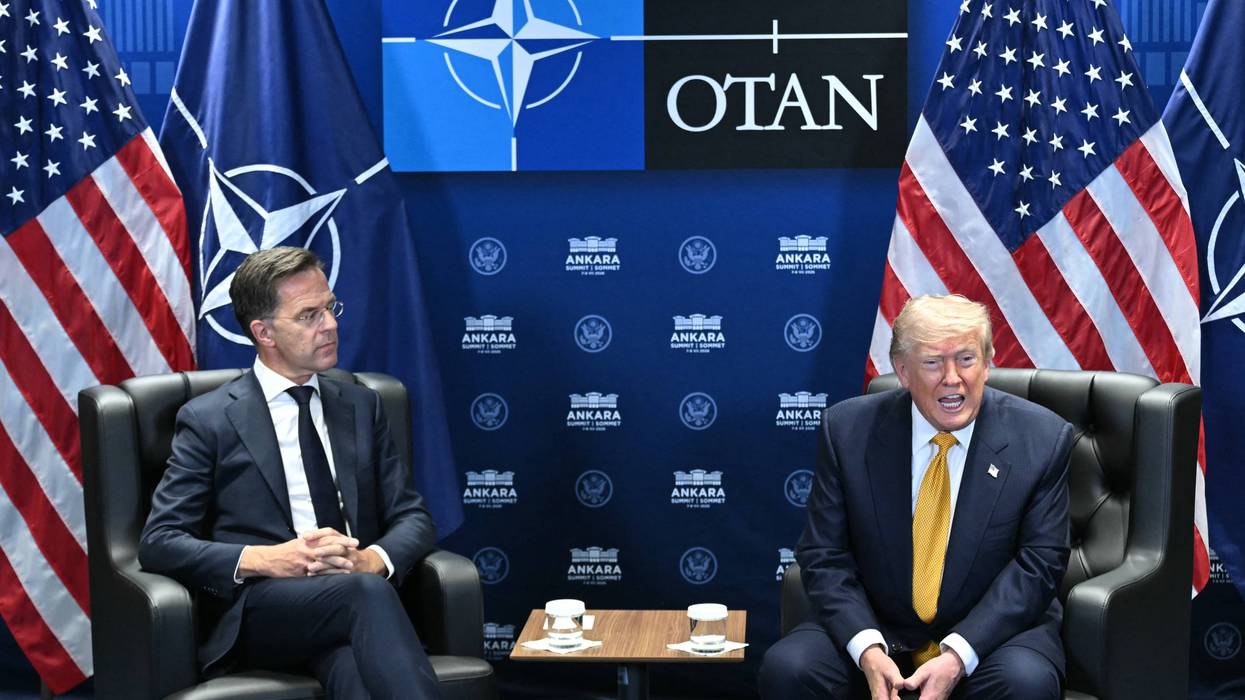
What was gained—and what did they refuse to admit—when the powerful military bloc held talks in Türkiye?
Despite its well-advertised tensions and tectonic geopolitical changes, this week’s NATO summit demonstrated that NATO has survived and is resilient. It remains committed to reinforcing US hegemony across Europe and globally. Not a lot has changed since former US National Security Advisor Zbigniew Brzezinski wrote that US global dominance relies on controlling the periphery of Eurasia: NATO in the West, in Southwest Asia to the South, as well as its Asia-Pacific allies from South Korea and Japan through the Philippines and Australia. In the 21st century, military planning as well as trade is deeply integrated across these three regions.
The Summit served to reinforce what is emerging as a new bloc system for our yet to be named era. Threatened by the US and NATO, as John Mearsheimer remarked, Russia, China, Iran, and North Korea each see the US as a mortal enemy. While each of these nations’ situations and ambitions are vastly different, they share an interest in fending off threats from the US. They are thus increasingly binding themselves to one another economically, militarily, and diplomatically.
There were four major dimensions to the summit: 1) NATO’s survival despite its fault lines, 2) the first day’s focus on expanding and integrating European and US military production infrastructures and weapons sales contracts. 3) The final declaration celebrated and committed to still more European military spending. And 4) support for Ukraine was manifest.
The move to what is termed NATO 3.0, with European nations assuming greater responsibilities for the European theater, reflects the United States relative decline, something which has been glaringly demonstrated in its failed war against Iran. Trump and his coterie understand that US “leadership” is only possible with NATO. Despite his rhetoric, Trump and company value NATO because it allows them to do what they want to do elsewhere, especially in the most economically dynamic part of the world: the Indo-Pacific.
The transatlantic and increasingly global NATO alliance remains strong despite its fault lines due to what the elites understand as overlapping US and European shared interests, if not values.
NATO Secretary General Rutte and his allies insulated the alliance from Trump, from his madness, his dementia, his claim that US ships have been attacked by the Islamic Republic of Japan, demands for Greenland, and his complaints that European nations didn’t deliver all that he wanted in his war on Iran. Toward that end, the summit was convened and adjourned in less than a day, and the final declaration was limited to just six paragraphs, leaving little room for debate.
In fact, although not widely reported, during the war European allies have allowed US warplanes and ships to operate from bases across the continent, and they have provided access to their facilities for repairs and refueling.
As we could read in Carnegie Europe, “…trans-Atlanticism was never only a values project. It was—and remains—a convergence of security, economic, and technological interests between two regions that together account for roughly 43 percent of global GDP and comprise the world’s most capable alliance.”
The best way to understand what transpired in Ankara may be to use the lens of transactional dealmaking among Mafia families. Trump and Colby got what they wanted: European elites signed onto NATO 3.0 with increased European military spending and preparations to militarily contain and press Russia, so that the US can focus on containing China’s ambitions and reinforcing its 21st century Indo-Pacific hegemony. Remember, this has been a US goal that began with Obama’s “pivot to Asia.”
With NATO 3.0, the US intends to gradually reduce its ostensible role in guaranteeing European security. It is worth noting that European NATO members already massively outspending Russia on their militaries. They have conventional military superiority over Russia. And with NATO 3.0 these differentials will only become greater.
In time, the US will provide only what its European allies cannot: nuclear threats and high-tech intelligence. But it is also worth noting is that Trump said nothing in Ankara about pulling more troops out of Europe. The announced 5,000 troop reduction in Germany has yet to begin, and a commitment for increased US troop rotations in Poland was made. The Hegseth-Colby campaign for major US force reductions in Europe has been slowed by the two-month review won by Secretary of State Marco Rubio. In the end, Trump, and no one else, is the decision maker. Remember too that despite Trump ranting about NATO’s limited support for his war against Iran, the US would be very limited in its Southwest Asian and North African power projection without it bases still in Europe.
The West wasn’t shattered. In the transactional exchange, the US joined the dominant European narrative forged by the Baltic states and Poland about Russia and signed onto the summit’s final declaration with its commitments to support Ukraine in the war with Russia. This includes blessing Ukrainian debilitating attacks on Russian energy infrastructure deep within Russia. The declaration identified Russia as a long-term threat and reinterred the Treaty’s Article V commitment to come to the aid of any NATO member that is attacked. Ukraine won’t be joining NATO any time soon, but its advanced military technologies and warfighting experience make it an increasingly powerful adjunct to NATO.
In fact, the arms sales announced as the summit began serve as glue for the alliance’s future. Fifty billion dollars in weapons contracts were signed, with commitments made to Lockheed Martin, Raytheon, Palantir, Anduril, Germany’s Rheinmetall, French Airbus, Sweden’s Saab, and Turkey’s Aselsan. Even Denmark, despite Trump’s Greenland threats, will be buying US Hellfire missiles and ships to patrol the Arctic.
NATO 3.0 makes it possible for the US to reinforce its lattice-like military alliance system and its military buildup across the Indo-Pacific. Note that the RIMPAC (Rim of the Pacific) naval show of force was held at the same time as the NATO summit. It includes the forces of 10 of 30 NATO nations. Almost one-third of all NATO countries sent military forces: land, air, and sea to Hawaii to participate in the RIMPAC 38-day war drills.
The summit also demonstrated Turkey’s increased role in NATO, both in relation to Southwest Asia, but also via its increased weapons production capacity for the alliance. Trump tossed Erdogan what may prove to be only a symbolic military bone with his offer to endorse the sale of F-35s to Turkey. There remain two major obstacles to those sales: Turkey’s S-400 air defense systems which were purchased from Moscow and the need for Congressional authorization for those sales.
On the subject of weapons sales, in his ostensible tilt toward Ukraine, Trump authorized the much-ballyhooed licensing for Ukraine to produce Patriot missile defense systems. This is too little too late to be meaningful. It will take at least a year to get such a complex weapons manufacturing system up and running. And Putin would certainly make these weapons facilities a primary target while they are being built. Moreover, to defend the construction of these facilities the already beleaguered Ukraine would need to divert its very limited missile and drone defenses to protect the construction, leaving the country still more vulnerable.
Reinforcing the global commitments of NATO, at a meeting on the sidelines of the summit the Japanese government called for deeper cooperation between NATO and its Indo-Pacific partners Australia, Japan, South Korea, and New Zealand at a meeting on the summit sidelines. Japan, which hosts more than 100 US military bases and installations, and has its most militarist government since 1945, has a security and defense pact with the EU. In recent months, Tokyo has created or deepened strategic partnerships and weapons development agreements with countries including Britain, Germany, Italy, and Sweden.
Tokyo is in the process of doubling its military spending. It is moving to trash Article 9, the heart of its Peace Constitution. It has deployed conventional preemptive strike missiles that can reach China and North Korea. And it has declared its readiness to go to war for Taiwan.
Despite the still open wounds of Japanese conquest and colonization of Korea in the last century, the US backed Japanese-ROK alliance is the strongest it has ever been. And there is increasing discussion in South Korea about returning US nuclear weapons to the Peninsula or developing its own nuclear arsenal.
Filling out the network of Indo-Pacific alliances, the US has been deepening military ties with its former colony, the Philippines. Add to this AUKUS (Australia, Britain and the US) and the QUAD (US, Japan, Australia, and India).
Several other points are worth noting. Europe’s massive military spending increases, trending at an annual rate of 20%, have been financed by increasing debt. That can’t continue. As Stop Re/Arm Europe network warns, if this increased spending continues it can only come at the expense of essential social services. Those cuts, and the suffering they cause, will further open the way for far-right wing political gains.
In truth, we are still a long way from an operational NATO 3.0. As the French and German refusal to cooperate on development of the next jet fighter indicates, continuing divisions among the leading European powers remain very real. Issues of command and control and many other concerns will be challenging for NATO to address. And while not widely reported in the US media, US and European national security mandarins have been remarking about the failure to announce a NATO summit in 2027. The absence of a NATO summit next year may serve to prevent a new round of headlines and reports about US-NATO divisions, and it will also allow for more backroom deals.
For more than 60 years (1945 – 1980) humanity was plagued by the clash of competing block systems. The Cold War was not always cold, and on several occasions, we were confronted by the specter of nuclear annihilation.
During the Cuban Missile Crisis, President Kennedy and his advisors believed the odds were 50-50 that the crisis would end in a thermonuclear exchange.
Computer and human errors were not uncommon. NATO’s 1983 Abel Archer military exercise sparked fears that they were under attack. That same year computer Soviet systems mistook a rare alignment of sunlight on high-altitude clouds for incoming US nuclear armed missiles. Most of us are alive today because Soviet Colonel Petrov, believed it to be a false alarm, defied his standing orders, dismissed the nuclear alert, and was later reprimanded for his courageous act.
Millions, from Vietnam to Afghanistan and Greece to Mozambique died in proxy wars between the US and Soviet led blocs. As President Dwight Eisenhower warned, the US military-industrial complex threatened democratic values and practice. And trillions of dollars, rubles, francs and other currencies were wasted on weaponry at the cost of essential medical care, education, housing and more.
One definition of stupidity is doing the same thing twice but expecting different results. With the creation of a new bloc system, the expansion and upgrading of the world’s nuclear arsenals, the climate emergency’s fires and rising seas, and uncertainty over where new high-tech weaponry will lead, it appears that NATO, Russian, and many other elites failed to learn the Cold War’s existential lessons.
But there is still time. It should be obvious that the only way to end the war between Russia and Ukraine is with a dirty deal that includes a ceasefire in place, security guarantees for both Ukraine and Russia, and a commitment to negotiate the status of currently occupied territories over time. How many more Russian and Ukrainian lives should be sacrificed in the killing fields of Donbass? How long should we tolerate spiraling military spending at the sacrifice of our living standards which in turn opens the way for fascist forces on the right?
There is also the lesson of Common Security diplomacy which thankfully provided the foundation for détente and the end of the Cold War. We can take some hope from off the record Track II discussions and others among elite Europeans, Russians, and US figures that there are increasing references to building on the traditions and surviving resources of the Helsinki process and the OSCE (Organization for Security and Cooperation in Europe) to build a post-war Common Security European and transatlantic strategic architecture. Too few among us now remember that three decades ago the Cold War came to an end when NATO and Russian leaders finally came to understand that security cannot be achieved against a nation’s rival, but only through hard won win-win diplomacy that addresses the fears of all parties to a conflict.

A Ukrainian drone attack on Russia's largest oil refinery highlights the inherent vulnerability of fossil fuel infrastructure, especially when compared with renewable alternatives.
I visited Omsk once, or at least its airport; we were en route from Moscow to Ulan Ade on the Mongolian border, and the Aeroflot flight landed there to refuel. (It was a memorable journey; this was still the Soviet Union, and on boarding for the full-day flight, the stewardess handed each passenger a baggie with a scrawny chicken drumstick). All of which is to say, I’m equipped to pronounce, with the gravitas proper to a pundit, that Omsk is long ways from anywhere else.
Including the Ukrainian border, which makes it remarkable that Ukraine's President Volodymyr Zelenskyy’s drone specialists managed to fly a whole squadron of their craft more than 2,500 kilometers from home and bomb the heck out of Russian President Vladimir Putin’s largest oil refinery. It was the high point of an ongoing campaign designed to highlight what may be Russia’s greatest weakness: that it, like a number of other countries, is heavily dependent on oil.
Just as US President Donald Trump has proposed building American prosperity on the back of “energy dominance" via “liquid gold,” oil was supposed to be Russia’s strength, the source of its greatest riches. (John McCain memorably called it a “gas station with nukes.”) And indeed in the early days of the war, Russia flexed its hydrocarbon muscle, threatening to cut off Europe’s gas supply. Throughout its invasion of its neighbor, Russia has relied on the often-covert export of oil via its fleet of “shadow tankers” to keep revenue flowing. Trump of course made this easier and more profitable for his buddy by temporarily lifting sanctions in the wake of our own ill-advised attack on Iran.
But if our attack on Iran has made other nations demonstrably more nervous about relying on the import of hydrocarbons, Ukraine’s attacks on Russia’s petroleum network should make them nervous about depending on the stuff even if they don’t have to bring it in from afar. It turns out that in the drone age it’s a very risky business, because it relies on colossal pieces of infrastructure that can’t be easily defended.
Once you can run cars and heat pumps and cooktops off the power those panels and turbines generate, then you’re far more protected against attack.
One of those is the supertanker—there was one on fire Tuesday in the Gulf, apparently hit by an Iranian missile because it strayed from the Tehran-approved shipping lane. Ukrainian drones attacked another Monday in the Sea of Azov, crippling the vessel. There’s essentially no defense for these slow-moving giant ships if an adversary with a few drones wants to take one out—they are, after all, a floating pool of flammable liquid.
Another vulnerability is the terminal where you load and unload the crude—Ukraine got one of those Monday too, in occupied Crimea:
The facility serves as a major logistics hub for petroleum products on the occupied peninsula, handling the receipt, storage, and transfer of oil between rail infrastructure, storage tanks, and tankers
And a third—and perhaps most exposed—is the refinery. An oil refinery is one of the most specialized pieces of equipment humans have ever built; anyone who’s ever driven by one on the highway will recognize that the tangle of pipes and tanks that makes each so complicated. It’s an industry truism that no two are alike.
That means that they’re highly vulnerable. If you aim your drone well, maybe it will smash, say, the ELOU-AVT-11 Unit, which at Omsk is what they call the thing that does the initial distillation and desalination of the crude. Without it, the secondary units that produce, say, gasoline and jet fuel have nothing to work with. And this is highly complicated equipment not easy to replace—given Western sanctions, the current guess is six months to a year. And it’s not as if Ukraine has hit just that refinery—in fact, it was one of the last squares on a drone pilot’s bingo card. As Illia Kabachynskyi reports:
It's also worth remembering that Ukraine has already hit all 10 of Russia's largest refineries, some of them more than once. That means it's no longer a single plant waiting for repairs—it's effectively all of them at once, which piles additional pressure on repair crews and on the supply of replacement parts that are hard to source under sanctions.
Russia started this energy war, of course—over the years of the conflict it has targeted heating plants and the like, trying to freeze the fighting spirit out of the Ukrainians during their long winters. It’s been effective at producing cold, but not at winning the war; along with the attacks on schools, hospitals, and other civilian targets it seems to have helped reinforce the Ukrainian will to resist.
Now—with far more attention to avoiding civilian casualties—the Ukrainians are striking back, at defense plants, and especially at refineries. As Zelensky said Tuesday morning:
The very idea of Russia having a strategic rear is gone. For a long time, Russia believed it had territorial advantage no one else possessed, a deep rear, where it could safely keep everything its war depends on, believing no one could reach them. We have reached them.
But of course what’s at stake here is not just the oil that the Russian war machine runs on. In Russia, as in America, almost everything runs on oil. I remember that the one and only time that I sat down with former President Barack Obama, the first thing he told me was that “the price of gasoline is the most salient fact in American politics.” If that’s even close to the case in Russia, Putin better watch out: in occupied Crimea, gas prices are going above $10 a gallon. The government is desperately trying to import gasoline from as far away as India. As Pjotr Sauer reported Tuesday morning, police are having to draw guns to quell disturbances at gas stations where lines can stretch for kilometers, “fuel tourists” are crossing the borders with China and Kazakhstan to fill their tanks, and as a result:
“Mass fatigue with the war is turning into mass irritation,” said Andrei Kolesnikov, a Moscow-based political analyst. Even so, he said the shortages were unlikely to trigger widespread protests in Russia’s tightly controlled political system. “There is certainly shock, but the lack of any real means of influencing the situation—and the risks associated with trying to do so—make protests unlikely.”
This seems likely to get worse. Here’s a social media post from an Omsk resident watching the drone strikes: "Don't waste any time right now. Anyone with a car who's watching me—head to the gas station! The lines are about to get crazy."
And here’s an account of how Russian horse breeders are reporting a surge in sales because a steed is now cheaper to maintain than a car; check out the video of the equestrian cantering past the endless line at the gas station.
Ukraine has stood up to Russia’s attacks on its energy infrastructure mostly by starting to diversify: as Paul Hockenos reported last winter, the country is undergoing a rapid renewables revolution:
According to estimates from the Solar Energy Association of Ukraine, the nation installed at least 1.5 gigawatts of new solar generation in 2025—enough to power roughly 1.1 million homes—and grid operators intend to almost double the country’s renewable energy production over the next four years.
“Ukraine’s energy transition is not a slogan,” says Ievgeniia Kopytsia, a Ukrainian energy analyst at the Institute for Climate Protection, Energy, and Mobility. “Since the full-scale invasion, Ukraine has added over 3 gigawatts of new renewable energy capacity. It’s a security-driven transformation, unfolding under extreme constraints, that prioritizes decentralization, flexibility, and speed of recovery.”
In the most basic terms, a single missile can take out a gas-fired power plant. But as Jeff Oatham of DTEK, Ukraine’s largest energy company and its largest private energy investor, explains:
“You would need around 40 missiles to do the equivalent amount of capacity damage at a wind farm.”
Solar, too, makes an unattractive target. “Attacking decentralized solar power installations is not economically rational,” says Ukrainian energy expert Olena Kondratiuk. “Missiles and drones are expensive, and significantly disrupting such systems would require a large number of strikes, while the overall impact on the energy system would remain limited.” Both solar and wind parks can function even when parts of them are out of operation.
That’s because sun and wind and batteries are not like oil—they are small, interchangeable pieces of infrastructure, easily subbed in. There aren’t choke points like refineries and tankers and terminals; there’s no cascading failure. My roof is covered with solar panels, and I suppose a saboteur could put a ladder against the wall and climb up there with a hammer and do some damage. But it wouldn’t shut down the electric grid across New England; it would be a problem, not a crisis. Which in turn is why no rational saboteur would ever bother.
And once you can run cars and heat pumps and cooktops off the power those panels and turbines generate, then you’re far more protected against attack. If Vladimir Putin had an electrified Russia he would worry far less about Ukrainian drones. Of course, if the world ran on electricity Russia would never have built up the treasury required to act like a bellicose beast.
Look, world leaders should be moving quickly to clean energy because it’s the one scaleable weapon in the war against climate change. But I’ll take any motivation—and I’ll count it as a real bonus if a cleaner world is also one where it’s harder to attack your neighbors because they don’t have vulnerable infrastructure. The peace dividend from sun and wind could be very real.
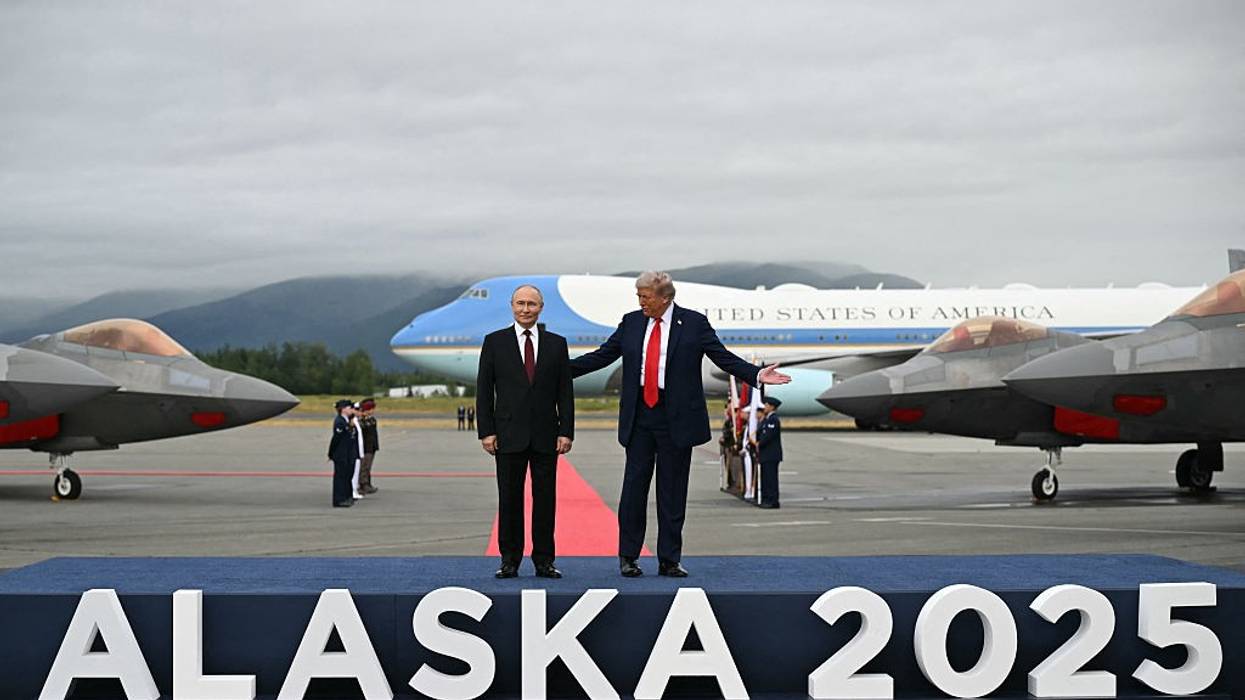
Common security lessons for the US and Russia in a world without arms control.
The following article was initially written at the request of Oleg Bodrov, a Russian physicist with commitments to peace and environmental sustainability and safety. I met Oleg about a decade ago during the World Conference against A- & H- Bombs in Hiroshima, and today we both serve on the board of the International Peace Bureau, a Nobel Peace Prize recipient organization. In addition to serving on IPB’s board, Oleg is chairman of the Public Council of the South Coast of the Gulf of Finland. He lives outside of St. Petersburg and does what he can given the limits of the possible in Putin’s Russia. When he and I last spoke, Ukrainian drones had devastated a massive Russian oil refinery, spewing toxins into the Baltic Sea and across many Russian communities. With Ukrainian drones flying overhead he hadn’t slept the previous night, making Oleg one more innocent caught in that mutually disastrous war.
In our exchanges, Oleg came up with a proposal to take a small step toward bridging the divisions of the new US-Russian Cold War and building for the time when the missiles, drones, and guns of the Ukraine War have been silenced. His idea: I should write an article that shared US peace movement thinking and named actions that can reduce the increasingly perilous military tensions and serve as foundations for a future era of US-NATO-Russian Common security. Oleg would translate the article and arrange for its publication in a Russian scientific journal. As we corresponded about the article’s publication, it occurred to us that it might also prove helpful for US readers, hence its publication here in Common Dreams. Where this will lead, only time will tell. But the truth is that both the US and Russia are going to be around for a long time, and a just and peaceful Common Security order will be essential for this and future generations.
The Bulletin of the Atomic Scientists’ Doomsday Clock report warns us that we face Cuban Missile Crisis level danger. Back then, in 1962, senior officials in the Kennedy administration thought the odds of the missile crisis leading to a nuclear war were 50-50. In the aftermath of the eyeball-to-eyeball nuclear confrontation, Daniel Ellsberg, a senior Kennedy nuclear adviser, became so pessimistic about humanity’s future that, not expecting to live to an old age, he ceased paying into his pension fund.
But both President John F. Kennedy and Chairman Nikita Khrushchev, along with their ruling circles, were sufficiently sobered by the specter of nuclear annihilation. They moved quickly to negotiate the Limited Test Ban Treaty. Their successors built on this foundation, constructing the six-decade-old arms control regime. They negotiated treaties from the Nuclear Nonproliferation Treaty to the SALT and START agreements. They limited, but failed to erase, the dangers of nuclear annihilation.
That arms control regime is now history. First came the loss of the Anti-Ballistic Missile Treaty almost 25 years ago. Then came the expiration of the New START Treaty. Now, President Donald Trump is obsessed with resuming nuclear-weapons testing, and both the US and Russia are moving to deploy new nuclear-capable missile systems.
Predictably, more and more nations are learning a lesson from North Korea: Great powers will not attack you if you have a nuclear arsenal.
Adding to nuclear dangers, Beijing is increasing its nuclear arsenal in pursuit of parity with Moscow and Washington. We are becoming three nuclear-armed scorpions in a bottle. This, together with Russian concerns about the French and British nuclear arsenals, complicates any possible future arms reduction diplomacy. The inability of the US, Russia, and China to find common ground—or even to agree on a least common denominator consensus document—was a major factor that dictated the third consecutive failure of the Nuclear Nonproliferation Treaty (NPT) Review Conference this past May.
The geopolitical landscape is further complicated by the US-Israeli-Iran war. During that conflict, President Trump speculated about possible low-yield nuclear attacks against Iran’s nuclear infrastructure.
Predictably, more and more nations are learning a lesson from North Korea: Great powers will not attack you if you have a nuclear arsenal. Political pressures for nuclear-weapons proliferation are therefore building in threshold nations from Seoul to Stockholm, including Iran, Poland, and Japan, among others.
Political realism and the survival of our species point in two complementary directions. As the Japanese A-bomb survivors and their organization Nihon Hidankyo (awarded the 2024 Nobel Peace Prize) warn, it should be obvious: “Human beings and nuclear weapons cannot coexist.”
We have already had too many close calls with extinction: false nuclear alerts, mistaken launch orders, accidents, and geopolitical miscalculations. And as Nobel Peace Laureate Joseph Rotblat, the founder of the Pugwash Conferences and the only senior Manhattan Project scientist to quit for reasons of conscience, explained, humanity faces a stark choice. We can either completely eliminate the world’s nuclear arsenals, or we will see their proliferation and eventual use. Why? Because no nation will long tolerate what it perceives as an unjust and threatening imbalance of power—in this case, the imbalance of nuclear terror.
Even in the best of circumstances, it will take valuable time—possibly more time than we have—to build the trust and to conduct the negotiations needed for a nuclear-weapon-free world. This, in turn, forces us to learn another lesson from US-Russian history: the possibility of Common Security. In crisis, as our Chinese friends remind us, there is opportunity as well as danger.
In the 1980s humanity faced a similar situation. The two great powers flirted with triggering a catastrophic war that could have caused a nuclear winter. The US and the Soviet Union brought the world to the nuclear brink with the planned deployments of SS-20, cruise, and Pershing II missiles.
The combination of popular movements calling for a halt to the nuclear arms race, and President Mikhail Gorbachev’s understanding that military spending had to be reduced if the Soviet economy were to be salvaged, led Swedish Prime Minister Olof Palme to convene the Independent Commission on Disarmament and Security Issues.
With the collapse of the Soviet Union and the rise of the Bush regime, great power relations reverted to the rules of the game among Mafia families.
Georgi Arbatov, the most senior military adviser to Gorbachev, later wrote about the commission’s work and its world-changing recommendations. In meetings with former US Secretary of State Cyrus Vance and leaders from Austria, Germany, Norway, India, and elsewhere, “a new approach to nuclear arms emerged.” Its essence, in Arbatov’s words, was that “we cannot guarantee our own security at the expense or detriment of someone else’s, but only on the basis of mutual interests.”
To reverse the spiraling arms race, each side needed to name the other’s actions that were most threatening to it and then negotiate agreements that would remove those threats without weakening anyone’s security. Those difficult negotiations led in 1987 to the Intermediate-Range Nuclear Forces Treaty, which prohibited the SS-20, cruise, and Pershing II deployments, and functionally ended the Cold War two years before the Berlin Wall fell.
Context is almost everything. Reflecting on the failure of the 2026 NPT Review Conference, Vietnamese Ambassador Do Hung Viet, the conference president, commented that it is a “fair judgment” to conclude that the US-Iran impasse, which “hung over our heads from the beginning,” together with the Ukraine War and North Korea’s nuclear arsenal, made consensus impossible. “Political concerns,” he said—including the race for artificial intelligence supremacy—“were overwhelming.”
As generations succeed one another, knowledge and wisdom are inevitably lost as well as gained. After two calamitous world wars that claimed between 75 and 97 million lives, the surviving great powers sought “to save succeeding generations from the scourge of war.” They attempted to do so while simultaneously securing their imperial powers and privileges. Thus Article 1 of the United Nations Charter committed governments “to maintain international peace and security, and to that end: to take effective collective measures for the prevention and removal of threats to the peace…”
For the most part, this first commitment was honored—with significant exceptions in Indochina, Afghanistan, and interventions in Eastern Europe and the Caribbean. However, with the collapse of the Soviet Union and the rise of the Bush regime, great power relations reverted to the rules of the game among Mafia families. Drunk with arrogance, the US Bush government boasted: “We’re an empire now, and when we act, we create our own reality. And while you’re studying that reality, we’ll act again, creating other new realities… We’re history’s actors.”
Washington’s arrogance of power continued into the 1990s with the Bill Clinton Administration. Rather than respect Russian history, political culture, sensitivities, and ordinary Russians’ need for economic security, Clinton and his mandarins imposed another cataclysmic revolutionary change: neoliberal economic shock therapy. The result was massive dislocation, impoverishment, a rising death rate, and the restoration of an authoritarian government in Moscow.
Russia’s political and economic systems imploded during Boris Yeltsin’s rule. Despite George Kennan’s warning—Kennan was the architect of Cold War containment—that NATO expansion would lead to disastrous conflict; President Clinton did exactly that in 1999. He initiated NATO enlargement, bringing Poland, Hungary, and the Czech Republic into the alliance. As “history’s actors,” Bush II added seven Central and Eastern European nations to NATO in 2004. Then, in 2008, against the advice of his senior adviser Fiona Hill and over the opposition of Germany and France, Bush the Lesser forced an invitation to Ukraine and Georgia through NATO’s summit.
Given Russia’s memories of invasions from the west—Napoleon, the Kaiser, and Hitler—the Kremlin responded as Kennan and Hill had predicted. In an obvious breach of the UN Charter, the ostensibly defensive Russian invasion of Georgia followed. Meanwhile, even without Kiev becoming a formal NATO member, and in response to the alliance’s expanding military presence in Ukraine, President Putin reportedly began planning what became the disastrous “special military operation” as early as 2007. Even before, among the earliest and most egregious Bush-Cheney acts was the withdrawal from the Anti-Ballistic Missile Treaty, then a cornerstone of arms control.
The little remaining mutual trust between the West and Russia was among the first casualties of the war. The war also spurred further NATO expansion, with Finland and Sweden joining the alliance and thus doubling the line of contact between NATO and Russia. In addition to the hundreds of thousands of Ukrainian and Russian casualties, US-Russian arms control agreements, including New START and Open Skies, became collateral damage. The new Cold War became even more dangerous as the US military-industrial complex and the Kremlin pressed to “modernize” their nuclear forces, and as European nations—fearing what Russian territorial ambitions might become—laid the foundations for a new European military superpower.
There is a mistaken but widespread belief that nuclear weapons have not been used since the atomic bombing of Nagasaki. This is wrong. As Daniel Ellsberg later wrote, during international crises and wars, US presidents have prepared to initiate nuclear war and have threatened to do so. They have done so in the same way that an armed robber points his gun at his victim’s head: Whether or not the trigger is pulled, the gun has been used. Not only during the Cuban Missile Crisis, but repeatedly during wars and interventions in the Middle East, the Vietnam War, the Taiwan Strait, and other crises, the United States has resorted to nuclear extortion. As former US Defense Secretary Harold Brown put it, with the US first-strike capacity and doctrine in place, our conventional forces become “meaningful instruments of military and political power.”
Noam Chomsky put it differently: “That means that under this umbrella of strategic nuclear weapons… we have succeeded in sufficiently intimidating anyone who might help protect people we are determined to attack.”
Although current geopolitical and technological landscapes are very different from those at the height of the first Cold War, we are not without diplomatic structures and models that can serve as foundations for trust-building dialogue and negotiations.
The United States is not the only nuclear power that has practiced nuclear blackmail. Every other nuclear-weapons state has done so at least once. As early as 1956, Prime Minister Nikolai Bulganin threatened London and Paris, hoping that the threat would force their withdrawal from Egypt during the Suez War. More recently, and to considerable effect, President Putin and former President and current Deputy Chairman of the Russian Security Council Dmitry Medvedev have engaged in nuclear saber-rattling.
Nuclear powers seek to legitimize their arsenals and “modernization” on the basis of deterrence theory—the idea that each new development is necessitated by the need to prevent a nuclear attack by a rival. In reality, the George H.W. Bush administration’s initial “Doctrine for Joint Nuclear Operations” gave the game away. As that document stated, “The focus of US deterrence efforts is… to influence potential adversaries to withhold actions intended to harm US national interests” The same applies to all other nuclear-weapons states. And as the history of false alerts, mistaken launch orders, accidents, and ill-conceived aggressions demonstrates, deterrence only works—until it doesn’t.
Even before the New START Treaty’s limit of 1,550 deployed strategic missiles expired, Washington and Moscow were arms racing. The US is spending $1.7 trillion to “modernize” and replace its entire nuclear triad—including its “use-them-or-lose-them” first-strike land-based intercontinental ballistic missiles (ICBMs)—and is racing to renew warhead pit production.
Seeking to maintain parity, Russia is also developing and moving to deploy a range of new strategic-range weapons. These include a hypersonic boost-glide vehicle carried by the Sarmat “super-heavy” ICBM; an air-launched hypersonic ballistic missile capable of evasive maneuvers; a nuclear-powered cruise missile of “unlimited range”; a nuclear-powered unmanned underwater vehicle of “unlimited range”; and a sea-launched hypersonic missile.
President Trump, committed to regaining nuclear and high-tech superiority and to prevailing in the artificial intelligence competition with China, also seeks to spend trillions of dollars on his “Golden Dome” missile defense system. It will never work, but it will be profoundly destabilizing and will bankrupt the United States.
Making matters still more dangerous, US-Russian military-to-military communications are at their nadir. Moscow has made clear that it is disinterested in renewed risk reduction and arms control diplomacy until it is satisfied with the outcome of the Ukraine War.
Rebuilding trust is essential for any risk and arms reductions, but it will require patience and steadfast commitments on all sides. It seems clear that negotiating a new European security system will only become possible when the post-Ukraine War dust settles over the European strategic landscape. Similarly, greater clarity about Washington’s commitment to NATO, and about the credibility of massive European rearmament, will be critically important factors in approaching any new risk-reduction and strategic-stability negotiations.
In approaching the urgent need to restore stability to US-Russian-European relations, we should reflect on the differences between Western and Chinese approaches to arms control diplomacy. We can learn from the Chinese.
The Western approach has been an exclusive focus on negotiations about particular nuclear-weapons systems and doctrines. Chinese diplomats and leaders, on the other hand, wisely think it necessary to identify and address the underlying causes that drive nuclear arms races and potential conflict.
Given that there is no military solution to the Ukraine War, it is past time for a ceasefire, for compromises, and for multidimensional peace negotiations—Ukraine-Russia, EU-Russia, US-Russia. Only then can we begin to address the existential US-Russian nuclear risks with Common Security diplomacy.
Although current geopolitical and technological landscapes are very different from those at the height of the first Cold War, we are not without diplomatic structures and models that can serve as foundations for trust-building dialogue and negotiations.
Among these resources is the Organization for Security and Cooperation in Europe (OSCE). A post-Ukraine War 21st-century version of that conference could be a constructive way to begin building a new Common Security order. Although its 57 European, North American, and Asian member states have reduced their financial and other commitments to the OSCE—which is mandated to work for stability, peace, and democracy in Europe—it can still serve as a neutral forum for diplomatic engagement and negotiations for a new Eurasian and Euro-Atlantic order.
The OSCE grew out of the 1973 Conference on Security and Co-operation in Europe (CSCE), “a multilateral forum for dialogue and negotiation between East and West.” Among its initiatives was the Helsinki Process, involving 35 nations that agreed to the inviolability of post-World War II frontiers, reinforced commitments to human rights, and facilitated the institutionalization of the OSCE.
Track II and other discussions among Europeans, Russians, and Americans have continued despite the war, and they have identified numerous traditional paths to nuclear risk reduction and arms control possibilities. A laundry list of sometimes competing proposals has been developed and can be drawn on when the time is ripe.
We can create visions and policies that reduce the growing nuclear danger and lead to arms control, common security, and nuclear disarmament.
Alexey Arbatov, of the Center for International Security at the Primakov Institute in Moscow, identified two conditions essential for arms control diplomacy during the Cold War: “a state of mutual nuclear deterrence” and “the emergence of approximate equality (parity) of strategic forces” of the dominant nuclear powers. A new conceptual approach, he argues, requires acknowledging the realities of multilateral deterrence, incorporating the security interests of all nuclear-armed states, and rebuilding strategic stability through inclusive frameworks rather than bilateral bargains. Chinese, French, and British nuclear arsenals, plus the nuclear four outside the NPT regime, must be factored into any negotiations. We are thus challenged by at least a four-dimensional diplomatic puzzle, and finding a solution is an urgent necessity.
There is a third requirement without which there can be no exit from a bellicose and mutually debilitating future: trust. It can only be developed over time, through patient confidence-building measures. These could include continuing to honor New START deployment limits and refraining from uploading additional warheads onto existing missiles. Wolfgang Richter, a former German colonel now associated with the Geneva Centre for Security Policy, writes that overcoming the current vicious circle of distrust requires “renewed and credible mutual commitment confirming that the independence and territorial integrity of states will be respected.” This could be achieved by a settlement of the Russia-Ukraine War and by trust-building initiatives between Russia and its European neighbors.
Even before the Ukraine War ends and opens the way for risk reduction and arms control negotiations, many on both sides of the US-Russia divide agree that the first priority must be preventing a resumption of nuclear-weapons testing, which President Trump has threatened. Related, and possibly of equal importance, is to honor and sustain the Nuclear Nonproliferation Treaty in the wake of the recent failed review conference.
Another limited but encouraging proposal is to convene a US-Russia-China leadership summit, at which a version of the Reagan-Gorbachev warning—that nuclear war can never be won and must not be fought—is reiterated. This would open the way for officials and experts to explore jointly how to reduce nuclear risk.
Unhinged and dangerous as he is, we need to acknowledge that despite his recent nuclear threat to Iran, over the years Trump has been willing to talk with Russia, and he has repeatedly stated that he wants movement toward denuclearization. Not that he has done much to make that happen.
Given the political environment in most European countries, and with Germany and France now competing for European military leadership as confidence in NATO wanes, initiatives for risk reduction and greater strategic stability inevitably lie with Washington and Moscow. If progress can be made by the US and Russia, Europeans could then be brought in.
Military-to-military communication needs to be revitalized, perhaps beginning with crisis communications, especially as drone warfare and wayward Ukrainian and Russian drones increase the danger of miscalculation. Building on the tradition of the Vienna Document, communication could then be expanded regarding troop movements, military exercises, and more. Addressing the growing military competition for control of the Arctic could be one place to begin.
Even though Russia and the United States have functionally withdrawn from the Open Skies verification treaty, 32 member states continue to honor it. A return to Russian and US participation would be a comparatively easy means to signal intentions to improve relations, and an important step toward trust building.
Like cultural exchanges in the past, trust can be built in many ways by renewing cooperative commitments. Low-hanging fruit could include building on the decades-long International Space Station collaboration; renewed scientific cooperation across the Arctic, where thawing permafrost poses increasing climate and health dangers; and, always, people-to-people exchanges.
Magic wands are in short supply. As the biblical proverb advises, “Where there is no vision, the people perish.” Across the lines and structures that divide us, like the Hibakusha and the men and women who preserved human survival through the worst of the Cold War, we can create visions and policies that reduce the growing nuclear danger and lead to arms control, common security, and nuclear disarmament. Naming, dialogue, and debate are essential building blocks to get there.
