Tag Archives: Director Squires

The Director Returns IPR Merits to the PTAB

by Dennis Crouch

This is a follow-up to my September post on Professor John Duffy's move to the USPTO. Duffy was sworn in as General Counsel on October 5, and the Office has now expanded his title to General Counsel and Supervisory Solicitor. Joining him as Deputy General Counsel and Solicitor is Professor Greg Dolin (Baltimore). Dolin is a former clerk for Judge Pauline Newman and later represented her in her lawsuit against Chief Judge Moore and the Federal Circuit's Judicial Council.

Duffy and Dolin are law professors and creative appellate litigators. I expect to see some interesting developments.
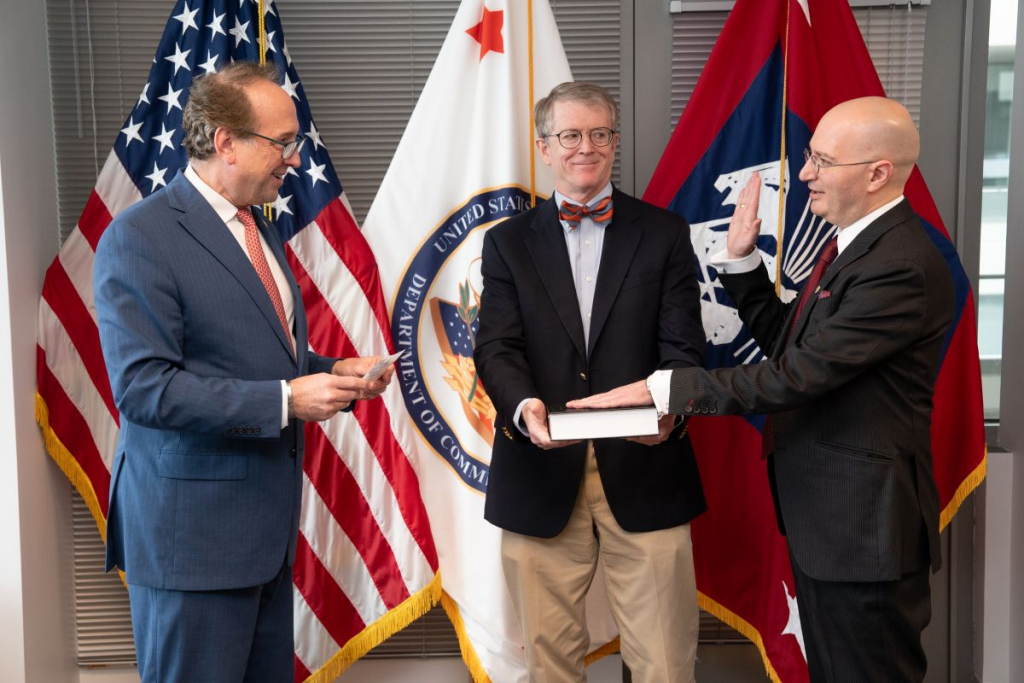
Swearing-in ceremony at the U.S. Patent and Trademark Office

Duffy's first visible work product was announced on November 10, 2026. In a memorandum co-signed with Director Squires, the Office is returning the merits portion of IPR and PGR institution decisions to the PTAB, effective November 16.

The Director will keep the initial screen on discretionary and other non-merits factors. Petitions that survive go to a three-judge panel that decides institution on the merits on the Director's behalf -- and if that panel institutes, a different panel will conduct the trial. The memo also tightens the merits standard. A petition fails if it falls short on a substantial majority of the challenged claims, and a claim whose arguments are in "equipoise" counts against the petitioner. Tie goes to denial.


To continue reading, become a Patently-O member. Already a member? Simply log in to access the full post.

PTAB Section 101 Appeal Data, 2009–2026

by Dennis Crouch

I have been parsing ex parte PTAB decisions - about 130 k for this post running from 2009 through September 2026 - looking particularly at the eligibility cases.  The short version: eligibility is again about a fifth of the PTAB's appeal docket; my report on lowered affirmance rates was a temporary blip; and the Board has nearly stopped raising Section 101 "new grounds of rejection."

Some background: once an examiner has rejected claims twice, the applicant can appeal to the PTAB. The Board then affirms or reverses each rejection. Sometimes a PTAB decision result is "affirmed-in-part" - meaning that some of the examiner's grounds were affirmed but others were reversed.  Under 37 C.F.R. § 41.50(b), the Board can also enter its own new ground of rejection, and the applicant then has two months to reopen prosecution or request rehearing.  That is what happened to DeepMind in Ex parte Desjardins, Appeal No. 2024-000567 (P.T.A.B. Sept. 26, 2025) (precedential). The Board affirmed the obviousness rejection of its machine learning claims and added its own Section 101 rejection. Director Squires, writing for an Appeals Review Panel, vacated the Section 101 rejection. See Dennis Crouch, Director Squires Takes Aim § 101 Rejections, Patently-O (Sept. 28, 2025).

Line chart: the share of PTAB ex parte appeal decisions reviewing a Section 101 rejection was 3–6% a quarter from 2009 to 2016, rose to 33% in 2019, fell to 8.5% in 2022, and was about 21% in 2026.


To continue reading, become a Patently-O member. Already a member? Simply log in to access the full post.

PTAB Law School Moot Court Competition Set for Spring 2027

by Dennis Crouch

I’m hoping Mizzou will be able to field a team in the newly announced PTAB moot court competition in Spring 2027, offered in collaboration with Indiana University Maurer School of Law. Each team will submit one written brief and argue at least once before a panel of Administrative Patent Judges, and the finalists will be invited to argue in person at USPTO headquarters in Alexandria. There is no entry fee, but only a limited number of teams will be admitted. Interested schools should contact PTABMOOT@iu.edu. The PTAB previously ran a moot court in 2024-25 and this one looks to be a continuation of that with a bit more structure.

Law students (and anyone making <$75 per year) – get a free Patently-O subscription here.
(more…)

Tie Goes to the Applicant: The USPTO’s SMED Flowchart

by Dennis Crouch

USPTO Director John Squires issued another memorandum on Subject Matter Eligibility Declarations (SMEDs) today: Subject Matter Eligibility Declarations (SMEDs) under 37 CFR 1.132: Flowchart for Analysis and Best Practices (Sept. 29, 2026). The four-page memo is styled as an addendum to the April 30, 2026 best-practices memo and comes with a two-page flowchart tracing how an examiner should evaluate a SMED, first for formal compliance and then on the merits, along with five best practices for applicants. The memo says it "does not announce any new USPTO practice or procedure," and for the most part that is accurate. Nearly every box on the flowchart points to an existing MPEP section.

USPTO flowchart, Evaluating SMEDs Part 2: Review on the Merits


To continue reading, become a Patently-O member. Already a member? Simply log in to access the full post.

A USPTO Docketing Change Behind the Terminal Disclaimer Collapse

by Dennis Crouch

Terminal disclaimers now appear on about 10% of issued utility patents, the lowest annual rate since 2008 and down from almost 22% in 2023. Obviousness-type double patenting (OTDP) may be the nerdiest of our patent doctrines - but I was surprised by the transformation in terminal disclaimer practice.

The Federal Circuit meanwhile is set to decide how much of the doctrine survives. In re Ablynx N.V., No. 26-1333 (Fed. Cir.), asks whether an OTDP rejection can rest solely on the risk of harassment by multiple assignees, with no extension of patent term to justify it. Last month I wrote about the USPTO's answer to that question in Ex parte Baurin (Aug. 9, 2026), and then the appeal itself (Aug. 16, 2026). Further briefing in the case is due later this month (September 2026).

Line chart of the share of issued utility patents carrying a terminal disclaimer, 2011 through 2026, peaking above 21% in 2023 and falling to 10.1%

I first looked for a doctrinal explanation for the shift because there has been a lot of action with regard to OTDP and terminal disclaimers the past few years. See, for example, In re Cellect, 81 F.4th 1216 (Fed. Cir. 2023); and Allergan USA, Inc. v. MSN Laboratories Private Ltd., 111 F.4th 1358 (Fed. Cir. 2024).

But, my data point to a different cause. The biggest single driver is a change in patent family size. From 2023-2025, we saw a large bolus of continuations, divisionals and CIPs  -- making up 40% of issued utility patents in mid-2023, but represent only 25% today. Follow-on applications (such as continuations) receive OTDP rejections about 10x the rate of original filings.

Continuations, divisionals and continuations-in-part as a share of US utility patent grants, 1976 through 2026

This sent me on a search for the cause of the swing in continuations. It turns out that the rise (and fall) is not about applicants -- it all traces back to shifts in USPTO examination policy about which applications the examiner should pick up next.


To continue reading, become a Patently-O member. Already a member? Simply log in to access the full post.

Prof John Duffy Next USPTO General Counsel

by Dennis Crouch

Professor John Duffy (UVA) appears to be in line to take over as USPTO General Counsel.  GC is the Director's principal legal advisor and runs an office of about 130 lawyers that include the Office of the Solicitor (which defends PTAB and TTAB decisions at the Federal Circuit and represents the Director in APA suits), the Office of General Law, and the Office of Enrollment and Discipline.

The Office is currently defending a substantial volume of litigation over the Director's discretionary control of IPR institution -- and Duffy's academic work focusing on the interplay between constitutional, administrative, and patent law will likely serve the agency well.  Duffy teaches administrative law alongside patent law, clerked for Judge Stephen Williams and Justice Scalia, and spent time in the Office of Legal Counsel at DOJ. His work has triggered substantial changes in the patent system, including as counsel in both the KSR and TC Heartland.  His 2007 Patently-O essay triggered a rewriting of appointment statutes for PTAB (then BPAI) judges; and eventually to Arthrex. John F. Duffy, Are Administrative Patent Judges Unconstitutional?, 2007 Patently-O Patent L.J. 21 (2007).

Duffy was my professor at the University of Chicago, where I took his international intellectual property course and we have spoken a number of times over the years. I wrote about him when the Director position was open for appointment by President Trump, see Dennis Crouch, The Next USPTO Director: Duffy's Four Factor Test, Patently-O (Nov. 30, 2024).  What I said then is still true. Duffy has a deep respect for the patent system as an institution and a historian's instinct for how it got the way it is. He is conservative in the older sense of that word, a careful student of history who tends to distrust judicial innovations that lack statutory or historical footing. This approach is visible in his role as co-counsel for KSR in KSR Int'l Co. v. Teleflex Inc., 550 U.S. 398 (2007), which pushed the Federal Circuit's obviousness test back toward the statute and the Court's own precedents, and in his 2008 warning that the PTO's position in Bilski and its companion cases would sweep in most software patents. John F. Duffy, The Death of Google's Patents?, Patently-O (July 21, 2008).


To continue reading, become a Patently-O member. Already a member? Simply log in to access the full post.

Strings Attached: The House Hearing on Renewing USPTO Fee Setting Authority

by Dennis Crouch

The House Judiciary Subcommittee on Courts, Intellectual Property, Artificial Intelligence, and the Internet held its hearing on renewal of USPTO fee setting authority on September 2, 2026, one day after the House passed the continuing resolution that extends the authority through December 11. Chairman Darrell Issa opened with his view that the question for December is not whether to renew but on what terms. That is the same advice that I gave House staffers when I discussed the issues with them last month.

Four witnesses testified, and none argued against renewal. Former Director David Kappos (who pushed through the original fee structure in 2011) asked for a clean seven- or eight-year extension with no policy riders. The other three wanted strings. Former Acting Director Teresa Stanek Rea proposed a two-year reauthorization cycle plus new statutory guardrails, including a requirement that the Office issue written reasons for PTAB institution decisions. Morgan Reed of the Association for Competitive Technology asked for a real sunset, a functioning PPAC, and limits on discretionary denial. Professor Melissa Wasserman of Texas Law recommended three to four years, structured financial reporting, and a GAO study.

Wasserman is a particularly apt witness for this issue. She, along with Professor Michael Frakes, has published a series of articles building an empirical case that the Office's fee structure shapes its granting decisions. But the 2024 Fee Study commissioned by the USPTO dismissed her work without ever truly engaging.

I wrote about the fee extension issues in a prior August 2026 post, laying out the leverage issue: IPR discretionary denial has nothing to do with fees, but the fee sunset is the one moment when the Office must come to Congress and ask for something.


To continue reading, become a Patently-O member. Already a member? Simply log in to access the full post.

USPTO Fee Setting Authority and PTAB Institution Reform

by Dennis Crouch

USPTO's fee setting authority is set to expire on September 16, 2026.  The Senate passed a continuing resolution for a short extension - to December 11, 2026 (after the mid-term election).  Congress will almost certainly extend the authority because it has been a major success.  The key questions are (1) whether it will again include a sunsetting provision; and (2) whether it will have additional strings attached.

The most focused potential tie-in relates to USPTO Director's thus-far unreviewable discretionary authority to deny IPR and PGR institution.

There is also some focus the agency's use of fee structure as a tool to encourage or discourage certain activity, such as filing repeat RCEs or repeat Continuations or "excess" claims.


To continue reading, become a Patently-O member. Already a member? Simply log in to access the full post.

Can Harassment Risk Alone Support Obviousness-Type Double Patenting?

by Dennis Crouch

With the USPTO's recent brief, In re Ablynx N.V., No. 2026-1333 (Fed. Cir.) is now teed up for the Federal Circuit to decide the nationwide policy on obviousness-type double patenting.  The case particularly asks whether an ODP rejection may be "based solely on the risk of harassment by multiple assignees."

Read my take below.


To continue reading, become a Patently-O member. Already a member? Simply log in to access the full post.

Ex parte Baurin and the Anti-Harassment Rationale for Double Patenting

by Dennis Crouch

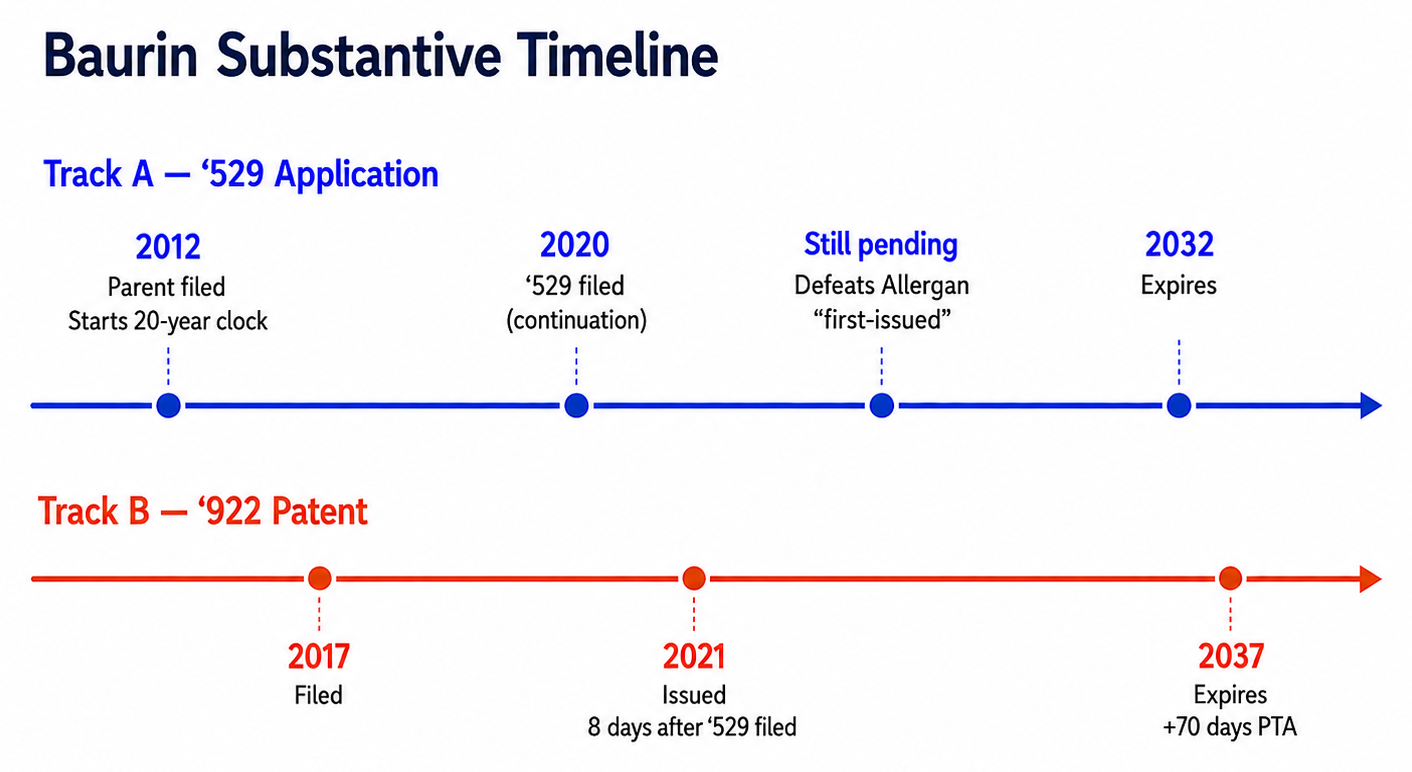
Director John Squires has issued another precedential decision, this time focusing on obviousness-type double patenting (ODP). In Ex parte Baurin, Appeal No. 2024-002920 (ARP Aug. 6, 2026), an Appeals Review Panel led by Director Squires (joined by Chief Administrative Patent Judge Deshpande and Acting Deputy Chief Judge Ankenbrand) reversed the Board and reinstated six ODP rejections of Sanofi antibody claims. The panel held that the risk of divided ownership and duplicative infringement suits, the "anti-harassment" rationale, independently supports an ODP rejection even though the rejected claims would expire five years before the reference patent.

The remarkable part is that the panel does not appear to believe in the rule it applies. They found the decision required by Federal Circuit precedent, but then explained in some detail why the standalone anti-harassment rationale should be abandoned or sharply limited, telling the Federal Circuit that the Office "would welcome" clarification.  The basic question: when - if ever - is a double patenting rejection proper in a pending application that will expire before the already-issued reference patent?

Timeline comparing the '529 application (2012 patent term filing date, 2032 expiration) with the '922 reference patent (2017 filing, 2021 issuance, 2037 expiration)

The CAFC has its opportunity to clarify. The same question is pending in In re Ablynx N.V., No. 26-1333 (Fed. Cir.), the appeal from Ex parte Baumeister, 2025 WL 3515282 (PTAB Nov. 20, 2025). The USPTO has not yet filed its brief in that appeal; after two extensions it is due August 14, 2026, with no further extensions anticipated. In these direct appeals the Office is represented by its own Solicitor's office rather than by the Department of Justice, so Director Squires controls the filing. I expect that Baurin reads as a preview of the USPTO's upcoming arguments.


To continue reading, become a Patently-O member. Already a member? Simply log in to access the full post.

Examiner Allowance Rates Under Director Squires

by Dennis Crouch

USPTO examiner allowance rate by director tenure, anchored to date of last substantive examiner action, 2005 to 2026

Director John Squires has been in office for about ten months, and the patent application allowance rate appears to be continuing its downward trend that began under Director Vidal.

A big caveat here is that our data ends in January 2026. The chart is keyed to office action rejections that lead to abandonment. But when an examiner mails a rejection, the applicant gets six months (three plus three under 37 C.F.R. § 1.136(a)). Nothing is abandoned until that six-month period runs. So the curve above ends in January 2026, and the Squires portion of it is just four months.

The chart above updates the measure I introduced in March - which anchors each disposed application to the date of the examiner's last substantive action: the Notice of Allowance on one side and, on the other, the last rejection for cases later abandoned. See Dennis Crouch, The Third Way: Examiner Action Dates and the Allowance Rate Curve, Patently-O (Mar. 2, 2026).  I like to use this anchoring because it captures the moment the agency decides rather than the moment the paperwork catches up or the applicant takes action: this helps us zero in on patent office activity.

One additional note - I have refined the allowance calculation since March, which moved levels by about one percentage point in some areas, but the general shape of the curve is unchanged.


To continue reading, become a Patently-O member. Already a member? Simply log in to access the full post.

SCOTUS: Patent Owner Joins the Section 314(d) Cert Queue

by Dennis Crouch

FedEx has asked the Supreme Court to decide whether any court can make the Patent Office follow 35 U.S.C. § 312(a)(2), the requirement that an IPR petitioner identify "all real parties in interest." The petition in Federal Express Corp. v. Qualcomm Inc., No. 26-170, seeks review of the Federal Circuit's precedential decision in Federal Express Corp. v. Qualcomm Inc., 174 F.4th 910 (Fed. Cir. 2026), where Judge Hughes wrote for a panel including Judges Cunningham and Stark. The Board in that case refused to decide whether Qualcomm's IPR petitions had named all real parties in interest, then went ahead and cancelled claims. The Federal Circuit held the refusal unreviewable because a challenge grounded in § 312(a)(2) "boils down to a challenge over whether there should have been institution at all."

Director Squires has reversed the underlying policy, but still argued that it was unreviewable on appeal.

This is the fifth petition now pending on the reach of § 314(d), and the first from the patent owner's side of the table. Google LLC v. VirtaMove, Corp., No. 25-1230, Intel Corp. v. Squires, No. 26-73, Tesla, Inc. v. Granite Vehicle Ventures LLC, No. 26-136, and the still-undocketed Kahoot! petition all come from challengers complaining that the Office will not institute. See Dennis Crouch, Four Petitions, One Question: Tesla Joins the Supreme Court's IPR Reviewability Docket, Patently-O (July 30, 2026). FedEx complains about the opposite: the Office instituted and adjudicated without satisfying a statutory precondition. Earlier this summer the Court denied certiorari in Dolby Laboratories Licensing Corp. v. Unified Patents, LLC, No. 25-1011, which raised the same question about the same agency practice.


To continue reading, become a Patently-O member. Already a member? Simply log in to access the full post.

Partial Retreat: Ten Months of § 101 Data After the Surge

by Dennis Crouch

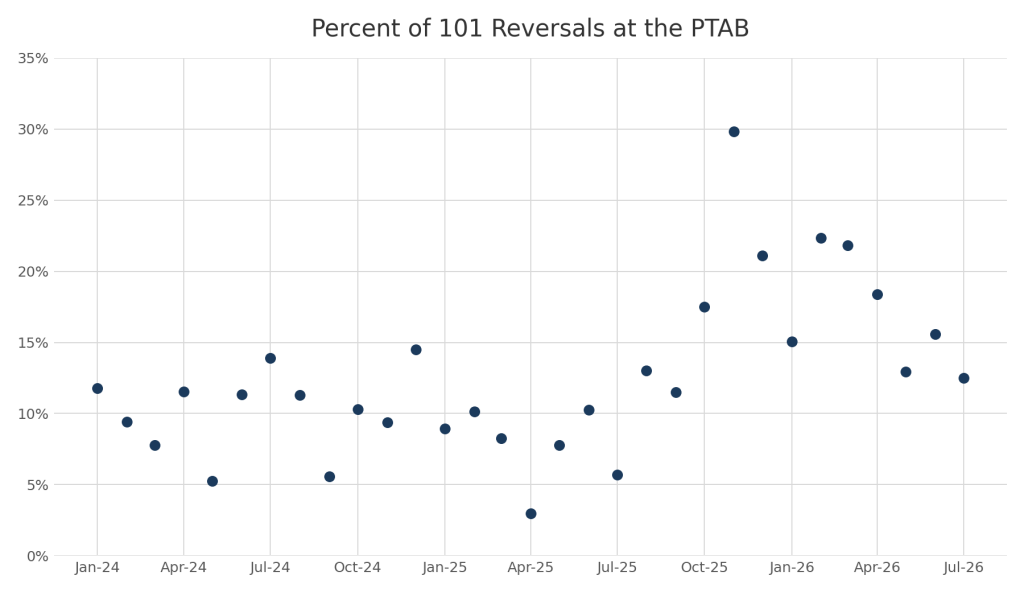
This is the third post tracking Section 101 reversals at the PTAB. The first, PTAB Doubles Section 101 Reversal Rate Under Director Squires (Jan. 2, 2026), reported that the Board's reversal rate on eligibility rejections roughly doubled after John Squires was sworn in as USPTO Director in September 2025. The second, Recalibration: Seven Months of PTAB § 101 Data (Apr. 23, 2026), found the surge had cooled off its November peak and settled into what looked like a new equilibrium near 20%. Data through July 31, 2026 shows that equilibrium has not held.

Monthly percent of Section 101 reversals at the PTAB, January 2024 through July 2026

The numbers. From October 2025 through March 2026, the Board reversed the examiner's § 101 rejection outright in 21% of ex parte appeals that reached an eligibility holding. From April through July 2026 the rate is 15%. The pre-Squires baseline, running January 2024 through September 2025, was 9.4%. What we're seeing here is a partial retreat, not a reversion.


To continue reading, become a Patently-O member. Already a member? Simply log in to access the full post.

Anonymous No More: Real-Party Disclosure Comes to Ex Parte Reexamination

by Dennis Crouch

The USPTO has proposed to end anonymous ex parte reexamination as we have known it. A notice of proposed rulemaking scheduled for Federal Register publication on July 22, 2026 would add 37 CFR 1.510(b)(7), requiring every third party request for ex parte reexamination to include a statement identifying all real parties in interest to the request. Docket No. PTO-P-2025-0545, RIN 0651-AD94. Comments are due 30 days after publication, or about August 21. A requester may ask that the statement be kept confidential, and the Office would then exclude it from the patent and reexamination files. But confidential is not the same as secret. A key part of the rule is that the Office would know who is behind a request even when the public does not.

Inter partes review has always demanded that a petitioner name all real parties in interest: the statute lets the Office consider a petition "only if" it does so. 35 U.S.C. 312(a)(2). Ex parte reexamination never has. Section 302 lets "any person" request reexamination, and Section 301(e) lets that person ask to have its identity excluded from the patent file and kept confidential. Anonymity here is a congressional design feature that has sometimes made reexamination attractive, but that feature appears gone.


To continue reading, become a Patently-O member. Already a member? Simply log in to access the full post.

Modest Rule, Real Traps: The USPTO’s Foreign-Applicant Representation Requirement Takes Effect July 20

by Dennis Crouch

The USPTO has finalized a rule requiring foreign-domiciled patent applicants, inventors, and owners to be represented by a registered patent practitioner in nearly everything they file. The final rule, signed by Director John Squires, was published at 91 Fed. Reg. 13510 (Mar. 20, 2026) and takes effect July 20, 2026. It amends 37 C.F.R. §§ 1.9, 1.31, 1.32, and 1.33 and applies to every covered paper received on or after that date, without regard to when the application was filed. In many ways this is a fairly small change since already about 97% of foreign-origin non-provisionals already list a U.S. patent practitioner of record.  So the rule mostly formalizes existing practice.

A "juristic entity" applicant such as a corporation has long needed a registered practitioner, so the population this rule newly reaches is the foreign individual inventor who has been prosecuting on their own. The trademark side has run a version of this since 2019, when the Office began requiring foreign-domiciled applicants and registrants to appoint a U.S.-licensed attorney.


To continue reading, become a Patently-O member. Already a member? Simply log in to access the full post.

The Survivors: IPR Petition Filings Stay Low and Highly Targeted in 2026

by Dennis Crouch

This is a quick follow up from my May post about the dramatic fall-off in IPR petition filings. See Inter Partes Review in 2026 (May 24, 2026). The chart above shows data through mid-July 2026.  And the result is simple – IPR petition filings are not bouncing back. They are running about 70 percent below the pre-2025 norm.

But low is not zero, and the petitions that remain are worth a closer look. The driver is familiar: since October 2025 Director John Squires has personally controlled every institution decision and has denied a large majority of petitions on discretionary grounds under 35 U.S.C. § 314(a), before any merits review. His precedential decision in Magnolia Medical Technologies, Inc. v. Kurin, Inc., IPR2026-00097 (Dir. May 14, 2026), states the rationale plainly: IPR should be an alternative to district court litigation, not an addition to it. Petitioners have responded rationally. If a petition with a weak discretionary profile (a parallel district court case, a repeat challenge, a foreign-manufactured accused product) will be turned away at the threshold no matter how strong the prior art, there is little reason to spend the money filing it. What is left is a smaller, self-selected pool of highly targeted petitions.

Trading Claims for Speed: USPTO Sweetens the Streamlined Claim Set Pilot

by Dennis Crouch

The USPTO announced today that it is waiving the petition fee for its Streamlined Claim Set Pilot Program, effective for petitions filed on or after June 10, 2026. The waiver eliminates the 37 C.F.R. § 1.17(h) fee that has accompanied petitions under the program since its launch last fall.  I have not previously written about the program, but it deserves attention because the deal is now remarkably good for applicants who fit its narrow eligibility window: free expedited examination in exchange for a lean claim set.

The basic structure: an original, noncontinuing utility application filed under 35 U.S.C. § 111(a) before October 27, 2025, that presents no more than one independent claim and ten total claims may be advanced out of turn (accorded special status) for its first Office action. Applications whose claims do not currently comply can be brought into compliance with a preliminary amendment filed before or with the petition (Form PTO/SB/472). The program runs until October 27, 2026, or until each Technology Center has docketed roughly 200 pilot applications, whichever comes first. As of today, every Technology Center still has open slots.


To continue reading, become a Patently-O member. Already a member? Simply log in to access the full post.

Revisiting Sixteen Years of §101 After a Data Correction

by Dennis Crouch

Three weeks ago I wrote a big post on §101 rejection rates from the past 16 years pulled from several million office actions -- and also arguing that examiner behavior on eligibility tracks USPTO administrative policy more closely than it tracks Supreme Court doctrine. See Dennis Crouch, Sixteen Years of §101: What Actually Moves Examiners, Patently-O (May 8, 2026). After publishing, I went back through the collection pipeline and found that I had been missing a small, but meaningful slice of the data. Two errors: the optical-character-recognition (OCR) step had been silently failing on the longest office actions, and the bulk USPTO dataset itself had dropped a substantial number of rejections that I then reconstructed using the USPTO API (pulling and parsing each retrieved action individually). I have now reprocessed the full series through May 15, 2026 (adding an additional week of data). The corrected chart does not disturb the central thesis, but it does provide additional insight.

Corrected versus pre-correction Section 101 rejection rate series, 2010-2026

The chat here shows the corrected series (solid) against the original, pre-correction version (dashed). The two are nearly identical through early 2019 but then diverge afterward, with the gap widening through 2024 and 2025.

What you see here is that the post-2019 recovery is substantially larger than my original chart showed, carrying the rejection rate back up to roughly 15.5% by mid-2025, within striking distance of the pre-PEG peak. The most recent decline, running through the Stewart and Squires tenures, is also larger than the original series indicated, though it remains small set against the size of the post-2019 trajectory.


To continue reading, become a Patently-O member. Already a member? Simply log in to access the full post.

Inter Partes Review in 2026

The chart above tracks IPR petitions filed by month from 2015 through May 2026. For most of that decade, filings hovered in a band between 100 and 185 per month, with a long-run trend line sloping gently downward. Then something dramatic happened: beginning in 2025 , filings fell off a cliff. The numbers for 2026 are the lowest since the AIA’s post-grant review system was fully operational.

The story of 2025 was collapsing institution rates. Director Squires assumed personal control of all institution decisions in October 2025 and proceeded to deny grant petitions at a rate approaching zero. The story of 2026 is the market’s response. Practitioners have done the math: if IPR petitions are denied at the front end regardless of merit, the cost-benefit calculus no longer works.

The IPR system, at least in its original form as a cost-effective alternative to district court litigation for challenging patent validity, is functionally suspended.

Borrowing from the Board: District Court Obviousness in the Post-IPR Era

In Otsuka Pharmaceutical Co. v. Lupin Ltd., No. 24-2297 (Fed. Cir. May 21, 2026) (nonprecedential), a Federal Circuit panel affirmed Judge Andrews’s bench-trial judgment that Lupin’s tolvaptan ANDA process does not infringe Otsuka’s U.S. Patent Nos. 8,273,735 and 8,501,730, and that the asserted method claims are invalid as obvious over Kondo’s 1999 small-scale synthesis paper.

I want to use this fact-bound affirmance as a vehicle for a broader doctrinal point. With Director Squires having effectively shut down inter partes review for most filers, district courts are now being asked to step up and do the §103 obviousness invalidation work. The PTAB has spent more than a decade building out the operational process of obviousness adjudication, with thousands of final written decisions parsing motivation to combine, motivation to modify, reasonable expectation of success, lead compound and lead reference selection, and the weighing of secondary considerations. That body of decisional law is the most extensive working corpus of patent obviousness doctrine in the United States. For bench trials, where the judge wears the factfinder hat, that corpus should be treated as persuasive authority and cited directly. For jury trials, the same corpus is much harder to deploy because the PTAB did the bulk of its work as a factfinder, and that role belongs to the jury, not the court.

Pre-AIA, defense counsel often steered away from §103 invalidity in district court and were especially wary of putting obviousness to a jury. The presumption of validity and clear-and-convincing burden, and the natural complexity of almost every patent made an obviousness finding seem like a long shot.  But, I believe we are at a different place now. The PTAB has cancelled thousands of claims on obviousness grounds over the past dozen years, demonstrating that many issued patents have §103 vulnerabilities that may also be exploited in district court litigation.

(more…)