Tag Archives: Subject Matter Eligibility

35 USC 101 eligibility generally; Alice/Mayo two-step

Supreme Court Patent Cases

by Dennis Crouch

This is an update to my September post on the Supreme Court's patent docket. The big news is the denial of certiorari in the IPR discretionary denial case of Google LLC v. VirtaMove, Corp., No. 25-1230. This was the lead case among five petitions asking for review of the USPTO's refusal to institute inter partes review.
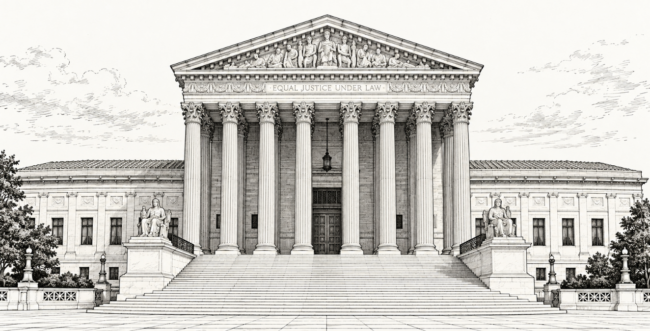
After denial in VirtaMove, I expect the other four petitions to be denied as well. Tesla's recently filed reply brief explained to the Court that it had vehicles "from every relevant angle" and listed VirtaMove alongside its own case, Intel, and Kahoot!. If the Justices were interested in any of those companions, I would have expected the Court to hold VirtaMove or relist it until the others were ready. Rather, the Court denied certiorari at the first conference after briefing closed. I still see Kahoot! AS v. Interstellar Inc., No. 26-198, as a cleaner test case than VirtaMove. But, the outright denial substantially reduces its chances in my view.

By my count, twelve petitions arising from patent disputes are now pending, and five more patent cases have open extension applications. The rest of this post walks through those petitions and extension applications filed since September, then the remaining Section 314(d) cases, the status of the other pending petitions, and the recent denials.


To continue reading, become a Patently-O member. Already a member? Simply log in to access the full post.

PTAB Affirmance by Rejection Type, 2009–2026

by Dennis Crouch

My October 18 post looked at Section 101 in PTAB ex parte appeals. This one looks at the other rejection types, using the same parsed decisions plus a rejection-by-rejection reading of the 35 thousand appeals decided since January 2020.

Bar chart: PTAB affirmance rate by rejection type, 2020 to 2026. Section 101 84%, double patenting 79%, Section 103 56%, Section 112(b) 55%, Section 112(a) 46%, Section 102 41%.

As the chart above demonstrates, the type of rejection matters a lot. Counting each rejection separately, the Board affirmed 84% of examiner eligibility rejections but only 41% of anticipation rejections, with obviousness in the middle at 56%.  Note here that obviousness remains the key driver because it represents the majority of rejections that still stand after final and the majority of appealed grounds.

Some background: once an examiner has rejected claims twice, the applicant can appeal to the PTAB. The examiner's final rejection usually includes more than one ground (often several obviousness combinations, sometimes an eligibility or indefiniteness rejection as well), and the Board rules on each one. The Board usually does not re-examine the application, though.  A rejection the applicant never argues though can be summarily sustained. That matters for reading the numbers below.


To continue reading, become a Patently-O member. Already a member? Simply log in to access the full post.

PTAB Section 101 Appeal Data, 2009–2026

by Dennis Crouch

I have been parsing ex parte PTAB decisions - about 130 k for this post running from 2009 through September 2026 - looking particularly at the eligibility cases.  The short version: eligibility is again about a fifth of the PTAB's appeal docket; my report on lowered affirmance rates was a temporary blip; and the Board has nearly stopped raising Section 101 "new grounds of rejection."

Some background: once an examiner has rejected claims twice, the applicant can appeal to the PTAB. The Board then affirms or reverses each rejection. Sometimes a PTAB decision result is "affirmed-in-part" - meaning that some of the examiner's grounds were affirmed but others were reversed.  Under 37 C.F.R. § 41.50(b), the Board can also enter its own new ground of rejection, and the applicant then has two months to reopen prosecution or request rehearing.  That is what happened to DeepMind in Ex parte Desjardins, Appeal No. 2024-000567 (P.T.A.B. Sept. 26, 2025) (precedential). The Board affirmed the obviousness rejection of its machine learning claims and added its own Section 101 rejection. Director Squires, writing for an Appeals Review Panel, vacated the Section 101 rejection. See Dennis Crouch, Director Squires Takes Aim § 101 Rejections, Patently-O (Sept. 28, 2025).

Line chart: the share of PTAB ex parte appeal decisions reviewing a Section 101 rejection was 3–6% a quarter from 2009 to 2016, rose to 33% in 2019, fell to 8.5% in 2022, and was about 21% in 2026.


To continue reading, become a Patently-O member. Already a member? Simply log in to access the full post.

Subject Matter Eligibility Declarations: An Empirical Study of Rule 132 Evidence and Examiner Response

by Dennis Crouch

In December 2025, Director Squires invited applicants to begin filing special Rule 132 declarations focused on patent eligibility. He called these Subject Matter Eligibility Declarations, or SMEDs. The practice is slowly becoming more popular. My most recent search of USPTO dockets found 460, filed in 414 applications, and enough of them have had time to get examiner responses to get a sense of their effectiveness. About one third are successful by my count: the next examiner action either allows the case or drops the §101 rejection.

Finding them in the USPTO dockets has been a bit tricky. Until very recently, most eligibility declarations have been filed as plain Rule 132 declarations, mixed in with thousands of unexpected-results, enablement and inventor-disclosure declarations. And, because they are offering factual declarations, a substantial number (around 15%) never use legalese such as "eligibility" or "101." The Office has a new AF/D.SMED document filing code that should help see them more directly. Ultimately, I downloaded every Rule 130, 131 and 132 affidavit filed in a published application since December 4, 2025, ran each of the 6k through OCR, and parsed the text of each one to sort out the eligibility declarations: those offered to show that the claims are patent-eligible. Nearly all of the ones I found were filed in response to a §101 eligibility rejection; only a handful were filed proactively, before any such rejection.

The result: of the ~6,100 declarations filed in the period, 460 are eligibility declarations. The big news though - once an eligibility declaration is filed, the examiner usually keeps the rejection. In cases where the next action is on the record, about 25% of applications received a notice of allowance, another 9% received an office action that dropped §101, but about 66% got the same rejection again. I also looked at what else was in the response and what the examiner said about it. Nearly all of these applicants amended their claims along with the declaration, and amending did not separate the winners from the losers. When the rejection did go away, the examiner credited the declaration about half the time.

Bar chart: Rule 132 declarations directed to Section 101 filed per month, December 2025 through September 2026, with the share of all declarations each month


To continue reading, become a Patently-O member. Already a member? Simply log in to access the full post.

Pre-Suit Validity Investigation: When Must a Patentee Look Before Suing?

by Dennis Crouch

Can a patentee rely on the presumption of validity when filing suit, even after the PTO has rejected closely related claims as ineligible? In Epic Tech, LLC v. Pen-Tech Associates, Inc., No. 2025-1624 (Fed. Cir. Sept. 30, 2026), the Federal Circuit said that, on that record, the presumption alone "does not suffice" for a patentee and its counsel facing "multiple indicators" that the claims are unpatentable. The court vacated an order denying Rule 11 sanctions and attorney fees and remanded for a better explanation. It did not decide whether sanctions are warranted.

Epic Tech's U.S. Patent No. 8,545,317 covers an electronic sweepstakes gaming system. It issued in October 2013, eight months before Alice Corp. v. CLS Bank International, 573 U.S. 208 (2014). After Alice, examiners rejected claims in three related applications under § 101, and Epic Tech abandoned all three. In two of those applications the examiner had also found the pending claims patentably indistinct from claims of the '317 patent.

FIG. 1 of Epic Tech U.S. Patent No. 8,545,317, a block diagram showing game terminals, a server, a database, and secondary game screens connected through a network

Still, Epic Tech sued Pen-Tech for infringement.  Its litigation counsel, Baker Donelson, had been prosecuting Epic Tech's applications since 2018.  The district court found the claims ineligible on summary judgment.  This appeal focused on the resulting motions for sanctions and fees against both Epic Tech and the firm.


To continue reading, become a Patently-O member. Already a member? Simply log in to access the full post.

Tie Goes to the Applicant: The USPTO’s SMED Flowchart

by Dennis Crouch

USPTO Director John Squires issued another memorandum on Subject Matter Eligibility Declarations (SMEDs) today: Subject Matter Eligibility Declarations (SMEDs) under 37 CFR 1.132: Flowchart for Analysis and Best Practices (Sept. 29, 2026). The four-page memo is styled as an addendum to the April 30, 2026 best-practices memo and comes with a two-page flowchart tracing how an examiner should evaluate a SMED, first for formal compliance and then on the merits, along with five best practices for applicants. The memo says it "does not announce any new USPTO practice or procedure," and for the most part that is accurate. Nearly every box on the flowchart points to an existing MPEP section.

USPTO flowchart, Evaluating SMEDs Part 2: Review on the Merits


To continue reading, become a Patently-O member. Already a member? Simply log in to access the full post.

Who Owns Mind Reading?

by Dennis Crouch

Back in May 2023 I wrote a short post about the University of Texas study that used a GPT-style language model to reconstruct the gist of stories from fMRI scans (An API for the Human Mind, May 6, 2023). What I did not know at the time was that the UT System had already filed a provisional application on the method a full year earlier, fourteen months before the Nature Neuroscience paper. The resulting non-provisional application published as US 2025/0068841 A1, titled “Decoding Language from Non-Invasive Brain Recordings,” naming Alexander Huth and Jerry Tang as inventors. It allowed on the first action in June 2026, without a single rejection. Texas paid the issue fee on September 18, so a patent should issue later this fall. No continuation in the record yet, but I expect they’ll file one.

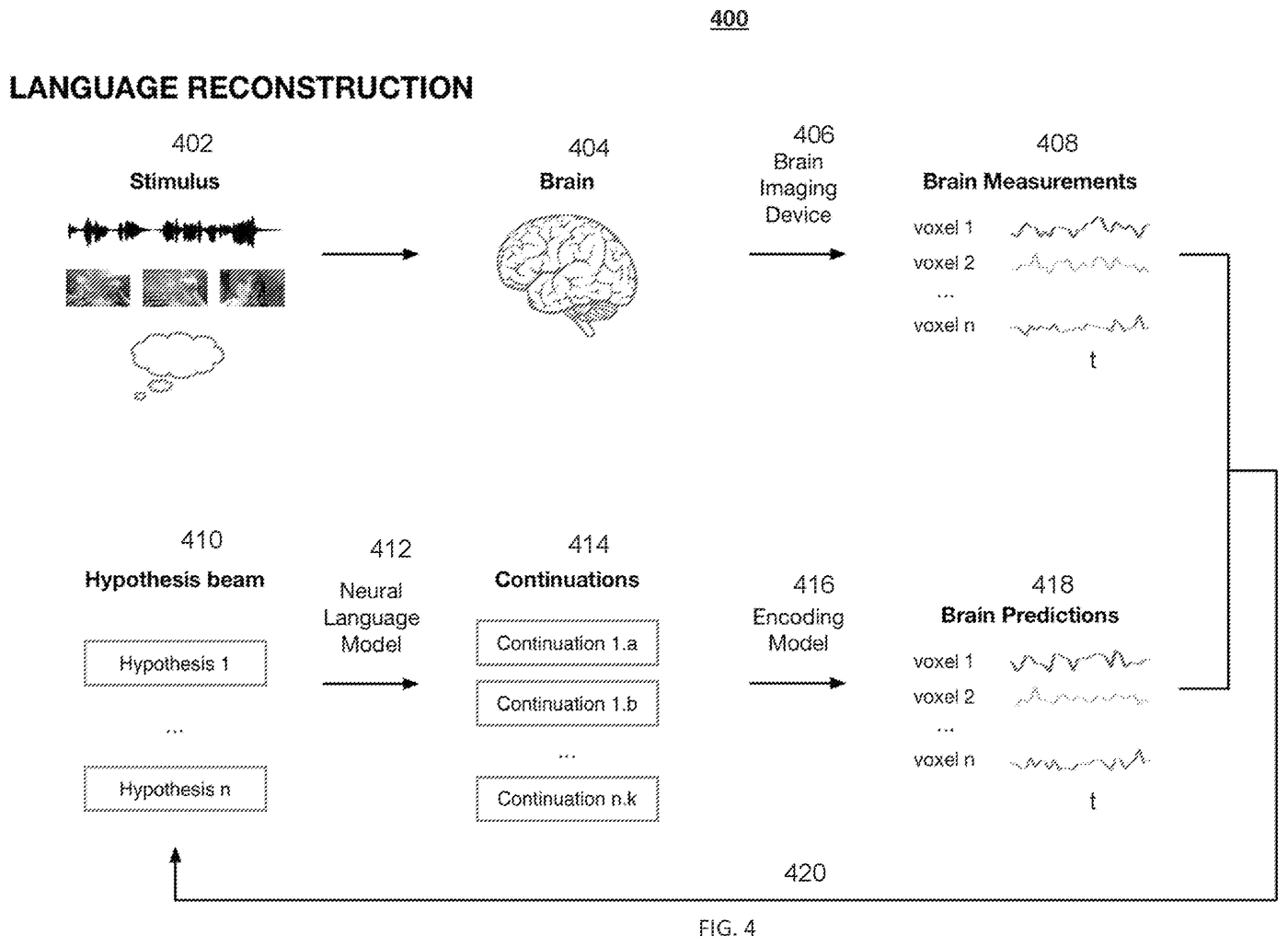
The basic idea here is that different words and ideas produce different patterns of neural activity across the brain, and fMRI can measure those patterns (via bloodflow) while a person listens to a story. Huth and Tang first trained an “encoding model” on many hours of scans.  Decoding then runs in the opposite direction.  A GPT-style language model proposes candidate word sequences; the encoding model predicts the brain activity each candidate should produce; and the system keeps the candidates whose predictions best match the actual scan. Repeat that word by word and the output is a running paraphrase of what the subject heard or imagined.  Ultimately, this results in the decoded output capturing the gist of the thought rather than exact wording.

FIG. 4 of US 2025/0068841 A1: a language model proposes continuations, an encoding model predicts the brain response to each, and the predictions are compared against measured voxel activity.

(more…)

Prof John Duffy Next USPTO General Counsel

by Dennis Crouch

Professor John Duffy (UVA) appears to be in line to take over as USPTO General Counsel.  GC is the Director's principal legal advisor and runs an office of about 130 lawyers that include the Office of the Solicitor (which defends PTAB and TTAB decisions at the Federal Circuit and represents the Director in APA suits), the Office of General Law, and the Office of Enrollment and Discipline.

The Office is currently defending a substantial volume of litigation over the Director's discretionary control of IPR institution -- and Duffy's academic work focusing on the interplay between constitutional, administrative, and patent law will likely serve the agency well.  Duffy teaches administrative law alongside patent law, clerked for Judge Stephen Williams and Justice Scalia, and spent time in the Office of Legal Counsel at DOJ. His work has triggered substantial changes in the patent system, including as counsel in both the KSR and TC Heartland.  His 2007 Patently-O essay triggered a rewriting of appointment statutes for PTAB (then BPAI) judges; and eventually to Arthrex. John F. Duffy, Are Administrative Patent Judges Unconstitutional?, 2007 Patently-O Patent L.J. 21 (2007).

Duffy was my professor at the University of Chicago, where I took his international intellectual property course and we have spoken a number of times over the years. I wrote about him when the Director position was open for appointment by President Trump, see Dennis Crouch, The Next USPTO Director: Duffy's Four Factor Test, Patently-O (Nov. 30, 2024).  What I said then is still true. Duffy has a deep respect for the patent system as an institution and a historian's instinct for how it got the way it is. He is conservative in the older sense of that word, a careful student of history who tends to distrust judicial innovations that lack statutory or historical footing. This approach is visible in his role as co-counsel for KSR in KSR Int'l Co. v. Teleflex Inc., 550 U.S. 398 (2007), which pushed the Federal Circuit's obviousness test back toward the statute and the Court's own precedents, and in his 2008 warning that the PTO's position in Bilski and its companion cases would sweep in most software patents. John F. Duffy, The Death of Google's Patents?, Patently-O (July 21, 2008).


To continue reading, become a Patently-O member. Already a member? Simply log in to access the full post.

Hurdling Eligibility with a “Separable Interface”

by Dennis Crouch

Amazon has asked the Federal Circuit to rehear Ceiva Opco, LLC v. Amazon.com, Inc., No. 2024-1721 (Fed. Cir. July 23, 2026) (nonprecedential), a Section 101 case about internet-connected digital picture frames.

The panel affirmed summary judgment of ineligibility as to representative claims of three patents (US9203930, US9654562, and US9124656), but reversed as to claim 19 of US6442573, finding that particular claim was not directed to an abstract idea.

The feature separating claim 19 from the rest was a single limitation: a user interface "physically separable" from the digital picture frame. The panel read that limitation as capturing a technological advance, remote user access to a picture frame, rather than a bare desired result.

Ceiva conceded below that it did not invent the interface technology. But, of course, Alice step one does not ask whether a claim is novel, but rather whether it is directed to an abstract idea. Conventionality (novelty) is a question for step two.


Amazon's rehearing petition, filed August 24 by folks at Fenwick & West, argues that the limitation cannot carry the weight assigned by the panel.


To continue reading, become a Patently-O member. Already a member? Simply log in to access the full post.

The Federal Circuit Edits Its Damages Footnote in Constellation Designs v. LG

by Dennis Crouch

The Federal Circuit today reissued its panel decision in Constellation Designs, LLC v. LG Electronics Inc., No. 2024-1822 (Fed. Cir. Aug. 31, 2026), four months after the original April 28 opinion.  But, the court did not follow the rehearing path suggested by the adjudged infringer LG, and the April panel decision stands unchanged:

  • The "optimization" claims of US8842761 and US10693700 are ineligible under § 101;
  • The "constellation" claims of US11019509 and US11018922 are eligible;
  • The infringement verdict stands (denial of JMOL was proper); and
  • The $1.7 million past royalty and $6.75 per television ongoing royalty stand.

What moved in the rehearing decision was just a footnote. The April opinion gave two reasons for leaving the damages award alone even though five of the nine asserted claims are headed toward a judgment of ineligibility. The first was forfeiture. The second was that Constellation's damages expert had testified that the value of the asserted patents was tied to the technology rather than to any of the particular asserted patents or claims, and that no LG witness disputed that testimony. LG's rehearing petition pointed to that testimony to argue that no apportionment ever happened. Valuing the technology instead of the asserted claims is the thing Garretson and its descendants forbid, and the panel converted that concession into the reason the award could survive the loss of five claims. LG went on to argue that its lack of rebuttal testimony was irrelevant because the damages theory was deficient on its face.

The rehearing petition asked the court to vacate the opinion and reverse the denial of judgment as a matter of law of no damages, or in the alternative to remand for damages proceedings on the surviving claims.  The court did not do any of these. It simply deleted the sentence regarding "technology based damages" for patent infringement, the sentence that would have supported infringement damages not tied appropriately to the patents being infringed. The result then is that the holding stands on forfeiture and says nothing about whether a single undifferentiated royalty survives the loss of half the asserted claims.

Here is the edit, with deleted text struck through:

During oral argument, LG argued for the first time that if we determine—as we do here—that some asserted claims are patent ineligible, we should vacate the damages award. See Oral Arg. 18:03–19:34, 42:44–45:38. This argument was foreseeable and should have been raised in LG's opening brief. See, e.g., ABS Glob., Inc. v. Cytonome/ST, LLC, 984 F.3d 1017, 1027 (Fed. Cir. 2021) (collecting cases for proposition that arguments raised for the first time during oral argument are forfeited). Even so, Constellation's damages expert, Dr. Sullivan, testified that the value of Constellation's asserted patents was tied to the technology rather than any asserted patent or claim, J.A. 20280 (Trial Tr. 42:11–23) (testimony of Dr. Sullivan), and none of LG's witnesses disputed this testimony. Cf. J.A. 20333 (Trial Tr. 256:3–16) (testimony of Mr. Lewis acknowledging that the Zenith licenses were similarly tied to the technology rather than any patents or claims).


To continue reading, become a Patently-O member. Already a member? Simply log in to access the full post.

Personal Privilege: Why Improper Venue Did Not Stop the § 101 Dismissal

by Dennis Crouch

AML IP, LLC v. Bath & Body Works Direct, Inc., No. 2025-1280 (Fed. Cir. Aug. 28, 2026).

This was an odd case - particularly because the appellant (represented by Bill Ramey) decided not to appear at oral arguments.  Those arguments began with a joke about how it might be embarrassing for Lance Wyatt (Fish & Richardson), who represented the successful defendants below, if he lost the appeal. He did not lose.

In a precedential opinion, the Federal Circuit that a district court which has just concluded that venue is improper may go on to dismiss the same complaint on the merits -- in this case holding the claims ineligible.  Judge Prost wrote for a unanimous panel affirming E.D.Tex. Judge Jordan's dismissal on two two independent grounds: improper venue under 28 U.S.C. § 1400(b), and failure to state a claim because the asserted claims of U.S. Patent No. 6,876,979 are ineligible under 35 U.S.C. § 101.

In the appeal, AML did not contest either ruling on the merits. Its entire appeal was about sequencing.  AML argued that the court should have stopped when it found the case was in the wrong forum.  The stakes here are big. Dismissal for lack of venue is generally without prejudice - allowing the patentee to refile the litigation in a proper forum.  The 101 ruling, on the other hand, is with prejudice and likely entirely ends the litigation campaign.


To continue reading, become a Patently-O member. Already a member? Simply log in to access the full post.

Rise of AI Patents and their Corresponding Eligibility Rejections

by Dennis Crouch

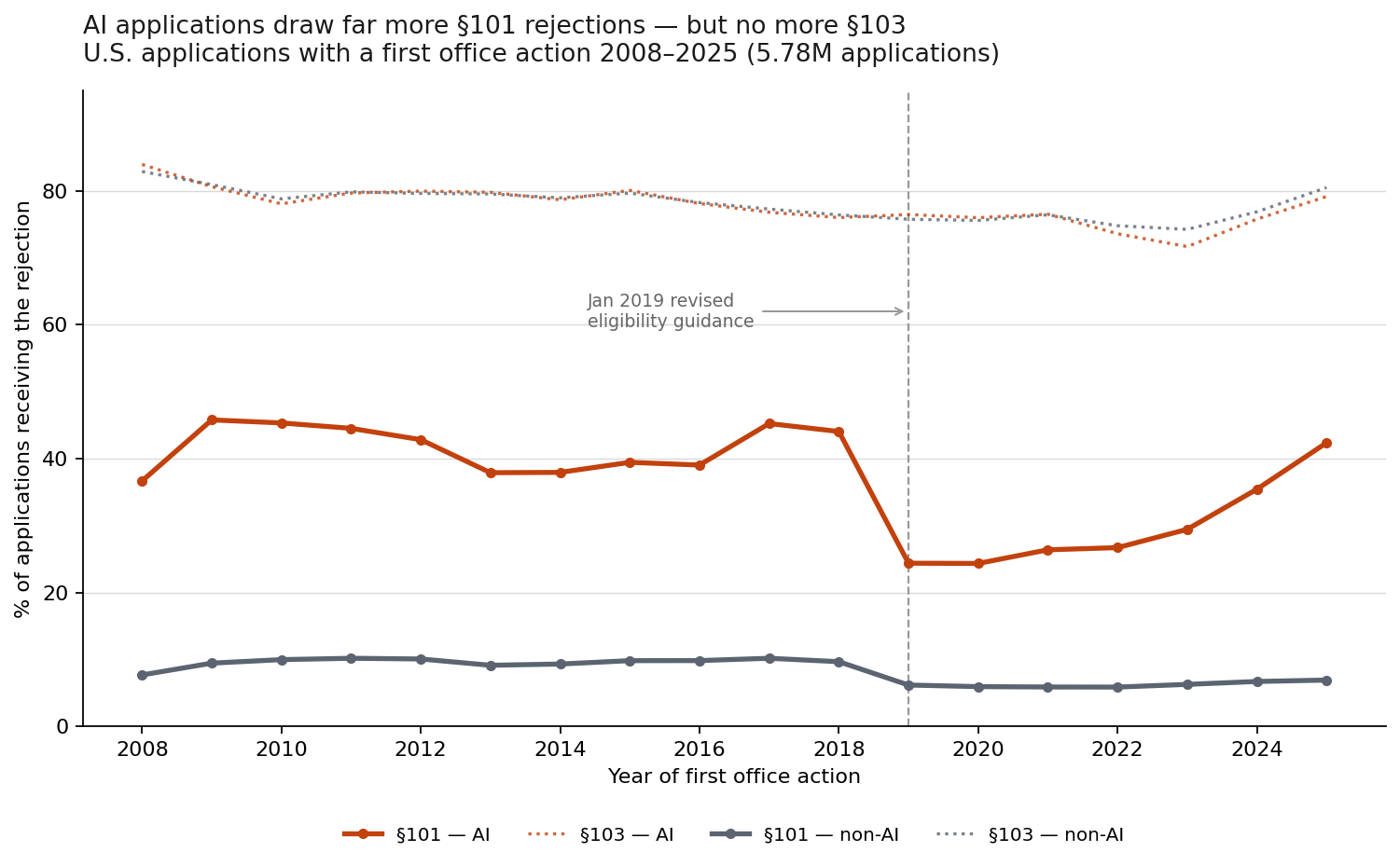
A few years ago the USPTO created an AI-patent classifier that identifies AI related patent applications.  I used that classifier to update activity through 2026. No surprise, AI application receive substantially more 101 eligibility rejections than their non-AI counterparts. An example - among applications whose first office action came in 2025, 42% of those containing AI have so far drawn a § 101 rejection, against 6.9% of those without.  The chart below shows no difference between the two categories for obviousness rejections, both of which hover close to 80%.

Share of U.S. applications receiving a section 101 and a section 103 rejection, AI against non-AI, by year of first office action, 2008 to 2025

As you can see from the chart, the pre-COVID Revised Patent Subject Matter Eligibility Guidance cut the AI §101 rate about in half.  By 2025 that reduction has essentially disappeared. Whereas the eligibility rejection rate in non-AI applications  has not risen. From this data, I cannot tell the extent that the change is tied to changes by applicants in what is being filed or instead changes at the USPTO.


To continue reading, become a Patently-O member. Already a member? Simply log in to access the full post.

Partial Retreat: Ten Months of § 101 Data After the Surge

by Dennis Crouch

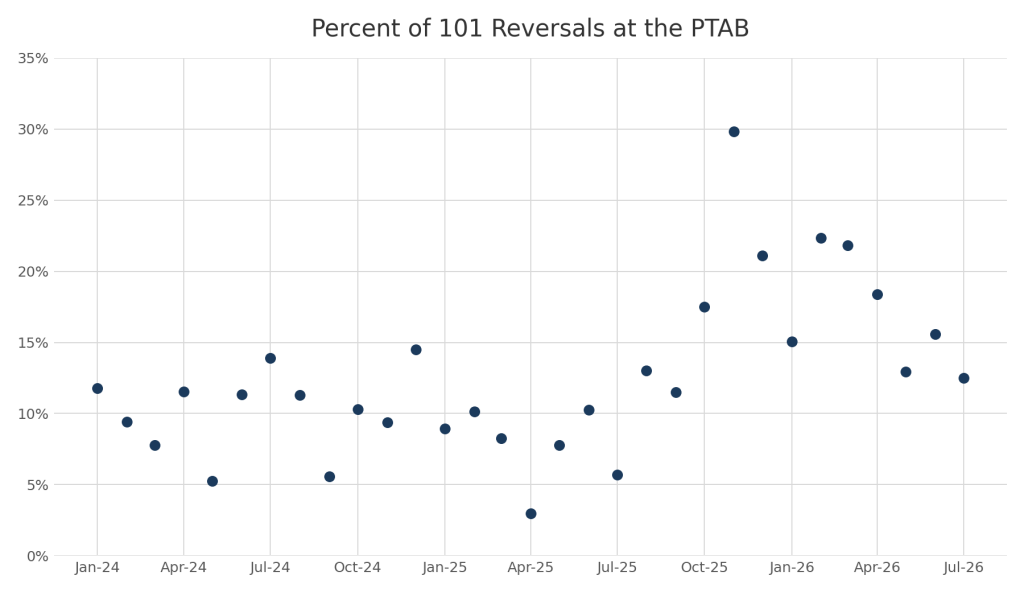
This is the third post tracking Section 101 reversals at the PTAB. The first, PTAB Doubles Section 101 Reversal Rate Under Director Squires (Jan. 2, 2026), reported that the Board's reversal rate on eligibility rejections roughly doubled after John Squires was sworn in as USPTO Director in September 2025. The second, Recalibration: Seven Months of PTAB § 101 Data (Apr. 23, 2026), found the surge had cooled off its November peak and settled into what looked like a new equilibrium near 20%. Data through July 31, 2026 shows that equilibrium has not held.

Monthly percent of Section 101 reversals at the PTAB, January 2024 through July 2026

The numbers. From October 2025 through March 2026, the Board reversed the examiner's § 101 rejection outright in 21% of ex parte appeals that reached an eligibility holding. From April through July 2026 the rate is 15%. The pre-Squires baseline, running January 2024 through September 2025, was 9.4%. What we're seeing here is a partial retreat, not a reversion.


To continue reading, become a Patently-O member. Already a member? Simply log in to access the full post.

From Genes to Machines: PERA’s First Full-Committee Hearing

by Dennis Crouch

On July 14, 2026, the full Senate Judiciary Committee held its hearing "From Genes to Machines: The Patent Eligibility Debate," which Chairman Chuck Grassley described as the first time the whole committee, rather than Senator Thom Tillis's Intellectual Property Subcommittee, has taken up the Patent Eligibility Restoration Act of 2025, S. 1546, 119th Cong. (2025) (companion H.R. 3152). PERA would erase the judicial exceptions to Section 101 that the Supreme Court expanded in Alice and Mayo, and replace them with a narrow statutory list of things that cannot be patented. No vote or markup was scheduled, and Grassley was candid that many members are still studying the bill (i.e., do not yet support the legislation).

Tillis, who is retiring at the end of this Congress, said he is willing to change PERA's human-gene language, and he asked Debra Leonard, the witness most opposed to aspects of the bill to send him wording that would, in her view, preserve Myriad.

Four witnesses testified, split evenly. Andrei Iancu (former USPTO Director) and Sue Peschin (Alliance for Aging Research) urged passage. J. John Lee (Computer and Communications Industry Association) and Dr. Leonard (Professor Emerita of Pathology at the University of Vermont and a past president of the Association for Molecular Pathology, the named plaintiff in Myriad) asked the committee to leave current law alone.  I found Dr. Leonard's discussion of gene patenting outdated at this point - that gold rush is over.  The isolated natural sequences behind her 1990s licensing letters have long since been sequenced and published, and those patents are expired, so a fresh claim to one would fail for want of novelty or nonobviousness, whatever Myriad says at the eligibility threshold. What is worth claiming today runs the other way, toward the engineered constructs she herself credited, CRISPR edits and gene therapies, and the cDNA that Myriad already treats as eligible.  But, she also mentioned basic correlations associated with human health - the diagnostic discoveries that continue to be ripe areas for research and that are largely blocked by Mayo.


To continue reading, become a Patently-O member. Already a member? Simply log in to access the full post.

Refilling the Pipeline: Two New Section 101 Petitions Heading to the Supreme Court

by Dennis Crouch

Two more Section 101 petitions are taking shape at the Supreme Court. Over the past two weeks, two patentees that lost on summary judgment of ineligibility, then lost again in nonprecedential Federal Circuit affirmances, filed applications to extend their certiorari deadlines: Innovaport LLC v. Target Corp., No. 26A8, and Oasis Tooling, Inc. v. Siemens Industry Software Inc., No. 26A34. The Chief Justice has already granted Innovaport's application, setting a September 4, 2026 petition deadline; Oasis Tooling's request would move its deadline to October 12. Both filings arrive on the heels of the Court's May 18 denial in United Services Automobile Ass'n v. PNC Bank N.A., No. 25-853.

  • Innovaport is likely to target the disconnect between USPTO examination and Article III adjudication: some of its patents overcame Section 101 rejections during prosecution, only to be invalidated by courts that owe the agency no deference.
  • Oasis Tooling is likely to focus on the mental process doctrine, asking how a computerized process can be dismissed as one that "can be performed in the human mind" when the court concedes it could not actually be performed in the human mind.

A third application involving 101 issues is also still in the queue, US Patent No. 7,679,637 LLC v. Google LLC, No. 25A1262. All other eligibility petitions filed this past year have been denied certiorari.

By my count, 89 petitions for writ of certiorari raising patent eligibility issues have been filed with the Supreme Court since the fall of 2017, where my tracking data begins. None of those petitions have been granted.


To continue reading, become a Patently-O member. Already a member? Simply log in to access the full post.

Six Petitions, Six Placeholders: The Patent Docket Awaiting the Supreme Court

by Dennis Crouch

The Supreme Court recently decided Hikma v. Amarin, its only patent case of the October 2025 term.  But, the docket of pending petitions is climbing again.  More than a dozen patent matters now sit before the Court, either as filed petitions for certiorari or as pending applications for extensions of time.

The largest focus involves the recurring question: how much discretion does the USPTO Director hold in refusing to act, and whether courts may review that refusal. Google LLC v. VirtaMove, Corp., No. 25-1230, is the leading case right now, challenging the agency's "settled expectations" basis for denying inter partes review  proceedings of patents that have been in force for 6+ years. Two petitions raise Seventh Amendment objections to the way the Federal Circuit reviews jury verdicts, two press patent eligibility under 35 U.S.C. § 101, and Hyatt v. Squires, No. 25-1049 focuses on prosecution laches.

In addition to the petitions, there are also six extension applications -- cases where the petitioner has asked for additional time in preparing the petition for writ of certiorari.  Those applications typically signal that a petition is coming and often include a preview of the upcoming petition.

I also want to note one particular non-patent case: Newman v. Moore. In that case, Judge Pauline Newman, the Federal Circuit's most senior judge, asks the Court to review the orders that have "temporarily" removed her from the bench since 2023. The first named respondent is Chief Judge Kimberly Moore, who is the face of Judge Newman's removal. It is the rare petition that asks the Justices to examine how the court handling patent appeals governs itself.


To continue reading, become a Patently-O member. Already a member? Simply log in to access the full post.

What the Verdict Might Have Said: Jury Black Boxes in Ollnova v. ecobee

by Dennis Crouch

The Logic Games are no longer on the LSAT, but they are still present in the law, often arising in the context of complex civil litigation.  This regularly arises with jury verdict forms, with judges seeking the simplest verdict form possible that still asks all the necessary questions.  In Ollnova Technologies Ltd. v. ecobee Technologies ULC, No. 2025-1045 (Fed. Cir. June 4, 2026), the Federal Circuit found that Judge Gilstrap (E.D.Tex.) had gone too far on the side of simplicity.

The infringement case asserted claims from four different patents, but the jury was asked simply did the Plaintiff (patentee) prove "that ecobee, the Defendant, infringed ANY of the Asserted Claims of the Asserted Patents?"  As you can see from my screenshot above, the jury answered "yes" and ultimately awarded $11.5 million in damages.

What the verdict fails to tell us is which patent (or which claim of which patent) ecobee infringed.  More importantly for the appeal, the verdict leaves open the possibility that some jurors thought a claim of the '495 patent was infringed while others thought it was a claim of the '282 patent. In his decision, Judge Chen treated that gap as a constitutional defect, vacating the infringement and damages judgments and ordering a new trial.  The risk here was the potential of non-unanimous verdict as to infringement of any particular claim.

Judge Gilstrap also asked the jury to an eligibility question under Alice step two: whether the claims involve merely well-understood, routine, or conventional technology.  The appellate panel found this jury instruction lacking - particularly because the jury was never told what the claimed abstract idea was (in the '495 patent), or that the abstract idea itself cannot supply the inventive concept.

The panel affirmed that the asserted claims of the '887 and '371 patents are not directed to an abstract idea at step one, and affirmed the denial of ecobee's motion for judgment as a matter of law on '371 non-infringement.


To continue reading, become a Patently-O member. Already a member? Simply log in to access the full post.

Revisiting Sixteen Years of §101 After a Data Correction

by Dennis Crouch

Three weeks ago I wrote a big post on §101 rejection rates from the past 16 years pulled from several million office actions -- and also arguing that examiner behavior on eligibility tracks USPTO administrative policy more closely than it tracks Supreme Court doctrine. See Dennis Crouch, Sixteen Years of §101: What Actually Moves Examiners, Patently-O (May 8, 2026). After publishing, I went back through the collection pipeline and found that I had been missing a small, but meaningful slice of the data. Two errors: the optical-character-recognition (OCR) step had been silently failing on the longest office actions, and the bulk USPTO dataset itself had dropped a substantial number of rejections that I then reconstructed using the USPTO API (pulling and parsing each retrieved action individually). I have now reprocessed the full series through May 15, 2026 (adding an additional week of data). The corrected chart does not disturb the central thesis, but it does provide additional insight.

Corrected versus pre-correction Section 101 rejection rate series, 2010-2026

The chat here shows the corrected series (solid) against the original, pre-correction version (dashed). The two are nearly identical through early 2019 but then diverge afterward, with the gap widening through 2024 and 2025.

What you see here is that the post-2019 recovery is substantially larger than my original chart showed, carrying the rejection rate back up to roughly 15.5% by mid-2025, within striking distance of the pre-PEG peak. The most recent decline, running through the Stewart and Squires tenures, is also larger than the original series indicated, though it remains small set against the size of the post-2019 trajectory.


To continue reading, become a Patently-O member. Already a member? Simply log in to access the full post.

Polar Electro’s New § 101 Cert Petition: When Courts Do the Challenger’s Job

by Dennis Crouch

Two Finnish sports-tech companies have been litigating U.S. Patent No. 6,537,227 in a Utah federal court since 2017. Polar Electro Oy — the heart rate monitor maker — owns the patent, which claims a process for estimating energy expenditure during exercise by combining a measured heart rate with a personalized physiological reference value tied to VO2max. Firstbeat Technologies Oy, a physiological analytics company acquired by Garmin in 2020, moved for summary judgment of patent ineligibility under 35 U.S.C. § 101 but, according to the record, supplied no prior art, no expert testimony, and no developed conventionality theory. The district court granted the motion anyway, assembling its own analysis from the prosecution history. The Federal Circuit affirmed without opinion (Rule 36). Polar is now asking the Supreme Court to take up three big questions. Polar Electro Oy v. Firstbeat Technologies Oy, No. 25-1268 (U.S. petition filed May 2026).

Questions:

  • Whether a court may construct its own invalidity argument — independently identifying evidence and assembling rationales — when the challenger raised the defense but failed to support it, especially given § 282's presumption of validity and the clear-and-convincing standard.
  • Whether a process that takes a real-world physiological input and uses it within an improved procedure to produce a more accurate technological result remains eligible under Diamond v. Diehr, 450 U.S. 175 (1981).
  • Whether the judicially created exceptions for abstract ideas, laws of nature, and natural phenomena are impermissible judicial legislation the Court should overrule in favor of the statutory text.

The first question is the most legally ripe; the last is the most ambitious; the middle is the one the Court has repeatedly declined to resolve.


To continue reading, become a Patently-O member. Already a member? Simply log in to access the full post.

Time Machines, Cold Fusion, and a Glucose Problem: A 2026 Report on § 101 Utility

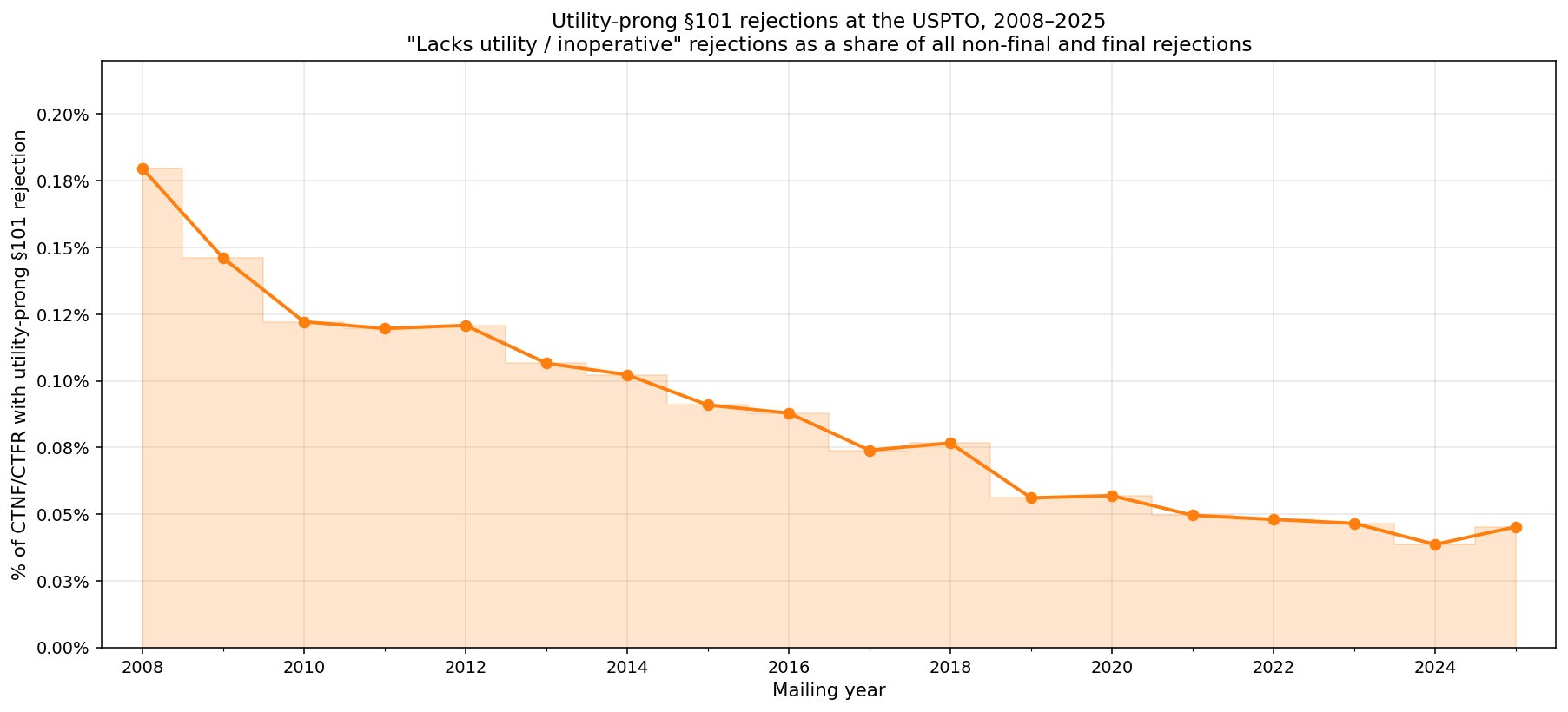
Utility rejections under 35 U.S.C. § 101 have become something of a relic at the USPTO. The Office mailed mailed over 650,000 office action rejections in 2025 - only 294 raised a utility ground. And, as you'll see below, utility rejections are typically an indication that the underlying disclosure is genuinely strange.

Utility-prong § 101 rejections as a share of all non-final and final office actions, 2008-2025

I pulled a small random sample of utility-bearing office actions mailed in early 2026 and want to walk through each:

  1. A pro se application for "curing leukemia and easy births" through time travel and "inspiration zones";
  2. Energy production by recreating black hole conditions in a heated steel enclosure;
  3. A cold-fusion-adjacent device, driven by "cycled electromagnetic radiation";
  4. A biochemistry case, now in its thirteenth year of prosecution, about whether melanin can synthesize glucose from carbon dioxide; and
  5. A room-temperature-superconductor application out of one of the most distinguished condensed-matter labs in the country.

This is a useful sample because each draws on a different strand of the utility doctrine, all tracing back through Brenner v. Manson, 383 U.S. 519 (1966), and the Federal Circuit's "implausible scientific principles" standard from In re Brana, 51 F.3d 1560 (Fed. Cir. 1995), that authorizes examiners to refuse claims premised on physics the applicant has not made credible.


To continue reading, become a Patently-O member. Already a member? Simply log in to access the full post.