Tag Archives: Judge Newman

The Director Returns IPR Merits to the PTAB

by Dennis Crouch

This is a follow-up to my September post on Professor John Duffy's move to the USPTO. Duffy was sworn in as General Counsel on October 5, and the Office has now expanded his title to General Counsel and Supervisory Solicitor. Joining him as Deputy General Counsel and Solicitor is Professor Greg Dolin (Baltimore). Dolin is a former clerk for Judge Pauline Newman and later represented her in her lawsuit against Chief Judge Moore and the Federal Circuit's Judicial Council.

Duffy and Dolin are law professors and creative appellate litigators. I expect to see some interesting developments.
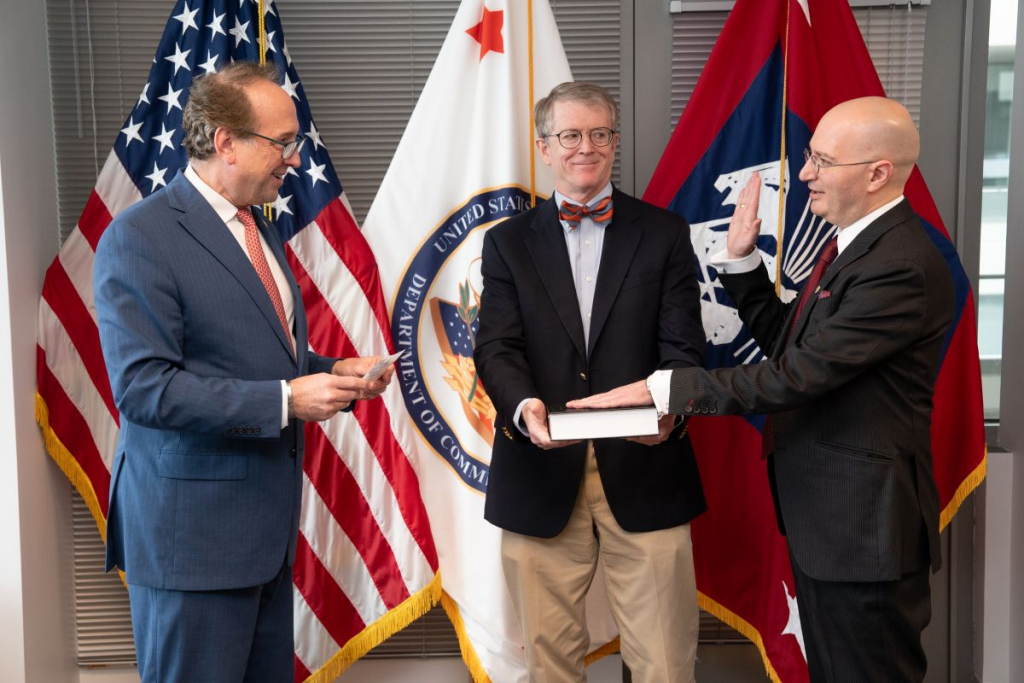
Swearing-in ceremony at the U.S. Patent and Trademark Office

Duffy's first visible work product was announced on November 10, 2026. In a memorandum co-signed with Director Squires, the Office is returning the merits portion of IPR and PGR institution decisions to the PTAB, effective November 16.

The Director will keep the initial screen on discretionary and other non-merits factors. Petitions that survive go to a three-judge panel that decides institution on the merits on the Director's behalf -- and if that panel institutes, a different panel will conduct the trial. The memo also tightens the merits standard. A petition fails if it falls short on a substantial majority of the challenged claims, and a claim whose arguments are in "equipoise" counts against the petitioner. Tie goes to denial.

To continue reading, become a Patently-O member. Already a member? Simply log in to access the full post.

Judge Newman’s Name may soon be on the Bench, Even if she is Barred from Entry

by Dennis Crouch

Representative Darrell Issa (R-CA) introduced H.R. 10026 on August 3, 2026, a bill that would designate Courtroom 201 of the Howard T. Markey National Courts Building at 717 Madison Place NW as the "Pauline Newman Courtroom." Room 201 is the Federal Circuit's main courtroom, where the court hears its argued cases and sits en banc. The bill, titled the Honoring Circuit Judge Pauline Newman Act of 2026, lists a set of findings and the only operative part designated the courtroom name.

Judge Newman has not sat in Room 201 since March 2023. Most recently, the Supreme Court denied certiorari in Newman v. Moore, No. 25-1101 (U.S. June 15, 2026), ending her three-year effort to get some Article III court to reach the merits of her constitutional challenge. Congress wrote the statute that allowed for her suspension, this bill though is only about a nameplate.


To continue reading, become a Patently-O member. Already a member? Simply log in to access the full post.

Three Is Company: New Data on § 103 Reference Counts

by Dennis Crouch

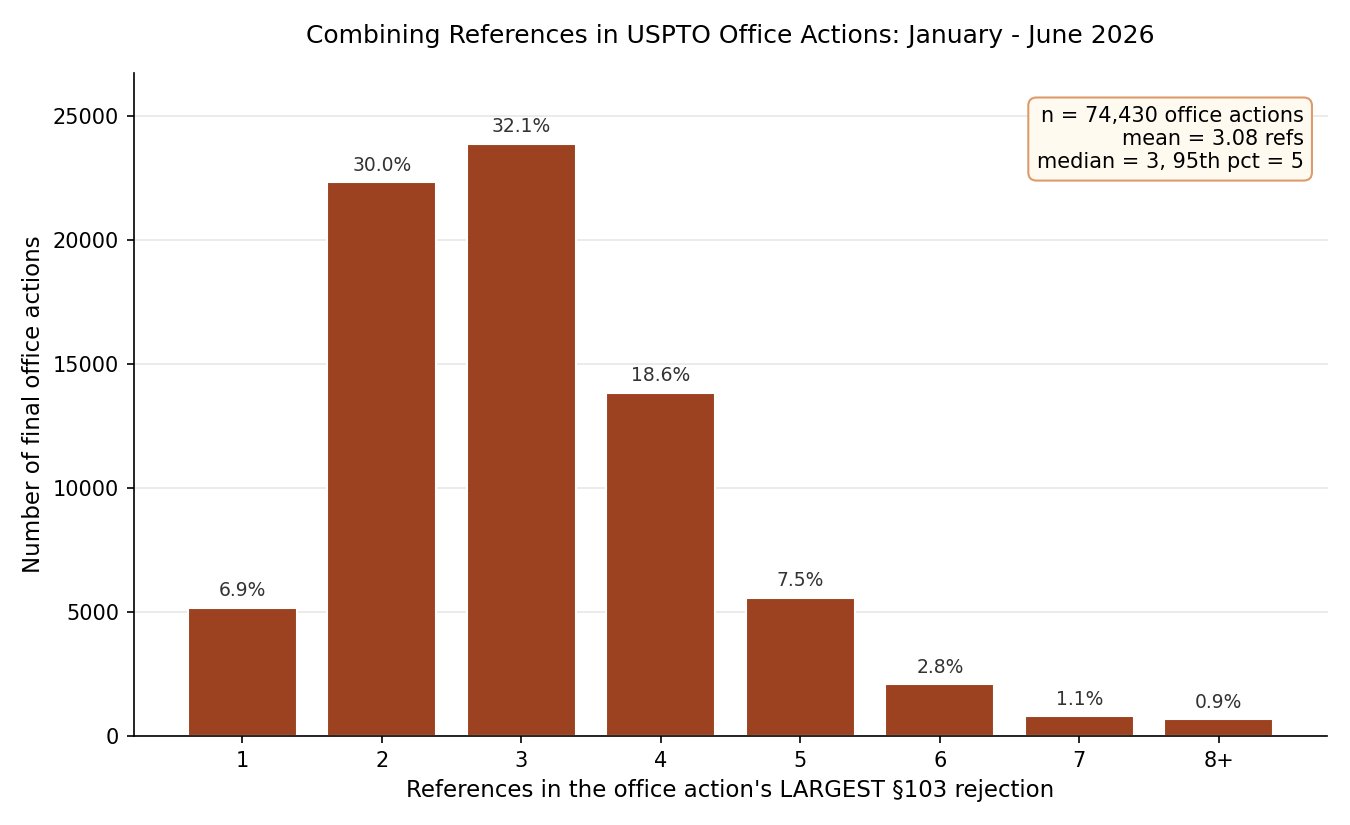
How many prior art references does an examiner combine in a typical obviousness rejection? Many patent prosecutors have a feel for this -- perhaps colored by their memory of a six-way rejection. To get an actual measurement, I parsed a collection of final action rejections mailed by the USPTO from January 1 through June 5, 2026 that includes at least one obviousness rejection under 35 U.S.C. § 103.  This is about 75k office actions containing 200k separate obviousness rejection statements.

The results: Two and three reference combinations together account for 65% of all rejection statements, the mean is 3.08 references, and single-reference § 103 rejections (one document modified by ordinary skill or general knowledge) make up 7%. See Dennis Crouch, Single-Reference Obviousness: Federal Circuit Says Don't Re-Do the Prior Art's Work, Patently-O (Jan. 26, 2026).  Examiners usually do not need more than three documents to make their case. (Note, these numbers focus on the single largest combination in an office action).

Histogram showing the distribution of references in the largest Section 103 rejection per USPTO final office action, January through early June 2026

31% of final office actions contain at least one rejection combining four or more references, and about one in twenty reaches six or more.

Some areas of technology use more references per rejection -- The art units examining artificial intelligence lead the agency at a 3.80 mean, with 11% of their final office actions including a stack of six or more references.

The Supreme Court's most recent pronouncement on obviousness came in KSR International Co. v. Teleflex Inc., 550 U.S. 398 (2007), but that case involved two key references.  In my view, multi-reference rejections create a different doctrinal puzzle as office practice builds larger combinations by chaining pairwise steps, each link carrying its own one-sentence motivation. That sequential structure is defensible as far as it goes. But, even where every individual combination might be obvious, a long enough series of obvious steps, with enough alternative branching paths, eventually stops being obvious as a whole. Examination practice has no tool for locating that limit.  See, Dennis Crouch, Mind the Gap: The Middle Layer of Obviousness Doctrine, Patently-O (Apr. 14, 2026).


To continue reading, become a Patently-O member. Already a member? Simply log in to access the full post.

Judge Newman Asks the Supreme Court to Intervene: Framing Judicial Independence as a Constitutional Imperative

by Dennis Crouch

I recently spoke by phone with Judge Pauline Newman. At 98 years old, she seemed sharp, engaged, and fully conversant -- particularly regarding the legal questions swirling around her case (and its impact on the patent system). She turns 99 in June.

Judge Newman has been barred from exercising any function of her judicial office since late 2023, when she issued her last opinion. She remains, in name, an active-service judge on the United States Court of Appeals for the Federal Circuit. But, in every practical respect, she has been removed from the bench by her colleagues, without impeachment, without an actual finding of disability, and without any court ever reaching the merits of her constitutional claims. This week, her attorneys filed a petition for certiorari asking the Supreme Court to consider her case.

Newman v. Moore, No. 25-___ (U.S. Mar. 12, 2026), presents two questions about the Judicial Conduct and Disability Act of 1980 (28 U.S.C. § 357(c)) that bars judicial review of judicial council "orders and determinations."

  • Whether that bar extends to ultra vires acts that exceed the council's statutory and constitutional authority.
  • Whether the bar forecloses claims seeking prospective injunctive relief against future unlawful orders.

Both questions arise against a factual backdrop that the D.C. Circuit itself described as raising "important and serious questions" about due process and judicial independence, while holding that its hands were tied by 25-year-old circuit precedent.


To continue reading, become a Patently-O member. Already a member? Simply log in to access the full post.

Federal Circuit Dissent Rates Collapse After Newman’s Removal

by Dennis Crouch

[PDF Version of this Essay]

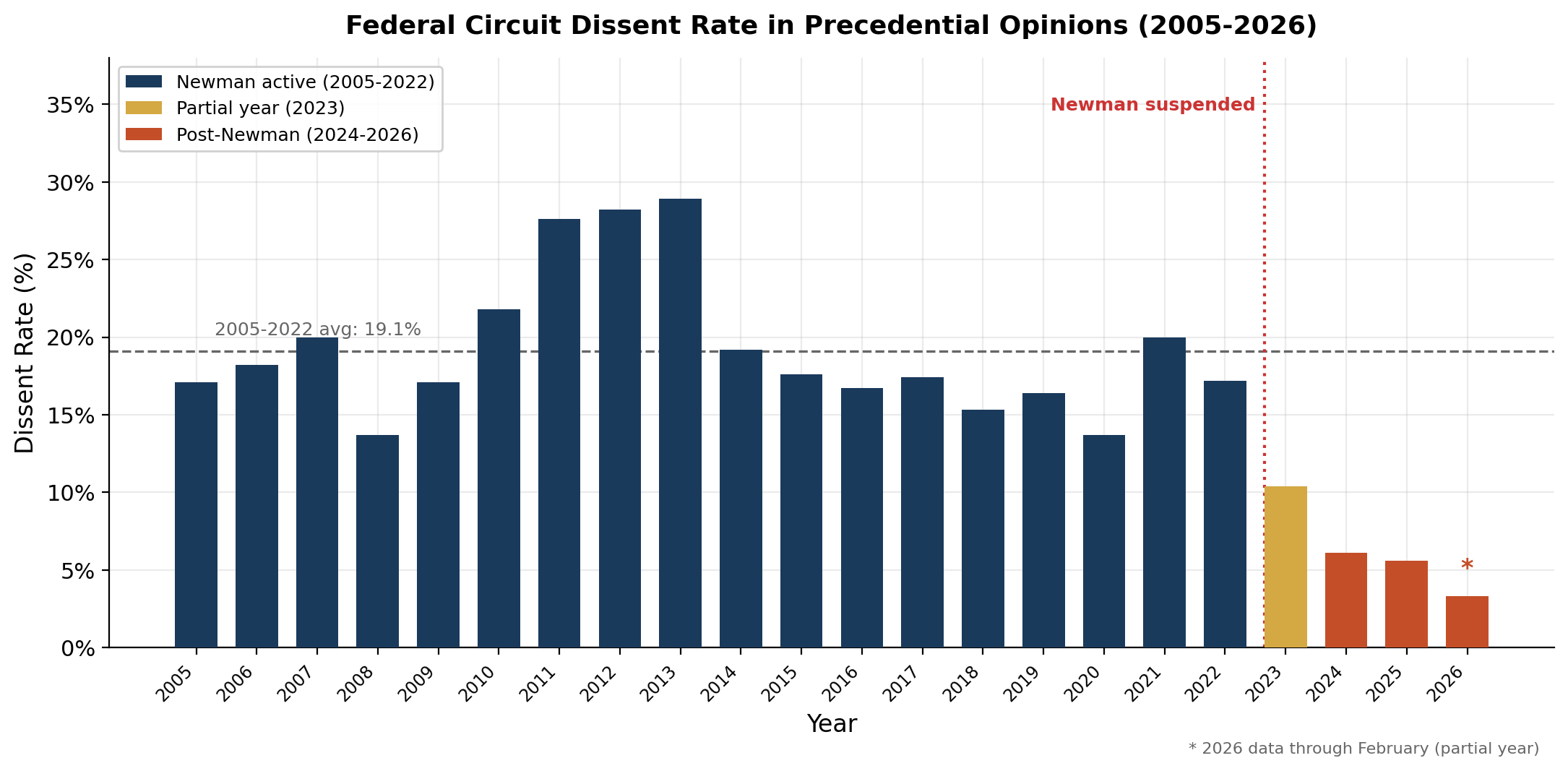
Justice John Marshall Harlan earned the title "The Great Dissenter" of the 1800s. Judge Pauline Newman holds that title for the millennium era - with over 300 dissents in precedential cases in just the final two decades of her tenure alone over her career. To an extent that existing scholarship has only begun to capture, Newman's voice of disagreement defined the Federal Circuit's internal dialogue on patent law. An empirical analysis of almost 5,000 precedential Federal Circuit opinions issued between 2004 and early 2026 reveals just how dramatically this one judge shaped the court's culture. We now have two full calendar years of post-Newman data, and the results are striking: in 2024 and 2025, the court's dissent rate fell dramatically.  The Federal Circuit has become, in the space of two years, one of the most consensus-oriented appellate courts in the federal system.

The data tell a straightforward story. From 2005 through 2022, the Federal Circuit's dissent rate in precedential opinions averaged about 19%. In some years it ran higher: the 2011-2013 period saw rates of >25%, the highest sustained period of disagreement in the dataset, driven by the doctrinal upheaval surrounding both Alice and the America Invents Act. In other years the rate dipped to around 13-14%. But it never once fell below double digits. In 2023, the year Newman was suspended from the bench, the rate dropped to 10%. In 2024, it fell to 6%,; about 10%; and in 2025 the rate was even lower. The Federal Circuit's dissent rate is settling into a new equilibrium roughly one-third of what it was for the prior two decades.

Federal Circuit Dissent Rate in Precedential Opinions, 2005-2026

The structural explanation for this decline is not complicated: Judge Newman dissented far more frequently than any of her colleagues, and when she was removed, the dissents left with her. But the magnitude of the effect is actually much greater than what can be accounted for from Newman's direct impact on panel opinions. As discussed below, the court's dissent rate has fallen not just by the amount attributable to Newman's own dissents, but to roughly half the historical baseline of even non-Newman panels—suggesting her departure transformed the court's broader culture of disagreement.


To continue reading, become a Patently-O member. Already a member? Simply log in to access the full post.

Ideology, Expertise, and the Evolving Federal Circuit

by Dennis Crouch

In my recent post, I traced how the Federal Circuit’s composition has shifted from a 10-1 Republican majority in the early 1990s to its present 8-3 Democratic-appointed tilt. Dennis Crouch, The Federal Circuit's Shifting Political Balance, Patently-O (June 15, 2025).  That transformation has not only symbolic weight, but also real jurisprudential and institutional consequences, especially as the court faces more politically charged litigation such as the pending V.O.S. Selections v. Trump case.  I note that the Federal Circuit’s response—en banc proceedings and unanimous per curiam orders—may reflect an institutional effort to shield itself from claims of partisanship.

Jason Rantanen and co-authors Paul Gugliuzza and Jonathan Nash have added more empirical substance to this conversation with a major study of separate opinions and dissents at the Federal Circuit from 2008–2021. Their article, Expertise, Ideology, and Dissent, provides powerful data to help make sense of how political ideology, judicial expertise, and institutional dynamics intersect at this court.


To continue reading, become a Patently-O member. Already a member? Simply log in to access the full post.

Federal Circuit Takes Center Stage in Trump’s Tariff Campaign

by Dennis Crouch

On May 28, 2025, the Court of International Trade issued a sweeping permanent injunction against President Trump's unilateral global tariffs, only to have the Federal Circuit grant an immediate administrative stay in a rare en banc order.  The stay is likely to remain in place only for about two weeks as the Court considers (likely en banc) whether to allow the tariffs to remain in place while it considers the merits of the U.S. government's appeal.  The dispute centers on fundamental questions about the scope of presidential emergency powers under the International Emergency Economic Powers Act (IEEPA) and represents one of the most significant judicial challenges to executive trade authority in decades.

The Court of International Trade's decision in V.O.S. Selections, Inc. v. United States, Slip Op. 25-66 (Ct. Int'l Trade May 28, 2025) [CIT Decision], struck down both President Trump's "Worldwide and Retaliatory Tariffs" and his "Trafficking Tariffs" as exceeding congressional delegation of authority.  The underlying legal framework is that the U.S. Constitution grants Congress, not the President, authority to set tariffs.  However, Congress has expressly delegated aspects of that authority to the President - most particularly under IEEPA, which authorizes the President to "regulate . . . importation" of foreign goods during declared national emergencies to address "unusual and extraordinary threat[s]" to national security, foreign policy, or the economy. 50 U.S.C. § 1702(a)(1)(B), § 1701(a). Congress enacted IEEPA in the 1970s after determining that President Nixon had abused a prior, more expansive delegation under the Trading with the Enemy Act (TWEA). See United States v. Yoshida Int'l, Inc., 526 F.2d 560 (C.C.P.A. 1975).


To continue reading, become a Patently-O member. Already a member? Simply log in to access the full post.

Federal Circuit Affirms: Rule 60(b) Motion Filed Too Late to Revive Patent Case

"You only get one shot, do not miss your chance to blow. This opportunity comes once in a lifetime, yo." Emenim

The Federal Circuit recently affirmed the District of Delaware's denial of Franz Wakefield's motion for relief from judgment under Rule 60(b), underscoring the importance of timely raising arguments during the normal appeal process. Wakefield v. Blackboard Inc., Nos. 2024-2030 (Fed. Cir. Apr. 23, 2025).

Wakefield, proceeding pro se, sought to reopen a judgment invalidating his U.S. Patent No. 7,162,696 based on indefiniteness grounds more than two years after the district court's original judgment and more than a year after the Federal Circuit's affirmance. The Federal Circuit panel of Judges Lourie, Dyk, and Chen had little difficulty concluding that the district court did not abuse its discretion in finding the Rule 60(b) motion untimely. As the court emphasized, Rule 60(b) is not a substitute for appeal.


To continue reading, become a Patently-O member. Already a member? Simply log in to access the full post.

Supreme Court Asked to Address Constitutionality of Judge Newman Removal

by Dennis Crouch

Miller Mendel, Inc. has petitioned the Supreme Court to review a Federal Circuit decision invalidating its background check software patent in a case that raises questions about both judicial independence and patent eligibility standards. The petition comes after both the district court and Federal Circuit found Miller Mendel's US Patent No. 10,043,188 ineligible under § 101 as directed to an abstract idea.

The Patent and Technology at Issue: The '188 patent covers a software system for managing pre-employment background investigations. The claimed system automates many aspects of the background check process, including collecting and storing applicant information, managing communications with references via email hyperlinks, and automatically generating suggested lists of law enforcement agencies based on an applicant's residential address.  Miller Mendel accused the City of Anna police department (northern Texas) of infringement through its use of Guardian Alliance Technologies' background check platform. The City successfully moved for judgment on the pleadings arguing patent ineligibility under § 101. The court characterized the claimed automation features as merely implementing conventional background check steps on generic computer components.

Three Questions for Supreme Court Review

The petition, filed by Kurt Rylander of Rylander & Associates, presents three questions that go to fundamental issues in patent law and judicial administration:

1. Constitutionality of Removing Article III Judges

The most striking issue challenges the Federal Circuit's effective removal of Judge Pauline Newman from judicial duties for refusing to submit to mental health evaluations. The petition argues that the Federal Circuit's self-policing usurped Congress's exclusive constitutional authority to remove Article III judges through impeachment. 


To continue reading, become a Patently-O member. Already a member? Simply log in to access the full post.

Judge Newman’s D.C. Lawsuit Against Fellow Judges Largely Dismissed on Jurisdictional Grounds

by Dennis Crouch

Federal Circuit Judge Pauline Newman has been fighting for her right to judge after charges implicating her fitness for office.  Earlier this month, a committee of federal judges upheld Newman's one-year suspension from new case assignments for refusing to cooperate with a misconduct investigation.  Newman had separately sued her colleagues in DC District Court, but Judge Cooper has now dismissed most of that lawsuit on jurisdictional grounds. While a few counts remain, the court's ruling deals a serious blow to Judge Newman's attempt to challenge the judiciary's self-policing procedures.  Newman v. Moore, 23-cv-01334 (D.D.C., February 12, 2024). Newman v. Moore Decision.


To continue reading, become a Patently-O member. Already a member? Simply log in to access the full post.

Three issues: Law/Fact Distinction in Obviousness; Envisaging the Invention; and Newman in Dissent

by Dennis Crouch

Incept LLC v. Palette Life Sciences, Inc., No. 21-2063 (Fed. Cir. Aug. 16, 2023) (Majority by Judges Schall and Taranto; Dissent-in-part by Judge Newman)

The most interesting line in the case for appellate attorneys (and legal scholars) is probably the court's law/fact distinction in the context of obviousness analysis.  The majority wrote: "We see no reversible error ... whether viewed as a factual one about the level of [commercial] success or a legal one about the weight of any such success in the overall obviousness analysis."  The law/fact divide is important because of the evidentiary requirements in the first instance and the standard for review on appeal. Here, the court makes clear that the weight given to any objective indicia of non-obviousness is a question of law rather than a question of fact.  The result then is that its analysis can generally be based upon reason rather than evidence, and that issue is one that will be heard de novo on appeal.


To continue reading, become a Patently-O member. Already a member? Simply log in to access the full post.