by Dennis Crouch
Point-of-novelty claiming is now rare in U.S. patents. Only about 0.03% of U.S. utility patents issued this year include a claim in Jepson form ("In a widget having A and B, the improvement comprising C"). This is down from about 14% in the early 1980s. The European two-part form ("A widget having A and B, characterized in that C") runs twelve to sixteen times higher, but it is also rare at still well under 1% of issued U.S. patents. In 2025 that came to about 1,200 patents with a two-part claim and 76 with a Jepson claim, out of 325k utility patents.
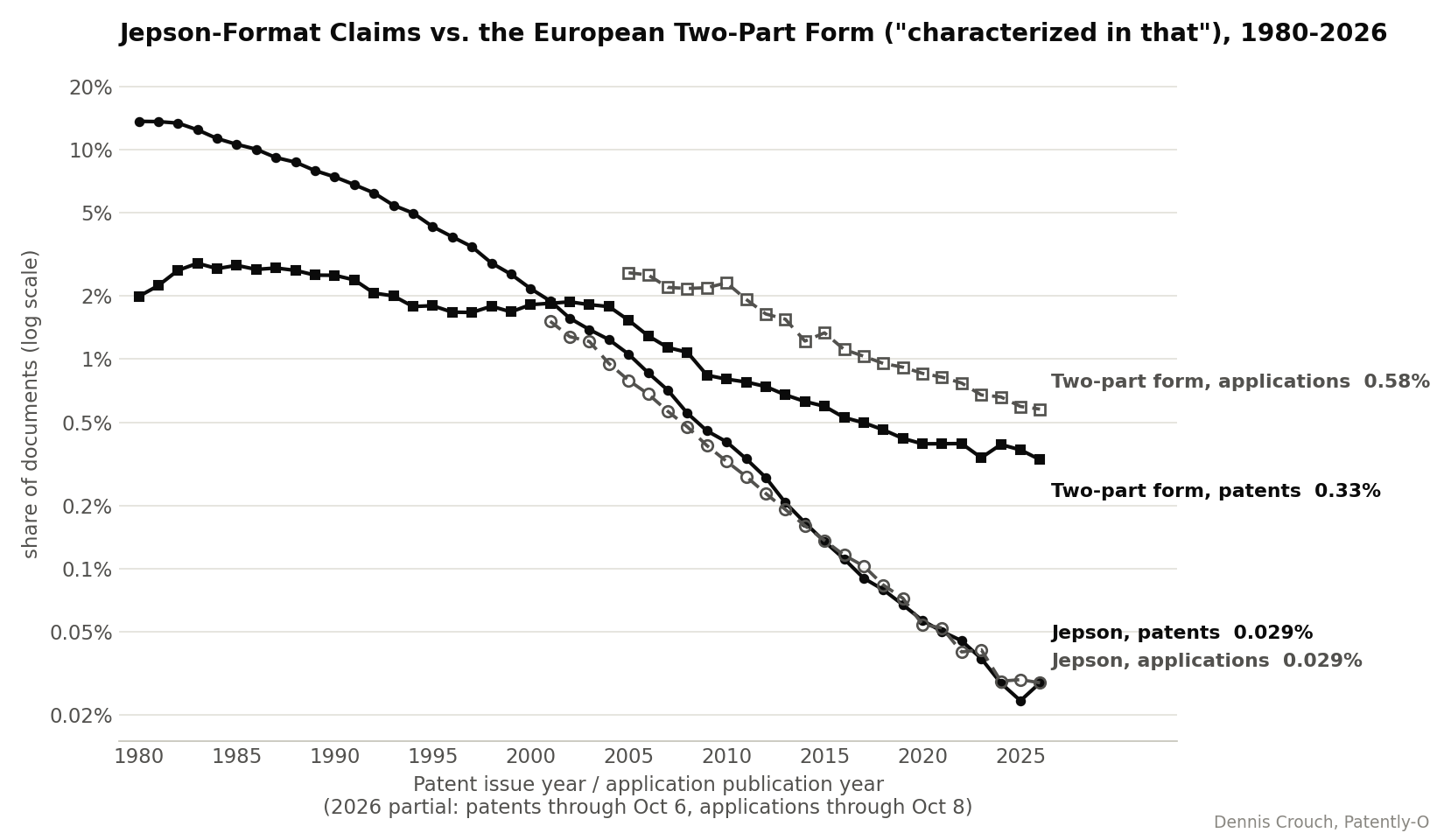
This updates my November 2023 post on Jepson claims (and the 2017 version before it). For this one I used a broader text search that also catches variants such as "the improvement wherein" and dependent claims to "the improvement of claim 1." That raises the early-1980s figures substantially (the 2023 chart peaked near 8%, this one near 14%) but makes almost no difference after 2015, when nearly every remaining Jepson claim uses the literal "improvement comprising" wording.
In re Xencor, Inc., No. 2024-1870 (Fed. Cir. Mar. 13, 2025), held that a Jepson preamble is a limitation that must be supported by the written description, so the applicant bears the burden of showing that what the preamble calls conventional was in fact well known in the art, with the amount of disclosure required scaling with the unpredictability and newness of the field. The upshot is a double burden unique to the form: the preamble counts as an admission of prior art against the applicant yet still has to be described like any other claim element. Ultimately this makes the form even less user-friendly. I wrote about the decision when it came down.