Tag Archives: Patent Term

term length, expiration, 20-year term

The Patent Term Distribution, and What it Reveals

by Dennis Crouch

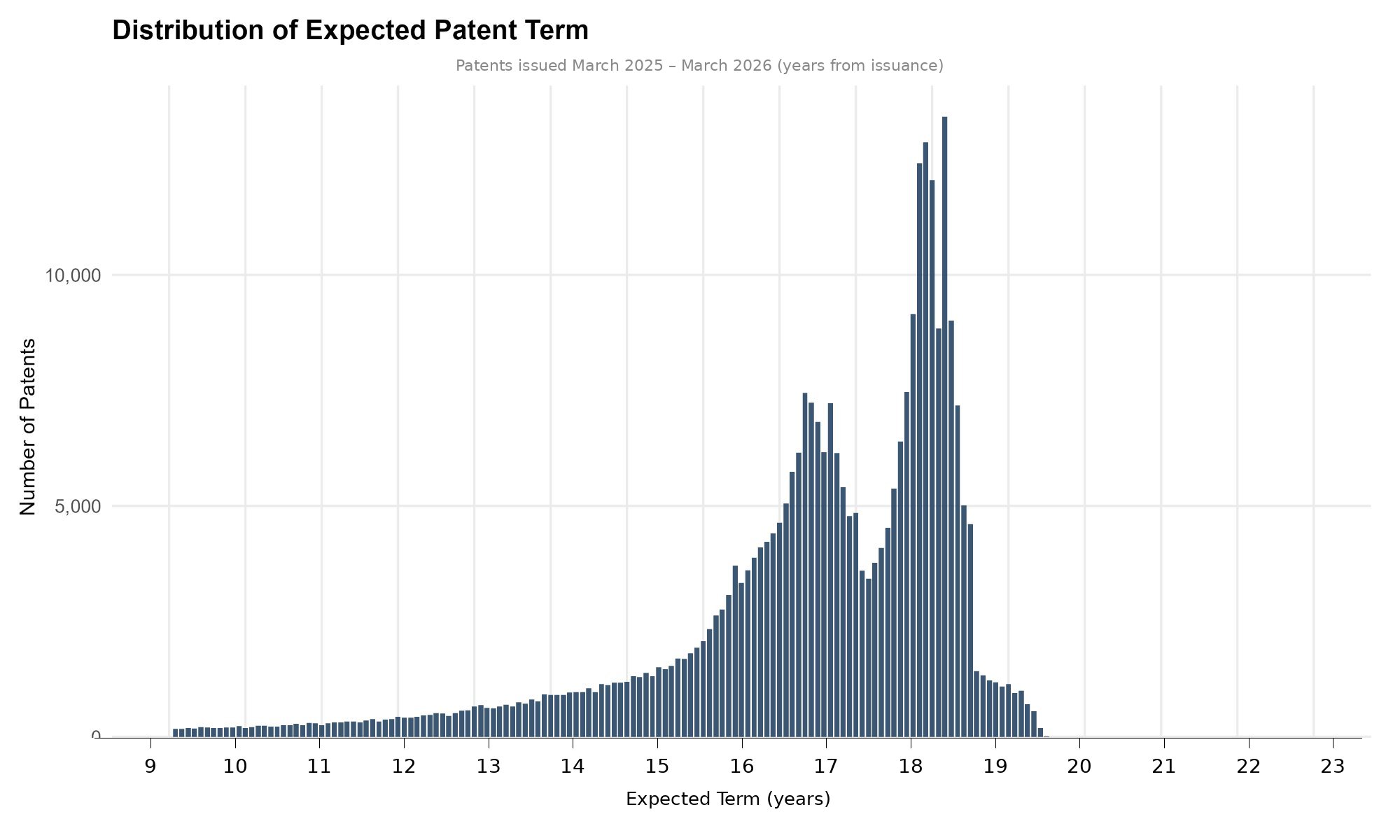
Congress set the patent term at twenty years from the earliest effective filing date. 35 U.S.C. § 154(a)(2) (not counting provisional or foreign national filing). But that statutory baseline is just the starting point. But, the actual term is shaped by a series of prosecution decisions, USPTO delays, terminal disclaimers, and patent family structure.  The chart below shows the distribution of expected remaining patent term (measured from issuance) for utility patents issued between March 2025 and March 2026. The calculation accounts for patent term adjustment (PTA) and terminal disclaimers, though the latter relies on a heuristics and so is not perfectly precise. Still, the overall shape tells a vivid story about what the patent system actually delivers.Distribution of Expected Patent Term for patents issued March 2025 to March 2026The most striking feature is

To continue reading, become a Patently-O member. Already a member? Simply log in to access the full post.

Are Rising Maintenance Fees Shortening the Effective Patent Term?

by Dennis Crouch

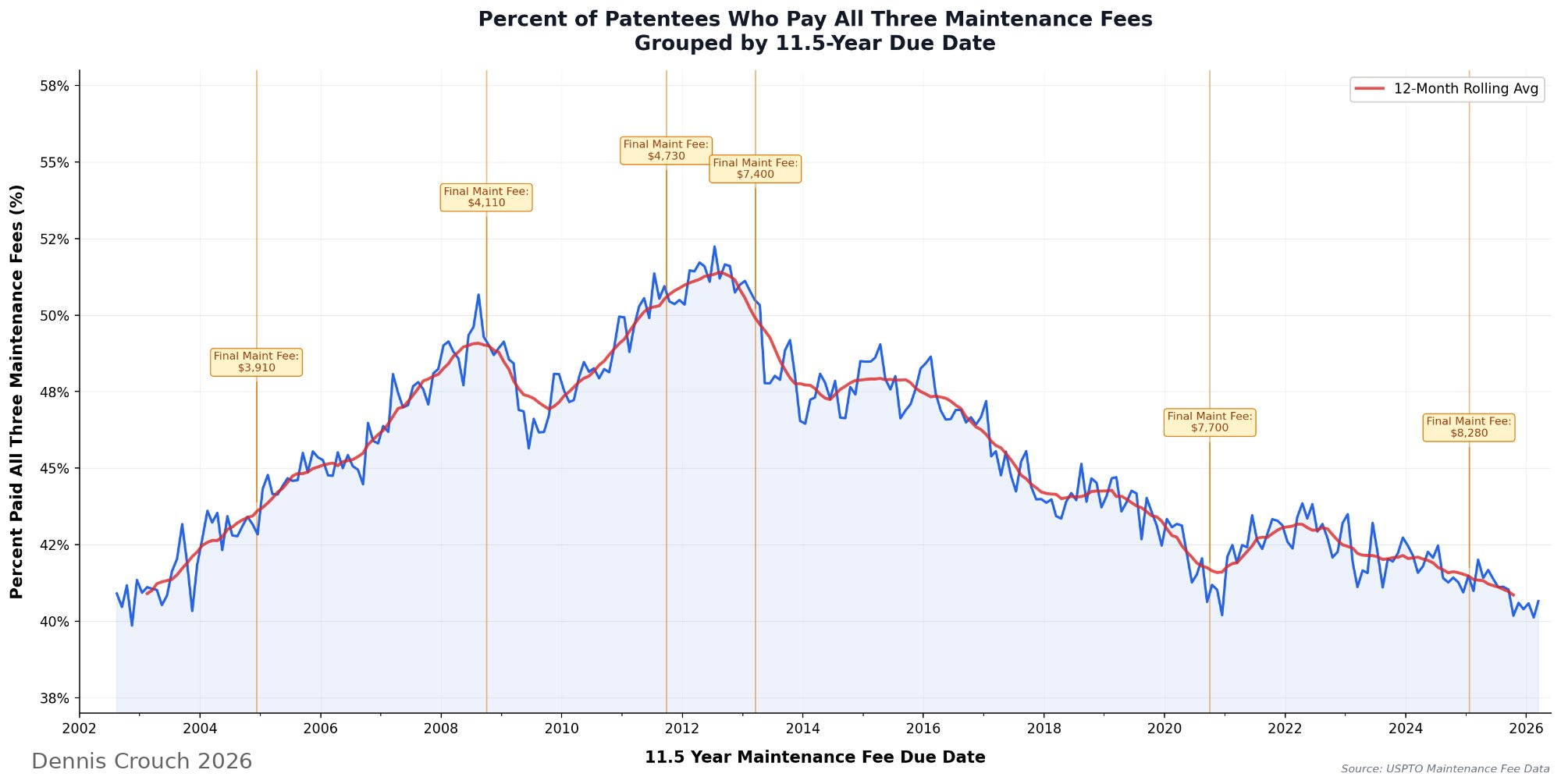
Congress set the patent term at 20 years from filing. But the effective term for most U.S. patents is considerably shorter - but these are self-selected patents. USPTO's maintenance fee records shows that roughly 60% of all patentees now abandon their patents before the full term expires, choosing not to pay the escalating series of post-issuance maintenance fees required to keep a patent in force. The rate of full-term patent maintenance has fallen to approximately 40%, approaching the lowest levels recorded in the past two decades, and the trajectory suggests further decline.

Chart showing percent of patentees who pay all three maintenance fees, grouped by 11.5-year due date, from 2002 to 2026

Under 35 U.S.C. § 41(b), patent holders must pay maintenance fees at three intervals after issuance: 3.5 years, 7.5 years, and 11.5 years. Failure to pay (including during a six-month grace period with surcharge) results in expiration of the patent. The chart below tracks the percentage of patentees who paid all three maintenance fees, grouped by the month their final (11.5-year) fee came due. The data reveals a striking arc: a steady rise from about 41% in 2002 to a peak of roughly 52% around 2012-2013, followed by a sustained decline back to approximately 40% today. The 11.5-year maintenance fee for large entities has nearly tripled during this period, from $3,100 in 2001 to $8,280 as of January 2025, well above the rate of inflation for this period. The question is whether this fee escalation is the primary driver of the decline, or whether other forces are at work.


To continue reading, become a Patently-O member. Already a member? Simply log in to access the full post.

No CA Fed Jurisdiction in _This_ Arbitration Award Challenge

by Dennis Crouch

Since Gunn v. Minton (2013), the Federal Circuit has been quite shy about non-patent patent cases. These are cases where the cause of action is not something like infringement, but that still involve substantial patent law analysis.  The newest example is Acorda v. Alkermes (Fed. Cir. 2025) involving a petition to modify an arbitration award based upon patent law public policy issues. The Federal Circuit ultimately transferred the case to the Second Circuit for lack of jurisdiction, holding that because the petitioner had pleaded alternative non-patent grounds for relief alongside its patent law arguments, the patent law issue was not "necessarily raised" under Gunn's first prong—meaning the district court could have granted relief without resolving any substantial question of federal patent law. Acorda Therapeutics, Inc. v. Alkermes PLC, No. 2023-2374 (Fed. Cir. July 25, 2025).

This narrow holding allowed the court to sidestep broader questions about when patent law issues arising in arbitration contexts warrant Federal Circuit review, leaving practitioners and lower courts without clear guidance on the boundaries of Federal Circuit jurisdiction over patent-related arbitration disputes.


To continue reading, become a Patently-O member. Already a member? Simply log in to access the full post.

Formalism, Fictions, and Federalism: Post Expiry Royalties Return to SCOTUS

by Dennis Crouch

I just read Atrium Medical's SCOTUS petition -- asking the court help resolve a circuit split involving the the Brulotte & Kimble doctrines that bars collecting royalties after a patent expires, even if agreed-to by contract.

In 1964, the Supreme Court established in Brulotte v. Thys Co. that "a patentee's use of a royalty agreement that projects beyond the expiration date of the patent is unlawful per se." 379 U.S. 29 (1964). The Court reaffirmed this rule in 2015 in Kimble v. Marvel Entertainment, LLC, where it held that "a patent holder cannot charge royalties for the use of his invention after its patent term has expired." 576 U.S. 446 (2015). The Kimble Court explained that this rule should be "simplicity itself to apply." A court "need only ask whether a licensing agreement provides royalties for post-expiration use of a patent. If not, no problem; if so, no dice." Importantly, license agreements can properly extend beyond a patent's expiration date if the post-expiration royalties are payments for something else—such as unexpired patents, trade secrets, or know-how—rather than for the continued use of the expired patent. Despite this straightforward directive, the circuits have split on how to determine what royalties are actually "for."


To continue reading, become a Patently-O member. Already a member? Simply log in to access the full post.

Patent Issuance Timeline Accelerated

by Dennis Crouch

The USPTO is shrinking the typical timeline from issuance to he USPTO has announced a significant improvement to their patent issuance process that will benefit inventors and patent holders across the nation. Beginning May 13, 2025, the time between Issue Notification and Issue Date will be reduced from approximately three weeks to just two weeks.   When everything is in order, the issue notification typically comes 1-2 weeks after paying the Issue Fee.

The USPTO formerly needed time for formatting the printing, but now that we have moved to electronic grants (eGrants), the issuance will come that much sooner.  Good work USPTO.

In addition to quicker patent issuance, the timeline also reduces the lame duck period where the inventors and attorneys still have a duty to submit known prior art relevant to patentability, but where such submission could significantly delay issuance.

But . . .


To continue reading, become a Patently-O member. Already a member? Simply log in to access the full post.

No Provisional Rights for Expired Patents

by Dennis Crouch

In a unique decision, the Federal Circuit has dismissed an appeal seeking to obtain a patent that would have issued after its expiration date. In re Forest, No. 2023-1178 (Fed. Cir. Apr. 3, 2025).   The dismissal on jurisdictional grounds holds that the would-be patent owner (here, the inventor) has no standing to appeal because any resulting patent would have no zero patent term.  (Note - I might have written "appears to hold" since the court does not actually use the term "standing")

The focus of the decision is on a novel argument about provisional rights under 35 U.S.C. § 154(d).  Ordinarily, we think of a patentee having only inchoate rights until the patent issues. While that is generally true, "provisional rights" provide some potential of back-pay for infringement that occurs between publication and issuance.  In particular, once a patent issues, the a patentee can collect a reasonable royalty from parties were infringing the claims even while pending - so long as they were on actual notice of the application publication and the issued claims are "substantially identical" to those that in the published application.  Importantly, as suggested, these provisional rights can only be enforced retroactively after a patent actually issues.


To continue reading, become a Patently-O member. Already a member? Simply log in to access the full post.

Expired Patent, Exploding Sanctions: A Costly Litigation Lesson for VDPP and its Attorney

In a recent decision out of the Southern District of Texas, Judge Lee Rosenthal found the patent infringement case brought by VDPP against Volkswagen to qualify for sanctions under the Patent Act 35 U.S.C. § 285.  The court also relied upon 28 U.S.C. § 1927 and its inherent powers to directly sanction VDPP's attorney William P. Ramey (Ramey LLP). VDPP, LLC v. Volkswagen Group of America, Inc., No. H-23-2961 (S.D. Tex. July 11, 2024).


To continue reading, become a Patently-O member. Already a member? Simply log in to access the full post.

Zimmer v. Insall: The Power of Arbitration Agreements in Patent Royalty Disputes

by Dennis Crouch

In the recent case of Zimmer Biomet Holdings, Inc. v. Insall, No. 23-1888 (7th Cir.  July 12, 2024), the Seventh Circuit affirmed an arbitration award requiring Zimmer to continue paying royalties to the estate of Dr. John Insall even after the expiration of the underlying patents.  This decision highlights the significant deference afforded to arbitration agreements and the limited ability of courts to vacate arbitral awards, even when they conflict with Supreme Court precedent.

The key precedents underlying the dispute in Zimmer v. Insall are Brulotte v. Thys Co., 379 U.S. 29 (1964) and Kimble v. Marvel Entertainment, LLC, 576 U.S. 446 (2015). In Brulotte, the Supreme Court held that "a patentee's use of a royalty agreement that projects beyond the expiration date of the patent is unlawful per se."


To continue reading, become a Patently-O member. Already a member? Simply log in to access the full post.