
Cloud Testing is a software testing approach where applications are tested using cloud computing environments instead of traditional on-premise infrastructure. It helps teams test applications efficiently under real-world conditions using scalable and on-demand cloud resources.
- Enables testing of applications using cloud-based infrastructure and services.
- Supports both functional and non-functional testing requirements.
- Reduces infrastructure management effort and improves testing efficiency.
Cloud Computing
Cloud Computing is a technology used to access and store data, servers, networking, databases, and other computing services over the internet instead of local systems. It provides on-demand resources that can be accessed anytime from anywhere.

- Provides services such as storage, servers, and databases over the internet.
- Reduces infrastructure cost by offering pay-as-you-use services.
- Examples include Amazon Web Services (AWS), Microsoft Azure, and Google Cloud.
Cloud Computing Models
Cloud computing is mainly divided into three service models that define how resources and services are delivered over the internet: SaaS, PaaS, and IaaS.
1. SaaS (Software as a Service)
SaaS is a cloud model that delivers software applications over the internet on a subscription or usage basis. Users can access applications through a web browser without installing or maintaining them on their devices. The service provider manages the infrastructure, security, and application updates.
- No installation required; applications are accessed via the internet.
- Provider handles maintenance, updates, security, and performance.
Example: include Gmail, Google Docs, and Microsoft Office 365.
2. PaaS (Platform as a Service)
PaaS provides a complete development platform over the cloud, including hardware, software, and tools needed for application development. It allows developers to build, test, and deploy applications without managing underlying infrastructure.
- Provides development tools, frameworks, and runtime environments.
- Eliminates the need to manage servers and hardware.
Example: include Google App Engine, Heroku, and Microsoft Azure App Services.
3. IaaS (Infrastructure as a Service)
IaaS provides virtualized computing resources such as servers, storage, and networking over the internet. Users can rent infrastructure as needed and configure systems based on their requirements.
- Offers virtual machines, storage, and networking resources.
- Allows full control over operating systems and applications.
Example: include AWS EC2, Google Compute Engine, and Microsoft Azure VMs.
Types of Cloud Testing
Cloud testing can be categorized into different types based on how applications and services are tested in a cloud environment.
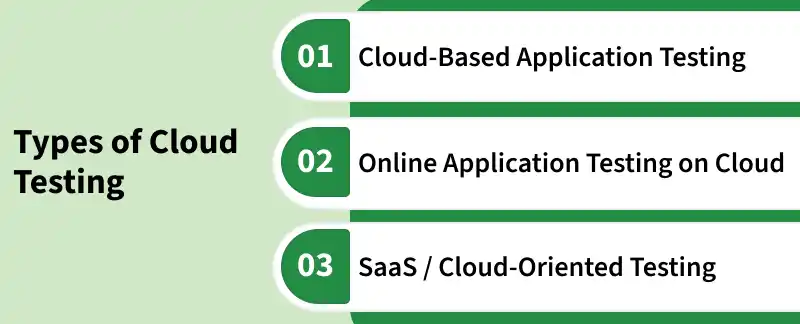
Cloud-Based Application Testing
This type of testing focuses on applications that are fully developed and deployed in cloud environments to verify their functionality, scalability, and reliability.
- Validates behavior of applications hosted on cloud infrastructure.
- Ensures scalability, performance, and reliability in cloud environments.
- Tests application behavior across different cloud platforms and configurations.
Online Application Testing on Cloud
This testing focuses on web-based applications accessed through the internet and verifies their communication with external systems and services.
- Checks functionality and performance of internet-based applications.
- Validates integration with APIs, databases, and legacy systems.
- Ensures smooth communication and data exchange between connected services.
SaaS / Cloud-Oriented Testing
This type focuses on testing Software as a Service (SaaS) applications provided by cloud vendors to ensure service quality and reliability.
- Evaluates individual service functions in SaaS applications.
- Ensures reliability, scalability, and usability of cloud services.
- Validates both functional and non-functional requirements.
Testing Performed within the Cloud
Cloud testing not only verifies functional requirements but also focuses on non-functional aspects such as performance, scalability, security, and availability. Different types of testing are performed to ensure that cloud-based applications work efficiently, securely, and reliably.
1. Functional Testing
Functional testing ensures that cloud applications and services work according to business and user requirements.
- System Testing: Verifies that the complete cloud application functions correctly as an integrated system. Ensures all modules work together and meet functional requirements.
- Acceptance Testing: Validates that the cloud application meets business requirements and user expectations. Confirms readiness for deployment and production use.
2. Non-Functional Testing
Non-functional testing focuses on evaluating the performance, reliability, security, availability, and scalability of cloud-based applications.
- Performance Testing: Measures the responsiveness, speed, and stability of the cloud application under different workloads. Ensures consistent performance and user experience.
- Stress Testing: Evaluates how the cloud application behaves under extreme workload conditions. Identifies system limits and recovery capability after failures.
- Load Testing: Assesses application performance under expected and increasing user loads. Ensures smooth operation during normal and peak traffic.
- Availability Testing: Verifies that cloud services remain accessible and operational with minimal downtime. Ensures continuous service availability for users.
- Scalability Testing: Checks the ability of cloud resources to scale up or down based on workload demands. Ensures efficient performance during workload changes.
- Security Testing: Ensures that cloud applications and data are protected from threats and unauthorized access. Identifies vulnerabilities and validates security controls.
- Disaster Recovery Testing: Verifies the ability of cloud systems to recover quickly from outages, failures, or disasters. Ensures effective backup and recovery mechanisms.
Tools Used in Cloud Testing
Different tools are used in cloud testing for performance, load, and security testing of cloud applications.
- Apache JMeter: Used for load, stress, and performance testing of cloud applications.
- LoadStorm: A cloud-based tool used to monitor application performance under heavy traffic.
- BlazeMeter: A modern cloud-based performance testing platform compatible with JMeter for scalable load testing.
- Nessus: A security testing tool used to identify vulnerabilities in cloud systems.
- Wireshark: Used for analyzing and monitoring network traffic.
- Nmap: Used for network scanning and security assessment.
Benefits of Cloud Testing
Cloud testing provides several advantages by improving flexibility, scalability, and cost efficiency during software testing.
- Provides on-demand access to cloud-based testing environments.
- Reduces infrastructure and maintenance costs.
- Eliminates the need to manage physical testing hardware.
- Supports scalable testing resources based on demand.
- Enables parallel test execution for faster testing.
- Provides access to multiple browsers, devices, and operating systems.
Challenges in Cloud Testing
Cloud testing also faces several challenges related to security, infrastructure management, and data handling across different cloud environments.
- Ensuring data security and privacy in cloud environments.
- Managing multiple cloud environments and testing configurations can be complex.
- Compatibility issues may arise across public, private, and hybrid cloud platforms.
- Network latency and internet dependency can affect test execution and performance.
- Migrating data between cloud providers can be time-consuming and challenging.
- Updating cloud services without disrupting existing applications or users requires careful planning.
Cloud Testing Vs Conventional Testing
The following table highlights the major differences between cloud testing and conventional testing based on infrastructure, cost, scalability, and execution process.
Parameters | Cloud Testing | Conventional Testing |
|---|---|---|
| Definition | Testing performed using cloud computing resources and services. | Testing performed in a traditional physical test environment. |
| Test Environment | Provides flexible and scalable cloud-based environments. | Uses fixed test labs with limited resources. |
| Cost | More cost-effective as users pay only for used resources. | Higher cost due to hardware and infrastructure maintenance. |
| Scalability | Resources can be scaled up or down easily. | Scalability is limited and requires additional setup. |
| Execution Time | Faster testing with online and distributed environments. | Slower testing due to manual infrastructure management. |
