

Mock Testing is a software testing technique that uses fake objects, services, or components to simulate real dependencies during testing. It allows testers to verify application behavior without connecting to actual external systems.
- It helps test individual components independently by replacing real dependencies with controlled mock objects.
- It is widely used in unit testing, API testing, and integration testing to improve test speed and reliability.
- It helps simulate different scenarios such as successful responses, failures, and error conditions.
Example: An online payment application uses a mock payment gateway to simulate successful or failed transactions instead of connecting to the real payment service.
Types of Mock Testing
Mock Testing can be performed in different forms depending on the type of dependency being simulated, such as objects, services, APIs, databases, or servers.
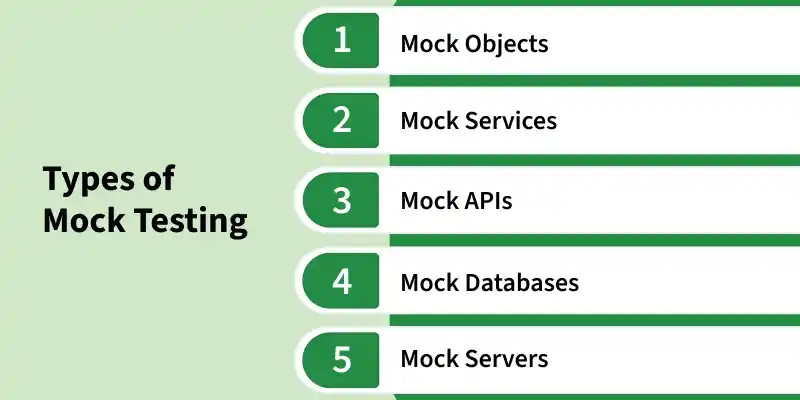
- Mock Objects: Mock objects are fake objects that imitate real objects and help test component interactions without using actual dependencies.
- Mock Services: Mock services simulate external systems or services to validate application behavior without relying on real services.
- Mock APIs: Mock APIs provide predefined responses for API requests to test functionality, validation, and error handling.
- Mock Databases: Mock databases simulate database operations to test data-related functionality without modifying real database data.
- Mock Servers: Mock servers act as virtual servers that process requests and return simulated responses for testing applications.
Mock Testing Process
The mock testing process involves creating mock objects, defining their behavior, executing tests, and verifying how the application interacts with simulated dependencies.
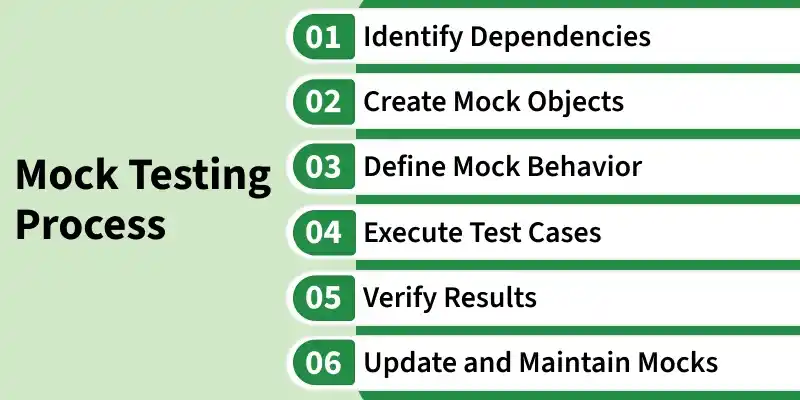
- Identify Dependencies: Identify the external components, services, or objects that need to be replaced with mock objects during testing.
- Create Mock Objects: Create mock objects or services that imitate the behavior of real dependencies required by the application.
- Define Mock Behavior: Configure mock objects with expected inputs, outputs, responses, and error conditions for testing scenarios.
- Execute Test Cases: Run test cases using mock dependencies to verify the functionality of the component under test.
- Verify Results: Check whether the application interacts correctly with mocks and produces the expected output.
- Update and Maintain Mocks: Regularly update mock objects according to changes in application logic or external dependencies.
Techniques of Mock Testing
Mock Testing uses different techniques to replace real dependencies with simulated ones, allowing components to be tested in a controlled environment.
- Classloader-Remapping-Based Mocking: In this technique, the class loader remaps object references so that a mock object is loaded instead of the original object during testing.
- Proxy-Based Mocking: In proxy-based mocking, a proxy object is created to intercept method calls and simulate the behavior of the real object.
- Database-Based Mocking: This technique uses mock database objects instead of performing actual database operations to test data-related functionality safely.
- API-Based Mocking: API-based mocking simulates external APIs and predefined responses to test application behavior without using real backend services.
Mock Testing Tools
Mock testing uses specialized frameworks to create mock objects, simulate dependencies, and support isolated testing of application components.
- EasyMock: EasyMock is an open-source mocking framework used to create mock objects for classes and interfaces during unit testing.
- JMock: JMock is a mocking library that supports interface-based mocking and integrates well with testing frameworks like JUnit.
- Mockito: Mockito is a popular mocking framework that uses annotations and simple APIs to create and manage mock objects in tests.
Advantages Of Mock Testing
- Improves test speed by avoiding real database, file system, and external service operations.
- Helps test components independently by replacing real dependencies with mock objects.
- Makes it easier to identify whether failures are caused by application code or external systems.
- Provides a controlled testing environment that is easier to understand and maintain.
- Allows testing to begin even when external services or systems are unavailable.
- Prevents unwanted effects on real third-party systems during testing.
Limitations Of Mock Testing
- Mock objects may not always behave exactly like real systems, which can cause differences between test and actual results.
- Creating and maintaining mock objects requires additional effort and time.
- Excessive use of mocks can make test cases complex and difficult to manage.
- Mock testing does not validate real integration between actual components and external services.
- Incorrectly configured mocks can lead to inaccurate test results and missed defects.
