

Test Closure is the final phase of the Software Testing Life Cycle (STLC) in which all testing activities are formally completed, reviewed, and documented. It ensures that testing is properly concluded, defects are evaluated, and final reports are prepared before the software is released.
- Marks the completion of all planned testing activities
- Confirms the status of defects and overall product quality
- Helps prepare final reports and lessons learned for future projects
Need for Test Closure
Test Closure is essential because it formally completes the testing process and ensures that all objectives have been achieved. It helps the team evaluate testing results, review defect status, and preserve important project records for future use.
- Confirms that all planned test cases and testing tasks have been completed
- Verifies that critical defects are resolved or properly documented
- Supports release decisions by providing a clear quality status of the product
- Helps improve future testing by recording lessons learned and challenges faced
- Maintains proper documentation such as reports, defect logs, and test artifacts
Test Closure Phase
Test Closure consists of a series of final activities performed to complete testing, review results, and prepare the project for formal sign-off and release. These phases ensure that all testing work is properly wrapped up before deployment.
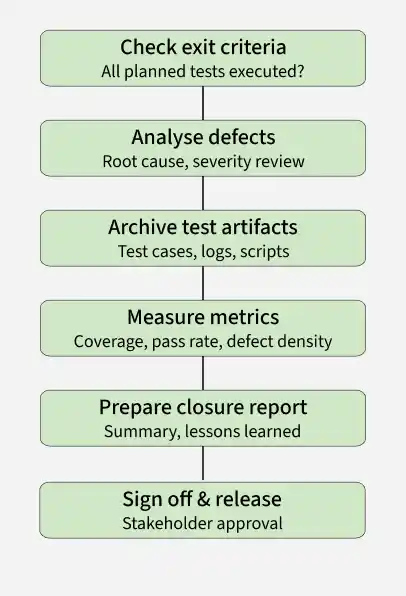
Phase 1: Check Exit Criteria
This phase ensures that all planned testing activities are completed and the defined quality goals are achieved before closure.
- Verify that all test cases have been executed successfully
- Ensure critical defects are fixed or properly documented
Phase 2: Defect Analysis
In this phase, all identified defects are reviewed to understand their severity, impact, and root cause. It helps in assessing product quality and improving future testing processes.
- Analyze defects based on severity, priority, and status
- Review open, closed, and deferred defects for final decisions
Phase 3: Archive Test Artifacts
All testing-related documents and records are stored properly for future reference, audits, and reuse in upcoming testing cycles.
- Save test cases, scripts, logs, and reports
- Maintain proper documentation for compliance and knowledge reuse
Phase 4: Measure Metrics
This phase focuses on evaluating testing performance through measurable indicators that reflect product quality and testing efficiency.
- Calculate metrics such as test coverage, pass/fail ratio, and defect density
- Analyze results to measure testing effectiveness
Phase 5: Prepare Closure Report
A final report is prepared to summarize the complete testing process, outcomes, risks, and key observations for stakeholders.
- Document results, risks, and deviations from the test plan
- Include lessons learned and suggestions for improvement
Phase 6: Sign-off and Release
In this phase, the testing work is formally closed after approval, and the product is considered ready for release or deployment.
- Obtain sign-off from stakeholders or clients
- Officially close testing and proceed to release
Test Closure Report
A Test Closure Report is the final document prepared after testing to summarize test execution, defect status, coverage, and overall product quality. It helps stakeholders decide whether the software is ready for release and serves as an official record of testing completion.
- Project Information: This section provides the basic details of the project and the testing cycle, such as project name, version, scope, and duration.
- Test Summary: This section gives an overview of the test execution results, including the number of test cases executed and their final status.
- Defect Summary: This section summarizes the defects found during testing, along with their severity and current status.
- Test Coverage: This section shows how much of the application, requirements, or features were covered during testing.
- Test Metrics: This section includes measurable values such as test pass percentage, defect density, and execution progress.
- Risks and Deviations: This section records any issues, limitations, or deviations from the original test plan that may affect the release.
- Lessons Learned: This section captures key observations, challenges, and suggestions for improving future testing cycles.
Challenges in Test Closure
- Incomplete test execution data or missing documentation
- Open or unresolved defects at the time of closure
- Delays in stakeholder review, approval, or sign-off
- Inaccurate or incomplete test metrics and reports
- Difficulty in tracing all test artifacts and defect records
- Poor communication between QA, development, and stakeholders
