The wait for a first action on the merits (FAOM) has eased a bit over the past year, but the numbers are still about seven months over target. Most recently, the average application waited about 21 months from filing to receive an action. That is down from about 24 months at the peak, and still well above the 16 months of 2020.
The chart below tracks the average by month mailed (a trailing three-month average) for utility applications in the USPTO's public file-wrapper data. The dashed line is the USPTO's own dashboard figure. Mine runs about half a month higher because the USPTO counts a restriction requirement as stopping the clock.
I recently received a question from a practitioner about how long patents are now taking to issue after the issue fee is paid. The short answer is about twice as long as this spring. For utility patents issued in the first half of 2026, the median wait from payment to grant was 29 days. For patents issued September 1 through October 20, the median was 60 days, with almost no patents issuing within four weeks of the fee-payment.
The irony is that the delay appears to come from an efficiency gain. Early this year, the USPTO reworked how it handles notices of allowance, cutting processing time from 25 minutes per application to 6. In April, the Office used that new speed to clear its backlog of allowance notices -- mailing about 17,000 in a single week, roughly two and a half times the usual number. Applicants have three months to pay the issue fee, and the payments arrived in a July (heat) wave. But the speed-up in one part of the system was then slowed down by another part. In particular, the problem appears to be that the Office of Patent Publication was not prepared for the influx. That group kept issuing about 6,000 utility patents a week, and the pile of paid-but-unissued applications grew from its usual ~28k to a peak of ~54k in early October. It now stands at about 51k and appears to be slowly shrinking.
And, the Office has stepped up the number of patents being readied for issue each week -- now issuing over 7,000 per week. But, even at the stepped up pace, the queue probably won't fully clear until early 2027.
Barron v. United States, Nos. 2025-1179, -1459 (Fed. Cir. Oct. 22, 2026). This is not a patent case, but decisions from the Court of Federal Claims are also appealed to the Federal Circuit -- making the case relevant to my interests.
One of my favorite parts of living in Columbia, Missouri is the MKT Trail, which connects to the Katy Trail - about 240 miles across the state, much of it along the Missouri River. The Katy is a rails-to-trails success story, but it also stepped on some property rights. Under Missouri law, the corridor would have reverted to the neighboring farmers when the railroad gave up the line in 1986. Instead, the federal Trails Act, 16 U.S.C. § 1247(d), kept it intact as a trail, and the landowners sued the United States. Glosemeyer v. United States, 45 Fed. Cl. 771 (2000). The first thirteen landowners were awarded about $410,000 in 2002, with nearly 300 more claims behind them.
Whether the adjacent landowners get paid depends upon what the railroad owned. If the railroad held only an easement limited to railroad purposes, the neighbors own the underlying fee - the servient estate - and state law would return all rights to the fee owner once rail service ended. The federal Trails Act prevents that by providing that interim trail use is not an abandonment, but the resulting trail easement would be a taking for which the United States owes just compensation -- because it goes (too far) beyond the scope of the original easement. On the other hand, if the railroad owned the strip in fee simple, the neighbors have nothing for the trail to take. The sketch below that I would use in Property Law class shows the difference.
The Federal Circuit's October 2026 decision in Barron stems from creation of the Legacy Trail in Sarasota, Florida. The court has sided with the government -- holding that the railroad owned its corridor outright and thus the government owes nothing. The court read seven deeds to the Seaboard Air Line Railway as unambiguous fee conveyances. It treated a 1926 condemnation judgment taking the strip "for use as a right of way" as ambiguous, but found that the record of the 1926 case pointed to a fee.
I have been reading a number of PTAB decisions recently. Two new ones from this week caught my attention because they both turned on claim-reading doctrines that the Board raised on its own. The Board labeled its move a new ground of rejection in the first case but not in the second -- and that label controls what the applicant can do next.
In Ex parte Lowder, Appeal No. 2026-001025 (PTAB Oct. 22, 2026), the Board reversed the obviousness rejections of a cannabidiol formulation -- but only pro forma, because the Board also entered its own rejection holding the claims indefinite. The problem, according to the Board, is that one ingredient (Labrafil M2125 CS) can serve as either an oily solvent or a surfactant. The claim names that ingredient by its chemistry and weight percentage and never says which role it plays.
Ex parte Gross, Appeal No. 2026-002355 (PTAB Oct. 22, 2026), is Apple's second trip to the Board with its application. The claims cover a phone that detects a place named during a call and then opens a map application populated with that location. This time, the Board has affirmed the obviousness rejections of all fifteen claims. For dependent claim 11 though, the Board did not rely on the examiner's prior art finding. Rather, it found that the added limitation - an instruction from the user that the call "should be analyzed" - is printed matter entitled to no patentable weight.
This is an update to my September post on the Supreme Court's patent docket. The big news is the denial of certiorari in the IPR discretionary denial case of Google LLC v. VirtaMove, Corp., No. 25-1230. This was the lead case among five petitions asking for review of the USPTO's refusal to institute inter partes review.
After denial in VirtaMove, I expect the other four petitions to be denied as well. Tesla's recently filed reply brief explained to the Court that it had vehicles "from every relevant angle" and listed VirtaMove alongside its own case, Intel, and Kahoot!. If the Justices were interested in any of those companions, I would have expected the Court to hold VirtaMove or relist it until the others were ready. Rather, the Court denied certiorari at the first conference after briefing closed. I still see Kahoot! AS v. Interstellar Inc., No. 26-198, as a cleaner test case than VirtaMove. But, the outright denial substantially reduces its chances in my view.
By my count, twelve petitions arising from patent disputes are now pending, and five more patent cases have open extension applications. The rest of this post walks through those petitions and extension applications filed since September, then the remaining Section 314(d) cases, the status of the other pending petitions, and the recent denials.
My October 18 post looked at Section 101 in PTAB ex parte appeals. This one looks at the other rejection types, using the same parsed decisions plus a rejection-by-rejection reading of the 35 thousand appeals decided since January 2020.
As the chart above demonstrates, the type of rejection matters a lot. Counting each rejection separately, the Board affirmed 84% of examiner eligibility rejections but only 41% of anticipation rejections, with obviousness in the middle at 56%. Note here that obviousness remains the key driver because it represents the majority of rejections that still stand after final and the majority of appealed grounds.
Some background: once an examiner has rejected claims twice, the applicant can appeal to the PTAB. The examiner's final rejection usually includes more than one ground (often several obviousness combinations, sometimes an eligibility or indefiniteness rejection as well), and the Board rules on each one. The Board usually does not re-examine the application, though. A rejection the applicant never argues though can be summarily sustained. That matters for reading the numbers below.
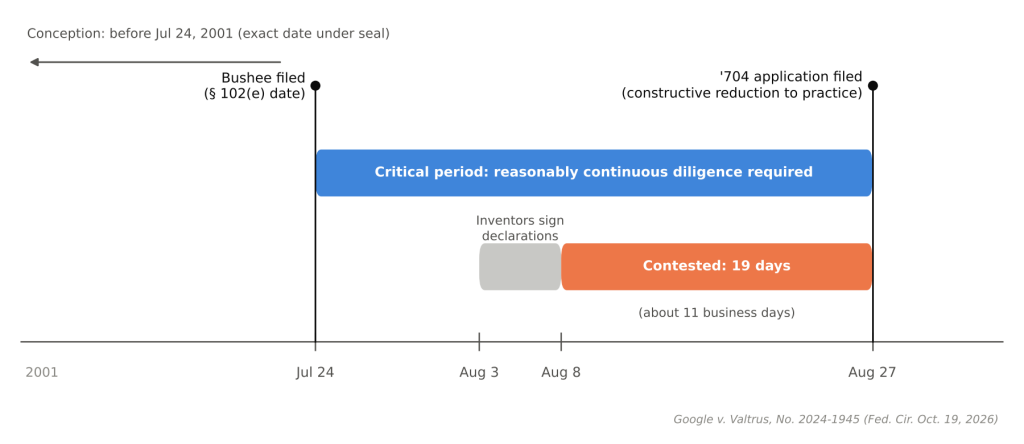
The Federal Circuit has affirmed the PTAB's decision siding with the patentee Valtrus -- upholding all of the claims of its US6728704 against Google's IPR challenge. Google LLC v. Valtrus Innovations Ltd., No. 2024-1945 (Fed. Cir. Oct. 19, 2026).
Google's lead reference was mooted as prior art because Valtrus proved an earlier invention date for its pre-AIA patent. The case has two interesting holdings:
Metadata generated when the inventor saved his notes in Microsoft Word served as the independent evidence needed to corroborate his testimony of conception, even though the Word files came from the inventor's own records.
An unexplained gap of about eleven business days while the law firm finished and filed the application did not break the chain of reasonably continuous diligence.
The metadata holding extends Global Health Solutions LLC v. Selner, 148 F.4th 1363 (Fed. Cir. 2025), where the winning inventor's proof included email metadata generated by AOL's mail server for a message he had sent to his rival. See Dennis Crouch, Love Letters Gone Wrong, Patently-O (Aug. 27, 2025). In Valtrus, the metadata was embedded in the inventor's own word processing files, and (according to Google) Valtrus only produced screenshots rather than native files.
I'll note that this victory may be short-lived. In August, a district court held the same claims ineligible under 35 U.S.C. § 101, and that appeal is pending.
I have been parsing ex parte PTAB decisions - about 130 k for this post running from 2009 through September 2026 - looking particularly at the eligibility cases. The short version: eligibility is again about a fifth of the PTAB's appeal docket; my report on lowered affirmance rates was a temporary blip; and the Board has nearly stopped raising Section 101 "new grounds of rejection."
Some background: once an examiner has rejected claims twice, the applicant can appeal to the PTAB. The Board then affirms or reverses each rejection. Sometimes a PTAB decision result is "affirmed-in-part" - meaning that some of the examiner's grounds were affirmed but others were reversed. Under 37 C.F.R. § 41.50(b), the Board can also enter its own new ground of rejection, and the applicant then has two months to reopen prosecution or request rehearing. That is what happened to DeepMind in Ex parte Desjardins, Appeal No. 2024-000567 (P.T.A.B. Sept. 26, 2025) (precedential). The Board affirmed the obviousness rejection of its machine learning claims and added its own Section 101 rejection. Director Squires, writing for an Appeals Review Panel, vacated the Section 101 rejection. See Dennis Crouch, Director Squires Takes Aim § 101 Rejections, Patently-O (Sept. 28, 2025).
I've been tracking Federal Circuit oral arguments on my SCOTUSGate page. This post looks at five arguments from the October session. One of these has already been decided: a week after argument, the court affirmed In re Burandt in a R.36 judgment without opinion.
I have also been training an AI model on predicting appeal outcomes based upon the oral argument transcripts, and get into some predictions on each of the five:
Samsung Display v. ITC (domestic industry; Samsung about 70% to win a remand),
Taylor Made v. Costco (which court hears an arbitration appeal; the hardest call),
In re Burandt (the USPTO's old Sensitive Application Warning System),
CEMCO v. KPSI (assignor estoppel after Minerva; likely affirmed by a divided panel), and
Wuhan China Star v. Samsung Display (APA arguments in PTAB appeals; the clearest affirmance besides Burandt that is already decided).
I started pulling at a loose bristle this week and ended up doing a deep dive into the history of the American toothbrush. I came across a Library of Congress explanation that H.N. Wadsworth of Washington, D.C. received the first American Toothbrush patent in 1857. That sounded way too late to me. And, in fact, the Patent Office's records tell a different story.
In 1874 the Office published a three-volume Subject-Matter Index of Patents for Inventions covering every patent from 1790 through 1873. Page 163 has fourteen entries under the heading “Brush, Tooth.” Thirteen of them carry patent numbers, and Wadsworth's No. 18,653 is the lowest. But, the last one doesn't have any number assigned at all.
The number is missing because U.S. patents were not numbered until 1836, and most of the earlier records burned in the Patent Office fire that December. A Connecticut state table of early patents calls the same grant a “tooth brush for machinery” and marks the record as likely missing. That made me wonder whether this was a brush for people at all. So, I did more digging into this.
I want to pause here to plug a new book that was just published: Unfettered Invention. For readers interested in the earliest American patents, Scott Guthery, Julie Burke, and Prof. Michael Risch have just published Unfettered Invention: How the X Patents Sparked Early American Technology (Docent Press 2026). The "X patents" are the patents issued from 1790 to 1836 -- like the Philos Blake patent discussed below. The Patent Office fire of December 1836 destroyed the originals, and the ones that were later restored were retroactively given numbers with an X prefix. For the book, the authors recovered hundreds of lost records and used them to tell stories of early American invention and of the first Patent Office.
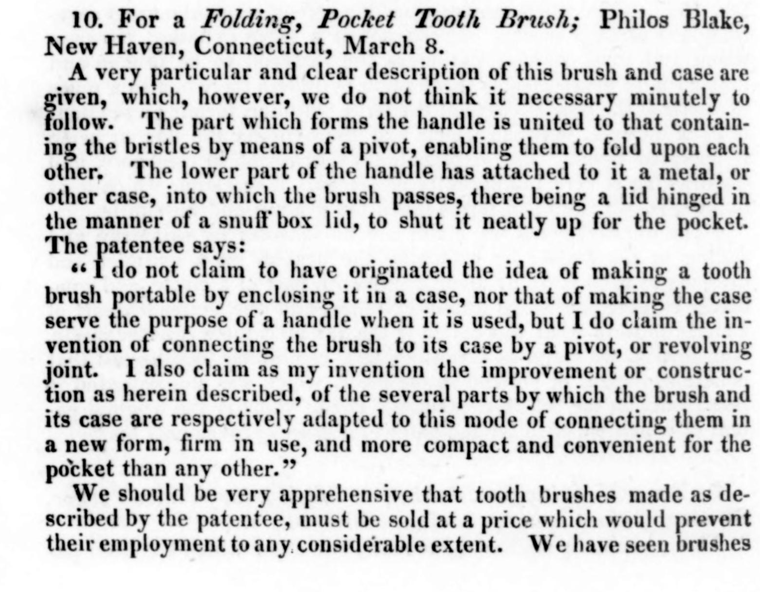
The 1830 patent itself is lost. But, it turns out that the Journal of the Franklin Institute published a monthly list of new American patents, with the editor's remarks on each. The June 1830 issue has this one as No. 10 for March: “For a Folding, Pocket Tooth Brush; Philos Blake, New Haven, Connecticut, March 8.” Blake was a nephew of Eli Whitney and later a New Haven hardware maker., but the journal quotes his claim:
I do not claim to have originated the idea of making a tooth brush portable by enclosing it in a case, nor that of making the case serve the purpose of a handle when it is used, but I do claim the invention of connecting the brush to its case by a pivot, or revolving joint.
Philos Blake, patent of March 8, 1830, as quoted in 5 J. Franklin Inst. (n.s.) 364 (June 1830).
So, Wadsworth holds the earliest surviving American toothbrush patent, but Philos Blake beat him by 27 years. (A second small correction: the Library of Congress dates the Wadsworth patent November 7, 1857. The patent itself says November 17.)Once I found this patent claim, it pushed me to shift the post into one focusing on claim drafting strategy - using the toothbrush as the subject matter example.
Blake's 1830 patent starts by disclaiming what was already known (the brush in a case, and the case that doubles as a handle) and only then claims his improvement, the pivot. That is the logic of a Jepson claim, almost ninety years before Ex parte Jepson. The journal's editor was not impressed with the business case: “We should be very apprehensive that tooth brushes made as described by the patentee, must be sold at a price which would prevent their employment to any considerable extent.”
Next step in this expanding project was to pull every toothbrush patent I could find. That turned out to be about 7,000 patents since 1976 alone, plus a selection going back to Wadsworth and Blake. The rest of this post walks through how the claims have changed, what patent attorneys are doing today, and why.
In December 2025, Director Squires invited applicants to begin filing special Rule 132 declarations focused on patent eligibility. He called these Subject Matter Eligibility Declarations, or SMEDs. The practice is slowly becoming more popular. My most recent search of USPTO dockets found 460, filed in 414 applications, and enough of them have had time to get examiner responses to get a sense of their effectiveness. About one third are successful by my count: the next examiner action either allows the case or drops the §101 rejection.
Finding them in the USPTO dockets has been a bit tricky. Until very recently, most eligibility declarations have been filed as plain Rule 132 declarations, mixed in with thousands of unexpected-results, enablement and inventor-disclosure declarations. And, because they are offering factual declarations, a substantial number (around 15%) never use legalese such as "eligibility" or "101." The Office has a new AF/D.SMED document filing code that should help see them more directly. Ultimately, I downloaded every Rule 130, 131 and 132 affidavit filed in a published application since December 4, 2025, ran each of the 6k through OCR, and parsed the text of each one to sort out the eligibility declarations: those offered to show that the claims are patent-eligible. Nearly all of the ones I found were filed in response to a §101 eligibility rejection; only a handful were filed proactively, before any such rejection.
The result: of the ~6,100 declarations filed in the period, 460 are eligibility declarations. The big news though - once an eligibility declaration is filed, the examiner usually keeps the rejection. In cases where the next action is on the record, about 25% of applications received a notice of allowance, another 9% received an office action that dropped §101, but about 66% got the same rejection again. I also looked at what else was in the response and what the examiner said about it. Nearly all of these applicants amended their claims along with the declaration, and amending did not separate the winners from the losers. When the rejection did go away, the examiner credited the declaration about half the time.
The fiscal year that ended September 30, 2026 closed with about 450 IPR petitions, a third of the 1,400 filed in FY2025 and even fewer than the 510 filed in FY2013, the program's first full year.
Petitions ran about 110 a month through mid-2025. They fell to 61 in November 2025 and 30 in December, and have stayed between 15 and 46 a month ever since. September 2026 came in at 37. There is no sign of a rebound, and also no sign of a further slide: the series has been flat at roughly 30 a month for nine months.
I’m hoping Mizzou will be able to field a team in the newly announced PTAB moot court competition in Spring 2027, offered in collaboration with Indiana University Maurer School of Law. Each team will submit one written brief and argue at least once before a panel of Administrative Patent Judges, and the finalists will be invited to argue in person at USPTO headquarters in Alexandria. There is no entry fee, but only a limited number of teams will be admitted. Interested schools should contact PTABMOOT@iu.edu. The PTAB previously ran a moot court in 2024-25 and this one looks to be a continuation of that with a bit more structure.
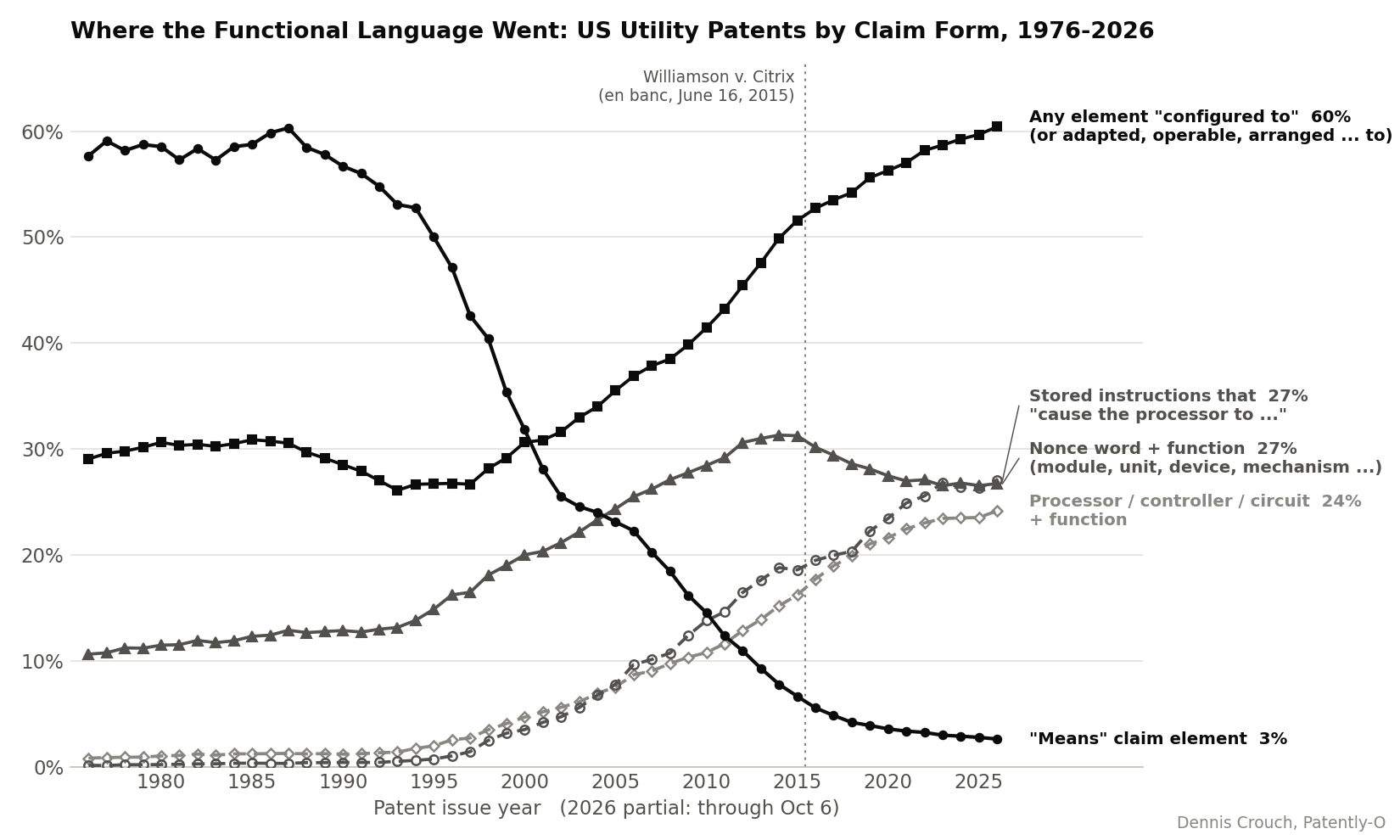
Back in May 2026, I wrote that Williamson found its mark. After the Federal Circuit’s 2015 en banc decision, functional claims that rely upon a function coupled with a generic noun such as “module” or “unit” turned downward for the first time in forty years. But I had a couple of questions left over that I wasn't able to answer with the data that I had at that time. If patent attorneys are backing away from "module" and "unit," what are they writing instead? And is the pullback coming from U.S. drafters, or from somewhere else?
Warning: this post is longer than my usual and takes a deep dive into functional claiming.
Only about 3% of U.S. utility patents issued so far in 2026 include a claim element written with the word “means” (“locking means,” “means for latching”). That is down from 7% in 2015, the year of Williamson, and from a peak of 60% back in 1987. (I last looked at this in 2023.)
But functional claiming has not gone anywhere. In 1976, 65% of patents had an apparatus or product claim that tied a function to a claim element in one of the forms that I count here. In 2026 that figure is 74%. In other words, throughout this time, patent attorneys have kept the functional claims, while shifting the words they use to get there.
Functional claiming has always been a lure for patent attorneys. The marketplace generally cares about an invention's functional capability - what it does for users - rather than the particular nuts and bolts of how it actually operates. A competitor can often swap out one structure for another to achieve the same or similar results. What that means is that it is much harder to design around a claim directed to the function. This is particularly important for technology that is likely to move forward over the 20-year life of a patent. Functional language ages well. In other words, a claim written to the function can reach later-developed technology that the inventor never built or even imagined, so long as that new technology achieves the same results. And, there is also a practical side that is focused on software and electronics - where in the industry components are typically described by engineers in terms of their function. And applications are regularly filed before the final design is settled. But the push-back here is that the law has never been comfortable with a claim that covers every way of achieving a result. That discomfort is what gave us Section 112(f), and it is also seen regularly in enablement, written description, and eligibility doctrine.
Four replacements for “means.” The way I see it, the chart above shows “means” handing its role off to four other claim forms.
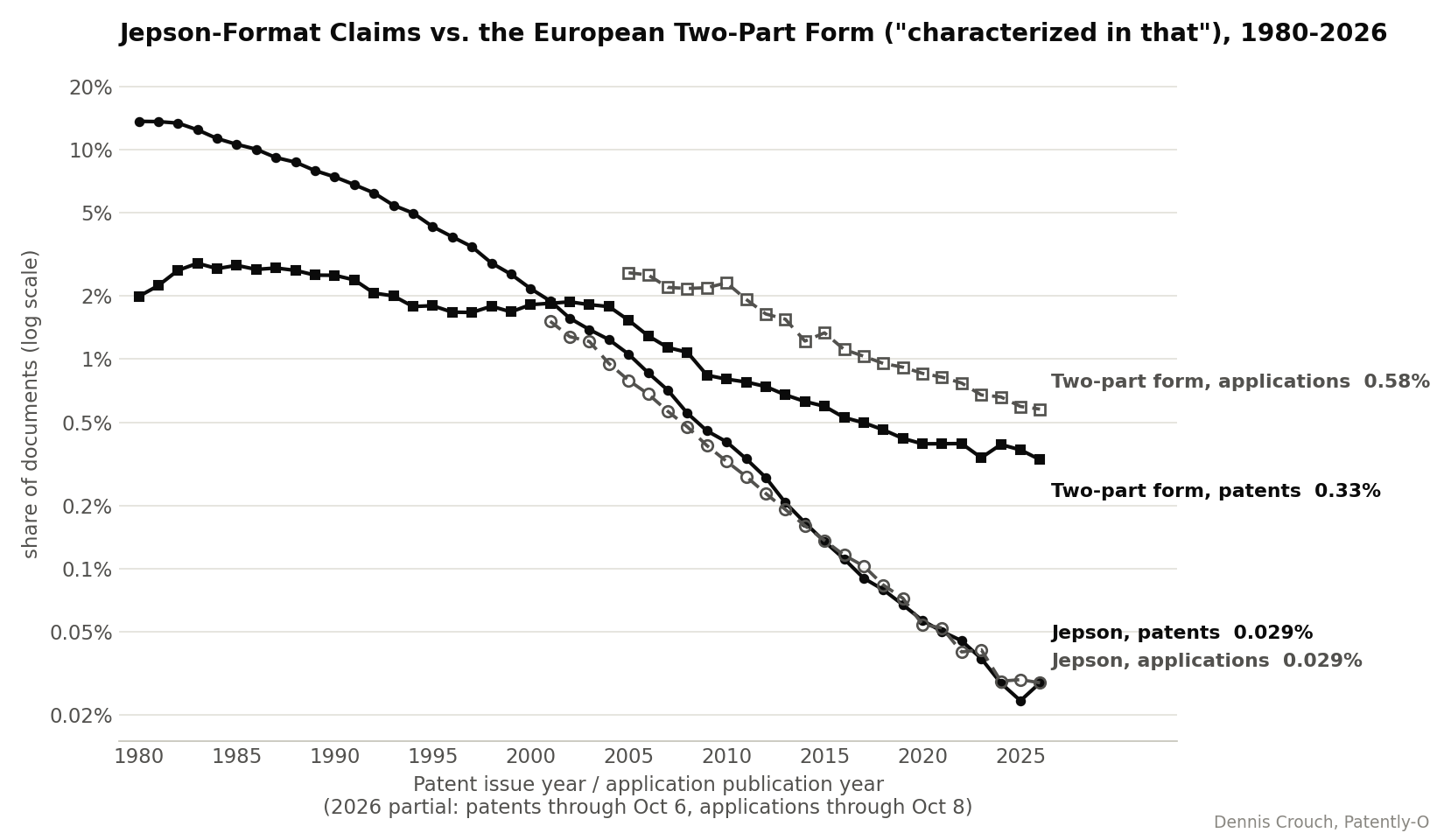
Point-of-novelty claiming is now rare in U.S. patents. Only about 0.03% of U.S. utility patents issued this year include a claim in Jepson form ("In a widget having A and B, the improvement comprising C"). This is down from about 14% in the early 1980s. The European two-part form ("A widget having A and B, characterized in that C") runs twelve to sixteen times higher, but it is also rare at still well under 1% of issued U.S. patents. In 2025 that came to about 1,200 patents with a two-part claim and 76 with a Jepson claim, out of 325k utility patents.
This updates my November 2023 post on Jepson claims (and the 2017 version before it). For this one I used a broader text search that also catches variants such as "the improvement wherein" and dependent claims to "the improvement of claim 1." That raises the early-1980s figures substantially (the 2023 chart peaked near 8%, this one near 14%) but makes almost no difference after 2015, when nearly every remaining Jepson claim uses the literal "improvement comprising" wording.
In re Xencor, Inc., No. 2024-1870 (Fed. Cir. Mar. 13, 2025), held that a Jepson preamble is a limitation that must be supported by the written description, so the applicant bears the burden of showing that what the preamble calls conventional was in fact well known in the art, with the amount of disclosure required scaling with the unpredictability and newness of the field. The upshot is a double burden unique to the form: the preamble counts as an admission of prior art against the applicant yet still has to be described like any other claim element. Ultimately this makes the form even less user-friendly. I wrote about the decision when it came down.
We didn't have any new precedential opinions yesterday and so instead I listened to several oral arguments. The most interesting for a court watcher was J&M Manufacturing Co. v. Kinze Manufacturing, Inc., No. 2025-1654 (Fed. Cir. argued Oct. 5, 2026). Chief Judge Moore opened Monday's argument by rebuking the patentee's lawyers for the way they litigated claim construction in the district court. As the Chief Judge described the Markman hearing, J&M's team introduced its advocate by reciting his mechanical engineering degree and 28 years of technical experience, and then told the district judge that two of its lawyers had clerked for Judge Prost, the author of O2 Micro. Her response from the bench: "Shame. Shame."
Still, the panel seems sympathetic to the appellant. Chief Judge C.J. Williams (N.D. Iowa) had granted summary judgment that the claim term "askewed angle" is indefinite. All three judges pressed Kinze on why the term is not simply broad. The full oral argument is on SCOTUSGate. The court heard oral arguments in Chicago at Northwestern University Pritzker School of Law, and Judge Stoll paused a couple of times to have counsel explain the doctrine "for the benefit of the students in the room."
Judge Alan Albright left the bench at the end of August and is now a partner at A&O Shearman. The Federal Circuit has since granted mandamus against one of his final venue rulings, ordering USC's infringement suit against Google transferred from Austin to the Northern District of California. In re Google LLC, No. 2026-157 (Fed. Cir. Oct. 6, 2026) (nonprecedential). The per curiam order from Judges Dyk, Mayer, and Stark may be the last in a long series of transfer orders that began during Covid times. See In re Adobe Inc., 823 F. App'x 929 (Fed. Cir. 2020).
USC sued in October 2025 on two patents listing former USC professor Michael Naimark as the sole inventor. U.S. Patent Nos. 8,026,929 and 8,264,504. The claims cover posing user-uploaded 2D photographs as aligned overlays within a pre-existing 3D model, and USC accuses the display of user-contributed imagery in Google Earth, Maps, and Street View. Naimark was also on the MIT team that built the late-1970s Aspen Movie Map, an interactive videodisc map often described as a forerunner of Street View. USC is in Los Angeles, Google is in Mountain View, and Naimark lives in Northern California. USC pointed to Google's Austin offices as the Texas connection, but the reality is that the case was filed in Texas in order to appear before a more patent-friendly judge.
Can a patentee rely on the presumption of validity when filing suit, even after the PTO has rejected closely related claims as ineligible? In Epic Tech, LLC v. Pen-Tech Associates, Inc., No. 2025-1624 (Fed. Cir. Sept. 30, 2026), the Federal Circuit said that, on that record, the presumption alone "does not suffice" for a patentee and its counsel facing "multiple indicators" that the claims are unpatentable. The court vacated an order denying Rule 11 sanctions and attorney fees and remanded for a better explanation. It did not decide whether sanctions are warranted.
Epic Tech's U.S. Patent No. 8,545,317 covers an electronic sweepstakes gaming system. It issued in October 2013, eight months before Alice Corp. v. CLS Bank International, 573 U.S. 208 (2014). After Alice, examiners rejected claims in three related applications under § 101, and Epic Tech abandoned all three. In two of those applications the examiner had also found the pending claims patentably indistinct from claims of the '317 patent.
Still, Epic Tech sued Pen-Tech for infringement. Its litigation counsel, Baker Donelson, had been prosecuting Epic Tech's applications since 2018. The district court found the claims ineligible on summary judgment. This appeal focused on the resulting motions for sanctions and fees against both Epic Tech and the firm.
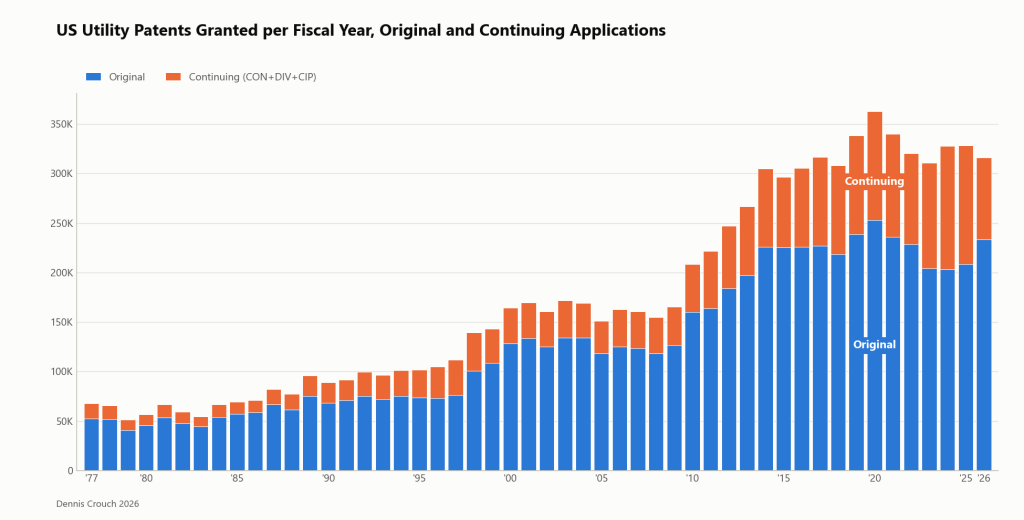
This post updates my September 21, 2026 post on FY2026 utility grants that was projecting out to end of the FY. The year is now over. I have also added two new cuts of the data: published applications by origin and cross-border inventor teams.
The USPTO issued 315,825 utility patents in FY2026, down 3.8% from FY2025. About half of this drop is due to a calendar artifact -- FY2025 had 53 Tuesdays (the day patents issue) and FY2026 was back to the usual 52. But the weekly rate was down overall about 2%.
The two shifts in the mix that I reported in September held up. Continuing applications (continuations, divisionals, and CIPs) accounted for about 26% of FY2026 utility grants, down from 36% in FY2025. That is a major drop I discussed in prior posts. Patents whose first-named inventor claims US residence fell below 40% for the first time.
The Third Circuit has affirmed partial summary judgment that ROSS Intelligence infringed Thomson Reuters's copyrights when it used Westlaw headnotes to train a competing AI legal search tool. Thomson Reuters Enterprise Centre GmbH v. ROSS Intelligence Inc., No. 25-2153 (3d Cir. Sept. 29, 2026).
Judge Bibas held as a matter of law that ROSS infringed 2,243 headnotes and that the copying was not fair use. He then certified two questions for immediate appeal: whether the headnotes are original, and whether ROSS's use was fair. The Third Circuit answered both for Thomson Reuters in an opinion by Judge Montgomery-Reeves. What remains for trial in Delaware is whether some of those copyrights have expired, the claims on the remaining headnotes, and damages. I previously wrote about Judge Bibas's decision (Feb. 11, 2025) and ROSS's opening brief on appeal (Sept. 23, 2025).
ROSS never showed a headnote to its users. The headnotes were copied and used to write AI training memos, and the finished tool returned only passages from judicial opinions. ROSS argued that this sort of intermediate copying is fair use under cases like Google LLC v. Oracle America, Inc., 593 U.S. 1 (2021). The court disagreed. In its reading, those cases turn on necessity, and ROSS already had the opinions and copied the headnotes because that was easier. "Unlike necessity, ease is not a justification for copying." The court called the dispute "no more than an ordinary copyright case" and set generative AI aside in a footnote responding to the Trump Administration's recent statement of interest in the OpenAI litigation.