Tag Archives: Inventorship

who is an inventor, joint inventorship, correction of inventorship

The Missing Inventor Problem

by Dennis Crouch

Fortress Iron has asked the Supreme Court to review the Federal Circuit's decision invalidating two of its cable-railing patents because an omitted coinventor could not be found. Fortress Iron, LP v. Digger Specialties, Inc., No. 26-362 (petition filed Sept. 3, 2026). Judge Lourie wrote the opinion below for a unanimous panel, 171 F.4th 1310 (Fed. Cir. 2026), and the full court denied rehearing in June. I previously wrote about the holding, and then followed up with a second post asking where the invalidity rule comes from now that the AIA has repealed Section 102(f). This post centers on the cert petition, and I also pull in the Supreme Court's 1868 inventorship decision in Agawam v. Jordan.

The invention is a vertical cable rail barrier, a railing whose infill is a set of tensioned vertical cables, of the kind used on a deck, balcony, or stairway. Fortress's owner had the idea and an employee sketched the design, adding some detailed features. But prototypes built in China had a problem: the cables rotated as they were being tensioned. Hua-Ping Huang suggested square openings and square swage fittings to stop the rotation, and a coworker, Shih-Te Lin, suggested changes to strengthen the rail. Both ideas went into the final product, but the patents named only the two Fortress employees. During litigation, the parties discovered that Huang and Lin should be added as inventors. Lin was located and added by the USPTO. But there was difficulty finding Huang.

Figures 1 through 3 of U.S. Patent No. 9,790,707, showing the vertical cable rail panel

So the basic setup here is that everyone agrees that Hua-Ping Huang contributed to the invention and should be named on the patents. Fortress wanted to add him. But Huang left the contractor in 2016 without leaving contact information, and Fortress could not locate him. Fortress argued that it owned rights regardless because the contribution was a "service invention-creation" immediately owned by the contractor who assigned rights to Fortress. No assignment from Huang appears in the USPTO records. The recorded chain runs from Quan Zhou Yoddex to Fortress Iron, and even after finding him Fortress took his consent to be named, not an assignment.

In the litigation, Fortress conceded that Huang and Lin were coinventors and turned to 35 U.S.C. § 256 to fix the patents. The statute offers two routes. Under subsection (a), the USPTO Director may issue a certificate of correction "on application of all the parties and assignees." Fortress used that route for Lin, but admitted it was unavailable for Huang, who could not be found to sign.

Section 256(b) is the courtroom route. It provides that the error of omitting an inventor can be corrected by the court "on notice and hearing of all parties concerned." Fortress argued that Huang is not a party concerned because he holds no ownership interest, would lack standing to bring his own Section 256 claim, and could only benefit from being named. The district court disagreed, and the Federal Circuit affirmed.

Judge Lourie wrote that inventors remain central to the patent system even after they assign their rights, and that a coinventor is a party concerned whether or not he owns anything. Limiting the phrase to those whose economic interests might be harmed would rewrite the statute, and in any event nobody knows whether Huang would be helped or hurt by being named. Notice and a hearing are "a prerequisite to relief, not a mere formality." Because Fortress could not give notice, the error could not be corrected, and the court ultimately concluded that an inventorship error that cannot be corrected invalidates the patent.

Huang has now been found. He signed a Statement of Inventor under 37 C.F.R. § 1.324(b)(1) on April 10, 2026, eight days after the panel opinion issued, and Fortress filed the papers on April 16. On July 20 a supervisory patent examiner granted the petitions and sent the files to the Certificates of Correction Branch. Nothing has issued since. But a certificate of correction does not undo a judgment of invalidity. The district court has already held the two patents invalid and the Federal Circuit has affirmed. Unless the Supreme Court intervenes or Fortress wins relief from the judgment under Rule 60(b), the corrected patents seemingly remain unenforceable against DSI. Other accused infringers could also invoke the invalidity ruling under Blonder-Tongue Laboratories, Inc. v. University of Illinois Foundation, 402 U.S. 313 (1971) (non-mutual issue preclusion applies to invalidated patents).


To continue reading, become a Patently-O member. Already a member? Simply log in to access the full post.

Same Problem, Same Solution: Reading Trade Secrets Across Fields

by Dennis Crouch

International Medical Devices, Inc. v. Cornell, No. 2025-1580 (Fed. Cir. Apr. 17, 2026)

The Federal Circuit reversed a substantial jury verdict and bench-trial damages award against a group of Texas urologists and their affiliates who were found to have misappropriated four trade secrets embodied in the Penuma cosmetic penile implant. Writing for a unanimous panel, Judge Dyk held that three of the asserted trade secrets (internal pockets to soften silicone, distal mesh tabs to promote tissue ingrowth, and absorbable sutures paired with mesh tabs) were generally known under California law because each had been disclosed in prior patents; that the fourth (the Penuma instrument list) had lost any secrecy when it was emailed to third parties without confidentiality restrictions; and that the same ideas that failed to qualify as trade secrets also failed to sustain a claim that plaintiff Dr. James Elist was a co-inventor of the defendants’ two patents. The court vacated roughly $17 million in reasonable-royalty and exemplary damages and a five-year permanent injunction, while affirming a $1 million statutory counterfeiting judgment tied to Dr. Cornell’s unauthorized use of the Penuma trademark.

The opinion is a useful teaching vehicle on the patent/trade-secret interface. It reinforces the familiar rule that ideas placed in the public domain through a patent disclosure cannot be reclaimed as trade secrets. It also articulates something of an obviousness rule for trade secrets: “no protectable trade secret results from translating a generally known concept from one environment to another environment where both environments present the same problem that is solved by the same solution.”

In most jurisdictions, the trade secrecy definition is limited to information “not being generally known to, and not being readily ascertainable through proper means by, another person …” 18 U.S.C. § 1839(3). But, California law – the law of this case – omits the “readily ascertainable” language its statutory definition of a trade secret.  Here, though the court found that the “generally known” standard absorbs much of the functional load.

The inventorship holding, grounded in Board of Education ex rel. Board of Trustees of Florida State University v. American Bioscience, Inc., 333 F.3d 1330 (Fed. Cir. 2003), illustrates how a finding that information is in the public domain for trade-secret purposes can ripple into patent validity by defeating a claim of inventive contribution.

(more…)

How the Federal Circuit Is Rebuilding Inventorship Law After the AIA

by Dennis Crouch

In yesterday's post on Fortress Iron v. Digger Specialties, No. 24-2313 (Fed. Cir. Apr. 2, 2026), I discussed the Federal Circuit's holding that two patents were invalid because a missing coinventor could not be located and added under 35 U.S.C. § 256(b). The court read § 256(b)'s savings clause by its "necessary and opposite implication:" if an inventorship error cannot be corrected, the patent is invalid. But the opinion did not identify where in the Patent Act that invalidity rule comes from. The court cited Pannu v. Iolab Corp., 155 F.3d 1344 (Fed. Cir. 1998), which grounded inventorship invalidity in former Section 102(f) and collected circuit court cases from the 1920s through the 1940s that predated § 102(f) entirely. The Fortress Iron court itself invoked the AIA-era definition of "inventor" in § 100(f). What it did not do is explain how these pieces fit together into a coherent theory of inventorship invalidity in 2026.

That absence matters because the statutory landscape has shifted dramatically. Before the America Invents Act, the doctrinal path was straightforward: Section 102(f) made correct inventorship a "condition of patentability," Section 282(b) made conditions of patentability available as defenses, and Section 256 operated as a savings clause that could rescue patents with correctable errors. The AIA repealed § 102(f) and did not replace it. At the same time, the AIA removed the longstanding requirement that inventorship errors arise "without any deceptive intention" before correction could be granted. Almost fifteen years later, the Federal Circuit still has not articulated a unified approach to inventorship invalidity under the post-AIA statute. In Fortress Iron and the recent Implicit, LLC v. Sonos, Inc., No. 2020-1173 (Fed. Cir. Mar. 9, 2026), the court has been content to cobble together fragments of old case law and new statutory text without confronting the structural question head-on.  What I try to do in this post is to trace the full doctrinal arc, from the nation's first patent statute through the 1952 Patent Act and the AIA, to show what the Federal Circuit is building on and what remains unresolved.

I. The Inventorship Defense from the Founding

The principle that a patent must name the correct inventor is as old as American patent law. The very first Patent Act, enacted on April 10, 1790, included a mechanism for challenging a patent on the ground that the patentee "was not the first and true inventor or discoverer." Under that provision, a district court could order "the repeal of such patent" upon such a finding. The Patent Act of 1793 continued the requirement, demanding that every inventor "swear or affirm that he does verily believe, that he is the true inventor or discoverer." And the Patent Act of 1836, which created the modern Patent Office and examination system, formalized the procedural structure.

The 1836 Act's defense provisions were consolidated in 1874 as Revised Statutes Section 4920 and enumerated several defenses going directly to inventorship. The fourth defense permitted proof that the patentee "was not the original and first inventor or discoverer of any material and substantial part" of the claimed invention. All of these defenses were available to any defendant in an infringement action, regardless of whether the defendant had any ownership interest in the patent or any relationship to the true inventor.


To continue reading, become a Patently-O member. Already a member? Simply log in to access the full post.

Missing Coinventors and the Death of a Patent

by Dennis Crouch

The Patent Act requires that patents correctly name their inventors. 35 U.S.C. §§ 115(a), 116(a). Before 2011, the statute also made incorrect inventorship an explicit ground for invalidity. Former Section 102(f) provided that "[a] person shall be entitled to a patent unless . . . he did not himself invent the subject matter sought to be patented." A defendant in an infringement action could raise § 102(f) as a straightforward invalidity defense under § 282(b). The America Invents Act repealed § 102(f) and did not replace it with any equivalent provision. That repeal left an open question that the patent bar has been debating for more than a decade: can incorrect inventorship still be raised as a defense in patent litigation? See Dennis Crouch, With 102(f) Eliminated, Is Inventorship Now Codified in 35 U.S.C. 101?, Patently-O (Oct. 4, 2012); Dennis Crouch, The Removal of Section 102(f)'s Inventorship Requirement; the Narrowness of Derivation Proceedings; and the Rise of 101's Invention Requirement, Patently-O (Oct. 5, 2012).

The structural problem is real. Section 282(b) enumerates the defenses available in infringement actions, and none of the inventorship grounds are expressly listed. In other contexts, the Federal Circuit has been strict about confining defenses to those the statute identifies. Yet the requirement that inventors be correctly named remains in the Patent Act, and Section 256 still states that inventorship errors "shall not invalidate the patent . . . if it can be corrected as provided in this section." The negative implication of that language is that if the error cannot be corrected, the patent is invalid.

In Fortress Iron v. Digger Specialties, No. 24-2313 (Fed. Cir. Apr. 2, 2026), the Federal Circuit confirmed that negative implication, holding two patents invalid because a missing coinventor could not be located and added. But the opinion leaves other question untouched.


To continue reading, become a Patently-O member. Already a member? Simply log in to access the full post.

Too Late to Invent an Inventor: Forfeiture and § 256 in IPR Proceedings

by Dennis Crouch

Section 256 of the Patent Act is a remarkable statutory provision. It declares that a patent "shall not be invalidated" on the grounds of incorrect inventorship so long as the error "can be corrected." 35 U.S.C. § 256(a). Unlike its neighboring provisions for correcting other types of patent errors, Section 256 operates retroactively, reaching back to the patent's original filing date. And the statute imposes no express timing requirement: it does not say "if corrected within X days" or "if diligently pursued." The statute simply says "if it can be corrected." In Implicit, LLC v. Sonos, Inc., No. 2020-1173 (Fed. Cir. Mar. 9, 2026), however, the Federal Circuit held that the absence of a statutory deadline does not immunize a patentee from the consequences of delay. Forfeiture principles, the court ruled, can prevent a patent owner from relying on a Section 256 correction to mount a new argument in an inter partes review that it failed to raise during the original proceeding.

The case involved two patents owned by Implicit that originally named Edward Balassanian and Scott Bradley as co-inventors. Both were employees of BeComm Corporation, Implicit's predecessor. A third engineer, Guy Carpenter, had written the source code and authored the document that became the provisional application, but was not a named inventor.


To continue reading, become a Patently-O member. Already a member? Simply log in to access the full post.

USPTO’s “Don’t Ask, Don’t Tell” Policy: The Quiet Death of Thaler and the Legal Fiction of Human Inventorship

by Dennis Crouch

The Federal Circuit's 2022 decision in Thaler v. Vidal seemed to settle a fundamental question: only natural persons can be inventors under U.S. patent law.  But, the bigger near-term question has always been about human-AI collaboration - and what level of human contribution is sufficient to qualify as inventive.  Director Kathi Vidal implemented a team-based framework that allowed patenting if the human made a "more than insignificant contribution" to the invention.  This approach basically asked whether the human had done enough to be considered a joint joint inventor (alongside the AI). While that approach had some conceptual problems (permitting patenting without complete human inventorship), it - at least - set a standard for the agency to consider.

In a November 2025 guidance, new USPTO Director John Squires has rejected the Vidal approach and instead established a "don't ask, don't tell" policy for AI-assisted inventions creates a presumption of human inventorship so long as any natural person is willing to sign the oath.  For all practical purposes, this approach is also a repudiation of Thaler, so long as the patent applicant is able to find a human close to the invention willing to self-identify as the inventor. The system now effectively rewards an old habit in invention culture: when attribution becomes optional and unverifiable, someone will always be willing to step forward and claim the mantle of inventor.  In a chapter I wrote a few years ago examining corporate invention, I observed: "It is easy to identify a human with some relation to the product or innovation and prop-up that human as the inventor." Dennis Crouch, Legal Fictions and the Corporation as an Inventive Artificial Intelligence in R. Abbott ed., Research Handbook on Intellectual Property and Artificial Intelligence (Edward Elgar Publ’g 2022).


To continue reading, become a Patently-O member. Already a member? Simply log in to access the full post.

Secret Springing Prior Art and Joint Research: Lessons from Merck v. Hopewell

by Dennis Crouch

The Federal Circuit’s recent decision in Merck Serono S.A. v. Hopewell Pharma Ventures, Inc. provides important clarification on when a patent reference qualifies as prior art “by another” under pre-AIA law 35 U.S.C. § 102(e).  It also highlights ways that the AIA has subtly changed this category of “secret springing prior art” that is now codified under § 102(a)(2) and the special exceptions found in § 102(b)(2) and §102(c).

The case comes as we also have a pending Supreme Court petition in Lynk Labs challenging whether this secret prior art qualifies as a “printed publication” that can serve as the foundation for an inter partes review (IPR) challenge.  That petition is set for consideration by the Court later this week. (more…)

Forgetting the Evidence: How Sherman Lost on Obviousness Before and After LKQ

by Dennis Crouch

Dynamite Marketing, Inc. v. The WowLine, Inc., 2024-1523, 2024-1525 (Fed. Cir. Sept. 12, 2025) (non-precedential)

This case involves design patent infringement claims over the "Wallet Ninja," a credit-card-sized multi-tool covered by U.S. Patent No. D751,877.   Patentee Dynamite Marketing sued Sherman Specialty (d/b/a The WowLine, Inc.).  The case was complicated by inventorship disputes involving LaErik Cooper, a mechanical engineer who assisted in developing the design but was not named as an inventor on the patent. A jury ultimately found that Cooper was not entitled to co-inventor status, that Sherman willfully infringed the valid patent through its competing "TOL4" product line, and awarded Dynamite $1,850,000 in lost profits damages. The district court then awarded $1.54 million in attorney fees, bringing the total judgment to over $3.5 million.

On appeal, the Federal Circuit dismissed Sherman's challenge to the inventorship determination because Sherman lacked standing to appeal that issue, since it was not a party to Cooper's inventorship counterclaim and Cooper himself did not appeal his loss. The court affirmed all other aspects of the district court's decision -- including a non-obviousness finding that survived even after the Federal Circuit's intervening LKQ decision changed the legal standard for design patent obviousness.


To continue reading, become a Patently-O member. Already a member? Simply log in to access the full post.

The USPTO’s AI Inventorship Guidance: A Legally Problematic Half-Measure

by Dennis Crouch

In 2024, the USPTO released its AI inventorship guidance that established a "significant contribution" standard for human inventorship for AI-assisted innovation situations. This short essay argues that the USPTO's approach creates a fundamental legal inconsistency with patent law's bedrock requirement of complete human conception. Because the USPTO's approach lacks both legal weight and legal merit, it ultimately threatens the validity of patents covering inventions generated with substantial AI-assistance.


To continue reading, become a Patently-O member. Already a member? Simply log in to access the full post.

USPTO Withdraws Biden Era AI Strategy

The USPTO has withdrawn its artificial intelligence strategy document published in January 2025, just days before the presidential transition. Acting Director Coke Morgan Stewart recently indicated the strategy has been removed because it was "driven in part by Biden executive orders" that have since been rescinded by the Trump administration.

This move is part of a broader reassessment of federal AI policy following President Trump's executive order on January 23, 2025, titled "Removing Barriers to American Leadership in Artificial Intelligence." This new EO outlines a fundamental shift in approach, emphasizing "America's global AI dominance" rather than the previous focus on "safe, secure, and trustworthy development."

USPTO AI Strategy


To continue reading, become a Patently-O member. Already a member? Simply log in to access the full post.

Federal Circuit: State Law Conversion Claim Preempted Where Pleading Seeks Patent-Like Protection

On January 13, 2025, the Federal Circuit issued a notable opinion on federal preemption of state law conversion (theft) claims and correction of inventorship. In BearBox LLC v. Lancium LLC, No. 2023-1922 (Fed. Cir. Jan. 13, 2025), the court affirmed the District of Delaware’s grant of summary judgment, holding that federal patent law preempted BearBox’s Louisiana state law conversion claim. The court also affirmed that BearBox failed to prove by clear and convincing evidence that Austin Storms should be listed as an inventor of U.S. Patent No. 10,608,433.

The dispute arose from a chance encounter at a Bitcoin mining conference in May 2019. After a brief conversation at cocktail hour and dinner between BearBox’s founder Austin Storms and Lancium’s co-founder Michael McNamara, Storms sent a single follow-up email with four attachments describing BearBox’s technology. Five months later, in October 2019, Lancium filed a patent application that ultimately issued as the ‘433 patent, naming McNamara and Raymond Cline as inventors, but not Storms. (Claim 1 is listed below). The patent covered methods and systems for adjusting power consumption based on power option agreements – a concept that BearBox claimed Storms had conceived and shared with Lancium at the conference. BearBox sued, asserting both correction of inventorship under federal patent law and conversion under Louisiana state law.

State Law Preemption: The preemption issue presents an important question about the intersection of state tort law and federal patent protection. While state law conversion claims are not automatically preempted by federal patent law, the Federal Circuit found that BearBox’s particular claim as pled sought “patent-like protection” for unpatented technology and thus ran afoul of longstanding Supreme Court precedent. The court relied heavily on Bonito Boats, Inc. v. Thunder Craft Boats, Inc., 489 U.S. 141 (1989), which held that states may not offer patent-like protection to intellectual creations that would otherwise remain unprotected under federal law. The Bonito Boats Court emphasized that “the efficient operation of the federal patent system depends upon substantially free trade in publicly known, unpatented design and utilitarian conceptions.”

The Federal Circuit’s analysis focused on how BearBox pled its conversion claim, rather than the abstract elements of Louisiana conversion law. The court noted that BearBox’s complaint was “replete with ‘patent-like’ language typically invoked when a party asserts inventorship or infringement of a patent.” This included allegations that Storms had “conceived, developed, and reduced to practice” the technology and that Lancium had engaged in “improper and unauthorized use.” The prayer for relief seeking damages based on Lancium’s use and monetization of the technology particularly troubled the court, as it effectively sought patent-like remedies.  Ultimately, the court concluded:

Here, we agree with the district court that BearBox’s conversion claim is preempted because the conversion claim, as pled, is essentially an inventorship cause of action and patent infringement cause of action, and thus seeks “patent-like protection” for ideas that are unprotected under federal law.

The court distinguished this case from situations where state law claims might validly protect against misappropriation without conflicting with federal patent policy. For instance, trade secret claims often survive preemption analysis, as the Supreme Court recognized in Kewanee Oil Co. v. Bicron Corp., 416 U.S. 470 (1974). But here, BearBox’s technology was neither patented nor kept as a trade secret – instead, it was “freely shared with others” and “otherwise in the public domain.” The Federal Circuit emphasized that federal patent law generally precludes recovery for a defendant’s use of an unpatented discovery after the plaintiff makes it publicly available.*

What particularly doomed BearBox’s conversion claim was its attempt to recover damages analogous to patent remedies. The court noted that under Louisiana conversion law, damages are typically limited to return of the converted property or its value at the time of conversion. But BearBox sought ongoing royalties and lost profits – remedies that mirror 35 U.S.C. § 284’s provision for patent infringement damages. As the court explained, allowing such recovery would effectively grant BearBox patent-like control over technology it had freely disclosed, undermining Congress’s careful balance between innovation incentives and public access to ideas.

In my view, this decision is somewhat dangerous because of its potential to undermine state law cases that have protected individuals in idea-submission scenarios. Courts have long recognized claims where someone provides an idea to a company and seeks compensation when the company uses it without permission or payment These are typically tied into breach of (implied) contract or misappropriation as part of a confidential relationship. See, Desny v. Wilder, 46 Cal. 2d 715 (1956); Hoeltke v. C.M. Kemp Mfg. Co., 80 F.2d 912 (4th Cir. 1935); Aronson v. Quick Point Pencil Co., 440 U.S. 257 (1979).   In Aronson, the Court upheld a contract requiring payment for use of an invention even after a patent application was rejected, distinguishing this from state law protection that would prevent others from using publicly available information.  See also Softel, Inc. v. Dragon Med. & Sci. Communs., 118 F.3d 955 (2nd Cir. 1997); Nadel v. Play-By-Play Toys & Novelties, Inc., 208 F.3d 368 (2nd Cir. 2000).

* I want to note one procedural oddity here.  The appellate court based its decision here at least partially on the factual finding that the technology here was not kept secret but instead had been “freely shared with others” and “otherwise in the public domain.”  The district court made those conclusions following the bench trial on inventorship.  But, the those facts were still in contention at the summary judgment stage when the district court decided the preemption issue.  And, normally an appellate court reviews the summary judgment record independently, applying the same standards as the district court to determine whether summary judgment was appropriate. This issue probably deserves some additional research, but it is not clear to me that the court appropriately relied upon the publicly-available status of the submissions in its review of the summary judgment.

Inventorship Claims Fail Due to Lack of Clear and Convincing Evidence

Apart from the state law claim, BearBox also claimed inventorship rights under 35 U.S.C. § 256.  That statute provides a court with authority to order correction of inventorship when it determines an inventor has been erroneously omitted from a patent. However, patent issuance creates a presumption that the named inventors are the true and only inventors, and the late-coming inventor faces the heavy burden of proving inventorship by clear and convincing evidence.

A key challenge for BearBox was the requirement that an alleged joint inventor’s testimony must be corroborated by independent evidence. As the Federal Circuit has long held, “an alleged co-inventor must supply evidence to corroborate his testimony.” Ethicon, Inc. v. U.S. Surgical Corp., 135 F.3d 1456 (Fed. Cir. 1998). While corroborating evidence can take various forms – including contemporaneous documents, physical evidence, circumstantial evidence about the inventive process, or testimony from others – BearBox’s case rested primarily on four attachments sent in a single email: a product specification sheet, an annotated system diagram, hardware component specifications, and a data file modeling system simulation.

The district court’s analysis, which the Federal Circuit affirmed, found these materials insufficient to establish Storms’ inventorship claims. First, Storms himself admitted that the hardware component specifications had nothing to do with the subject matter of the ‘433 patent. More fundamentally, for the remaining documents, BearBox could not establish either that Storms had conceived of the claimed invention or that he had communicated any relevant information prior to Lancium’s independent conception.  This timing issue proved particularly problematic because Lancium had filed a prior patent application in February 2018 – fifteen months before Storms ever met anyone from Lancium – disclosing many key aspects of the technology.

To qualify as a joint inventor, an individual must “show that he contributed significantly to the conception—the definite and permanent idea of the invention—or reduction to practice of at least one claim.” Blue Gentian, LLC v. Tristar Prod., Inc., 70 F.4th 1351 (Fed. Cir. 2023). These contributions must arise from “some element of joint behavior, such as collaboration or working under common direction.” Kimberly-Clark Corp. v. Procter & Gamble Distrib. Co., Inc., 973 F.2d 911 (Fed. Cir. 1992). The Federal Circuit found no error in the district court’s conclusion that the limited interaction between Storms and Lancium – essentially one dinner conversation and a single email – failed to establish the required level of collaboration or significant contribution to conception.

BearBox raised several procedural challenges to the district court’s inventorship analysis, but none proved persuasive. The Federal Circuit rejected BearBox’s argument that the district court improperly excluded as hearsay Storms’ testimony about what he told McNamara at dinner. While acknowledging some merit to the argument that the testimony was offered for a non-hearsay purpose (to prove notice rather than truth), the court found that BearBox’s failure to make an offer of proof about what the testimony would have been was “fatal” to preserving the issue for appeal.

The Federal Circuit also dismissed BearBox’s criticism of the district court’s element-by-element analysis of the patent claims.  At oral arguments BearBox’s counsel argued:

All claims, or maybe most, the majority of claims, are a combination of known elements. And so, if the District Court is looking at the elements in isolation for evidence of earlier conception or conception, it will always be found.

While BearBox argued that the court should have considered claim elements in combination, the Federal Circuit found no error in the limitation-by-limitation approach given that BearBox needed to demonstrate Storms’ significant contribution to at least one claim. The court noted that this analysis actually mirrored how BearBox itself had presented its case in post-trial briefing.

= = =

The appellate panel also affirmed the district court’s exclusion of Dr. McClellan’s supplemental expert report, which had been filed three weeks before trial and five months after the close of expert discovery.

= = =

The Federal Circuit panel consisted of Judges Chen, Bryson, and Stoll, with Judge Stoll writing the opinion. The case was appealed from the District of Delaware where Judge Williams presided. Benjamin Horton argued the case for BearBox who was also represented by John Labbe, Chelsea Murray, and Raymond Ricordati of Marshall Gerstein. Mark Nelson argued for Lancium and was joined on the brief by other Barnes & Thornburg lawyers, including Adam Kaufmann and Chad Stover.

= = =

Claim 1. A system comprising:

a set of computing systems, wherein the set of computing systems is configured to perform computational operations using power from a power grid;

a control system configured to:

monitor a set of conditions;

receive power option data based, at least in part, on a power option agreement, wherein the power option data specify: (i) a set of minimum power thresholds, and (ii) a set of time intervals, wherein each minimum power threshold in the set of minimum power thresholds is associated with a time interval in the set of time intervals;

responsive to receiving the power option data, determine a performance strategy for the set of computing systems based on a combination of at least a portion of the power option data and at least one condition in the set of conditions, wherein the performance strategy comprises a power consumption target for the set of computing systems for each time interval in the set of time intervals, wherein each power consumption target is equal to or greater than the minimum power threshold associated with each time interval; and

provide instructions to the set of computing systems to perform one or more computational operations based on the performance strategy.

DABUS AI Again Denied European Patent

by Dennis Crouch

The European Patent Office (EPO) has again rejected Dr. Stephen Thaler’s patent application that attempted to name his artificial intelligence system DABUS as an inventor.  The EPO examining division’s decision reinforces the foundational principle that inventors must be natural persons under European patent law. Article 81 of the European Patent Convention (EPC) requires a mandatory designation of inventor, and according a prior precedential decision that went against Thaler, the inventor “must be a natural person.” The examining division emphasized that this requirement stems from the interconnection between Article 81 EPC (designation of inventor) and Article 60(1) EPC (right to European patent).

Article 81: Designation of the inventor — The European patent application shall designate the inventor. If the applicant is not the inventor or is not the sole inventor, the designation shall contain a statement indicating the origin of the right to the European patent.

Article 60: Right to a European patent — (1) The right to a European patent shall belong to the inventor or his successor in title. . .

Of course, neither of these articles expressly state that the inventor must be human, but the implication from Article 60(1) in particular is that the inventor is someone with the capability of holding title. (more…)

The Team-Based Reality of Modern Innovation: Average Patent Now Lists More Than Three Inventors

by Dennis Crouch

New data from the USPTO shows that the amazing transformation in patent inventorship continues: the average number of inventors per utility patent has reached 3.2 in 2024, nearly double the 1.7 inventors per patent seen in 1976. This steady rise in team-based inventing reflects fundamental changes in how innovation occurs and how the patent system operates.


To continue reading, become a Patently-O member. Already a member? Simply log in to access the full post.

Recent Patent Law Scholarship

by Dennis Crouch

This post offers some insight into four patent-focused academic articles that I've been reading lately.

1. A textualist approach to patent eligibility under § 101; 2. Reflections on the Myriad, ten years later 3. Message to Competition Regulators: Patents are not simply a necessary evil 4. Philosophical critique of AI inventorship

These pieces offer insights into ongoing debates within patent law and policy. Although I don't necessarily agree with the conclusions made by the various authors, each article provides fodder for continued discussion on these important topics.


To continue reading, become a Patently-O member. Already a member? Simply log in to access the full post.

Inventorship Correction Affirmed for Patent on Intermodal Container for Transporting Gaseous Fluids

by Dennis Crouch

In a recent nonprecedential decision, the Federal Circuit affirmed a district court ruling ordering the correction of inventorship for U.S. Patent No. 9,376,049. Tube-Mac Indus., Inc. v. Campbell, No. 2022-2170 (Fed. Cir. Mar. 15, 2024). The patent at issue, originally naming a single inventor (Steve Campbell), claims a lightweight intermodal container system for transporting refrigerated gaseous fluids.

This post examines the reasoning behind the Federal Circuit's affirmance as well as the potential applicability of the equitable defense of laches in cases brought under 35 U.S.C. § 256 to correct inventorship on an issued patent.


To continue reading, become a Patently-O member. Already a member? Simply log in to access the full post.

Joint Inventorship: AI-Human Style

by Dennis Crouch

The U.S. Patent and Trademark Office (USPTO) recently published examination guidance and a request for comments on the treatment of inventorship for inventions created with the assistance of artificial intelligence (AI) systems.  Inventorship Guidance for AI-Assisted Inventions.

The key takeaway here is that the USPTO believes that an AI-developed invention is patentable so long as a human satisfies the joint-inventorship standard of "significantly contributing to the invention." A human who provides a significant contribution may be the sole inventor and original owner, even in situations where the AI provided the greater contribution.

The PTO's approach here is fairly broad and will likely serve current AI use cases in most situations because most AI invention models of today are tightly controlled and managed by humans rather than simply arising from AI autogeneration or broad prompting. Thus, from a practical effect, there will likely be at least one natural person who satisfies the joint inventorship standard in the vast majority of cases. (Recognizing here that mere control of an AI is insufficient. Rather, the human must provide significant inventive contribution).

Although I am very sympathetic to recognizing human contributions, I also want a patent system that broadly encourages innovation without either prescribing or proscribing particular approaches. The flexibility of this guidance allows room for both human and machine intelligence to intersect in the creative process. But, we should continue monitoring the effects the policy to ensure it does not unduly constrain AI's eventual capacity to autonomously formulate inventive concepts. But for now, the USPTO's basic framework reasonably balances competing interests.

But, the USPTO's approach is not fully grounded in the law because it allows for patenting of an invention in a situation where no human or combination of humans fully conceived of and originated the invention. Rather, we are simply looking for at least one human who provided a significant contribution. The guidance does not particularly address this issue and, by declining to specifically justify the legal grounds why human "significant contributions" suffice even without complete conception, the USPTO leaves the door open to contrary arguments. Opponents could contend that full conception remains legally required for inventorship and that this expansion of the inventorship doctrine exceeds the statutory language.  It is not clear who will have standing to make this particular argument.


To continue reading, become a Patently-O member. Already a member? Simply log in to access the full post.

Patent Law Exam 2023: Are you Smarter than a Law Student?

by Dennis Crouch

The following is my patent law exam from this past semester. As in years past, the exam was worth less than half of the final grade because the students did other substantial work during the semester, including a major moot court competition.   Students were permitted access to their book/notes/internet, but were barred communications with another human during the exam.

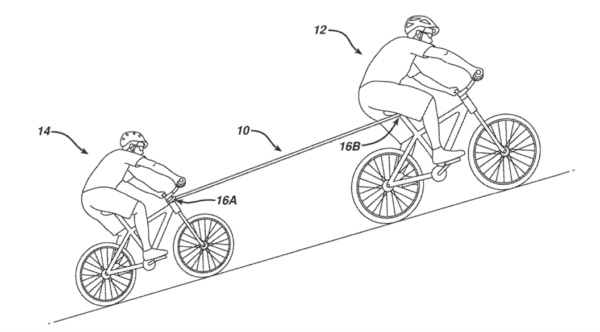
This year's exam is very loosely based upon an interesting patent that I found associated with the Tow Whee product created by Eric Landis.  See US11167164, US11731470, and US11724148.  But, the events described are entirely my creation.

= = =


To continue reading, become a Patently-O member. Already a member? Simply log in to access the full post.

No Patent for Robot Inventions: UK Supreme Court Rules on AI Inventorship in Thaler v. Comptroller-General

by Dennis Crouch

Thaler v. Comptroller-General of Patents, Designs and Trade Marks, [2023] UKSC 49. 

In a December 20, 2023 decision, the UK Supreme Court has agreed with American courts that an inventive machine is not deserving of patent rights.  The underlying case will be familiar to many with Dr. Stephen Thaler of St. Louis seeking to patent a thermal-mug designed by an artificial intelligence machine that he created.  Thaler has argued that the AI (called DABUS) conceived of the particular invention in question and also identified its practical utility.  The UK Supreme court based its holding upon the text of the UK Patents Act of 1977 as it reached the same ultimate conclusion as the Federal Circuit in Thaler v. Vidal, 43 F.4th 1207 (Fed. Cir. 2022), cert. denied, 143 S. Ct. 1783 (2023).

These Thaler cases showcase that under the current patent law regime, autonomous AI systems cannot qualify as inventors entitled to patent rights, irrespective of their creativity. For AI-generated inventions to become patentable, intervention by policymakers to amend inventorship laws would likely be necessary. However, the arguably bigger questions of immediate importance surround collaborative human-AI inventions where both human and machine contribute in creation of a new invention. Thaler expressly disclaimed any human input into DABUS’s inventions, but going forward mixed human-AI inventor teams seem inevitable. Neither the UK Supreme Court’s decision nor the parallel US rulings provide direct guidance on the requisite threshold quality or quantity of human participation in such collaborative inventions to satisfy legal inventorship requirements. Thus, for instance, an open issue remains whether token perfunctory human approval of an AI-devised invention would suffice, or if substantive intellectual contribution is needed. And for primarily AI-driven inventions, are minor tweaks by a human collaborator enough? Or must the human contributor objectively supply the novel concept?


To continue reading, become a Patently-O member. Already a member? Simply log in to access the full post.