
Big Bang Integration Testing is an integration testing approach in which all individual modules of a software application are integrated at once and tested as a complete system. It is mainly used for small applications where all modules are available before integration begins.
- All modules are integrated simultaneously and tested together.
- Integration testing starts only after every module has been developed.
- It is simple to implement but makes defect identification and debugging more difficult.
Example: Consider a system with three modules A, B, and C. After each module is individually tested, all three are integrated and tested together to verify that the complete system works correctly.
Big Bang Integration Testing Architecture
In Big Bang Integration Testing, all software modules are developed and unit tested independently first. After that, they are integrated into one complete system in a single phase. The integrated application is then tested to verify that all modules communicate and work correctly together.
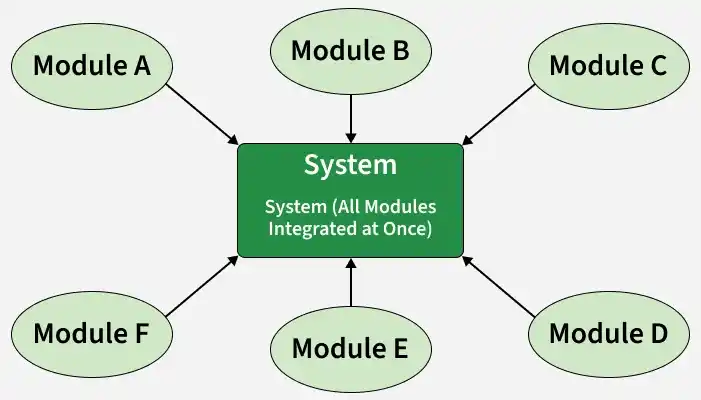
- Modules A, B, C, D, E, and F are developed independently before integration.
- All modules are integrated into the system at the same time rather than step by step.
- Integration testing begins only after every module is available.
- The complete application is tested to verify communication and data flow between modules.
- If an integration defect occurs, identifying the exact faulty module can be difficult because all modules are tested together.
Process of Big Bang Integration Testing
The process of Big Bang Integration Testing involves combining all completed modules at once and then testing the entire integrated system to verify that the modules work correctly together.
- Develop Individual Modules: All modules of the application are developed and unit tested separately before integration begins.
- Integrate All Modules Together: Once the modules are ready, they are combined into a single system at the same time instead of integrating them step by step.
- Prepare Test Cases for Integration: Test cases are created to verify data flow, communication, and interactions between the integrated modules.
- Execute Integration Tests: The complete integrated system is tested to check whether all modules work together as expected.
- Identify and Report Defects: Any issues related to module interaction, data exchange, or interface failures are identified and reported.
- Fix Defects and Retest: Developers fix the reported issues, and the integrated system is tested again to confirm that the defects are resolved.
Tools Used for Big Bang Integration Testing
Big Bang Integration Testing can be performed using various testing and automation tools to execute test cases, identify integration defects, and generate test reports.
- Selenium: Automates integration testing for web applications by verifying interactions between modules.
- JUnit: Used for Java applications to execute integration test cases and validate module behavior.
- TestNG: Provides advanced testing features such as grouping, parallel execution, and detailed reporting.
- Postman: Tests the integration of APIs and verifies communication between different services.
- Apache JMeter: Performs load and performance testing on integrated applications.
Real-World Applications
- Small Business Applications: Used to test simple systems such as inventory, billing, or payroll software after all modules are completed.
- Student and Academic Projects: Suitable for integrating and testing all project modules at once before final submission.
- Prototype Applications: Used to validate the functionality of complete prototype systems with limited modules.
- Desktop Applications: Applied to small desktop software where all features are developed before integration testing.
- Proof-of-Concept (PoC) Projects: Helps verify that all developed components work together before further development or deployment.
Advantages of Big Bang Integration Testing
- Simple integration approach because all modules are combined and tested together in one phase.
- No need for test stubs or drivers when all dependent modules are available.
- Suitable for small applications with a limited number of modules and simple interactions.
- Validates the interaction of all integrated modules in a complete system environment.
- Reflects real system behavior since testing is performed after the full application is integrated.
- Avoids multiple integration cycles because modules are integrated at once rather than in stages.
Limitations of Big Bang Integration Testing
- Difficult to identify defects because all modules are integrated and tested at the same time.
- Debugging becomes complex and time-consuming when multiple modules fail together.
- Testing can begin only after all modules are fully developed, which delays feedback.
- Interface issues may be discovered late in the testing cycle.
- Failures in one module can affect the testing of other modules, making analysis harder.
- Not suitable for large or complex applications with many interdependent modules.
- If a major defect occurs, the entire integrated system may become unstable, slowing testing progress.
Big Bang Integration Testing Vs Incremental Integration Testing
| Feature | Big Bang Integration Testing | Incremental Integration Testing |
|---|---|---|
| Integration Approach | All modules are integrated at once. | Modules are integrated step by step. |
| Testing Begins | After all modules are developed. | As modules become available. |
| Defect Identification | Difficult to locate integration defects. | Easier to identify and isolate defects. |
| Debugging | More time-consuming due to simultaneous integration. | Faster because fewer modules are tested at a time. |
| Stubs and Drivers | Not required. | May require stubs and drivers. |
| Suitable For | Small and simple applications. | Medium and large, complex applications. |
| Risk Level | Higher due to complete system integration at once. | Lower because integration is performed gradually. |
| Testing Efficiency | Lower for complex systems. | Higher due to early detection of integration issues. |
