
Contract Acceptance Testing (CAT) is a type of acceptance testing performed to verify that a software system meets the agreed contractual requirements between the client and the vendor before final delivery.
- Ensures all contract terms, conditions, and specifications are fulfilled.
- Conducted after system testing and before final acceptance.
- Focuses on legal and business requirements rather than just technical aspects.
Example: If a contract states that a web application must support 10,000 concurrent users, CAT verifies whether the application meets this requirement before final acceptance.
Important Aspects of Contract Acceptance Testing (CAT)
Contract Acceptance Testing focuses on verifying the contractual commitments agreed between the client and vendor to ensure the delivered software meets business and quality expectations.
- Checks whether all features and functions mentioned in the contract are implemented.
- Ensures compliance with agreed standards, service-level agreements (SLAs), and deliverables.
- Verifies user manuals, reports, and other supporting documents required by the contract.
- Confirms that contractual conditions such as deadlines, performance targets, and penalties are properly addressed.
Process of Contract Acceptance Testing (CAT)
Contract Acceptance Testing is performed in a structured way to validate whether the software satisfies all requirements and conditions mentioned in the contract between the client and the development company.
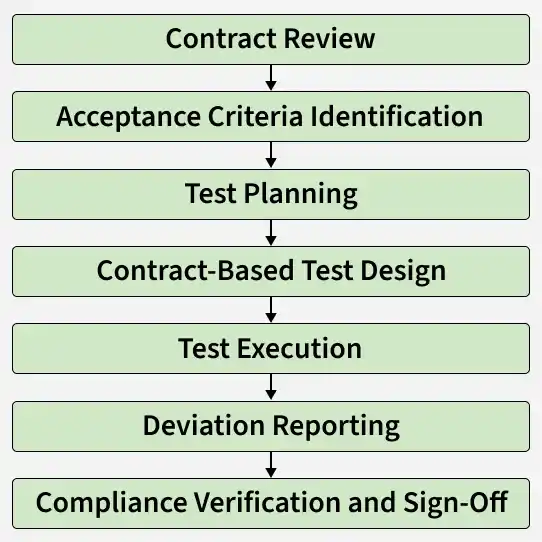
- Contract Review: Analyze the contract to identify agreed deliverables, business expectations, timelines, and acceptance conditions defined between the client and vendor.
- Acceptance Criteria Identification: Break down contract clauses into clear and testable acceptance criteria for validation.
- Test Planning: Prepare a test plan focused on verifying contractual obligations, including scope, resources, schedule, and validation strategy.
- Contract-Based Test Design: Create test cases mapped to contract terms so that each requirement can be traced to a specific contractual clause.
- Test Execution: Execute the test cases to verify whether the software fulfills all agreed contractual terms and deliverables.
- Deviation Reporting: Identify and document any deviations from contract specifications, missing features, or unmet conditions.
- Compliance Verification and Sign-Off: Confirm that all contractual obligations are satisfied and obtain formal client approval for final acceptance.
Key Areas Covered in Contract Acceptance Testing
Contract Acceptance Testing covers the major testing areas required to verify whether the software satisfies the technical, quality, and operational expectations defined in the contract.
- Functional and Non-Functional Requirement Verification: Checks whether the software meets all contractual functional and non-functional requirements.
- Use Case Validation: Verifies that the software works correctly for the use cases and business scenarios defined in the contract.
- Performance Criteria Evaluation: Ensures the software satisfies agreed performance requirements such as response time, scalability, and throughput.
- Usability Standards Verification: Confirms that the software meets the usability and user experience expectations mentioned in the contract.
- Security Verification: Validates that the software fulfills contractual security requirements such as data protection and access control.
- Integration and Interoperability Testing: Checks whether the software integrates and works properly with other systems as specified in the contract.
Tools Used in Contract Acceptance Testing (CAT)
These tools help in test execution, defect tracking, reporting, and collaboration.
- Jira: Used for defect tracking, task management, and monitoring test progress during CAT.
- TestRail: Used for managing test cases, test execution, and reporting in Contract Acceptance Testing.
- Selenium: Used for automating web application testing and validating contract-based functional requirements.
- Postman: Used for API testing, request validation, and response verification during CAT.
- Jenkins: Used for automating builds, test execution, and continuous integration in testing workflows.
- Bugzilla: Used for reporting, tracking, and managing defects identified during CAT.
- Microsoft Excel: Used for maintaining test cases, test data, and acceptance testing reports.
Best Practices for Contract Acceptance Testing
Following best practices in Contract Acceptance Testing helps ensure that the delivered software is validated effectively against the contract and accepted without disputes.
- Review the contract carefully to understand all agreed requirements, deliverables, timelines, and acceptance criteria.
- Define clear acceptance test cases based on the contract so every requirement can be verified properly.
- Involve both client and testing teams during planning and execution to avoid misunderstandings.
- Maintain proper documentation of test cases, results, defects, and contract references for smooth approval.
- Use a stable test environment that reflects the agreed project setup and expected usage conditions.
- Track defects and gaps early so issues can be fixed before final acceptance and project handover.
Advantages of Contract Acceptance Testing (CAT)
Contract Acceptance Testing offers several benefits by ensuring software quality, contractual compliance, and successful project delivery according to client expectations.
- Ensures that the software meets all requirements and conditions defined in the contract.
- Helps confirm that the delivered product matches the agreed scope, features, and quality standards.
- Reduces the risk of disputes between the client and the development team.
- Increases client confidence by validating the software before final acceptance and handover.
- Helps identify missing, incomplete, or non-compliant features before project closure.
- Supports a smooth project sign-off, approval, and final payment process.
Limitations of Contract Acceptance Testing (CAT)
Contract Acceptance Testing has certain limitations that can affect project timelines, cost, and overall testing efficiency.
- CAT can be time-consuming because it requires detailed validation of contractual requirements and documentation.
- It may increase project cost due to additional testing resources, tools, and environments.
- Managing contracts, requirements, and test reports can become complex, especially in large projects.
- Unclear or incomplete contract requirements can create confusion during testing and acceptance.
- Finding major defects during CAT may delay software release and final approval.
- CAT mainly focuses on contractual requirements, so it may not fully address actual user experience or business needs.
CAT vs User Acceptance Testing (UAT)
| Contract Acceptance Testing (CAT) | User Acceptance Testing (UAT) |
|---|---|
| Verifies whether the software meets the agreed contractual specifications and terms. | Verifies whether the software meets user needs and business expectations. |
| Focuses on contract terms, specifications, and deliverables. | Focuses on user workflows, usability, and real-world scenarios. |
| Usually performed by clients, business stakeholders, or contract teams. | Usually performed by end-users or customers. |
| Ensures compliance with agreed conditions and standards. | Ensures the software is user-friendly and suitable for daily use. |
| Based on contractual documents and agreements. | Based on user requirements and business processes. |
| Mainly checks whether promised features are delivered. | Mainly checks whether users are satisfied with the software. |
| Performed before final project approval and handover. | Performed before software deployment or release. |
| Objective is contractual validation. | Objective is user validation and acceptance. |
