Rule 60(d) Independent Actions and the Conversion of Merits Into Jurisdiction

by Dennis Crouch

Traxcell Technologies, LLC v. Cellco Partnership, No. 25-1496, --- F.4th --- (Fed. Cir. Nov. 16, 2026)

Traxcell lost its 2017 patent suit against Verizon in the Eastern District of Texas, and then lost the fee fight that followed. The district court awarded Verizon attorney fees under 35 U.S.C. § 285 -- roughly half a million dollars -- and the Federal Circuit affirmed. Traxcell - represented by Bill Ramey - then filed a new lawsuit in the Western District of Texas, an independent action under Fed. R. Civ. P. 60(d)(1), asking Judge Albright to declare the fee award void. Traxcell's theory: the Federal Circuit's merits mandate in the first appeal stripped the Eastern District of power to award fees afterward. Judge Albright rejected that theory on the merits. Ramey appealed, but rather than deciding that question, the Federal Circuit vacated and ordered dismissal -- holding that the Western District never had jurisdiction over the case.

The opinion makes two jurisdictional rulings about the same lawsuit.

  1. The court concluded this case arose under the patent laws because it was a collateral attack on a § 285 award. As a patent case, the appeal was properly before the Federal Circuit.
  2. The court held that the district court lacked jurisdiction over the collateral action because the allegations fell far short of the "grave miscarriage of justice" standard for collateral attack. United States v. Beggerly, 524 U.S. 38 (1998). In addition, the appellate panel concluded that one district court cannot entertain an independent action to undo another district's judgment after it has been affirmed on appeal.

I question the first holding. As I explain below, Traxcell's challenge was about the impact of an appellate mandate on a lower court's jurisdiction, and did not directly raise any patent law issue.

And, IMO, the second holding is also wrong, at least in part, because it treats Traxcell's failure to meet the Beggerly standard for an independent action as a lack of jurisdiction - converting the merits into jurisdiction.


To continue reading, become a Patently-O member. Already a member? Simply log in to access the full post.

Federal Circuit Reversal Rates by Tribunal: District Courts vs. the PTAB

by Dennis Crouch

Since 2021, the Federal Circuit changed the judgment (reversed or vacated, in whole or in part) in 33% of district court patent decisions, but in only 19% of PTAB trial decisions. But, back in 2021, the two rates were almost identical. The gap opened in 2022 and has persisted, even after accounting for year, which side appealed, and the issues on appeal.

Stacked bars showing how Federal Circuit opinions and Rule 36 judgments decided January 1, 2021 through November 3, 2026 ended, by the tribunal appealed from. District court patent judgments were changed in whole or part 32.6% of the time, Court of International Trade 27.8%, TTAB 23.5%, Court of Federal Claims 20.1%, PTAB trials 19.3%, ITC 19.0%, PTAB ex parte appeals 9.8%, Veterans Court 9.5% and MSPB 8.5%. PTAB trials have the largest share of Rule 36 affirmances (37%). The Veterans Court bar's largest segment is dismissals (38%).


To continue reading, become a Patently-O member. Already a member? Simply log in to access the full post.

18 Years of Federal Circuit Mandamus: The Rise and Fall of the Texas Venue Surge

by Dennis Crouch

In re Google LLC, No. 2026-157 (Fed. Cir. Oct. 6, 2026) (nonprecedential order)

In early October, 2026, the Federal Circuit granted Google's mandamus petition and ordered USC v. Google transferred from Judge Albright's (former) Austin docket to the Northern District of California. This was the court's first mandamus grant since In re Honeywell in January 2024. The court had denied the prior 100+ mandamus petitions.  The recent drought followed much more actions by the court in 2021 and 2022.

Two-panel black-and-white chart. Left: mandamus petitions filed each year, 2019 through Oct. 30, 2026 (26, 41, 87, 54, 46, 48, 54, 45), stacked by outcome: granted, denied, dismissed or transferred, no outcome on file, and petitions from other tribunals. Grants by year filed: 1, 5, 22, 12, 4, 0, 0, 1. Right: days from docketing to ruling, median 53 for denials, 67 for grants, 42 for dismissals.

Every mandamus grant since 2019 (45 total) came from a Texas district court case, seeking a venue ruling. For Texas venue petitions filed 2021 through 2023, the court granted about 44%. Since then it has granted only 4%: one petition, Google's. And now, with Judge Albright off the bench, everyone has calmed down a bit.

Two bar charts by year filed, 2019 to 2026. Left: Texas venue and transfer mandamus petitions, peaking at 46 in 2021 (42 from Judge Albright's court) and falling to 13, 7 and 4 in 2024 to 2026; in 2025 and 2026 Judge Gilstrap's court was the largest source. Right: petitions granted, 22 in 2021 and 12 in 2022, then none in 2024 or 2025 and 1 in 2026.


To continue reading, become a Patently-O member. Already a member? Simply log in to access the full post.
The Director Returns IPR Merits to the PTAB

by Dennis Crouch

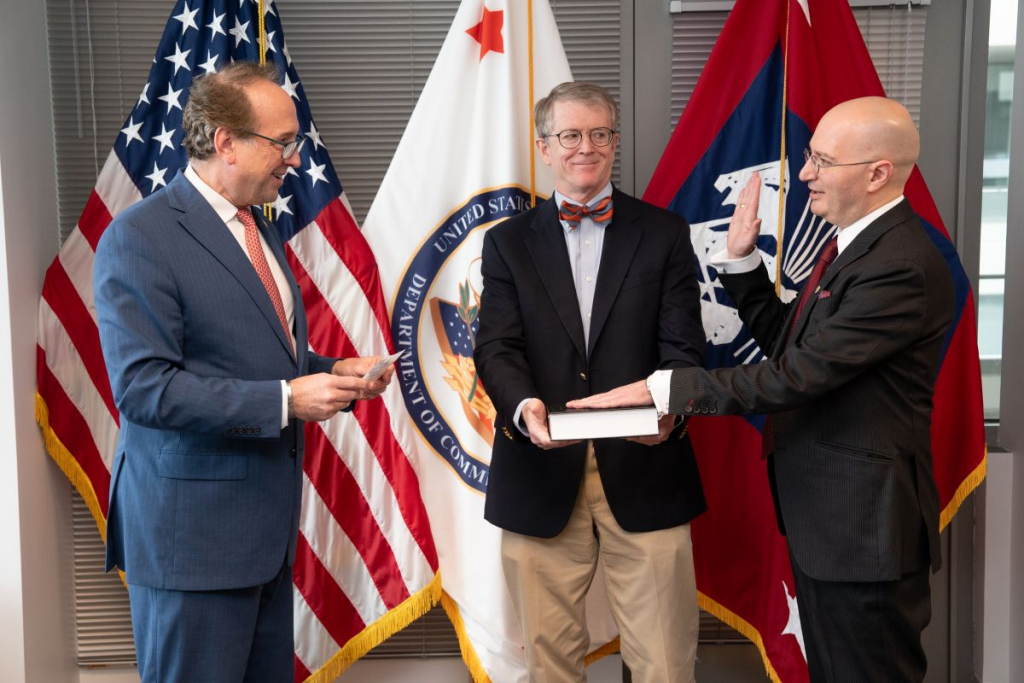
This is a follow-up to my September post on Professor John Duffy's move to the USPTO. Duffy was sworn in as General Counsel on October 5, and the Office has now expanded his title to General Counsel and Supervisory Solicitor. Joining him as Deputy General Counsel and Solicitor is Professor Greg Dolin (Baltimore). Dolin is a former clerk for Judge Pauline Newman and later represented her in her lawsuit against Chief Judge Moore and the Federal Circuit's Judicial Council.

Duffy and Dolin are law professors and creative appellate litigators. I expect to see some interesting developments.

Swearing-in ceremony at the U.S. Patent and Trademark Office

Duffy's first visible work product was announced on November 10, 2026. In a memorandum co-signed with Director Squires, the Office is returning the merits portion of IPR and PGR institution decisions to the PTAB, effective November 16.

The Director will keep the initial screen on discretionary and other non-merits factors. Petitions that survive go to a three-judge panel that decides institution on the merits on the Director's behalf -- and if that panel institutes, a different panel will conduct the trial. The memo also tightens the merits standard. A petition fails if it falls short on a substantial majority of the challenged claims, and a claim whose arguments are in "equipoise" counts against the petitioner. Tie goes to denial.


To continue reading, become a Patently-O member. Already a member? Simply log in to access the full post.
Don’t Get Me Started: High Cost of a Lopsided Bench

by Dennis Crouch

At the Federal Circuit, the more the judges talk during a party's argument, the less likely that party is to win.

I've been developing a system that does oral argument transcription and then uses voice-matching for speaker identification: https://scotusgate.com/dockets/cafc_arguments.php.

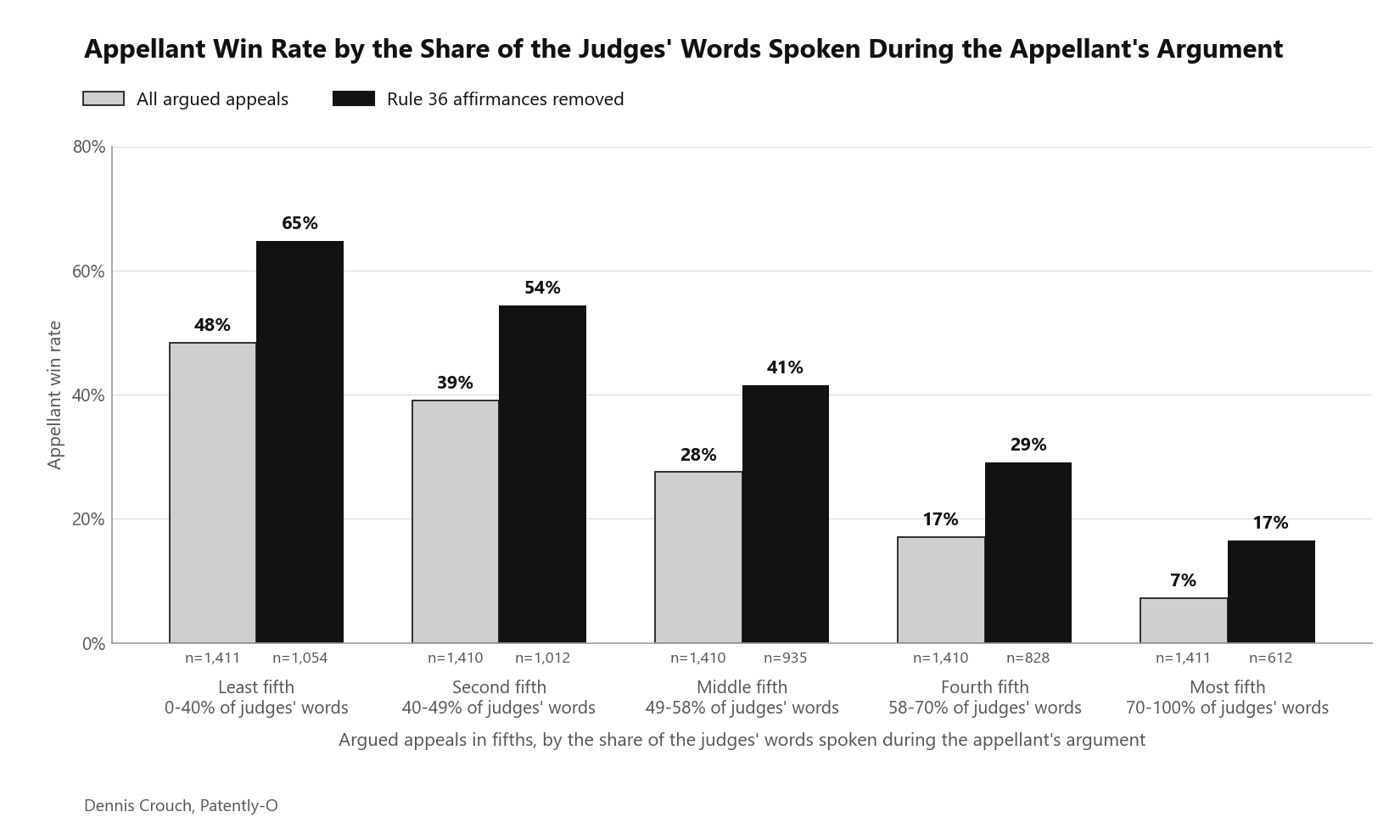
I used those transcripts and timestamps for about 7,000 appeals from the past 20 years -- comparing the relative wordcounts. The chart below shows the trend by sorting the oral arguments into five equal groups -- from those where the judges spoke the least during the appellant’s argument relative to the appellee’s argument (left side of the chart) to those where they spoke the most (right side of the chart).

Bar chart of Federal Circuit appellant win rates in five groups of argued appeals, ranked by the share of the judges' words spoken during the appellant's argument: 48%, 39%, 28%, 17% and 7%, and 65%, 54%, 41%, 29% and 17% with Rule 36 affirmances removed.

The gray bars show the appellant’s win rate in each group, falling from 48% to 7%, and the black bars show the same drop (65% to 17%) with Rule 36 affirmances removed (appellants always lose on R.36).

An appellant “won” if the Federal Circuit reversed, vacated, or modified any part of the judgment below. An affirmance counts as a loss. Dismissals and other dispositions (most often settlements) are left out of the analysis.

And one caveat - my study found a hot bench overall is actually good news for appellants -- they won about 46% of the time before the busiest third of panels, compared with about 12% before the quietest third.  What this study does is look at when the judicial questioning is lopsided.

I also wanted to test the pattern going forward. During the week of November 2, 2026, the court heard 35 arguments that I was able to rank by the same measure. The chart at the end of this post orders them from the appellant most likely to win (Enovsys v. Uber) to the least likely (Finjan v. Palo Alto Networks). Based upon the study's numbers, I expect about eight appellant wins. As of this morning, five of the 35 have already been decided in Rule 36 affirmances.  And another caveat here - I generally am awful at predictions.  A recent case in point was this past Tuesday evening (voting day). I arrived home after a dinner with colleagues and told my wife that I really don't think that Democrats will win the Senate...


To continue reading, become a Patently-O member. Already a member? Simply log in to access the full post.
The Wait for Oral Argument at the Federal Circuit

by Dennis Crouch

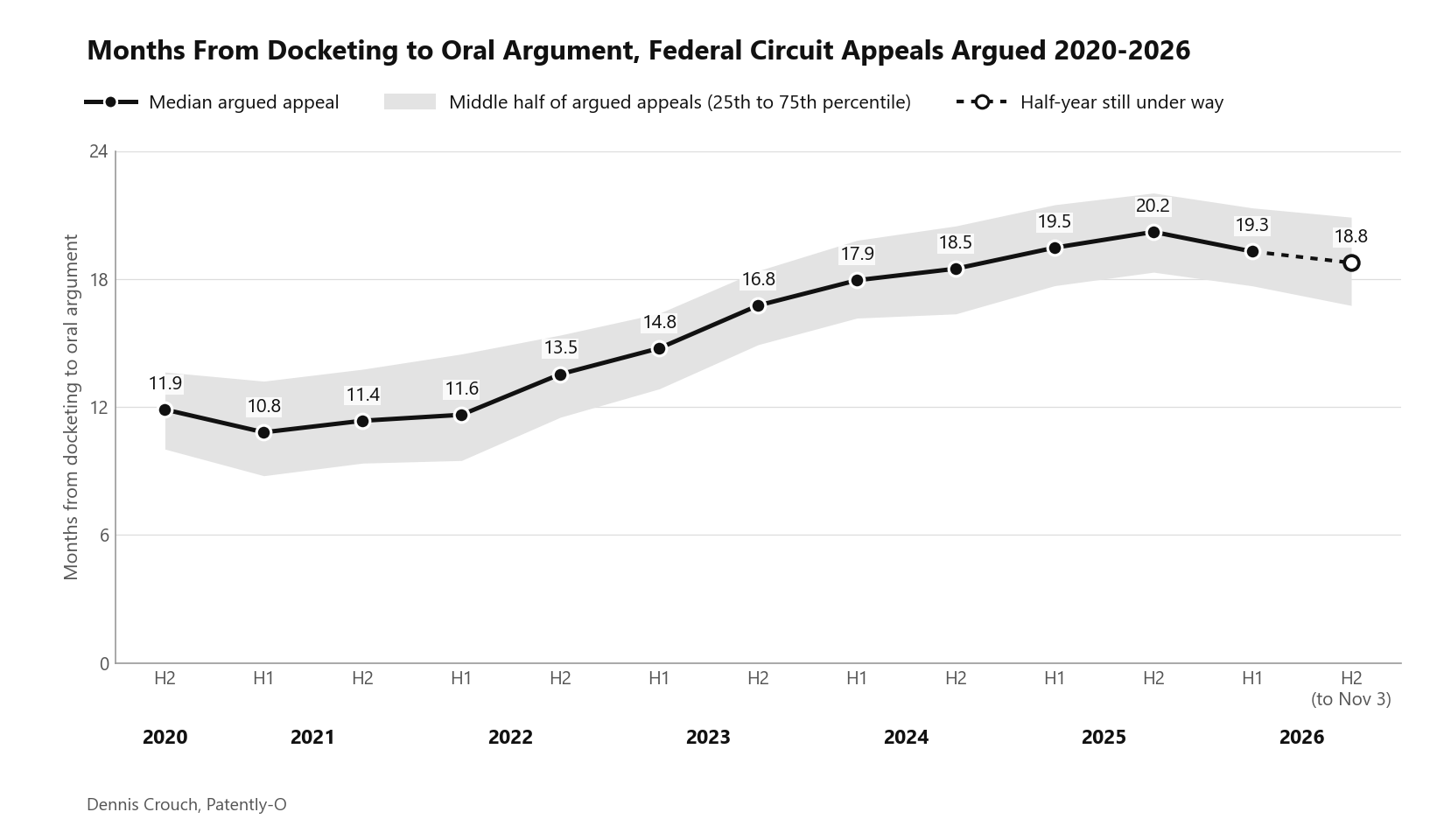
Parties are now waiting about 19 months from docketing to oral arguments at the Federal Circuit. That is well above the 11 month average in 2021. Decisions still typically follow relatively quickly after arguments, although that time is extended a bit as the court issues fewer R36 judgments without opinion. My data show the wait peaked at about 20 months in 2025 and fallen a bit over the past two years.

Line chart of the median months from docketing to oral argument for Federal Circuit appeals argued in each half-year from mid-2020 to late 2026. The median was about 11 to 12 months through mid-2022, climbed steadily to 20.2 months in the second half of 2025, and eased to 19.3 and then 18.8 months in 2026. A shaded band for the middle half of appeals rises with it.

What I'm finding here is that the added time is the court's delay after briefing until a slot is given on the argument calendar. This means that a fully briefed appeal waits for about one year for its argument - whereas that was only about four months back in 2021.

In my recent post on visiting judges, I noted that the court has brought back judges sitting by designation after more than five years without one on a merits panel. This wait for argument shows why they are needed.


To continue reading, become a Patently-O member. Already a member? Simply log in to access the full post.

Visiting Judges Return to the Federal Circuit

by Dennis Crouch

Visiting judges are back at the Federal Circuit. So far in 2026, about 17% of the court's merits decisions (opinions and Rule 36 judgments) have come from a panel that included a judge from another court sitting by designation. Before 2024, the court had gone more than five years without a visitor on any merits panel.

Bar chart of the share of Federal Circuit merits decisions decided by a panel that included a visiting judge, 2005 to 2026, with a band below the years marking the tenures of Chief Judges Michel (2004 to 2010), Rader (2010 to 2014), Prost (2014 to 2021) and Moore (since 2021). The share was about 21% in 2007 and 2008, fell to 13% in 2009 and a few percent through 2015, was nearly zero from 2016 to 2023, then rose to 9% in 2024, 14% in 2025 and 17% in 2026 through November 5.

Federal Circuit uses visiting judges to help alleviate "heavy caseloads or unanticipated personnel needs."  Recall that Judge Newman has been barred from hearing cases since March 2023, so only 11 of the court's 12 active judges have been sitting.  And, the court's senior judges handling a smaller share of decisions than they did a few years ago.  Meanwhile, the wait-time from docketing to decision has nearly doubled, from about 11 months in 2021 to over 21 months in 2026.


To continue reading, become a Patently-O member. Already a member? Simply log in to access the full post.

Self Citations in the Federal Judiciary

By Jason Rantanen and Jason Reinecke
Earlier this week, Dennis posted about the idea of self-citations by judges – that is, judges citing their own work – drawing on a  set of a Federal Circuit cases from 2021-2025 to show that this appears to be the case at the Federal Circuit.
Unbeknownst to him, we’ve been working on a full-legnth study of the extent to which judges engage in the practice of self-citations, a draft of which we’ve just posted to LawArchive.

In the paper, we take a deep dive into decisions by the Federal Circuit and Eighth Circuit, looking at the extent to which judges cite their own prior decisions relative to citing those by other judges on the court. We also look at the rate that judges cite their own prior decisions relative to the rate at which they’re cited by other judges. Previous studies have used the rate at which judges cite their own opinion to draw conclusions about their individual behaviors relative to other judges, but to our knowledge no one has previously looked at this topic more broadly.

Our principal finding is that judges disproportionately cite to opinions they authored, but we were surprised by the extent of disproportionate self-citation. At the Federal Circuit, ten of the twelve studied judges cite themselves more than they cite any other judge, as do eleven of the twelve studied judges at the Eighth Circuit. For each judge, we compared self-citations to the number of citations to the third-party judge whom that judge cited most frequently, and the mean differences are a factor of 1.6 and 1.8, respectively. In addition, at both courts, every judge cites themselves more frequently than any other judge cites them. The mean differences are 1.7 and 2, respectively. The following graphs illustrate this for the set of Federal Circuit judges in our study.

A graph showing the relative number of self-citations to citations to other judges in precedential opinions at the Federal Circuit.

A graph showing the relative fraction of self-citations to citations by other judges in precedential opinions at the Federal Circuit.The paper also develops a framework for thinking about why judges cite themselves.  Dennis mentioned familiarity, which is a likely reason in many instances. But there may be motivations beyond that, including preferred language, doctrinal preference, marketing, and a desire to be consistent with one’s own past decisions. We also consider alternate explanations such clerk behavior and case selection effects, but conclude that they do not significantly explain the results.

If you’re interested in digging into this topic further, a draft of the paper is available on Iowa Research Online. Since the paper is still in draft state, we haven’t published the dataset yet, but are happy to provide it on request if you’re interested in replicating or looking more closely at our analysis.

CAFC Citation History

Here is a fun chart going back to the CAFC origin and adding up what cases the court cites.  You'll note by the end that 5 of the top-12 are claim construction, which still remains a central issue raised year-after-year.

Below you can see a more detailed timeline for some of the top decisions:


To continue reading, become a Patently-O member. Already a member? Simply log in to access the full post.

Clear but Absurd: The Federal Circuit Searches for a Middle Ground in Vicor v. ITC

by Dennis Crouch

Vicor Corp. v. ITC, No. 25-1616 (Fed. Cir. argued Nov. 3, 2026)

This is a follow-up to my post previewing the case. The case involves enforceability of a broad boilerplate patent license buried inside Foxconn purchase orders.

The briefing focuses on contract formation under UCC § 2-207 — whether a Vicor salesperson’s one-line email of ship dates accepted the purchase order and its license term. At oral argument though, Judge Dyk (sitting with Judges Lourie and Hughes) raised a different question: how much does the license actually cover?

General Term 10 of Foxconn’s purchase order says that the seller:

agrees to grant Buyer and its customer(s) a perpetual, irrevocable, non-transferable, and royalty-free license under all intellectual property rights included in the Products supplied to Buyer by Seller, so that Buyer and its customer(s) have the right to make, use, sell, offer to sell or import similar products or other products which contain the aforesaid intellectual property rights worldwide.

General Term 10. The plain reading of this seems to be that the seller (Vicor) is granting the buyer (Foxconn) and its customers rights to start reproducing the patented goods – even though this is just an order to purchase the goods themselves.

Judge Dyk saw the clause as ridiculously broad and suggested that the most sensible reading was as a license to replace the particular items sold under that purchase order, rather than a license to all of Vicor’s intellectual property for every future power module. When told that neither party suggested this reading before the ITC, Judge Dyk responded that the court has adopted intermediate positions between two extreme contract readings before. I don’t actually know what cases Judge Dyk is talking about, but I’m confident he’ll find them if needed.

(more…)

Who Pays for the 500 Million COVID Doses? Section 1498 in Arbutus v. Moderna

by Dennis Crouch

Arbutus Biopharma Corp. v. Moderna, Inc., No. 26-1581, oral args set for Nov 5 at the Federal Circuit.

You may recognize Moderna as key COVID vaccine developer/distributor.  Arbutus holds patents on lipid nanoparticle technology that Moderna used for its vaccine (without a license). The US govt bought about 500 million doses from Moderna that were distributed to the public.

The question on appeal is whether Moderna owes the money for infringement; or does the US govt under 28 U.S.C. § 1498(a).

Were the COVID-19 vaccine doses that the federal government bought from Moderna and gave to the public made "for the Government"?

If so, the Fed Govt takes responsibility for paying under Section 1498(a), and the case would need to be pursued in the Court of Federal Claims (CFC), with the United States as the defendant. If not, Moderna pays - something like $1.3 billion.


To continue reading, become a Patently-O member. Already a member? Simply log in to access the full post.

Self-Citation in Federal Circuit Opinions

by Dennis Crouch

[See the Detailed Study from Rantanen and Reinecke]

Judges on the Federal Circuit cite their own prior opinions about twice as often as their colleagues cite those same opinions.

What I did here was analyze about 2000 FedCir opinions (2021-2026); extracted a list of their cited-authorities and then looked at the opinion author of the prior precedent.  The chart below shows the comparison -- Across the opinions, about 10% of the citations are to the opinion-author's own prior opinions.  This is about 2x the rate at which the rest of the court cites those same opinions.

Bar chart: Federal Circuit judges' citations to their own prior opinions make up about 10% of their citations to earlier Federal Circuit opinions, compared with about 5% expected if they cited those opinions at the rate other judges do.

The extra-cites are tied to opinion-authorship - not the panel.  Each appeal is heard by three judges, but typically only one writes the opinion.  When the two non-authors later cite that opinion, they do so at about the same rate as the rest of the court. Thus, a judge also cites opinions they wrote about twice as often as opinions for cases they heard but did not author.  One additional quirk here - A good percentage of the extra-cites are directed to a small number of opinions that a judge cites again and again.


To continue reading, become a Patently-O member. Already a member? Simply log in to access the full post.
A Patent License by Purchase Order

by Dennis Crouch

The Federal Circuit hears argument Tuesday (Nov 3) in Vicor Corp. v. ITC, No. 25-1616. The key issue focuses on UCC and contract law: Did Vicor grant Foxconn a perpetual, royalty-free patent license when a Vicor salesperson answered a purchase order with a list of ship dates?

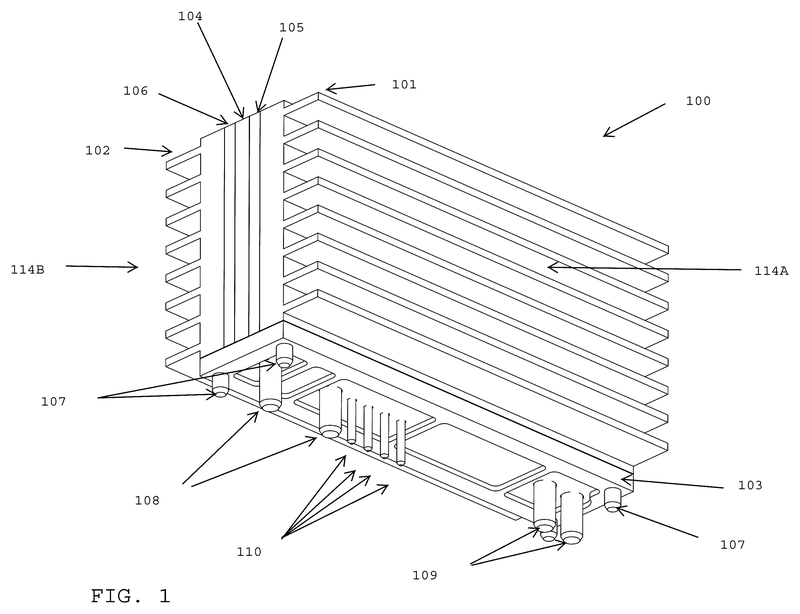
Figure 1 of U.S. Patent No. 9,516,761 showing an encapsulated power converter module with heat-sink fins

The ITC said yes - reversing its own ALJ and rejecting the position of the ITC's Office of Unfair Import Investigations. Judge Sorokin (D. Mass.), who considered the same contract in a different case, had also come out the other way.


To continue reading, become a Patently-O member. Already a member? Simply log in to access the full post.

Guest Post by Profs. Masur & Ouellette: Public Use, Sales, and Public Disclosure Under the AIA

Guest post by Professors Jonathan S. Masur (UChicago Law) and Lisa Larrimore Ouellette (Stanford Law).

Imagine the following hypothetical scenarios:

Scenario 1:

  • January 1, 2026: Aleida invents a new widget and gives it without a confidentiality restriction to Charlise, who uses the invention (thus creating a public use) but in a non-enabling way.
  • February 1, 2026: Bruno independently invents the same widget and files for a patent on it.
  • March 1, 2026: Aleida files for a patent on the widget.

Scenario 2:

  • January 1, 2026: Aleida invents a new widget and offers the widget for sale to Charlise, but without any enabling disclosure. Charlise accepts the offer.
  • February 1, 2026: Bruno independently invents the same widget and files for a patent on it.
  • March 1, 2026: Aleida delivers the widget to Charlise and files for a patent on it.

Who do you think should receive the patent in each of these two scenarios? Maybe you think it should be Aleida in both cases, or Bruno in both cases, or Aleida in one and Bruno in the other. Regardless, we suspect that you don’t think the answer is that neither of them should receive a patent in either scenario. After all, in each scenario, both independent inventors filed patent applications less than one year after any plausible prior art. Surely someone qualifies for a patent under the America Invents Act (AIA). And yet if Federal Circuit caselaw continues on its current path, the answer might turn out to be that neither party can obtain a patent in either scenario. Let us explain.

(more…)

Oral Args at the Federal Circuit: Seven Patent Appeals on Nov 2, 2026

by Dennis Crouch

The Federal Circuit hears seven patent appeals on Monday, November 2, before two panels sitting at 10 a.m. The full lineup is on the Federal Circuit argument calendar - a tool I am testing in alpha. The court keeps the names of the particular judges on the panel secret until about an hour before the 10:00 am arguments. Four of the cases are back to the old patent law standard appeal - claim construction. Two focus on eligibility under Section 101. (GE v. LPP raises both.)

Can you tell what these images represent?

Side views of the protective phone case in Figs. 1E and 1F of U.S. Patent No. 10,327,524, marking end height H and side-edge height h

In re Jefferson Street Holdings LLC, Nos. 25-1661, 25-2037, 26-1008 (PTAB). Must a "continuous" height be a constant height? Jefferson Street's three related patents claim a phone case whose side edges are lower than its ends, so the screen stays easy to reach. The side views above, from the '524 patent, mark the end height (H) and the lower side-edge height (h).


To continue reading, become a Patently-O member. Already a member? Simply log in to access the full post.

Building the Internet We Want: Law for a Connected World

by Dennis Crouch

I’m excited to announce my new book – Building the Internet We Want: Law for a Connected World, which is now available via Amazon (Hardcover $29 or Kindle $13)!

Internet law has changed so quickly that even many lawyers have struggled to keep up. Yet more and more of our lives take place online. We conduct business, manage our finances, build relationships, and participate in public debate all through digital platforms managed by some of the globe’s largest companies. The internet is central to modern life, but few of us really understand the legal rules that govern it.

I’ve been teaching internet law classes for the past 20 years, with an undergraduate version for the past few years.  I started writing this book for my undergrad class, but ultimately decided to develop it for a broad audience—not just lawyers or students.

It explores the legal and policy choices shaping our digital world, from free speech and privacy to artificial intelligence, online contracts, and the extraordinary power of technology companies

I hope you’ll check it out!

https://www.amazon.com/dp/B0HP6XYM4S

The En Banc Queue for October 2026

by Dennis Crouch

Eight en banc petitions are pending at the Federal Circuit, though two are pro se. The court makes pretty quick work of petitions and so the list has turned over almost completely since my July post. The only holdover from then is ClearPlay v. DISH, which remains stayed based upon a bankruptcy order.

Most of the en banc petitions stem from a non-precedential opinion or R.36 summary affirmance. That ratio makes sense given that only 14% of the Federal Circuit’s substantive decisions over the past two months have been precedential (17 of 122). The odds are long for any en banc petition, with the court granting about one per year.

(more…)

The Wait for a First Action, by Technology

by Dennis Crouch

In my post on Monday, I created a time series chart showing the average/median wait time for utility patent applications from filing to the first action on the merits. But, that office-wide average hides some major differences across technology areas.  For this post, I broke out the data for the past three months by technology family as shown in the chart below.

Bar chart of average months from filing to first action on the merits for 33 USPTO technology families, first actions mailed July 27 to October 26, 2026

The dashed line on the chart marks 14 months -- the benchmark in the patent term adjustment statute. The solid line is the all-family average, about 20 months on this measure.

The 33 technology families are my own groupings. I created them to keep the number of groups manageable, combining art units that appear to share similarities in both technology and prosecution process.  I also have a table at the end of the post that lists the art units in each family.


To continue reading, become a Patently-O member. Already a member? Simply log in to access the full post.

Design Patent Infringement Test Heads Toward the Supreme Court

by Dennis Crouch

Range of Motion Products, LLC v. Armaid Co., No. 26A564 (U.S. 2026)

I have been following Range of Motion v. Armaid since before the Federal Circuit's divided panel decision in February. Range of Motion Prods., LLC v. Armaid Co., 166 F.4th 981 (Fed. Cir. 2026). The design patent case is now starting its Supreme Court journey. Most recently, Chief Justice Roberts granted the patentee's unopposed application for a 42-day extension -- making its petition for certiorari due December 21, 2026. Noted IP-focused Supreme Court counsel Joshua Rosenkranz (Orrick) is handling the case on behalf of the patentee.

Your lawyering professor likely taught that every court filing provides an opportunity to make your case. This includes applications for extending a filing deadline. The application filed here previews two questions. The first is whether the "plainly dissimilar" noninfringement shortcut from Egyptian Goddess, Inc. v. Swisa, Inc., 543 F.3d 665 (Fed. Cir. 2008) (en banc), conflicts with the "substantially the same" test that the Supreme Court set out in Gorham Co. v. White, 81 U.S. 511 (1871). The second asks whether judges may resolve factual disputes over which features of a design are functional as part of claim construction -- or whether that is a question for the jury.

Three-way comparison of the Armaid1 prior art, Fig. 3 of U.S. Design Patent No. D802,155, and the accused Armaid2 massager

Range of Motion contends that leaving those disputes to the judge conflicts with the Seventh Amendment jury right and with Markman v. Westview Instruments, Inc., 517 U.S. 370 (1996). Both questions divided the Federal Circuit. When the court denied rehearing en banc in August, Chief Judge Moore dissented, joined by Judge Reyna, and Judges Stoll and Stark dissented without opinion.


To continue reading, become a Patently-O member. Already a member? Simply log in to access the full post.

Revived and Forgotten: Should This Patent Issue?

by Dennis Crouch

I have been looking at patent applications that appear to be lost within the USPTO digital files. A common pattern is abandonment, followed by revival on petition, but then the file is apparently forgotten about for years. In many cases the PTO's internal docket flag remained abandoned.

This post takes a closer look at one of those files: U.S. Application No. 13/734,654, filed by IBM in 2013 and owned by Lenovo since 2014.

The application was allowed in December 2014, but the issue fee was not paid on time. In October 2015, the USPTO granted a petition to revive (the fee came with the petition) and sent the file off to be printed as a patent. Eleven years later, it still has not issued. Meanwhile, the patent term adjustment clock continues to run. If the Office printed it now, the patent would expire around 2044 rather than 2033 - more than a decade after its own continuation.

Question for you: Should this patent issue? Or should we blame the applicant for eleven years of silence?


To continue reading, become a Patently-O member. Already a member? Simply log in to access the full post.